1 / 66Use ← → to flip
ANSI Z10 Session 3: Discussion of ANSI Z10 Elements
One session of a course on the ANSI Z10 occupational health and safety management system standard. An archived deck: check it against the current standard before teaching from it.
Slide text
· 63 of 66 slides · by University of Florida
The words on each slide as the author wrote them, read from the file by software so they can be searched. Layout, pictures and tables are not shown here: the slides above and the download are the original.
- Slide 1
Session3:
- Discussion of ANSI Z10 Elements
- ANSI Z10 Section 3.0—Management
- Leadership and Employee Participation
- Slide 2
Disclaimer
- DISCLAIMER: This material was produced under grant number SH-19494-09-60-F-12 from the Occupational Safety and Health Administration, U.S. Department of Labor. It does not necessarily reflect the views or policies of the U.S. Department of Labor, nor does mention of trade names, commercial products, or organizations imply endorsement by the U.S. Government. The U.S. Government does not warrant or assume any legal liability or responsibility for the accuracy, completeness, or usefulness of any information, apparatus, product, or process disclosed.
- To this end, permission is granted to use such copyrighted material solely for non-commercial, instructional, personal, or scholarly purposes. The material may be used and incorporated into other workplace safety and health programs on the condition that no fee may be charged for the subsequent use of the material. Use of the material for any other purpose, particularly commercial use, without the prior, express written permission of the copyright owner/s is prohibited. Furthermore, any modification to the material is prohibited without the prior, express written permission of the copyright owners.
- Slide 3
IMPROVE:
- employee H&S productivity satisfaction image
- CONTINUAL
- IMPROVEMENT
- 3.0 Policy Management
- Leadership & Employee
- Participation
- 7.0 Management
- Review
- 6.0 Evaluation and Corrective
- Action
- REDUCE:
- hazards risks incidents comp costs lost time
- 4.0 Planning
- 5.0
- Implementation and Operation
- Z10 OHSMS Cycle
- Slide 4
Management Leadership and Employee Participation
- 3.1 Management Leadership
- Occupational Health and Safety Management
- System (OHSMS): (Establish, implement, maintain)
- OHS Policy (specifies commitments)
- Responsibility and Authority (top management duties to lead, such as provision of resources)
- Appendix B
- Management must give visible support and take an active role in promoting the OHSMS Policy commitments and OHSMS developmental efforts
- Slide 5
Policy Statements:
- Example Policy Statements/Values
- “Organization will uphold its position as global leader by promotion of occupational health and safety excellence”
- “Health and safety of each employee is the overriding priority of the organization.”
- This organization pledges to communicate our OHS Policy to our employees and stakeholders”
- “Nothing is more important than safety— nothing”
- Slide 6
Management Leadership/Employee Participation
- 3.2 Employee Participation
- Involvement by employees at all levels
- Provide time and resources for employee involvement in planning, implementation and preventive and corrective actions
- Provide access to OHSMS information
- Remove barriers/obstacles to participation
- Examples of employee participation include process hazard analysis, development of job instructions, training development, committees
- Slide 7
Employee Engagement
- Opportunities for upward feedback
- Being kept informed
- Feeling appreciated
- Visible, tangible management commitment
- Slide 8
Management Leadership/Employee Participation
- Motivating Employee Participation
- Be aware of the morale level
- Ask for suggestions
- Be sure to listen and value ideas
- Demonstrate how their input generates output
- Give appropriate recognition, often
- Understand that not everyone wants to jump in
- Slide 9
Management Leadership and Employee Participation Employee Participation:
- Incident investigation
- Procedures development
- Health and safety-related audits
- Job safety analysis
- All aspects of the Planning process
- Typically accomplished through a Safety
- Committee
- Slide 10
Management Leadership and Employee Participation
- Provision of Relevant Information to
- Employees:
- OHSMS objectives, implementation plans
- Results of incident investigations
- Monitoring data
- Injury and illness data
- Barriers to participation might include a lack of response to employee input/suggestions
- Slide 11
Management Leadership and Employee Participation
- Z10 Guidance on Policy:
- Policy should reflect the organization’s culture and health/safety values
- Appendix A of Z10 includes examples and methods of communicating Policy
- Non-supervisory personnel considered to have the most intimate knowledge of work hazards and the ways to address them
- Slide 12
Management Leadership and Employee Participation
- ISO 9001/14001 Linkages:
- Written Policy endorsed by Top
- Management
- Commitments to compliance, improvement
- Communication of Policy to stakeholders
- ISO 9001:2008 includes a “Management
- Commitment” element; 14001 has it in Policy
- Slide 13
Planning
- ANZI Z10 Section 4.0
- Slide 14
IMPROVE:
- employee H&S productivity satisfaction image
- CONTINUAL
- IMPROVEMENT
- 3.0 Policy Management
- Leadership & Employee
- Participation
- 7.0 Management
- Review
- 6.0 Evaluation and Corrective
- Action
- REDUCE:
- hazards risks incidents comp costs lost time
- 4.0 Planning
- 5.0
- Implementation and Operation
- Z10 OHSMS Cycle
- Slide 15
4.0 Planning
- 4.1 Initial and Ongoing Reviews
- Initial Review
- This is commonly referred to as the “gaps analysis” which accesses the status of the organization relative to Z10 conformance, to develop a work plan to fill “gaps”. Review should consider:
- Existing business management systems
- Hazards, risks and controls
- Resources
- Applicable regulations/other requirements and Assessments and other relevant activities
- Ongoing Review: takes into account OHSMS data
- Slide 16
4.0 Planning
- 4.1 Initial and Ongoing Reviews
- Initial Review
- Intent is to review management systems in areas that may be outside the traditional context of health and safety such as: Procurement
- Engineering
- Quality
- Environmental
- Hazards/risks may include weather-related emergencies
- Assessments include Workman’s Comp info, injury and illness metrics, audits, monitoring and measurement
- Slide 17
Planning Element Discussion
- What are some of the OHSMS concerns with activities occurring in the following areas:
- Procurement?
- Engineering?
- Quality?
- Environmental?
- Information Technology?
- Exercise: Possible Information Needs versus
- Sources
- Slide 18
Planning: Initial and Ongoing Reviews
- ISO 9001/14001 linkages:
- Several elements in 9001 involve broad organizational involvement including:
- Design and development (Engineering, safety criteria)
- Purchasing process (Procurement)
- Customer communications (Marketing)
- Internal audits (Auditing function)
- ISO 14001 can be less broad but still typically includes:
- Environmental Staff
- Line Management
- Safety Staff (especially where toxic exposure is “significant”)
- Slide 19
4.0 Planning
- 4.2 Assessment and Prioritization
- Systematic process to access and prioritize the
- OHSMS issues identified in 4.1
- Factors used in the assessment include:
- Level of risk
- Potential for system improvement
- Relevant standards and regulations
- Feasibility
- Potential business consequences
- Slide 20
4.0 Risk Assessment Resources
- ACGIH Threshold Limit Values (TLVs)
- OSHA Permissible Exposure Limits (PELs)
- NIOSH Pocket Guide to Chemical Hazards
- AlChE:
- Guidelines for Chemical Process Quantitative
- Risk Analysis
- Evaluating Process Safety in the Chemical Industry
- Other publications (ANSI, others)—Appendix K in Z10 provides a good list of risk assessment references
- Slide 21
Systematic Prioritization
- Issu e
- Level of Risk
- Potential for Improvemen t
- Laws/
- Feasibilit
- Standards y
- Business
- Consequenc e
- High
- Medium
- High
- Medium
- High
- Low
- High
- Low
- High
- Medium
- Mediu m
- Medium
- High
- Medium
- Medium
- Low = 1.0, Medium = 5.0, High = 10.0, except where weighted (e.g., laws = x 2)
- Z10 Appendix E has guidance on how to assess the level of risk.
- Slide 22
4.0 Planning
- 4.3 Objectives
- Set objectives, especially for those issues with the greatest opportunity for improvement and risk reduction
- In accordance with the Safety Policy
- Periodically reviewed and modified
- Links to ISO 9001/14001:
- Both require setting of objectives in accordance with a Policy. Likely overlap in “objective setters”.
- Slide 23
4.0 Planning
- 4.3 Objectives
- Objectives should meet “SMART” criteria:
- Specific—Clearly defined desired outcome
- Measurable—Concrete metric for success
- Actionable—Written as a concrete action plan
- Realistic—Practical in its scope
- Time-bounded—A specific timeframe is set
- In ISO 14001, “Objectives” are more general; the relevant “Targets” are what meet SMART criteria
- Slide 24
4.0 Planning
- 4.4 Implementation Plans and Allocation of Resources
- Documented implementation plan for achieving the objectives
- Defines resources
- Responsibilities
- Timeframes
- Intermediate steps
- Appropriate measures of progress
- Slide 25
4.0 Planning
- 4.4 Implementation Plans and Allocation of
- Resources
- Task
- Responsible
- Party
- Resources
- Completion
- Criteria
- Target
- Date
- This process is analogous to the setting of targets in the ISO 14001 system for significant aspects.
- Actual Date
- Slide 26
Implementation and Operation
- ANSI Z10 Section 5.0
- Slide 27
IMPROVE:
- employee H&S productivity satisfaction image
- CONTINUAL
- IMPROVEMENT
- 3.0 Policy Management
- Leadership & Employee
- Participation
- 7.0 Management
- Review
- 6.0 Evaluation and Corrective
- Action
- REDUCE:
- hazards risks incidents comp costs lost time
- 4.0 Planning
- 5.0
- Implementation and Operation
- Z10 OHSMS Cycle
- Slide 28
5.0 Implementation and Operation
- 5.1 OHSMS Operational Elements
- 5.1.1 Hierarchy of Controls
- 5.1.2 Design Review and Management of
- Change
- 5.1.3 Procurement
- 5.1.4 Contractors
- 5.1.5 Emergency Preparedness
- These elements are intended to serve as the means to pursue objectives from planning, and provide data on performance for future planning
- Slide 29
5.1.1 Hierarchy of Controls
- Risk reduction is based on the hierarchy:
- Controls
- Example
- Elimination
- Design to eliminate hazards, such as noise
- Substitution
- Substitute for a less hazardous material
- Engineering controls
- Ventilation system, machine guarding
- Warnings
- Signs, barriers, horns, beepers
- Administrative controls
- Limit employee exposures based on time
- PPE
- Safety
- glasses, face
- shields, gloves, etc.
- ISO 9001 has Design and
- Development
- Element
- that might lend itself to risk assessment and hierarchy of controls; ISO 14001 does not specify design analysis.
- Slide 30
Hierarchy Discussion
- Elimination of paint booth
- Increase ventilation in paint booth
- Substitution of leaded paint
- Provide full-face respirator/coverall s
- Spray paint booth uses lead paint on one of the painted products, resulting in a potential overexposure Post lead warning sign on booth
- to lead.
- What is the most acceptable and least acceptable safety approaches?
- Limit time in paint booth to <3 hours
- Slide 31
5.1.2 Design Review and Management of Change
- This element shall address:
- New processes at the design stage
- Changes to existing operations, products, services or suppliers
- The process for this element shall include:
- Identification of tasks and associated hazards;
- Consideration of hazards from human factors;
- Consideration of control measures;
- Consideration of applicable regulations, codes, etc.
- Slide 32
Safety Through Design
- Project
- Conception
- Build
- Eliminate
- Operate Maintain
- Recycle Revise
- Design
- COST OF INTEGRATING SAFETY
- Adapted from Safety Through Design, by W.C. Christensen and F.A. Manuele, 1999, Itasca, IL; National Safety Council
- Slide 33
5.1.3 Procurement
- This element shall address:
- Health and safety risks associated with new products
- Requirements for supplies, equipment, raw materials and other goods purchased
- Ensure that purchased products conform to the organization’s health and safety requirements
- ISO 9001/14001 linkages:
- ISO 9001 has strong linkages in terms of design and development reviews and purchasing processes
- ISO 14001 has a much more general requirement to periodically review aspects and operational procedures
- Slide 34
5.1.4 Contractors
- This element shall address:
- Identification and control of risks from contractor’s activities, operations and materials on the premises
- Identification of risks presented to contractor from organization’s activities
- ISO 9001/14001 linkages:
- ISO 9001 requires a company to maintain control over “outsourced” processes that can affect product quality
- ISO 14001 requires training of contractors whose work involves a significant environmental aspect
- Slide 35
5.1.4 Contractors
- Maintenance
- Construction
- Janitorial
- Security
- Consultants
- Slide 36
5.1.5 Emergency Preparedness
- The organization shall establish a process to prevent, prepare for and/or respond to emergencies including:
- Development of plans to prevent/minimize risks
- Periodic testing of emergency plans (e.g., drills)
- Evaluating and updating plans/procedures as necessary
- ISO 14001 link, 4.4.7, Emergency Preparedness/Response
- ISO 9001, weak link, “Control of Non-conforming Product”
- Slide 37
5.1.5 Emergency Preparedness
- Yes, we all know you have an
- Emergency Plan, but:
- Does it address all hazards (e.g., weather disaster)?
- Has it been updated lately?
- Does it meet the most current regulations?
- Is it consistent with other emergency plans?
- Have you conducted emergency drills?
- Considered attacks on physical/cyber assets?
- Slide 38
5.2 Education, Training, Awareness, Competence
- The organization shall establish processes to:
- Define the OHSMS competence needed for employees and contractors
- Ensure that employees and contractors are aware of applicable OHSMS requirements and competent to carry out their responsibilities
- Remove barriers to participation in education and training
- Ensure training is presented in a language trainees understand
- Ensure trainers are competent to train employees
- Slide 39
5.2 Education, Training, Awareness, Competence
- Most regulated issues have a training requirement
- Non-regulatory based safety skills training:
- Engineers (safety design)
- Procurement personnel (chemicals to avoid)
- Training in OHSMS awareness, new procedures
- Training matrix recommended, periodically reviewed
- ISO 9001/14001 linkages
- ISO 9001, 6.2.2
- ISO 14001, 4.4.2
- Slide 40
5.3 Communication
- The organization shall establish and implement processes to:
- Communicate information about OHSMS and the implementation plan to affected personnel;
- Achieve prompt reporting of injuries, illnesses, hazards and risks;
- Encourage employees to make recommendations regarding possible hazard controls/reporting;
- Identify and remove barriers to all the above.
- Slide 41
5.3 Communication
- Extent and nature of communication processes should be tailored to the audience in terms of detail, scope
- Examples of obstacles or barriers:
- Language differences
- Fear of reprisals from supervisors or peers
- Illiteracy
- ISO 9001/14001 linkages:
- ISO 9001, 5.5.3, Internal
- Communication
- ISO 14001, 4,4,3, Communication
- Slide 42
5.4 Document and Record Control Processes
- The organization shall establish and implement a process to create and maintain documents to:
- Implement an effective OHSMS
- Demonstrate conformance with the standard
- Demonstration of OSHA compliance isn’t stated but it can be inferred
- ISO 9001/14001 linkages (found in “check” sections):
- ISO 9001, 4.2.1, 4.2.3, 4.2.4
- ISO 14001, 4.4.4, 4.4.5, 4.5.4
- Slide 43
5.4 Document and Record Control Processes
- Must identify documents that need to be controlled:
- Policy
- Objectives
- Implementation Plan
- Management reviews
- Documents must be labeled with dates of revision
- Differences with ISO Standards:
- Records included in the “do” section of Z10
- Z10 does not require an “OHSMS Manual”
- Slide 44
5.4 Document and Record Control Processes
- Decisions for documents:
- Standard format for operational procedures?
- Centralized document control, or by department?
- Maintain everything hardcopy, or use software?
- Which regulatory plans/procedures incorporated?
- Recordkeeping:
- Means of archival (protection against loss, damage)
- Retention periods
- Slide 45
Evaluation and Corrective Action
- ANSI Z10 Section 6.0
- Slide 46
IMPROVE:
- employee H&S productivity satisfaction image
- CONTINUAL
- IMPROVEMENT
- 3.0 Policy Management
- Leadership & Employee
- Participation
- 7.0 Management
- Review
- 6.0 Evaluation and Corrective
- Action
- REDUCE:
- hazards risks incidents comp costs lost time
- 4.0 Planning
- 5.0
- Implementation and Operation
- Z10 OHSMS Cycle
- Slide 47
6.0 Evaluation and Corrective Action
- Defines requirements for processes to:
- Evaluate the performance of the
- OHSMS using a variety of techniques
- Take corrective actions when non-conformance is found
- Use the results of the evaluation processes as input in the planning processes and management review
- Slide 48
6.1 Monitoring, Measuring and Assessment
- Processes to monitor and measure hazards, risks and their controls:
- Workplace inspections and testing
- Exposure assessment
- Injury, illness and incident tracking
- Employee input
- Occupational health assessment
- Other methods as required by the OHSMS
- The results of these processes shall be communicated to relevant parties, as per laws on medical confidentiality
- Slide 52
6.1 Monitoring, Measuring and Assessment
- Predictive indicators:
- Near-miss incidents
- OHSMS Non-conformances
- Safety climate surveys
- Performance indicators:
- Injury and illness rates
- OSHA non-compliances
- Time to correct safety deficiencies
- Slide 53
6.1 Monitoring, Measuring and Assessment
- ISO 9001/14001 Linkages:
- ISO 9001, 8.1, 8.2, 8.3, 8.4 (product focused)
- ISO 14001, 4.5.1 and 4.5.2
- Slide 54
6.2 Incident Investigation
- Processes to investigate and analyze work-related incidents to determine:
- Deficiencies that may be be causing incidents
- Investigation shall be done in a timely manner
- Recommended process elements:
- What needs to be investigated
- When the investigation needs to occur
- Who participates in the investigation
- How recommendations should be handled
- Slide 55
6.2 Incident Investigation
- The incident investigation should drill deep into causal factors (root causes):
- Organizational
- Operational
- Cultural
- Resist the temptation to “fix and fire”
- “If you keep doing what you did, you will keep getting what you got”
- Slide 56
6.2 Incident Investigation
- ISO 9001/14001 Linkages:
- ISO 9001, 8.3 (non-conforming product)
- ISO 14001, 4.5.3 (corrective/preventive action)
- Slide 57
6.3 Audits
- Processes to:
- Conduct periodic audits to determine if the
- OHSMS has been appropriately applied and is effectively implemented
- Communicate results to:
- Those responsible for corrective/preventive actions
- Area Supervisors and others that are affected
- Immediately communicate situations that might cause a fatality, serious injury or illness so that corrective actions can be taken
- Slide 58
6.3 Audits
- Benefits of auditing:
- Drive the continual improvement forward
- Opportunity for employee participation
- Identifies risks and OSHA compliance issues
- ISO 9001/14001 Linkages:
- ISO 9001, 8.2.2
- ISO 14001, 4.5.5
- Slide 59
International Standard for Auditing
- ISO 19011:2002, provides audit guidelines on:
- Terms and definitions
- Principles of auditing
- Managing an audit program
- Audit program implementation
- Audit activities
- Preparing for audit activities
- Conducting audit activities
- Audit reporting
- Slide 60
6.4 Corrective and Preventive Actions
- Processes to:
- Address OHSMS deficiencies and inadequately controlled hazards
- Identify any new hazards resulting from preventive and corrective actions, and overall risk reduction
- Expedite actions on inadequately controlled hazards that could cause serious injury/illness
- Track actions to ensure effective implementation
- Slide 61
6.4 Corrective and Preventive Actions
- When a significant amount of time will be needed to completely correct a hazard, interim measures should be taken
- ISO 9001/14001 Linkages:
- ISO 9001, 8.5.2, 8.5.3
- ISO 14001, 4.5.3
- Slide 62
6.5 Feedback to the Planning Process
- Processes to ensure that the results of monitoring and measuring, audits, incident investigation and preventive and corrective action are included in the ongoing processes of:
- Planning
- Management review
- Slide 63
Management Review
- ANSI Z10 Section 7.0
- Slide 64
IMPROVE:
- employee H&S productivity satisfaction image
- CONTINUAL
- IMPROVEMENT
- 3.0 Policy Management
- Leadership & Employee
- Participation
- 7.0 Management
- Review
- 6.0 Evaluation and Corrective
- Action
- REDUCE:
- hazards risks incidents comp costs lost time
- 4.0 Planning
- 5.0
- Implementation and Operation
- Z10 OHSMS Cycle
- Slide 65
6.5 Management Review
- Top Management reviews the OHSMS at least annually and makes recommendations to ensure its continued suitability and effectiveness
- Information to be covered during the review:
- Progress in the reduction of risk
- Effectiveness of processes to identify, access and prioritize risks and system deficiencies
- Effectiveness in identifying underlying causes of risks and system deficiencies
- Input from employees and their representatives
- Follow-up actions from previous audits and reviews
- The extent to which objectives have been met
- Slide 66
6.5 Management Review
- ISO 9001/14001 Linkages:
- ISO 9001, 5.6
- ISO 14001, 4.6
More on Programs
pptx
54 slidesSafety and Health Programs (OSHA 10-Hour General Industry Outreach)
OSHA's own 10-hour General Industry Outreach deck on safety and health programs (v. 03-01-17), editable PowerPoint with trainer notes.
U.S. Department of Labor, OSHA (with the OTIEC Outreach Workgroup)Public domain
pdf
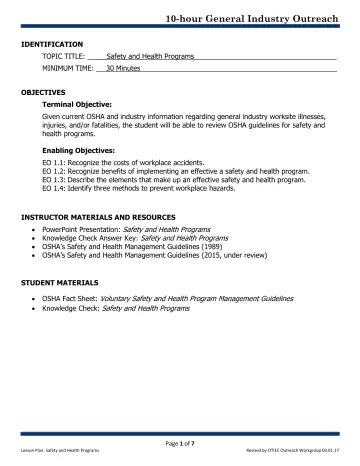
7 slidesSafety and Health Programs: Lesson Plan (OSHA 10-Hour General Industry Outreach)
Instructor lesson plan (objectives, timing, teaching steps) for the OSHA General Industry safety and health programs outreach deck.
U.S. Department of Labor, OSHA (with the OTIEC Outreach Workgroup)Public domain
pdf
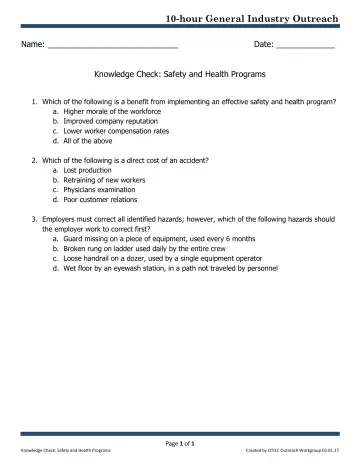
1 slidesSafety and Health Programs: Knowledge Check (OSHA 10-Hour General Industry Outreach)
Student knowledge-check quiz for the OSHA General Industry safety and health programs outreach deck.
U.S. Department of Labor, OSHA (with the OTIEC Outreach Workgroup)Public domain