1 / 4Use ← → to flip
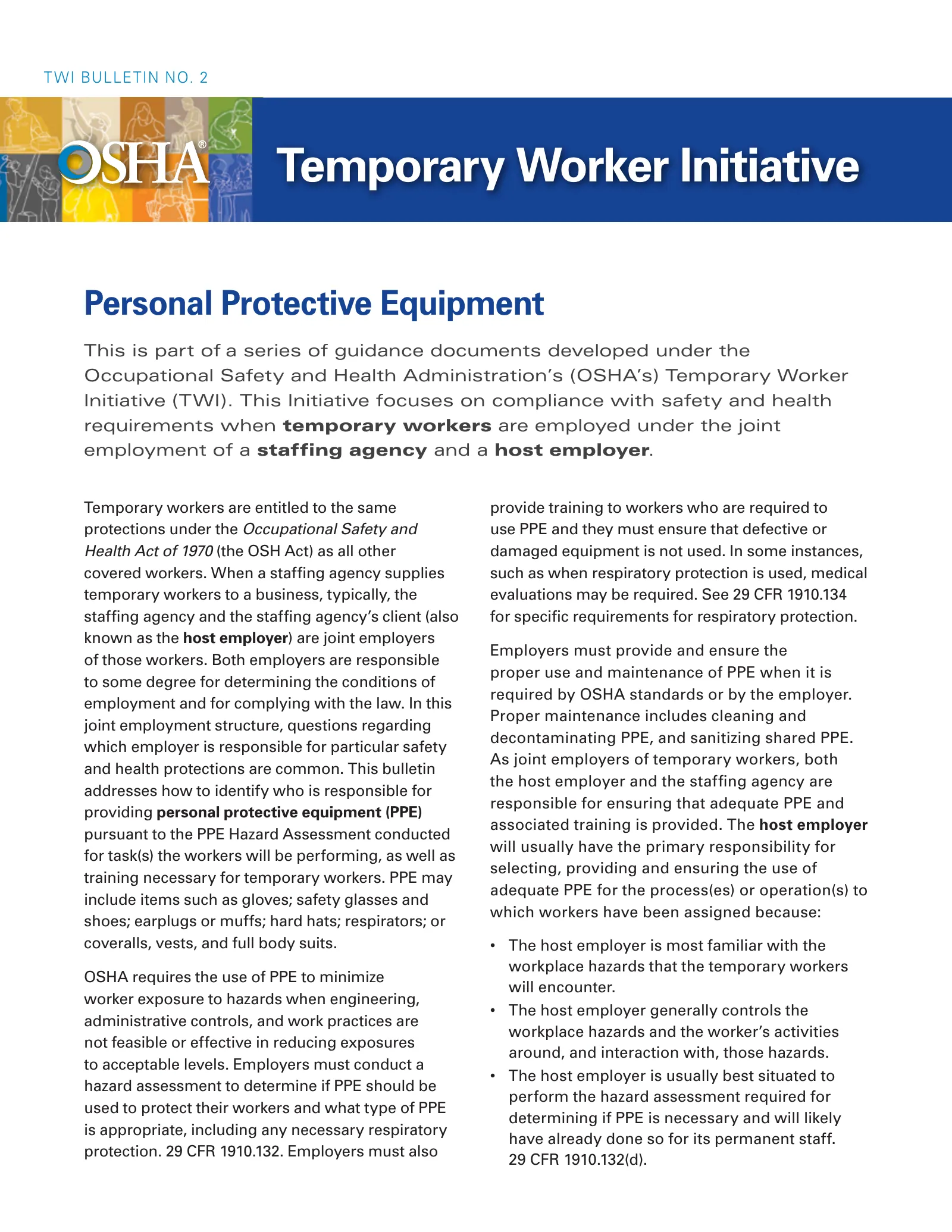
Temporary Worker Initiative (TWI) Bulletin No. 2 - Personal Protective Equipment (OSHA 3780)
OSHA fact sheet or bulletin, for General Industry classes.
Page text
· 4 pages · by U.S. Department of Labor, OSHA
The words on each page as the author wrote them, read from the file by software so they can be searched. Layout, pictures and tables are not shown here: the pages above and the download are the original.
- Page 1
Temporary Worker Initiative
- T WI BULLETIN NO. 2
- Personal Protective Equipment
- This is part of a series of guidance documents developed under the Occupational Safety and Health Administration’s (OSHA’s) Temporary Worker Initiative (TWI). This Initiative focuses on compliance with safety and health requirements when temporary workers are employed under the joint employment of a staffing agency and a host employer.
- Temporary workers are entitled to the same protections under the Occupational Safety and Health Act of 1970 (the OSH Act) as all other covered workers. When a staffing agency supplies temporary workers to a business, typically, the staffing agency and the staffing agency’s client (also known as the host employer) are joint employers of those workers. Both employers are responsible to some degree for determining the conditions of employment and for complying with the law. In this joint employment structure, questions regarding which employer is responsible for particular safety and health protections are common. This bulletin addresses how to identify who is responsible for providing personal protective equipment (PPE) pursuant to the PPE Hazard Assessment conducted for task(s) the workers will be performing, as well as training necessary for temporary workers. PPE may include items such as gloves; safety glasses and shoes; earplugs or muffs; hard hats; respirators; or coveralls, vests, and full body suits.
- OSHA requires the use of PPE to minimize worker exposure to hazards when engineering, administrative controls, and work practices are not feasible or effective in reducing exposures to acceptable levels. Employers must conduct a hazard assessment to determine if PPE should be used to protect their workers and what type of PPE is appropriate, including any necessary respiratory protection. 29 CFR 1910.132. Employers must also provide training to workers who are required to use PPE and they must ensure that defective or damaged equipment is not used. In some instances, such as when respiratory protection is used, medical evaluations may be required. See 29 CFR 1910.134 for specific requirements for respiratory protection.
- Employers must provide and ensure the proper use and maintenance of PPE when it is required by OSHA standards or by the employer. Proper maintenance includes cleaning and decontaminating PPE, and sanitizing shared PPE. As joint employers of temporary workers, both the host employer and the staffing agency are responsible for ensuring that adequate PPE and associated training is provided. The host employer will usually have the primary responsibility for selecting, providing and ensuring the use of adequate PPE for the process(es) or operation(s) to which workers have been assigned because:
- The host employer is most familiar with the workplace hazards that the temporary workers will encounter.
- The host employer generally controls the workplace hazards and the worker’s activities around, and interaction with, those hazards.
- The host employer is usually best situated to perform the hazard assessment required for determining if PPE is necessary and will likely have already done so for its permanent staff. 29 CFR 1910.132(d).
- Page 2
EXAMPLE SCENARIO
- The staffing agency shares responsibility for its workers’ safety and must take reasonable steps to ensure that the host employer conducts the appropriate hazard assessment and provides adequate PPE. To this end, the staffing agency should become familiar with the hazards at the host employer’s worksite and maintain communication with its workers and the host employer. Such pre-planning and ongoing communication also alerts the staffing agency to persistent or newly-created workplace hazards that may need to be addressed.
- Employers must provide training to each worker who is required to use PPE. The training must teach, at minimum, when PPE is necessary; what
- A metal equipment manufacturer, Metal Works Co. (MWC), needs lathe operators for a short-term increase in production. The company contracts with Industrial Staffing to provide workers to work shifts on a temporary basis. Industrial Staffing hires ten workers and sends them to work at MWC.
- When a lathe is operated, metal splinters can fly off and hit the worker. There is no mention of PPE in MWC’s contract with Industrial Staffing and no safety glasses are provided to the workers. A week later, a temporary worker mentions to an Industrial Staffing representative that safety glasses have not been provided. When Industrial Staffing discusses this with MWC, MWC refuses to supply the glasses.
- Analysis:
- Because an eye injury hazard exists, adequate PPE must be provided to both the permanent and temporary lathe workers by their employer(s). Because MWC controls the lathe, supervises and controls the day-to-day work of the temporary employees, and is, overall, best situated to control the hazard, MWC is also best positioned to select, provide, and maintain adequate PPE for those operating and working in the vicinity of the lathes and therefore may be subject to OSHA citations. Industrial Staffing, in turn, should be familiar with MWC’s operation and the specific work that the temporary workers are doing. The staffing agency must take reasonable steps to ensure that MWC is providing adequate PPE and can do so by communicating with MWC and the temporary workers. Thus, as should happen, here the staffing agency discovered MWC’s lapse in safety protection reasonably quickly and, upon discovery, immediately addressed the issue with MWC. If MWC continues to refuse to provide the PPE, Industrial Staffing has the choice of supplying the PPE itself or withdrawing its workers from the site. If Industrial Staffing does neither, it may also be subject to OSHA citations.
- If MWC did not want to be the provider of PPE, it could have initially negotiated with Industrial Staffing for the staffing agency to provide the safety glasses (and any other necessary PPE) so long as MWC ensured that the PPE provided by Industrial Staffing was adequate for the worksite’s hazards. MWC should understand, however, that in this scenario, with its knowledge and control over the hazards and workers as outlined above, the host itself holds primary responsibility for providing the PPE because it is in a better position to do so.
- Should OSHA discover that the workers are using the lathe without eye protection, both employers may be subject to OSHA citations. Because MWC itself has primary responsibility for providing the PPE, by neither providing PPE nor having the staffing agency supply the PPE, MWC would be subject to OSHA citations. By failing to a) establish that MWC would provide PPE, and
- b) diligently act to maintain communication with MWC and the workers to ensure that PPE was actually being provided, Industrial Staffing could also be subject to OSHA citations.
- Page 3
HOW CAN OSHA HELP?
- PPE is necessary; how to properly don, doff, adjust, and wear the PPE; the limitations of the PPE; and the proper care, maintenance, useful life, and disposal of the PPE. See 29 CFR 1910.132(f) and other applicable standards. As above, both the host employer and the staffing agency are responsible for ensuring the provision of PPE training. For the same reasons, the host employer is often best situated to provide the PPE, as well as to provide the training.
- Neither the host nor the staffing agency can require workers to provide or pay for their own PPE. 1 Employers cannot avoid their obligations under the standard by requiring their workers to purchase PPE as a condition of employment or placement, nor can employers deduct the cost of PPE from the workers’ wages.
- The staffing agency and the host employer may agree to have the staffing agency supply some or all of the PPE and provide PPE training as long as the host employer ensures that the PPE is appropriate for the worker’s assigned tasks, and that it is provided at no cost to the worker. Such an agreement should be made during the pre-planning meeting(s) and detailed in writing. However, neither employer may escape liability for its ultimate responsibilities under the OSH Act by requiring another party to perform those responsibilities. Both employers may still be liable if adequate PPE and training is ultimately not provided to the workers, regardless of which employer agreed to provide the PPE and training.
- PPE requirements vary between industries and according to applicable OSHA standards.
- Information on these requirements is available on OSHA’s Personal Protective
- Equipment (PPE) page (www.osha.gov/
- SLTC/personalprotectiveequipment). Further information on protecting temporary workers is available at the OSHA Protecting Temporary
- Workers website (www.osha.gov/temp_workers).
- 1. There are very specific exceptions to this rule. To see the list of PPE and the circumstances under which the employer is not required to provide it, see 29 CFR 1910.132(h) and 29 CFR 1926.95(d).
- Twenty-seven states and U.S. territories have their own OSHA-approved occupational safety and health programs. These state plans have and enforce their own occupational safety and health standards that must be at least as effective as OSHA’s, but may have different or additional requirements. A list of the state plans and more information is available at: www.osha.gov/dcsp/osp.
- Workers have a right to a safe workplace. If you think your job is unsafe or you have questions, contact OSHA at 1-800-321-OSHA (6742). It’s confidential. We can help. For other valuable worker protection information, such as Workers’ Rights, Employer Responsibilities and other services OSHA offers, visit OSHA’s Workers page (www.osha.gov/workers).
- The OSH Act prohibits employers from retaliating against their employees for exercising their rights under the OSH Act. These rights include raising a workplace health and safety concern with the employer, reporting an injury or illness, filing an OSHA complaint, and participating in an inspection or talking to an inspector. If workers have been retaliated or discriminated against for exercising their rights, they must file a complaint with OSHA within 30 days of the alleged adverse action to preserve their rights under section 11(c). For more information, please visit www.whistleblowers.gov.
- OSHA also provides help to employers. OSHA’s On-site Consultation Program (www.osha.gov/ consultation) offers free and confidential advice to small and medium-sized businesses in all states across the country, with priority given to high-hazard worksites. For more information or for additional compliance assistance, contact OSHA at 1-800-321-OSHA (6742), or visit our website at www.osha.gov.
- Page 4
For more information
- Occupational
- Safety and Health
- Administration
- www.osha.gov (800) 321-OSHA (6742)
- U.S. Department of Labor
- OSHA 3780-03 2015
- Disclaimer: This bulletin is not a standard or regulation, and it creates no new legal obligations. It contains recommendations as well as descriptions of mandatory safety and health standards. The recommendations are advisory in nature, informational in content, and are intended to assist employers in providing a safe and healthful workplace. The Occupational Safety and Health Act requires employers to comply with safety and health standards and regulations promulgated by OSHA or by a state with an OSHA-approved state plan. In addition, the OSH Act’s General Duty Clause, Section 5(a)(1), requires employers to provide their employees with a workplace free from recognized hazards likely to cause death or serious physical harm.
More on PPE
pptx
65 slidesPersonal Protective Equipment (OSHA 10-Hour General Industry Outreach)
OSHA's general industry outreach PPE deck (2017).
U.S. Department of Labor, OSHAPublic domain
pdf
12 slidesPersonal Protective Equipment: Lesson Plan (OSHA 10-Hour General Industry Outreach)
Instructor lesson plan (objectives, timing, teaching steps) for the OSHA General Industry personal protective equipment outreach deck.
U.S. Department of Labor, OSHA (with the OTIEC Outreach Workgroup)Public domain
pdf
2 slidesPersonal Protective Equipment: Knowledge Check (OSHA 10-Hour General Industry Outreach)
Student knowledge-check quiz for the OSHA General Industry personal protective equipment outreach deck.
U.S. Department of Labor, OSHA (with the OTIEC Outreach Workgroup)Public domain