1 / 12Use ← → to flip
Personal Protective Equipment: Lesson Plan (OSHA 10-Hour General Industry Outreach)
Instructor lesson plan (objectives, timing, teaching steps) for the OSHA General Industry personal protective equipment outreach deck.
Page text
· 12 pages · by U.S. Department of Labor, OSHA (with the OTIEC Outreach Workgroup)
The words on each page as the author wrote them, read from the file by software so they can be searched. Layout, pictures and tables are not shown here: the pages above and the download are the original.
- Page 1
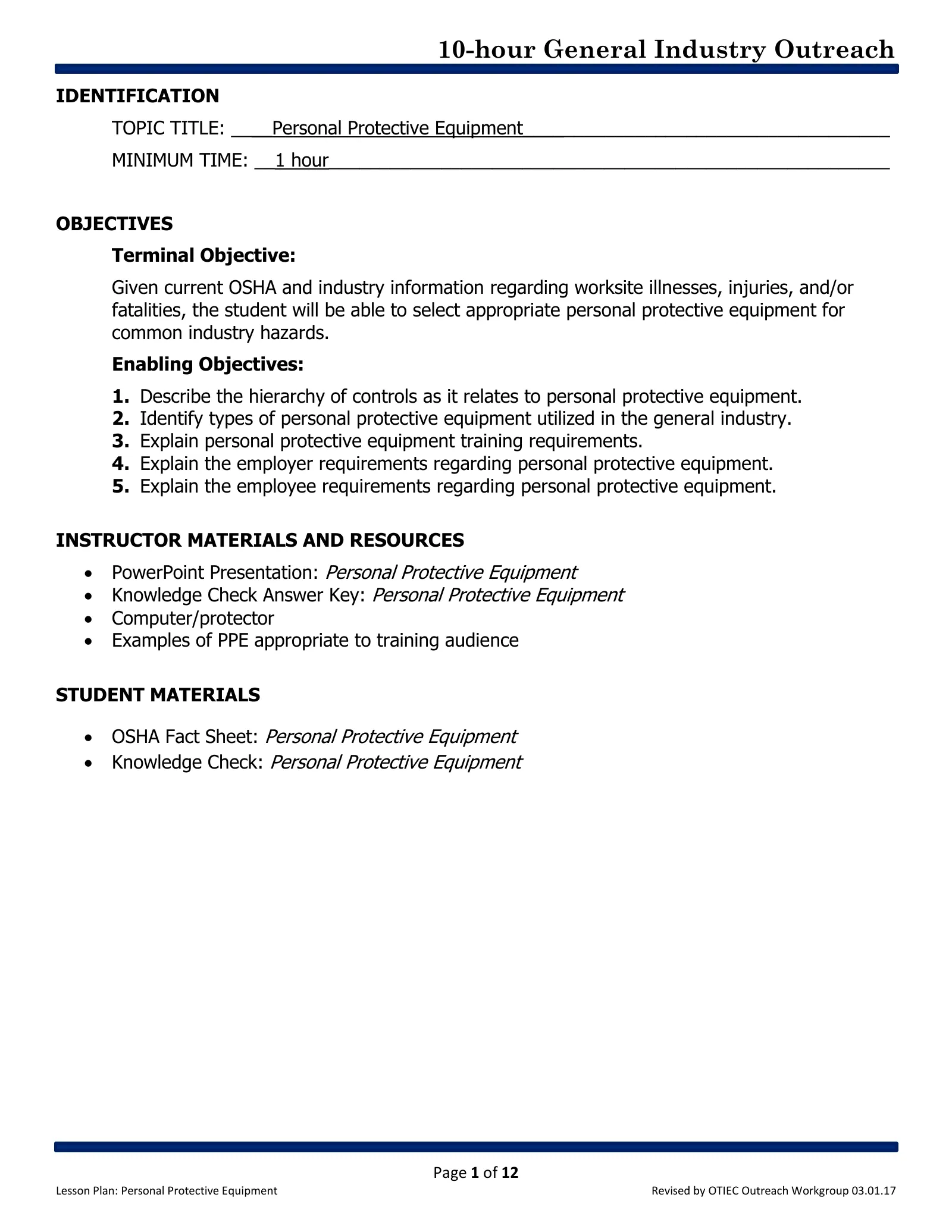
IDENTIFICATION
- TOPIC TITLE: ___Personal Protective Equipment___
- MINIMUM TIME: __1 hour___
- OBJECTIVES
- Terminal Objective:
- Given current OSHA and industry information regarding worksite illnesses, injuries, and/or fatalities, the student will be able to select appropriate personal protective equipment for common industry hazards.
- Enabling Objectives:
- 1. Describe the hierarchy of controls as it relates to personal protective equipment.
- 2. Identify types of personal protective equipment utilized in the general industry.
- 3. Explain personal protective equipment training requirements.
- 4. Explain the employer requirements regarding personal protective equipment.
- 5. Explain the employee requirements regarding personal protective equipment.
- INSTRUCTOR MATERIALS AND RESOURCES
- PowerPoint Presentation: Personal Protective Equipment Knowledge Check Answer Key: Personal Protective Equipment Computer/protector
- Examples of PPE appropriate to training audience
- STUDENT MATERIALS
- OSHA Fact Sheet: Personal Protective Equipment Knowledge Check: Personal Protective Equipment
- Page 2
TEACHING PROCEDURES --- Preparation, Presentation, Application, Evaluation
- Anticipatory Set (Focus Attention/ Gain I nterest)
- Estim ated Tim e: ?? hours
- Key Points
- Methods
- In every workplace, there exists the potential for hazards in many
- PPT Slides #1 - #4 different forms, such as sharp edges, falling objects, slippery surfaces, flying sparks, chemicals, noise, or other harmful conditions.
- Eliminating or controlling these hazards are the best way for employers to protect their employees. When elimination/substitution, engineering, administrative, and work practice controls are not feasible or do not provide sufficient protection, employers must provide PPE to their employees and ensure that it is used.
- Review topic objectives.
- P resentation (I nstruction) ___
- Key Points
- Methods
- I.
- PPT Slides #5 - #9
- Hierarchy of controls
- A. Employers must protect their employees
- 1. Assess workplace hazards
- 2. Eliminate and reduce hazards
- 3. Provide appropriate PPE as last resort
- B. Elimination/substitution
- 1. Provides the highest level of protection; should be first priority
- 2. Eliminate/remove the exposure before it can occur
- 3. Substitute a safer item/substance
- 4. Use same chemical, but substitute a safer form
- C. Engineering controls
- 1. Second most effective control method
- 2. Requires a physical change to the workplace
- Page 3
3. Examples – isolation, ventilation, equipment modification
- D. Administrative controls/work practice controls
- 1. Requires worker or employer to do something
- 2. Examples
- a. Written proper operation procedures, work permits, and safe work practices
- b. Inspection and maintenance
- c. Housekeeping
- d. Monitoring the use of highly hazardous materials
- e. Supervision
- f. Training
- g. Alarms, signs, and warnings
- h. Regulated areas
- i. Limited exposure by time or distance
- E. Personal protective equipment controls
- 1. Requires the worker to wear something
- 2. Last resort; when other controls are not feasible or do not provide sufficient protection, PPE is required
- 3. Examples: gloves, safety glasses, hard hat, protective clothing and footwear
- II. Types of PPE
- PPT Slides #10 - #52
- A. Head protection
- 1. Frequent causes of head injuries
- a. Falling objects
- b. Exposed fixed objects (bumping head)
- c. Contact with electrical hazards
- 2. Importance of head protection
- a. Head injury can impair an employee for life or be fatal
- b. Head protection protects eyes, ears, nose, mouth, brain
- Page 4
- 3. Classes of hard hats
- a. Class G (General)
- i. Protects against impact, penetration
- ii. Low-voltage electrical protection (2,200 volts)
- b. Class E (Electrical)
- i. Designed for electrical/utility work – protects against high-voltage (20,000 volts)
- ii. Protects against falling objects, impact
- c. Class C (Conductive)
- i. Designed for comfort; offers limited protection, mainly against bumps (fixed objects)
- ii. Do not provide protection against electrical hazards
- 4. ANSI Z89.1
- a. Type I
- b. Type II
- B. Eye and Face Protection
- 1. Common causes of eye injuries
- a. Chemical splashes
- b. Blood or OPIM splashes or sprays
- c. Intense light
- d. Dust and other flying particles
- e. Molten metal splashes
- 2. Eye and face protection - comply with ANSI Z87.1
- 3. Selecting eye and face protection – elements to consider:
- a. Ability to protect against workplace hazards
- b. Should fit properly
- c. Should provide unrestricted vision; should not restrict movement
- d. Durability and cleanability
- e. Allow unrestricted functioning of other PPE
- Page 5
4. Safety glasses - protect against moderate impacts from particles
- 5. Prescription glasses – employees must use eye protection that:
- a. Incorporates the prescription in its design, or
- b. Can be used over prescription glasses with interference
- 6. Goggles
- a. Protect the eyes/immediate facial area from impact, dust, and splashes
- b. Some can be used over corrective lenses
- c. Types – direct-ventilated, indirect-ventilated, and non-ventilated
- 7. Face shields
- a. Protect face from nuisance dusts and potential splashes/sprays of liquids
- b. Unless rated, provide no protection from impacts
- c. Do not provide eye protection – wear safety glasses or goggles under shield to protect eyes
- 8. Welding shields
- a. Protect eyes from burns – infared light and intense radiant light
- b. Protect eyes/face from flying sparks, metal spatter, slag chips
- 9. Laser safety goggles – provide protection from flying particles, ultraviolet light, laser, and welding
- C. Respiratory Protection
- 1. Elimination/substitution or engineering controls first priority; only when engineering controls are not feasible, will respirators be used
- 2. Types of respirators
- a. Air-Purifying Respirators (APRs) – remove contaminants from air
- i. Particulate respirators
- ii. Chemical cartridge/gas mask respirators
- iii. Powered Air-Purifying Respirator (PAPR)
- Page 6
- b. Atmosphere-Supplying Respirators – provide clean, breathable air from an uncontaminated source
- i. Self-Contained Breathing Apparatus (SCBA)
- ii. Supplied-Air Respirator (SAR)
- 3. Medical Evaluation
- a. Required before fit test are conducted and employee is authorized to use respirator to determine ability to use a respirator
- b. Performed by a physician or other licensed health care professional using medical questionnaire or initial medical evaluation obtaining same information
- 4. Inspecting, cleaning, and storing respirators
- a. Inspect all respirators for wear and tear before and after each use
- b. Wash in a detergent solution and disinfect in a sanitizing solution
- c. Store respirators
- i. To protect against dust, sunlight, heat, extreme cold, excessive moisture, and damaging chemicals
- ii. In a position to retain natural configuration
- D. Hearing Protection
- 1. Noise hazards
- a. Exposure to levels over 85 dB can cause hearing loss
- b. Hearing protection required at 90 dB
- c. Implement effective Hearing Conservation Program
- 2. Hearing protection required when noise level exceeds PELs – 29 CFR 1910.95(b)(1)
- a. Duration per day (hrs.) / Sound level (dBA)
- b. Combined effect is considered when two or more periods of noise exposure at different levels occurs in a day
- 3. Examples of hearing protection – consider Noise
- Reduction Rating (NRR) of devices
- a. Disposable foam plugs
- b. Molded ear plug
- Page 7
- c. Noise-cancelling ear plugs
- d. Ear muffs
- 4. How to insert ear plugs properly
- a. Roll
- b. Pull
- c. Hold
- E. Hand Protection
- 1. Potential hazards for hands
- a. Skin absorption of hazardous substances
- b. Lacerations, severe cuts, or punctures
- d. Chemical or thermal burns
- e. Extreme temperatures
- 2. Factors to consider
- a. Types of chemicals handled
- b. Nature of contact (total immersion, splash, etc.)
- c. Duration of contact
- d. Area requiring protection (hand only, forearm, arm)
- e. Grip requirements (dry, wet, oily)
- f. Thermal protection
- g. Size and comfort
- h. Abrasion/resistance requirements
- F. Foot and leg protection
- 1. Causes of foot injuries
- a. Falling or rolling of heavy objects
- b. Crushing or penetrating materials
- c. Sharp objects penetrating soles
- d. Exposure to molten metal
- e. Working on, or around, hot, wet, or slippery surfaces
- f. Working when electrical hazards are present
- 2. Conditions requiring foot protection
- a. Impacts
- b. Compressions
- c. Cuts/punctures
- Page 8
- d. Chemicals
- e. Temperatures
- 3. Examples of foot and leg protection
- a. Impact-resistant toe and/or instep – steel or composite
- b. Heat-resistant soles
- c. Metal shanks
- d. Specialty footwear – metatarsal guards, liquid- or chemical-resistant, conductive or nonconductive
- e. Compliance with consensus standards
- i. ANSI Z41.1
- ii. ASTM F-2412
- iii. ASTM F-2413
- 4. Protection from hazards
- a. Metal toe-cap shoes protect against knocks, falling objects
- b. Rubber shoes protect against chemicals
- G. Body Protection – protective clothing
- 1. Selection of body protection
- a. Provide protective clothing for body parts exposed to possible hazards/injuries
- b. Types of body protection – laboratory coats, coveralls, vests, jackets, aprons, surgical gowns, full-body suits
- c. Materials – protection provided
- i. Paper-like fiber protects against dust and splashes
- ii. Treated wool and cotton is fire-resistant and protects against dust, abrasions, rough or irritating surfaces
- iii. Duck (closely woven cotton fabric) protects against cuts and bruises
- iv. Leather protects against dry heat and flames
- v. Rubber, rubberized fabrics, neoprene, and plastics protect against certain chemicals and physical hazards
- Page 9
2. Protective clothing is required for HAZWOPER activities
- 3. EPA’s levels of PPE
- a. Level A – highest level of protection; required when greatest potential for exposure exists and greatest level of skin, respiratory, and eye protection is required
- b. Level B – required for highest level of respiratory protection and lesser level of skin protection
- c. Level C – required when concentration and type of airborne substances are known and criteria for using APR is met
- d. Level D – required when minimum protection is needed; sufficient when no contaminants are present or work operations preclude splashes, immersion, or potential for unexpected inhalation or contact
- III. Training Requirements
- A. Employees required to use PPE must be trained
- PPT Slide #53
- B. Employees must demonstrate an understanding of
- 1. When PPE is necessary
- 2. What PPE is necessary
- 3. How to properly put on, take off, adjust, and wear PPE
- 4. Limitations of the PPE
- 5. Proper care, maintenance, useful life, and disposal of PPE
- IV. Responsibilities
- PPT Slides #54 - #57
- A. Employers
- 1. Requirements
- a. Perform hazard assessment
- b. Provide appropriate PPE
- c. Train employees
- d. Maintain PPE; replace worn or damaged PPE
- e. Review, updated, evaluate PPE Program
- Page 10
- 2. Pay for PPE used to comply with OSHA standards
- a. Examples – foot protection, eye protection, respirators, fire fighting PPE, hard hats, hearing protection, welding PPE
- b. Exemptions – non-specialty foot wear or prescription eyewear; everyday clothing; ordinary clothing, skin creams, or other items used solely for protection from weather; lifting belts; lost/intentionally damaged PPE
- B. Employee – required to
- 1. Properly wear PPE
- 2. Attend PPE training
- 3. Care for, clean, and maintain PPE
- 4. Inform supervisor of need to repair or replace PPE
- Application (How students apply w hat they learn) __
- Key Points
- Estim ated Tim e: ?? hours
- Methods
- Discuss specific workplace conditions/operations in which participants are involved and identify what PPE is needed in those situations.
- Evaluation/ Sum m ary
- Key Points
- Methods
- Complete Knowledge Check.
- PPT Slides #58 - #65
- Review key points and answer any remaining questions.
- Page 11
R eferences
- OSHA Standard
- 1910 Subpart I - Personal Protective Equipment o o o o o o o o o
- 1910.132 - General requirements. 1910.133 - Eye and face protection. 1910.134 - Respiratory Protection.
- 1910.134 App A - Fit Testing Procedures (Mandatory).
- 1910.134 App B-1 - User Seal Check Procedures (Mandatory).
- 1910.134 App B-2 - Respirator Cleaning Procedures (Mandatory).
- 1910.134 App C - OSHA Respirator Medical Evaluation Questionnaire (Mandatory).
- 1910.134 App D - (Mandatory) Information for Employees Using Respirators When not Required Under Standard.
- 1910.135 - Head protection.
- 1910.136 - Foot protection.
- 1910.137 - Electrical Protective Equipment.
- 1910.138 - Hand Protection.
- 1910 Subpart I App A - References for further information (Non-mandatory)
- 1910 Subpart I App B - Non-mandatory Compliance Guidelines for Hazard Assessment and Personal Protective Equipment Selection.
- OSHA Publications
- Chemical, Biological, Radiological, and Nuclear (CBRN) Escape Respirators (2003, August 29)
- (English: HTML PDF*)
- Construction PPE QuickCard™ (OSHA 3289 - 2005) (English: HTML PDF*) (OSHA 3289)
- (Spanish: HTML PDF*)
- Eye Protection against Radiant Energy during Welding and Cutting in Shipyard Employment
- (OSHA FS 3499 – 2012; English: HTML PDF*) (OSHA FS 3588 – 2012; Spanish: PDF*)
- General Respiratory Protection Guidance for Employers and Workers (2011) (English: HTML)
- Hand Hygiene and Gloves in Hurricane-Affected Areas Fact Sheet (2005) (English: HTML PDF*)
- Hand Hygiene QuickCard™ (OSHA 3262 – 2005; English: HTML PDF*) (OSHA 3598 – 2012; Portuguese: PDF*) (OSHA 3262 – 2005; Spanish: HTML PDF*)
- Potential for Sensitization and Possible Allergic Reaction to Natural Rubber Latex Gloves and other Natural Rubber Products (2008, January 28) (English: HTML PDF*)
- Potential Hazards of Mislabeled Steel Toe Logger Boots (2004, September 30) (English: HTML PDF*)
- Page 12
- Proposed Guidance on Workplace Stockpiling of Respirators and Facemasks for Pandemic Influenza (2008, May 12) (English: PDF*)
- OSHA References/Resources
- Eye and Face Protection eTool (OSHA 2002), https://www.osha.gov/SLTC/etools/eyeandface/index.html
- Respiratory Protection eTool (OSHA 1998) https://www.osha.gov/SLTC/etools/respiratory/index.html
- Respiratory Protection Video Series (OSHA) https://www.osha.gov/SLTC/respiratoryprotection/training_videos.html#video Includes (but not limited to):
- Respiratory Protection in General Industry (OSHA 2012)
- Respirator Types (OSHA 2012)
- Respirator Fit Testing (OSHA 2012)
- Maintenance and Care of Respirators (OSHA 2012)
- Medical Evaluations for Workers Who Use Respirators (OSHA 2012) Respiratory Protection Training Requirements (OSHA 2012)
- Voluntary Use of Respirators (OSHA 2012)
- Respirator Safety: Donning and Doffing and User Seal Checks (OSHA 2009)
More on PPE
pptx
65 slidesPersonal Protective Equipment (OSHA 10-Hour General Industry Outreach)
OSHA's general industry outreach PPE deck (2017).
U.S. Department of Labor, OSHAPublic domain
pdf
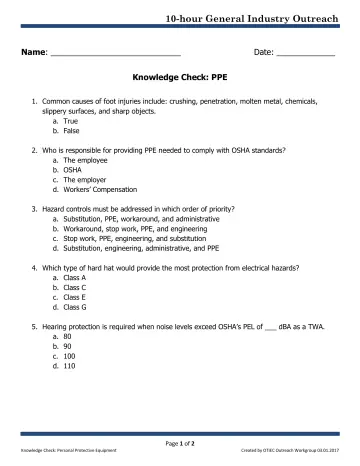
2 slidesPersonal Protective Equipment: Knowledge Check (OSHA 10-Hour General Industry Outreach)
Student knowledge-check quiz for the OSHA General Industry personal protective equipment outreach deck.
U.S. Department of Labor, OSHA (with the OTIEC Outreach Workgroup)Public domain
pdfes
65 slidesEquipo de protección personal (Capacitación de Extensión de 10 horas de OSHA, Industria General)
Spanish edition of OSHA's 10-hour General Industry Outreach deck on personal protective equipment (PDF slides; OSHA does not publish an editable Spanish PowerPoint).
U.S. Department of Labor, OSHA (with the OTIEC Outreach Workgroup)Public domain