1 / 124Use ← → to flip
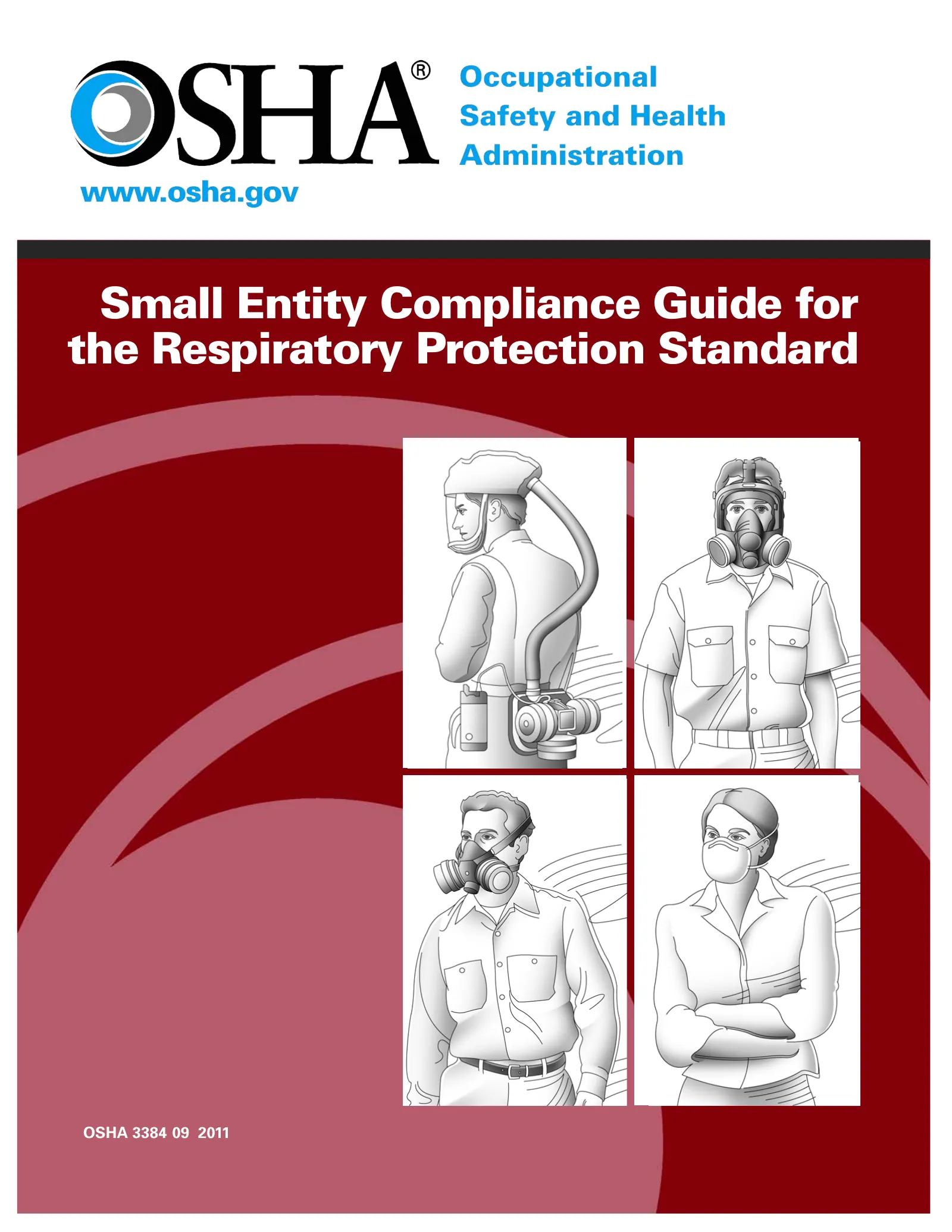
Respiratory Protection Standard: Small Entity Compliance Guide (OSHA 3384)
OSHA booklet, for General Industry classes.
Page text
· 122 of 124 pages · by U.S. Department of Labor, OSHA
The words on each page as the author wrote them, read from the file by software so they can be searched. Layout, pictures and tables are not shown here, and long pages are shortened: the pages above and the download are the original.
- Page 1
Small Entity Compliance Guide for the Respiratory Protection Standard
- OSHA 3384 -09 2011
- Page 2
Occupational Safety and Health Act of 1970
- “To assure safe and healthful working conditions for working men and women; by authorizing enforcement of the standards developed under the Act; by assisting and encouraging the States in their efforts to assure safe and healthful working conditions; by…
- …
- Page 3
Small Entity Compliance Guide for the Respiratory Protection Standard
- Occupational Safety and Health Administration
- U.S. Department of Labor
- OSHA 3384-09
- 2011
- Original cover illustrations created by Attiliis & Associates
- Page 4
Contents
- I ntroduction … 5
- The audience for this guide … 6
- How to use this guide … 6
- Respiratory protection equipment … 8
- OSHA’s Respiratory Protection
- Standard … 9
- The Respiratory Protection Program … 9
- When to use the Respiratory
- Protection Program … 9
- Updates to OSHA’s Respiratory
- …
- Page 5
- (f)(3) When fit testing must be conducted: changes in the respirator wearer’s physical condition … 35
- (i)(6) Compressors that are not oil lubricated … 52
- (f)(4) When fit testing must be conducted: unacceptable fit as determined by an employee after fit testing … 35
- …
- Page 6
Attachment 3: Respiratory Protection Standard … 67
- Checklist for Breathing Air Quality and Use … 65
- Checklist for Training and Information … 65
- Checklist for Program Evaluation … 66
- Checklist for Recordkeeping … 66
- Agencies are required to prepare and publish one or more guides to assist small…
- …
- Page 7
Introduction
- Agencies are required to prepare and publish one or more guides to assist small entities in complying with regulations for which an agency is required to prepare a regulatory flexibility analysis. (See the Small Business Regulatory Enforcement Fairness Act, (P.L. …
- …
- Page 8
- Protection standard also applies to: Shipyards (29 CFR 1915.154); Marine Terminals (29 CFR 1917.92); Longshoring (29 CFR 1918.102); and, Construction
- (29 CFR 1926.103). The final standard covers required respiratory protection for use against hazardous airborne workplace exposures, including…
- …
- Page 9
Section (k) – Training and Information
- Section (l) – Program Evaluation
- Section (m) – Recordkeeping
- Section (n) – Effective dates
- Section (o) – Appendices
- The appendices to the Respiratory Protection standard are:
- Appendix A to § 1910.134: Fit Testing Procedures
- (Mandatory)
- …
- Page 10
- In the final Respiratory Protection standard, Table I: Assigned Protection Factors is at the end of section (d)(3)(iv). From this example, it is clear that major provisions, such as those covering APFs and MUCs, are actually subparagraphs of the larger selection citation provision for non-IDLH…
- …
- Page 11
Examples of an air-purifying respirator and an atmosphere-supplying respirator
- Air-purifying respirators (APR) remove contaminants from the air
- Supplied-air respirators (SAR) or Atmosphere-supplying respirators provide clean air from an uncontaminated source
- Half mask filtering facepiece
- Dust Mask
- …
- Page 12
- You need to supply employees with respirators when all preferred methods of protecting them from breathing contaminated air have been determined to be insufficient to reduce the contamination to non-hazardous levels. …
- …
- Page 13
Section (a): Permissible practice
- apply to respirators and their use. (See: Attachment 1 of this guide (APF Glossary of Definitions); and the definitions under Section (b) of the standard).
- Points of Contact for additional information
- …
- Page 14
Insufficient oxygen
- What guidance is available on the type of engineering and administrative controls that may need to be put in place?
- CHECKLIST FOR PERMISSIBLE PRACTICE
- Potential sources for this type of information include:
- Check all that apply:
- Hazard Determination
- Trade associations.
- …
- Page 15
Section (b): Definitions
- Is employee rotation acceptable as an interim administrative control while engineering control measures are being developed and implemented?
- Rotation is an acceptable practice for less-toxic contaminants. It is never permitted for protection against cancer-causing substances. …
- …
- Page 16
- Regularly evaluating the effectiveness of the program.
- The checklist in this section on establishing a written respiratory protection program at page 16 provides a quick list to use for guidance on the required content of the respiratory protection program.
- Program Implementation and Updating
- …
- Page 17
- your written program needs to include only the elements that pertain to voluntary users, e.g., a section on medical evaluations, and one on inspection, care, and maintenance.
- types of relatively simple respirators, knowledge of this guide and materials supplied by the manufacturer may be sufficient…
- …
- Page 18
Your specific workplace
- CHECKLIST FOR RESPIRATORY PROTECTION
- PROGRAMS
- Does your program contain written procedures for (check all that apply):
- Selecting respirators
- Medical evaluations of employees required to
- wear respirators
- Fit testing
- Routine and emergency respirator use
- …
- Page 19
The location and movement of other personnel and equipment
- Would the mobility of your employees or the presence of moving machinery entangle the airlines of atmosphere-supplying respirators?
- (d)(1)(ii) Selected respirator must be certified by the National Institute for Occupational Safety and Health…
- …
- Page 20
- that existed in the survey, such as the processes, types of materials, control methods, work practices, and environmental conditions, are similar to those in your own workplace.
- You should be aware that exposures can be quite variable from day to day and from employee to employee. …
- …
- Page 21
- compliance with all other OSHA requirements under routine and reasonably foreseeable emergency situations air-purifying filter), employers must ensure that the APF is appropriate to the mode of operation in which the respirator is being used.
- …
- Page 22
- OSHA PELs (permissible exposure limits) establish the maximum level of a specific airborne hazard that an employee can be exposed to, averaged over an 8-hour workday (8-hour time-weighted average, or TWA) or over a specified portion of a workday (for example, a 15-minute short-term exposure limit…
- …
- Page 23
Temperature, humidity and air flow through the
- considerable benefits to their use. Thus far, however, NIOSH has only certified ESLIs for a few cartridges or canisters (for example, mercury vapor, carbon monoxide, ethylene oxide and hydrogen sulfide). …
- …
- Page 24
as high efficiency particulate air filters (HEPA), or
- Humidity above 85% will reduce service life by 50%.
- filters certified by NIOSH under 42 CFR part 84.
- These generalizations can be used in concert with other methods of predicting service life for specific contaminants.
- …
- Page 25
Respiratory hazards in your workplace have been
- filters are not required to demonstrate resistance to the potentially “degrading” effects of oils and are, therefore, not intended for use in workplace atmospheres that contain oily aerosols. …
- …
- Page 26
Table I: Assigned Protection Factors 5
- Type of Respirator 1, 2
- Quarter Mask
- Half Mask
- Full Facepiece
- Helmet/Hood Loose-Fitting Facepiece
- 1. Air-Purifying Respirator
- 10 3
- 2. Powered Air-Purifying
- Respirator (PAPR)
- 1,000
- 25/1,000 4
- Demand mode
- Continuous flow mode
- 1,000
- 25/1,000 4
- …
- Page 27
Original Illustrations created by Attiliis & Associates
- Air-purifying respirators
- Air-purifying respirators, which remove contaminants from the air.
- Half mask Filtering Facepiece
- Dust mask
- APF=10
- Needs to be fit tested
- Half mask Elastomeric Respirator
- APF=10
- Tight-Fitting Full Facepiece
- …
- Page 28
- Examples of Air-purifying respirators that can not be fit tested because they are loose-fitting
- Loose-Fitting Powered Air-Purifying Respirator (PAPR)
- APF=25
- Hooded Powered Air-Purifying
- Respirator
- (PAPR)
- APF=25 (1,000)*
- Atmosphere-supplying respirators
- …
- Page 29
Section (e): Medical evaluation
- Table II: Oxygen Deficient Atmospheres
- Altitude (ft)
- Oxygen deficient atmospheres (% O 2 ) for which the employer may rely on any atmospheresupplying respirator
- Less than 3001
- 16.0-19.5
- 3001-4000
- 16.4-19.5
- 4001-5000
- 17.1-19.5
- 5001-6000
- 17.8-19.5
- 6001-7000
- 18.5-19.5
- …
- Page 30
- All medical evaluations can be performed using the medical questionnaire of the standard, in Appendix C, or by a medical examination that obtains the same information as the medical questionnaire.
- Question number 1 in Part A. Section 1, and question number 9 in Part A. …
- …
- Page 31
Who pays for the medical evaluation?
- This information includes:
- You must pay for the medical evaluation and any related expenses, including travel costs, incurred by your employee during the evaluation.
- The type and weight of the respirator to be worn by the worker.
- …
- Page 32
(e)(6) Medical determination
- (e)(7) Additional medical evaluations
- This portion of the standard requires you to obtain a recommendation from the PLHCP about the employee’s ability to use a respirator. The PLHCP’s recommendation must be in writing, and it must provide only the following information:
- …
- Page 33
All employees have been evaluated to determine
- CHECKLIST FOR MEDICAL EVALUATION
- Check that the following has been done at your facility:
- their ability to wear a respirator prior to being fit tested for or wearing a respirator for the first time in your workplace.
- …
- Page 34
Examples of respirators that need to be fit tested
- (tight-fitting facepieces) ( continued)
- Examples of air-purifying respirators that can not be fit tested because they are loose-fitting
- Loose-Fitting Powered Air-Purifying Respirator (PAPR)
- APF=25
- Full Facepiece Elastomeric
- Respirator
- APF=50
- …
- Page 35
Examples of tight-fitting facepieces
- Half mask Filtering Facepiece
- Dust mask
- APF=10
- Examples of the two major types of respirators that require fit testing, negative pressure (air-purifying) and positive pressure (atmosphere-supplying)
- Air-purifying respirator, which removes contaminants from the air
- …
- Page 36
- For the condensation nuclei counter QNFT, ambient air particles are used as the test aerosol with measurements made of their concentration outside and inside the facepiece, and an assessment is made of the quantitative fit of the facepiece.
- …
- Page 37
(f)(1) Respirators that require fit testing
- You must ensure that quantitative or qualitative fit testing is conducted for all employees required to wear either positive or negative pressure tight-fitting facepiece respirators. …
- …
- Page 38
- 10 times or less than the permissible exposure limit (PEL) and lower than the level that is immediately dangerous to life or health (IDLH). For example, if the PEL for a specific workplace contaminant is 5 ppm, you could use a qualitative fit test to fit test a negative pressure APR to be used in…
- …
- Page 39
- whether a sampling adapter can be temporarily installed in the facepiece.
- Any modifications made to a respirator for testing purposes must be removed before use.
- If temporary modifications cannot be made, you will need to permanently convert the facepiece to allow for testing. …
- …
- Page 40
Air-purifying respirators
- Air-purifying respirators, which remove contaminants from the air.
- Half mask Filtering Facepiece
- Dust mask
- APF=10
- Needs to be fit tested
- Half mask Elastomeric Respirator
- APF=10
- Loose-Fitting Powered Air-Purifying Respirator (PAPR)
- APF=25
- Hooded Powered Air-Purifying
- …
- Page 41
Tight-Fitting Full Facepiece
- Powered Air-Purifying Respirator
- (PAPR)
- APF= 1,000
- Needs to be fit tested
- Tight-Fitting Half Facepiece
- (PAPR)
- APF= 50
- Atmosphere-supplying respirators
- Atmosphere-supplying respirators, which provide clean air from an uncontaminated source.
- …
- Page 42
- Filtering facepiece (N95) respirators, surgical (N95) respirators, and surgical masks
- Filtering facepiece (N95) surgical mask
- Surgical (N95) respirator
- Respirators are designed to reduce a worker’s exposure to airborne contaminants. Respirators come in various sizes and must be individually selected…
- …
- Page 43
Employees who are using tight-fitting respirator
- CHECKLIST FOR FIT TESTING
- Check all the fit tests listed below that are used at your facility:
- facepieces have passed an appropriate fit test prior to being required to use a respirator.
- Fit testing is conducted with the same make,
- …
- Page 44
- You must make sure that the employee’s eyewear does not interfere with the respirator seal, or that the worker has to remove the eyewear altogether.
- What if an employee has a condition that does not interfere with the face-to-facepiece seal?
- …
- Page 45
(g)(2) Continuing respirator effectiveness
- You must be aware of conditions in work areas where employees are using respirators. You must also allow employees to leave the respirator use area to perform any activity that involves removing or adjusting a respirator facepiece, or if there is any…
- …
- Page 46
- would cause irreversible adverse health effects, or would impair an individual’s ability to escape from a dangerous atmosphere.” (See Section (d) of this guide or paragraphs (g)(3)-(4) of the standard.)
- The provisions of paragraph (g)(3) of the Respiratory Protection standard are requirements for…
- …
- Page 47
- Is voice communication the only acceptable method for employees in the IDLH environment and standby personnel to communicate with one another?
- No, communication can be in the form of signal lines. It is advisable to have several means of communication systems available, in the event that one form of…
- …
- Page 48
- enable rescuers to retrieve the employee without entering the hazardous atmosphere. In these instances, you must be prepared to provide employees inside IDLH atmospheres and standby personnel employees with emergency medical treatment.
- …
- Page 49
Employees using tight-fitting respirators have no
- Section (h): Maintenance and care of respirators
- You must provide respirator users with equipment that is clean, sanitary, and in good working order. To
- CHECKLIST FOR PROPER USE OF RESPIRATORS
- Check your facility to be certain that:
- …
- Page 50
Who is responsible for cleaning and disinfecting respirators?
- You may choose the program that best meets the needs of your workplace. For example, you may use a centralized operation where employees receive respirators that have been cleaned, disinfected and repaired by employees assigned to this…
- …
- Page 51
Respirators are provided that are clean, sanitary,
- that are designed for the particular respirator being repaired.
- Valves, regulators, and alarms must be adjusted and repaired only by the manufacturer or a technician trained by the manufacturer.
- …
- Page 52
- The requirements detailed in this section are critical for ensuring the integrity of high purity breathing air for use with respirators, whether the air is delivered in tanks by a supplier or produced on site using a compressor. …
- …
- Page 53
Specification for Air” (CGA G-7.1-1989). This specification requires that:
- (A) Oxygen content in compressed breathing air must be 19.5 to 23.5 percent of the total volume of air.
- D breathing air. This certification will provide you with a reasonable assurance that the breathing air supplied to your…
- …
- Page 54
- sorbent bed is a filter designed to capture impurities in the air.) You must maintain, refurbish, or replace inline sorbent beds and filters as specified by the equipment manufacturer.
- (i)(5)(iv) Tracking of bed and filter changes
- …
- Page 55
Compressed breathing air meets the requirements
- both light-emitting diodes (LED) that provide backlighting for indicators and beepers that trigger with increasing frequency as carbon monoxide levels rise. Optional aspirator kits let the user draw flue gas samples up to 370 degrees C (700 degrees F).
- …
- Page 56
- Section (j): Identification of filters, cartridges and canisters
- successful respiratory protection program and is essential for correct respirator use. You must provide training to your employees who are required to wear respirators.
- …
- Page 57
- result in an uncontrolled substantial release of an airborne contaminant. Respirators malfunction on occasion, work routines change, and emergency situations occur that require a different respirator. …
- …
- Page 58
Why the respirator is necessary and the conse-
- appears necessary to ensure safe respirator use.
- Section (l): Program Evaluation
- (k)(6) Information for voluntary respirator users
- (l)(1) Conducting program evaluations
- For employees who choose to wear a respirator but are not required to do so, you are…
- …
- Page 59
Conducts workplace evaluations as necessary to
- Are you confident that you are using your respirator correctly?
- Are you confident that your respirator is performing adequately?
- CHECKLIST FOR PROGRAM EVALUATION
- Check that your facility:
- …
- Page 60
Attachment 1: APF Glossary and definitions
- LLNL
- Lawrence Livermore National Laboratory
- MSHA
- Mine Safety and Health Administration
- The preamble to the final rule for Assigned Protection Factors (APF) includes a glossary (see 71 FR 50122; August 24, 2006) that provides an auxiliary list of terms used…
- …
- Page 61
- *Atmosphere-supplying respirator: A respirator that supplies the respirator user with breathing air from a source independent of the ambient atmosphere, and includes SARs and SCBA units.
- *Canister or cartridge: A container with a filter, sorbent, or catalyst, or combination of these items, which…
- …
- Page 62
- *Powered air-purifying respirator (PAPR): An air-purifying respirator that uses a blower to force the ambient air through air-purifying elements to the inlet covering.
- *Pressure demand respirator: A positive pressure atmosphere-supplying respirator that admits breathing air to the facepiece when the…
- …
- Page 63
Insufficient oxygen
- Attachment 2:
- Checklists
- CHECKLIST FOR PERMISSIBLE PRACTICE
- Check all that apply:
- Hazard Determination
- Is there a hazardous atmosphere in your workplace, which has (check all that apply):
- Harmful levels of chemical, biological, or
- radiological contaminants
- …
- Page 64
Respiratory hazards in your workplace have been
- CHECKLIST FOR RESPIRATOR SELECTION
- Check that the following has been done at your facility:
- identified and evaluated.
- Employee exposures that have not been, or
- cannot be, evaluated must be considered IDLH.
- Respirators are NIOSH-certified, and used under
- …
- Page 65
Employees who are using tight-fitting respirator
- CHECKLIST FOR FIT TESTING
- Check all the fit tests listed below that are used at your facility:
- facepieces have passed an appropriate fit test prior to being required to use a respirator.
- Fit testing is conducted with the same make,
- …
- Page 66
CHECKLIST FOR RESPIRATOR MAINTENANCE
- AND CARE
- Check to make sure that your facility has met the following requirements:
- Cleaning and disinfecting:
- Respirators are provided that are clean, sanitary,
- and in good working order.
- Respirators are cleaned and disinfected using the
- …
- Page 67
Why the respirator is necessary and the conse-
- CHECKLIST FOR BREATHING AIR QUALITY
- AND USE
- Check that at your facility:
- CHECKLIST FOR TRAINING AND INFORMATION
- Check that your facility provides the following:
- Demonstration of employees’ knowledge of:
- General
- …
- Page 68
Conducts workplace evaluations as necessary to
- CHECKLIST FOR PROGRAM EVALUATION
- CHECKLIST FOR RECORDKEEPING
- Check that your facility:
- Check that your facility does the following:
- Retains records of medical evaluations.
- Retains fit testing records.
- Retains a copy of the current respiratory
- …
- Page 69
Attachment 3 Respiratory Protection Standard
- This section applies to General Industry (part 1910), Shipyards (part 1915), Marine Terminals (part 1917), Longshoring (part 1918), and Construction (part 1926).
- 1910.134(a)
- Canister or cartridge means a container with a filter, sorbent, or catalyst, or…
- …
- Page 70
- High efficiency particulate air (HEPA) filter means a filter that is at least 99.97% efficient in removing monodisperse particles of 0.3 micrometers in diameter. The equivalent NIOSH 42 CFR 84 particulate filters are the N100, R100, and P100 filters.
- …
- Page 71
1910.134(c)
- 1910.134(c)(1)(vii)
- Respiratory protection program.
- Training of employees in the respiratory hazards to which they are potentially exposed during routine and emergency situations;
- This paragraph requires the employer to develop and implement a written respiratory protection program with…
- …
- Page 72
1910.134(d )
- 1910.134(d)(2)(i)(A)
- Selection of respirators.
- A full facepiece pressure demand SCBA certified by NIOSH for a minimum service life of thirty minutes, or
- This paragraph requires the employer to evaluate respiratory hazard(s) in the workplace, identify relevant workplace and user factors…
- …
- Page 73
Table I: Assigned Protection Factors 5
- Type of Respirator 1, 2
- Quarter mask
- Half mask
- Full facepiece
- 1. Air-Purifying Respirator
- 10 3
- 2. Powered Air-Purifying Respirator (PAPR)
- 1,000
- 25/1,000 4
- 10 50 50
- 1,000
- 1,000
- 25/1,000 4
- 10,000
- 10,000
- 3. Supplied-Air Respirator (SAR) or Airline Respirator
- …
- Page 74
(% O2) for which the employer
- cartridge change schedule and the basis for reliance on the data.
- 1910.134(d)(3)(iv)
- For protection against particulates, the employer shall provide:
- respirator, before the employee is fit tested or required to use the respirator in the workplace. …
- …
- Page 75
- Supplemental information for the PLHCP.
- The recommendation shall provide only the following information:
- 1910.134(e)(5)(i)
- 1910.134(e)(6)(i)(A)
- The following information must be provided to the PLHCP before the PLHCP makes a recommendation concerning an employee’s ability to use a respirator:
- …
- Page 76
- than 500 for tight-fitting full facepieces, the QNFT has been passed with that respirator.
- 1910.134(f)
- Fit testing.
- This paragraph requires that, before an employee may be required to use any respirator with a negative or positive pressure tight-fitting facepiece, the employee must be fit tested…
- …
- Page 77
- 1910.134(g)(1)(i)(A)
- respirator before allowing the employee to return to the work area.
- Facial hair that comes between the sealing surface of the facepiece and the face or that interferes with valve function; or
- 1910.134(g)(3)
- 1910.134(g)(1)(i)(B)
- …
- Page 78
1910.134(g)(4)(i)
- 1910.134(h)(1)(iv)
- At least two employees enter the IDLH atmosphere and remain in visual or voice contact with one another at all times;
- Respirators used in fit testing and training shall be cleaned and disinfected after each use.
- 1910.134(h)(2)
- 1910.134(g)(4)(ii)
- …
- Page 79
1910.134(h)(3)(ii)(A )
- A check of respirator function, tightness of connections, and the condition of the various parts including, but not limited to, the facepiece, head straps, valves, connecting tube, and cartridges, canisters or filters; and
- 1910.134(h)(4)(ii)
- …
- Page 80
1910.134(i)(3)
- The employer shall ensure that oxygen concentrations greater than 23.5% are used only in equipment designed for oxygen service or distribution.
- 1910.134(i)(4)
- The employer shall ensure that cylinders used to supply breathing air to respirators meet the following requirements:
- …
- Page 81
1910.134(k)(1)(iii)
- 1910.134(k)(5)(iii)
- How to use the respirator effectively in emergency situations, including situations in which the respirator malfunctions;
- Any other situation arises in which retraining appears necessary to ensure safe respirator use.
- 1910.134(k)(6)
- 1910.134(k)(1)(v)
- …
- Page 82
- formation will facilitate employee involvement in the respirator program, assist the employer in auditing the adequacy of the program, and provide a record for compliance determinations by OSHA.
- 1910.134(m)(2)(ii)
- Fit test records shall be retained for respirator users until the next fit test is…
- …
- Page 83
Appendix A to §1910.134: Fit Testing Procedures (Mandatory)
- Part I. OSHA-Accepted Fit Test Protocols
- A. Fit Testing Procedures -- General Requirements
- The employer shall conduct fit testing using the following procedures. The requirements in this appendix apply to all OSHA-accepted fit test methods…
- …
- Page 84
- 14. Test Exercises.
- (a) Employers must perform the following test exercises for all fit testing methods prescribed in this appendix, except for the CNP quantitative fit testing protocol and the CNP REDON quantitative fit testing protocol. …
- …
- Page 85
- (2) Odor-free water (e.g., distilled or spring water) at approximately 25 deg. C (77 deg. F) shall be used for the solutions.
- (3) The isoamyl acetate (IAA) (also known a3 isopentyl acetate) stock solution is prepared by adding 1 ml of pure IAA to 800 ml of odor-free water in a 1 liter jar, closing…
- …
- Page 86
- test chamber and leave the test area to avoid olfactory fatigue.
- (8) If the test is failed, the subject shall return to the selection room and remove the respirator. The test subject shall repeat the odor sensitivity test, select and put on another respirator, return to the test area and again begin…
- …
- Page 87
- Note to paragraph 3. (a): If the test subject eats or drinks something sweet before the screening test, he/she may be unable to taste the weak saccharin solution.
- (12) If a taste response is elicited, the test subject shall be asked to take note of the taste for reference in the fit test.
- …
- Page 88
to the 3M hood assembly, parts # FT 14 and # FT
- 15 combined, is adequate.
- (2) The test enclosure shall have a 3/4 inch (1.9 cm) hole in front of the test subject’s nose and mouth area to accommodate the nebulizer nozzle.
- …
- Page 89
- ber of squeezes required to elicit a taste response as noted during the screening test.
- irritant smoke in the general atmosphere.
- (b) Sensitivity Screening Check
- (8) After generating the aerosol, the test subject shall be instructed to perform the exercises in section I. A. 14. of this appendix.
- …
- Page 90
- (5) The exercises identified in section I.A. 14. of this appendix shall be performed by the test subject while the respirator seal is being continually challenged by the smoke, directed around the perimeter of the respirator at a distance of six inches.
- …
- Page 91
- (7) The test setup shall permit the person administering the test to observe the test subject inside the chamber during the test.
- (8) The equipment generating the test atmosphere shall maintain the concentration of test agent constant to within a 10 percent variation for the duration of the test.
- …
- Page 92
- penetration is determined by an average of the peak heights on the graph or by computer integration, for each exercise except the grimace exercise. Integrators or computers that calculate the actual test agent penetration into the respirator for each exercise will also be considered to meet the…
- …
- Page 93
- the comfort of the respirator upon completion of the protocol. If it has become unacceptable, another model of respirator shall be tried.
- (b) Portacount Test Instrument.
- (1) The Portacount will automatically stop and calculate the overall fit factor for the entire set of exercises. …
- …
- Page 94
- (b) CNP Test Exercises.
- (1) Normal breathing. In a normal standing position, without talking, the subject shall breathe normally for 1 minute. After the normal breathing exercise, the subject needs to hold head straight ahead and hold his or her breath for 10 seconds during the test measurement.
- …
- Page 95
Table A-1. CNP REDON Quantitative Fit Testing Protocol
- Exercises(1)
- Exercise procedure
- Measurement procedure
- Facing Forward
- Stand and breathe normally, without talking, for 30 seconds.
- Face forward, while holding breath for 10 seconds.
- Bending Over
- …
- Page 96
Appendix B-1 to §1910.134: User Seal Check Procedures (Mandatory)
- The individual who uses a tight-fitting respirator is to perform a user seal check to ensure that an adequate seal is achieved each time the respirator is put on. …
- …
- Page 97
Appendix B-2 to §1910.134: Respirator Cleaning Procedures (Mandatory)
- 1. Hypochlorite solution (50 ppm of chlorine) made by adding approximately one milliliter of laundry bleach to one liter of water at 43 deg. C (110 deg. F); or,
- …
- Page 98
Appendix C to §1910.134: OSHA Respirator Medical Evaluation Questionnaire (Mandatory)
- To the employer: Answers to questions in Section 1, and to question 9 in Section 2 of Part A, do not require a medical examination.
- To the employee:
- Can you read (circle one): Yes/No
- …
- Page 99
Shortness of breath: Yes/No
- Shortness of breath when walking fast on level ground or walking up a slight hill or incline:
- Yes/No
- Shortness of breath when walking with other people at an ordinary pace on level ground: Yes/No
- Have to stop for breath when walking at your own pace on level ground: Yes/No
- …
- Page 100
Back pain: Yes/No
- Difficulty fully moving your arms and legs: Yes/No
- Pain or stiffness when you lean forward or backward at the waist: Yes/No
- Difficulty fully moving your head up or down:
- Yes/No
- Difficulty fully moving your head side to side:
- Yes/No
- Difficulty bending at your knees: Yes/No
- …
- Page 101
- writing, typing, drafting, or performing light assembly work; or standing while operating a drill press (1-3 lbs.) or controlling machines.
- 18. Provide the following information, if you know it, for each toxic substance that you’ll be exposed to when you’re using your respirator(s):
- …
- Page 102
- Appendix D to §1910.134: Information for Employees Using Respirators When Not Required Under the Standard (Mandatory)
- Respirators are an effective method of protection against designated hazards when properly selected and worn. Respirator use is encouraged, even when exposures are below the exposure…
- …
- Page 103
Attachment 4: Sample Program
- 1. Purpose
- Small Entity Compliance Guide: Sample Respiratory
- Protection Program (fill in blanks with your company’s/ facility’s information).
- TABLE OF CONTENTS
- 1. Purpose
- 2. Scope and Application
- 3. Responsibilities
- Program Administrator
- Supervisors
- Workers
- …
- Page 104
Table 1: Voluntary and Required Respirator Use at ___
- Type of Respirator
- Employee Work Area
- Conditions of Use
- Filtering facepiece (dust mask)
- Warehouse workers
- Voluntary
- Filtering facepiece
- Maintenance workers when cleaning spray booth walls or changing spray booth filter
- Voluntary
- …
- Page 105
- Continually monitoring work areas and operations to identify respiratory hazards.
- Coordinating with the Program Administrator on how to address respiratory hazards or other concerns regarding the program.
- Ensuring adequate air quantity, quality, and flow of breathing air for atmosphere-supplying…
- …
- Page 106
- Prep-cleaning: Average methylene chloride exposures measured at 70 ppm based on 8-hour TWA exposure results for workers cleaning/stripping furniture pieces. Ventilation controls are planned but will not be implemented until designs are completed and a contract has been let for installation of the…
- …
- Page 107
Table 2: Hazard Assessment (Sample Program) - Date of Assessment
- Department
- Contaminants
- Spray Booth
- Cleaning Area
- Possible emergency spills of hazardous substances
- Alarms; escape respirators located in Locker #1 in Spray Booth
- Dip Coat/
- Drying Area
- …
- Page 108
Updating the Hazard Assessment – The Program
- Administrator:
- Must revise and update the hazard assessment as needed (i.e., any time work process changes may potentially affect exposure). If an employee feels that respiratory protection is needed during a particular activity, he/she is to contact his…
- …
- Page 109
- A copy of this program, and a copy of the Respiratory Protection standard.
- Prior to being allowed to wear any respirator with a tight fitting facepiece.
- The list of hazardous substances by work area, and for each employee requiring evaluation, his or her work area or job.
- Annually.
- …
- Page 110
- Not wear headphones, jewelry, or other articles that may interfere with the facepiece-to-face seal.
- buddy that he or she has had a respirator malfunction. The buddy shall don an emergency escape respirator and aid the worker in immediately exiting the spray booth.
- Emergency Procedures:
- …
- Page 111
- cylinder for each SAR unit. In addition, cylinders may be recharged as necessary from the breathing air cascade system located near the respirator storage area.
- Worn or deteriorated parts will be replaced prior to use.
- No components will be replaced or repairs made beyond those recommended by the…
- …
- Page 112
- Based on discussions with our respirator distributor about ___’s workplace exposure conditions, employees voluntarily wearing APRs with organic vapor cartridges must change the cartridges on their respirators at the end of each work week to ensure the continued effectiveness of the respirators.
- …
- Page 113
- paragraph (k)(1)(i) through (vii) is not required to repeat such training provided that, as required by paragraph (k)(1), the employee can demonstrate knowledge of those element(s).
- Previous training not repeated initially by the employer must be provided no later than 12 months from the date of the…
- …
- Page 114
Attachment 5: NIOSH MultiVapor Information
- The National Institute for Occupational Safety and Health (NIOSH) announced new computer software that enables administrators of workplace respiratory protection programs to consider the effects of relative humidity on the service life of NIOSH-approved…
- …
- Page 115
Attachment 6: NIOSH Tables of Cartridges and Canisters by APFs (Modified to OSHA APFs)
- Table 1: Particulate Respirators
- Assigned protection 1 factor
- Type of Respirator
- Quarter mask respirator
- Any air-purifying elastomeric half mask respirator equipped with appropriate type of particulate filter. 2
- …
- Page 116
Table 2: Gas/Vapor Respirators
- Assigned protection 1 factor
- Type of Respirator
- Any air-purifying half mask respirator equipped with appropriate gas/vapor cartridges. 2
- Any negative pressure (demand) supplied-air respirator equipped with a half mask.
- …
- Page 117
Table 3: Combination Gas/Vapor and Particulate Respirators
- Assigned protection 1 factor
- Type of Respirator
- Any air-purifying half mask respirator equipped with appropriate gas/vapor cartridges 2 in combination with appropriate type of particulate filter. 3
- …
- Page 118
Workers’ Rights
- Under OSHA law, workers are entitled to working conditions that do not pose a risk of serious harm. To help assure a safe and healthful workplace, the law provides workers with the right to:
- File a confidential complaint with OSHA to have their workplace inspected.
- …
- Page 119
- For more information, to find the local On-site Consultation office in your state, or to request a brochure on Consultation Services, visit www.osha.gov/ consultation, or call 1-800-321-OSHA [6742].
- Under the consultation program, certain exemplary employers may request participation in OSHA’s…
- …
- Page 120
NIOSH Health Hazard Evaluation Program
- Getting Help with Health Hazards
- The National Institute for Occupational Safety and Health (NIOSH) is a federal agency that conducts scientific and medical research on workers’ safety and health. …
- …
- Page 121
OSHA Regional Offices
- Region I
- Boston Regional Office
- (CT*, ME, MA, NH, RI, VT*)
- JFK Federal Building, Room E340 Boston, MA 02203
- (617) 565-9860 (617) 565-9827 Fax
- Region II
- New York Regional Office
- (NJ*, NY*, PR*, VI*)
- 201 Varick Street, Room 670
- New York, NY 10014
- (212) 337-2378 (212) 337-2371 Fax
- …
- Page 123
How to Contact OSHA
- For questions or to get information or advice, to report an emergency, report a fatality or catastrophe, order publications, sign up for OSHA’s e-newsletter QuickTakes, or to file a confidential complaint, contact your nearest
- …
More on PPE
pptx
65 slidesPersonal Protective Equipment (OSHA 10-Hour General Industry Outreach)
OSHA's general industry outreach PPE deck (2017).
U.S. Department of Labor, OSHAPublic domain
pdf
12 slidesPersonal Protective Equipment: Lesson Plan (OSHA 10-Hour General Industry Outreach)
Instructor lesson plan (objectives, timing, teaching steps) for the OSHA General Industry personal protective equipment outreach deck.
U.S. Department of Labor, OSHA (with the OTIEC Outreach Workgroup)Public domain
pdf
2 slidesPersonal Protective Equipment: Knowledge Check (OSHA 10-Hour General Industry Outreach)
Student knowledge-check quiz for the OSHA General Industry personal protective equipment outreach deck.
U.S. Department of Labor, OSHA (with the OTIEC Outreach Workgroup)Public domain