1 / 51Use ← → to flip
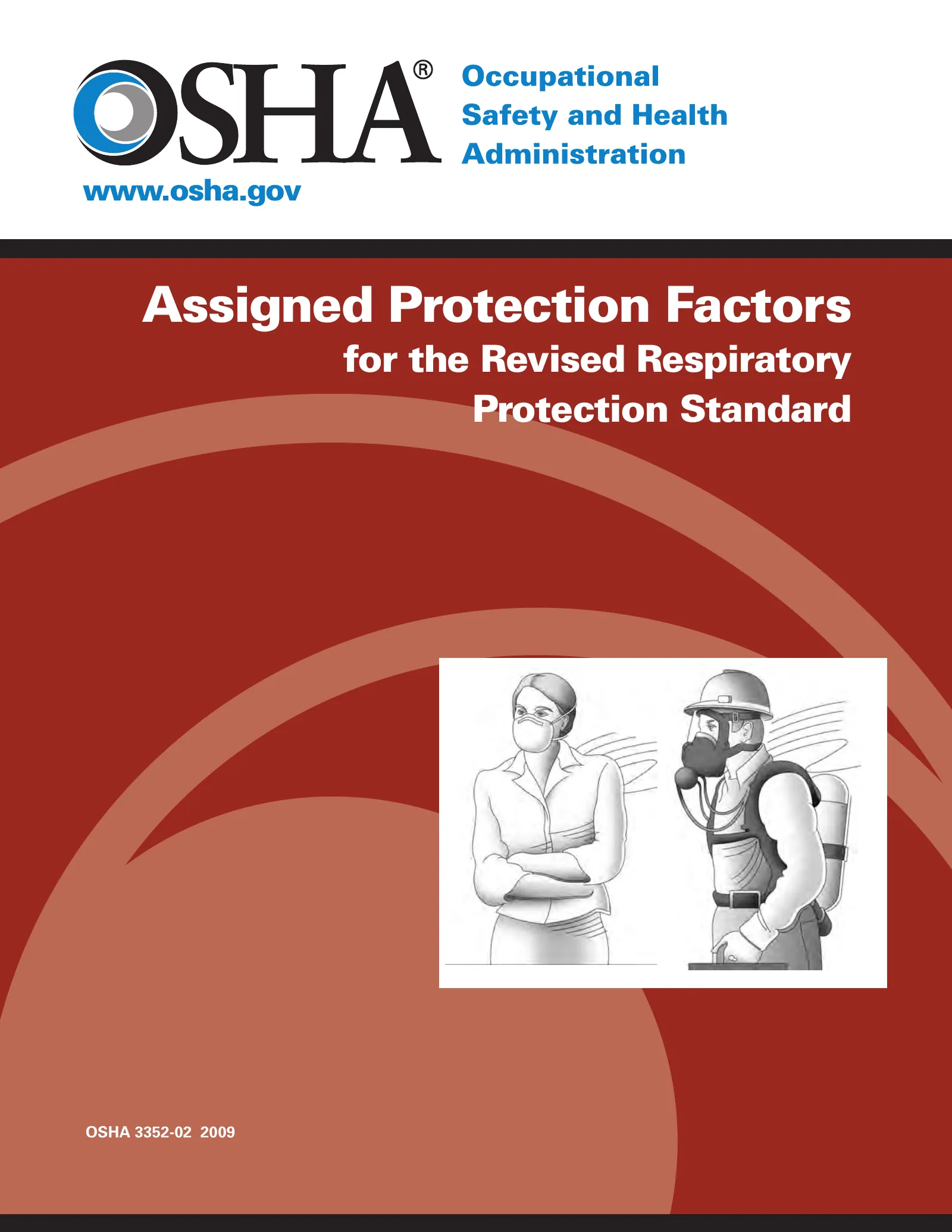
Respiratory Protection: Assigned Protection Factors for the Revised Respiratory Protection Standard (OSHA 3352)
OSHA booklet, for General Industry classes.
Page text
· 49 of 51 pages · by U.S. Department of Labor, OSHA
The words on each page as the author wrote them, read from the file by software so they can be searched. Layout, pictures and tables are not shown here, and long pages are shortened: the pages above and the download are the original.
- Page 1
Assigned Protection Factors
- for the Revised Respiratory
- Protection Standard
- OSHA 3352-02 2009
- Page 2
- Employers are responsible for providing a safe and healthy workplace for their employees. OSHA’s role is to promote the safety and health of America’s working men and women by setting and enforcing standards; providing training, outreach and education; establishing partnerships; and encouraging continual improvement in workplace safety and health.
- This publication provides a general overview of a particular standards-related topic. This publication does not alter or determine compliance responsibilities which are set forth in OSHA standards, and the Occupational Safety and Health Act. …
- …
- Page 3
Assigned Protection Factors for the Revised Respiratory Protection Standard
- Occupational Safety and Health Administration
- U.S. Department of Labor
- OSHA 3352-02
- 2009
- Original cover Illustrations created by Attiliis & Associates
- Page 4
Contents
- Introduction
- The Audience for this Guide
- How to Use this Guide
- History
- Assigned Protection Factors (APFs) and Maximum Use Concentrations (MUCs)
- How to Use APFs and MUCs
- Major Types of Respirators
- Attachment A Glossary
- Attachment B
- Regulatory Text of the Respiratory Protection Standard
- Permissible practice
- Definitions
- Respiratory protection program
- Selection of respirators
- Table I: Assigned Protection Factors
- Appendix A to §1910.134:
- Fit Testing Procedures (Mandatory)
- Appendix B-1 to §1910.134: User Seal Check Procedures (Mandatory)
- Appendix B-2 to §1910.134:
- Respiratory Cleaning Procedures
- …
- Page 5
Introduction History
- In a final rule on Assigned Protection Factors (APFs), OSHA revised its existing Respiratory Protection standard to add definitions and requirements for APFs and Maximum Use Concentrations (MUCs). (See 63 FR 1152; 29 CFR 1910.134; 71 FR 50122, August 24, 2006.) This guidance document focuses on the mandatory selection provisions of the APFs, MUCs, and Table I 1 at page 14 and their role in the overall Respiratory Protection standard. The provisions can only be used when respirators are properly selected and used in compliance with the full Respiratory Protection standard. …
- …
- Page 6
- the upper limit at which the class of respirator is expected to provide protection. Whenever the exposures approach the MUC, then the employer should select the next higher class of respirators for the employees.
- taminant. You need different types of filters, cartridges, and canisters depending on whether dusts, fumes, mists, vapors, or gases are present in your workplace and depending on the kinds and concentrations of the substances present.
- Employers must not apply MUCs to conditions that are immediately dangerous to life or health (IDLH); instead, they must use respirators listed for IDLH conditions…
- …
- Page 7
Original Illustrations created by Attiliis & Associates
- Major Types of Respirators
- Air-purifying respirators, which remove contaminants from the air.
- Half mask/Dust mask APF=10
- Needs to be fit tested
- Half mask (Elastomeric)
- APF=10
- Loose-Fitting Powered
- Air-Purifying Respirator (PAPR)
- APF= 25
- Hood Powered Air-Purifying
- Respirator (PAPR)
- APF= 25
- Full facepiece (Elastomeric)
- APF=50
- Page 8
- Atmosphere-supplying respirators, which provide clean air from an uncontaminated source.
- Full Facepiece Supplied-Air Respirator (SAR) with an auxiliary Escape Bottle
- APF=1,000
- APF = 10,000 (if used in “escape” mode)
- Needs to be fit tested
- Full Facepiece Abrasive Blasting Continuous Flow
- APF=1,000
- Full Facepiece Self-Contained
- Breathing Apparatus (SCBA)
- Pressure demand mode is APF=10,000
- Page 9
Attachment A Glossary
- At the beginning of the final rule for Assigned Protection Factors (APF), in a separate glossary, there are lists for both acronyms and common terms used throughout the preamble to the final APF rule. (See 63 FR 1152; 29 CFR 1910.134; 71 FR 50122, August 24, 2006). The glossary is provided as an auxiliary list for terms used both in the APF rulemaking as well as throughout the preamble to the APF final rule. This glossary is in addition to the definitions in the APF rulemaking for Assigned Protection Factor and Maximum Use Concentration (MUC). …
- …
- Page 10
Definitions
- Terms preceded by an asterisk (*) refer to definitions that can be found in paragraph (b) (“Definitions”) of OSHA’s Respiratory Protection standard (29 CFR 1910.134).
- *Air-purifying respirator: A respirator with an air-purifying filter, cartridge, or canister that removes specific air contaminants by passing ambient air through the air-purifying element.
- *Atmosphere-supplying respirator: A respirator that supplies the respirator user with breathing air from a source independent of the ambient atmosphere, and includes SARs and SCBA units.
- …
- Page 11
- vided to employees by the respirator. Four types of protection factor studies are:
- Effective Protection Factor (EPF) study - a study, conducted in the workplace, that measures the protection provided by a properly selected, fit tested, and functioning respirator when used intermittently for only some fraction of the total workplace exposure time (i.e., sampling is conducted during periods when respirators are worn and not worn). …
- …
- Page 12
Attachment B Regulatory Text of the Respiratory Protection Standard
- For additional information about proper selection and use of respiratory protection, see the final Respiratory Protection standard (29 CFR 1910.134), below.
- phere, and includes supplied-air respirators (SARs) and self-contained breathing apparatus (SCBA) units.
- Canister or cartridge means a container with a filter, sorbent, or catalyst, or combination of these items, which removes specific contaminants from the air passed through the container.
- Demand respirator means an atmosphere-supplying respirator that admits breathing air to the…
- …
- Page 13
- High efficiency particulate air (HEPA) filter means a filter that is at least 99.97% efficient in removing monodisperse particles of 0.3 micrometers in diameter. The equivalent NIOSH 42 CFR 84 particulate filters are the N100, R100, and P100 filters.
- Hood means a respiratory inlet covering that completely covers the head and neck and may also cover portions of the shoulders and torso.
- Immediately dangerous to life or health (IDLH) means an atmosphere that poses an immediate threat to life, would cause irreversible adverse health effects, or would impair an individual’s ability to escape from a dangerous…
- …
- Page 14
1910.134(c)
- 1910.134(c)(1)(vii)
- Respiratory protection program.
- Training of employees in the respiratory hazards to which they are potentially exposed during routine and emergency situations;
- This paragraph requires the employer to develop and implement a written respiratory protection program with required worksite-specific procedures and elements for required respirator use. The program must be administered by a suitably trained program administrator. In addition, certain program elements may be required for voluntary use to prevent potential hazards associated with the use of the respirator.
- …
- Page 15
1910.134(d )
- 1910.134(d)(2)(i)(A)
- Selection of respirators.
- A full facepiece pressure demand SCBA certified by NIOSH for a minimum service life of thirty minutes, or
- This paragraph requires the employer to evaluate respiratory hazard(s) in the workplace, identify relevant workplace and user factors, and base respirator selection on these factors. The paragraph also specifies appropriately protective respirators for use in IDLH atmospheres, and limits the selection and use of air-purifying respirators.
- 1910.134(d)(2)(i)(B)
- A combination full facepiece pressure demand supplied-air respirator (SAR) with…
- …
- Page 16
Table I: Assigned Protection Factors 5
- Type of Respirator 1, 2
- Quarter mask
- Half mask
- Full facepiece
- 1. Air-Purifying Respirator
- 10 3
- 2. Powered Air-Purifying Respirator (PAPR)
- 1,000
- 25/1,000 4
- 10 50 50
- 1,000
- 1,000
- 25/1,000 4
- 10,000
- 10,000
- 3. Supplied-Air Respirator (SAR) or Airline Respirator
- Demand mode
- Continuous flow mode
- Pressure-demand or other positive-pressure mode
- 4. Self-Contained Breathing Apparatus (SCBA)
- Demand mode
- Pressure-demand or other positivepressure mode (e.g., open/closed circuit)
- Helmet/Hood Loose-fitting facepiece
- Notes:
- …
- Page 17
(% O2) for which the employer
- cartridge change schedule and the basis for reliance on the data.
- 1910.134(d)(3)(iv)
- For protection against particulates, the employer shall provide:
- respirator, before the employee is fit tested or required to use the respirator in the workplace. The employer may discontinue an employee’s medical evaluations when the employee is no longer required to use a respirator.
- 1910.134(e)(2)
- Medical evaluation procedures.
- 1910.134(d)(3)(iv)(A)
- An atmosphere-supplying respirator; or
- 1910.134(e)(2)(i)
- 1910.134(d)(3)(iv)(B)
- …
- Page 18
- Supplemental information for the PLHCP.
- The recommendation shall provide only the following information:
- 1910.134(e)(5)(i)
- 1910.134(e)(6)(i)(A)
- The following information must be provided to the PLHCP before the PLHCP makes a recommendation concerning an employee’s ability to use a respirator:
- 1910.134(e)(5)(i)(A)
- Any limitations on respirator use related to the medical condition of the employee, or relating to the workplace conditions in which the respirator will be used, including whether or not the employee is medically able to use the respirator;
- …
- Page 19
- than 500 for tight-fitting full facepieces, the QNFT has been passed with that respirator.
- 1910.134(f)
- Fit testing.
- This paragraph requires that, before an employee may be required to use any respirator with a negative or positive pressure tight-fitting facepiece, the employee must be fit tested with the same make, model, style, and size of respirator that will be used. This paragraph specifies the kinds of fit tests allowed, the procedures for conducting them, and how the results of the fit tests must be used.
- 1910.134(f)(8)
- …
- Page 20
- 1910.134(g)(1)(i)(A)
- respirator before allowing the employee to return to the work area.
- Facial hair that comes between the sealing surface of the facepiece and the face or that interferes with valve function; or
- 1910.134(g)(3)
- 1910.134(g)(1)(i)(B)
- Procedures for IDLH atmospheres. For all IDLH atmospheres, the employer shall ensure that:
- Any condition that interferes with the face-to-facepiece seal or valve function.
- 1910.134(g)(3)(i)
- 1910.134(g)(1)(ii)
- One employee or, when needed, more than one employee is located outside the IDLH atmosphere;
- …
- Page 21
1910.134(g)(4)(i)
- 1910.134(h)(1)(iv)
- At least two employees enter the IDLH atmosphere and remain in visual or voice contact with one another at all times;
- Respirators used in fit testing and training shall be cleaned and disinfected after each use.
- 1910.134(h)(2)
- 1910.134(g)(4)(ii)
- At least two employees are located outside the IDLH atmosphere; and
- Storage. The employer shall ensure that respirators are stored as follows:
- 1910.134(h)(2)(i)
- 1910.134(g)(4)(iii)
- All employees engaged in interior structural firefighting use SCBAs.
- …
- Page 22
1910.134(h)(3)(ii)(A )
- A check of respirator function, tightness of connections, and the condition of the various parts including, but not limited to, the facepiece, head straps, valves, connecting tube, and cartridges, canisters or filters; and
- 1910.134(h)(4)(ii)
- Repairs shall be made according to the manufacturer’s recommendations and specifications for the type and extent of repairs to be performed; and
- 1910.134(h)(4)(iii)
- A check of elastomeric parts for pliability and signs of deterioration.
- Reducing and admission valves, regulators, and alarms shall be adjusted or repaired only by the manufacturer or…
- …
- Page 23
1910.134(i)(3)
- The employer shall ensure that oxygen concentrations greater than 23.5% are used only in equipment designed for oxygen service or distribution.
- 1910.134(i)(4)
- The employer shall ensure that cylinders used to supply breathing air to respirators meet the following requirements:
- 1910.134(i)(4)(i)
- Cylinders are tested and maintained as prescribed in the Shipping Container Specification Regulations of the Department of Transportation (49 CFR part 173 and part 178);
- 1910.134(i)(4)(ii)
- Cylinders of purchased breathing air have a certificate of analysis from the supplier that the breathing air meets…
- …
- Page 24
1910.134(k)(1)(iii)
- 1910.134(k)(5)(iii)
- How to use the respirator effectively in emergency situations, including situations in which the respirator malfunctions;
- Any other situation arises in which retraining appears necessary to ensure safe respirator use.
- 1910.134(k)(6)
- 1910.134(k)(1)(v)
- The basic advisory information on respirators, as presented in Appendix D of this section, shall be provided by the employer in any written or oral format, to employees who wear respirators when such use is not required by this section or by the employer.
- …
- Page 25
- formation will facilitate employee involvement in the respirator program, assist the employer in auditing the adequacy of the program, and provide a record for compliance determinations by OSHA.
- 1910.134(m)(2)(ii)
- Fit test records shall be retained for respirator users until the next fit test is administered.
- 1910.134(m)(3)
- 1910.134(m)(1)
- Medical evaluation. Records of medical evaluations required by this section must be retained and made available in accordance with 29 CFR 1910.1020.
- A written copy of the current respirator program shall be retained by the employer.
- 1910.134(m)(4)
- …
- Page 26
Appendix A to §1910.134: Fit Testing Procedures (Mandatory)
- Part I. OSHA-Accepted Fit Test Protocols
- A. Fit Testing Procedures -- General Requirements
- The employer shall conduct fit testing using the following procedures. The requirements in this appendix apply to all OSHA-accepted fit test methods, both QLFT and QNFT.
- 1. The test subject shall be allowed to pick the most acceptable respirator from a sufficient number of respirator models and sizes so that the respirator is acceptable to, and correctly fits, the user.
- 2. Prior to the selection process, the test subject shall be shown how to put on a…
- …
- Page 27
- 14. Test Exercises.
- (a) Employers must perform the following test exercises for all fit testing methods prescribed in this appendix, except for the CNP quantitative fit testing protocol and the CNP REDON quantitative fit testing protocol. For these two protocols, employers must ensure that the test subjects (i.e., employees) perform the exercise procedure specified in Part I.C.4(b) of this appendix for the CNP quantitative fit testing protocol, or the exercise procedure described in Part I.C.5(b) of this appendix for the CNP REDON quantitative fit-testing protocol. …
- …
- Page 28
- (2) Odor-free water (e.g., distilled or spring water) at approximately 25 deg. C (77 deg. F) shall be used for the solutions.
- (3) The isoamyl acetate (IAA) (also known at isopentyl acetate) stock solution is prepared by adding 1 ml of pure IAA to 800 ml of odor-free water in a 1 liter jar, closing the lid and shaking for 30 seconds. A new solution shall be prepared at least weekly.
- (4) The screening test shall be conducted in a room separate from the room used for actual fit testing. The two rooms shall be well-ventilated to prevent the odor of IAA from becoming evident in the general room air where…
- …
- Page 29
- test chamber and leave the test area to avoid olfactory fatigue.
- (8) If the test is failed, the subject shall return to the selection room and remove the respirator. The test subject shall repeat the odor sensitivity test, select and put on another respirator, return to the test area and again begin the fit test procedure described in (b) (1) through (7) above. The process continues until a respirator that fits well has been found. Should the odor sensitivity test be failed, the subject shall wait at least 5 minutes before retesting. Odor sensitivity will usually have returned by this time.
- …
- Page 30
- charin fit test.
- response as noted during the screening test. A minimum of 10 squeezes is required.
- Note to paragraph 3. (a): If the test subject eats or drinks something sweet before the screening test, he/she may be unable to taste the weak saccharin solution.
- (12) If a taste response is elicited, the test subject shall be asked to take note of the taste for reference in the fit test.
- (13) Correct use of the nebulizer means that approximately 1 ml of liquid is used at a time in the nebulizer body.
- (14) The nebulizer shall be thoroughly rinsed in water, shaken dry, and refilled at least each morning and…
- …
- Page 31
- closure shall be clear from the respirator and allow free movement of the head when a respirator is worn. An enclosure substantially similar to the 3M hood assembly, parts # FT 14 and # FT 15 combined, is adequate.
- (2) The test enclosure shall have a 3/4 inch (1.9 cm) hole in front of the test subject’s nose and mouth area to accommodate the nebulizer nozzle.
- (3) The test subject shall don the test enclosure. Throughout the threshold screening test, the test subject shall breathe through his or her slightly open mouth with tongue extended. …
- …
- Page 32
- tion of the fit test solution is sprayed into the enclosure using the same number of squeezes (either 10, 20 or 30 squeezes) based on the number of squeezes required to elicit a taste response as noted during the screening test.
- (5) The fit test shall be performed in an area with adequate ventilation to prevent exposure of the person conducting the fit test or the build-up of irritant smoke in the general atmosphere.
- (b) Sensitivity Screening Check
- (8) After generating the aerosol, the test subject shall be instructed to perform the exercises in section I. A. 14. of this appendix.
- …
- Page 33
- smoke, proceed with the test exercises.
- (5) The exercises identified in section I.A. 14. of this appendix shall be performed by the test subject while the respirator seal is being continually challenged by the smoke, directed around the perimeter of the respirator at a distance of six inches.
- (6) If the person being fit tested reports detecting the irritant smoke at any time, the test is failed. The person being retested must repeat the entire sensitivity check and fit test procedure.
- (7) Each test subject passing the irritant smoke test without evidence of a response (involuntary cough, irritation) shall…
- …
- Page 34
- (7) The test setup shall permit the person administering the test to observe the test subject inside the chamber during the test.
- (8) The equipment generating the test atmosphere shall maintain the concentration of test agent constant to within a 10 percent variation for the duration of the test.
- (9) The time lag (interval between an event and the recording of the event on the strip chart or computer or integrator) shall be kept to a minimum. There shall be a clear association between the occurrence of an event and its being recorded.
- …
- Page 35
- penetration is determined by an average of the peak heights on the graph or by computer integration, for each exercise except the grimace exercise. Integrators or computers that calculate the actual test agent penetration into the respirator for each exercise will also be considered to meet the requirements of the average peak penetration method.
- (B) Maximum peak penetration method means the method of determining test agent penetration in the respirator as determined by strip chart recordings of the test. …
- …
- Page 36
- the comfort of the respirator upon completion of the protocol. If it has become unacceptable, another model of respirator shall be tried.
- (b) Portacount Test Instrument.
- (1) The Portacount will automatically stop and calculate the overall fit factor for the entire set of exercises. The overall fit factor is what counts. The Pass or Fail message will indicate whether or not the test was successful. If the test was a Pass, the fit test is over.
- (2) Since the pass or fail criterion of the Portacount is user programmable, the test operator shall ensure that the pass or fail criterion meet the requirements for…
- …
- Page 37
- (b) CNP Test Exercises.
- (1) Normal breathing. In a normal standing position, without talking, the subject shall breathe normally for 1 minute. After the normal breathing exercise, the subject needs to hold head straight ahead and hold his or her breath for 10 seconds during the test measurement.
- (2) Deep breathing. In a normal standing position, the subject shall breathe slowly and deeply for 1 minute, being careful not to hyperventilate. After the deep breathing exercise, the subject shall hold his or her head straight ahead and hold his or her breath for 10 seconds during test measurement.
- …
- Page 38
Table A-1. CNP REDON Quantitative Fit Testing Protocol
- Exercises(1)
- Exercise procedure
- Measurement procedure
- Facing Forward
- Stand and breathe normally, without talking, for 30 seconds.
- Face forward, while holding breath for 10 seconds.
- Bending Over
- Bend at the waist, as if going to touch his or her toes, for 30 seconds.
- Face parallel to the floor, while holding breath for 10 seconds
- Head Shaking
- For about three seconds, shake head back and forth vigorously several times while shouting.
- REDON 1
- Remove the respirator mask, loosen all facepiece straps, and then redon the respirator mask.
- REDON 2
- …
- Page 39
Appendix B-1 to §1910.134: User Seal Check Procedures (Mandatory)
- The individual who uses a tight-fitting respirator is to perform a user seal check to ensure that an adequate seal is achieved each time the respirator is put on. Either the positive and negative pressure checks listed in this appendix, or the respirator manufacturer’s recommended user seal check method shall be used. User seal checks are not substitutes for qualitative or quantitative fit tests.
- I. Facepiece Positive and/or Negative Pressure
- Checks
- A. Positive pressure check. Close off the exhalation valve and exhale gently into the…
- …
- Page 40
Appendix B-2 to §1910.134: Respirator Cleaning Procedures (Mandatory)
- 1. Hypochlorite solution (50 ppm of chlorine) made by adding approximately one milliliter of laundry bleach to one liter of water at 43 deg. C (110 deg. F); or,
- These procedures are provided for employer use when cleaning respirators. They are general in nature, and the employer as an alternative may use the cleaning recommendations provided by the manufacturer of the respirators used by their employees, provided such procedures are as effective as those listed here in Appendix B- 2. …
- …
- Page 41
Appendix C to §1910.134: OSHA Respirator Medical Evaluation Questionnaire (Mandatory)
- To the employer: Answers to questions in Section 1, and to question 9 in Section 2 of Part A, do not require a medical examination.
- To the employee:
- Can you read (circle one): Yes/No
- Your employer must allow you to answer this questionnaire during normal working hours, or at a time and place that is convenient to you. To maintain your confidentiality, your employer or supervisor must not look at or review your answers, and your employer must tell you how to deliver or send this questionnaire to the health care…
- …
- Page 42
Shortness of breath: Yes/No
- Shortness of breath when walking fast on level ground or walking up a slight hill or incline:
- Yes/No
- Shortness of breath when walking with other people at an ordinary pace on level ground: Yes/No
- Have to stop for breath when walking at your own pace on level ground: Yes/No
- Shortness of breath when washing or dressing yourself: Yes/No
- Shortness of breath that interferes with your job: Yes/No
- Coughing that produces phlegm (thick sputum): Yes/No
- Coughing that wakes you early in the morning: Yes/No
- Coughing that occurs mostly when you are lying down: Yes/No
- …
- Page 43
Back pain: Yes/No
- Difficulty fully moving your arms and legs: Yes/No
- Pain or stiffness when you lean forward or backward at the waist: Yes/No
- Difficulty fully moving your head up or down:
- Yes/No
- Difficulty fully moving your head side to side:
- Yes/No
- Difficulty bending at your knees: Yes/No
- Difficulty squatting to the ground: Yes/No
- Climbing a flight of stairs or a ladder carrying more than 25 lbs: Yes/No
- Any other muscle or skeletal problem that interferes with using a respirator: Yes/No
- Part B
- Any of the following questions, and other questions not listed, may be added to the questionnaire at the…
- …
- Page 44
- writing, typing, drafting, or performing light assembly work; or standing while operating a drill press (1-3 lbs.) or controlling machines.
- 18. Provide the following information, if you know it, for each toxic substance that you’ll be exposed to when you’re using your respirator(s):
- Moderate (200 to 350 kcal per hour): Yes/No
- If “yes,” how long does this period last during the average shift:___hrs.___mins.
- Examples of moderate work effort are sitting while nailing or filing; driving a truck or bus in urban traffic; standing while drilling, nailing, performing assembly work, or transferring a moderate load…
- …
- Page 45
- Appendix D to §1910.134: Information for Employees Using Respirators When Not Required Under the Standard (Mandatory)
- Respirators are an effective method of protection against designated hazards when properly selected and worn. Respirator use is encouraged, even when exposures are below the exposure limit, to provide an additional level of comfort and protection for workers. However, if a respirator is used improperly or not kept clean, the respirator itself can become a hazard to the worker. …
- …
- Page 46
OSHA Assistance
- cal to, or at least as effective as, the Federal OSHA standards.
- OSHA can provide extensive help through a variety of programs, including technical assistance about effective safety and health programs, state plans, workplace consultations, voluntary protection programs, strategic partnerships, training and education, and more. An overall commitment to workplace safety and health can add value to your business, to your workplace, and to your life.
- Safety and Health Program Management
- Guidelines
- Effective management of employee safety and health protection is a decisive factor in reducing…
- …
- Page 47
Strategic Partnership Program
- OSHA’s Strategic Partnership Program, the newest member of OSHA’s cooperative programs, helps encourage, assist, and recognize the efforts of partners to eliminate serious workplace hazards and achieve a high level of employee safety and health. Whereas OSHA’s Consultation Program and VPP entail one-on-one relationships between OSHA and individual worksites, most strategic partnerships seek to have a broader impact by building cooperative relationships with groups of employers and employees. …
- …
- Page 48
- OSHA or contact your nearest OSHA Regional office listed at the end of this publication. The teletypewriter (TTY) number is (877) 889-5627.
- Written correspondence can be mailed to the nearest OSHA Regional or Area Office listed at the end of this publication or to OSHA’s national office at: U.S. Department of Labor, Occupational Safety and Health Administration, 200 Constitution Avenue, N.W., Washington, DC 20210.
- By visiting OSHA’s website at www.osha.gov, you can also:
- File a complaint online,
- Submit general inquiries about workplace safety and health electronically, and
- …
- Page 49
OSHA Regional Offices
- Region I
- (CT,* ME, MA, NH, RI, VT*)
- JFK Federal Building, Room E340
- Boston, MA 02203
- (617) 565-9860
- Region II
- (NJ,* NY,* PR,* VI*)
- 201 Varick Street, Room 670
- New York, NY 10014
- (212) 337-2378
- Region III
- (DE, DC, MD,* PA, VA,* WV)
- The Curtis Center
- 170 S. Independence Mall West
- Suite 740 West
- Philadelphia, PA 19106-3309
- (215) 861-4900
- Region IV
- (AL, FL, GA, KY,* MS, NC,* SC,* TN*)
- 61 Forsyth Street, SW, Room 6T50
- Atlanta, GA 30303
- (404) 562-2300
- Region V
- (lL, IN,* MI,* MN,* OH, WI) 230 South Dearborn Street Room 3244
- Chicago, IL 60604
- (312) 353-2220
- Region VI
- (AR, LA, NM,* OK, TX)
- …
More on PPE
pptx
65 slidesPersonal Protective Equipment (OSHA 10-Hour General Industry Outreach)
OSHA's general industry outreach PPE deck (2017).
U.S. Department of Labor, OSHAPublic domain
pdf
12 slidesPersonal Protective Equipment: Lesson Plan (OSHA 10-Hour General Industry Outreach)
Instructor lesson plan (objectives, timing, teaching steps) for the OSHA General Industry personal protective equipment outreach deck.
U.S. Department of Labor, OSHA (with the OTIEC Outreach Workgroup)Public domain
pdf
2 slidesPersonal Protective Equipment: Knowledge Check (OSHA 10-Hour General Industry Outreach)
Student knowledge-check quiz for the OSHA General Industry personal protective equipment outreach deck.
U.S. Department of Labor, OSHA (with the OTIEC Outreach Workgroup)Public domain