1 / 25Use ← → to flip
Respiratory Protection Program
Elements of a respiratory protection program (1910.134) from Central Georgia Technical College.
Slide text
· 25 slides · by Central Georgia Technical College
The words on each slide as the author wrote them, read from the file by software so they can be searched. Layout, pictures and tables are not shown here: the slides above and the download are the original.
- Slide 1
Respiratory
- Protection Program
- Slide 2
OSHA Susan Harwood Grant Program
- This material was produced under grant number SH-22297-SH1 from OSHA. It does not necessarily reflect the views or policies of the U.S. Department of Labor, nor does mention of trade names, commercial products, or organizations imply endorsement by the U.S. Government.
- Revisions were made to this material under grant number SH-05059-SH8 from the Occupational Safety and Health Administration, U.S. Department of Labor.
- Slide 3
Objectives:
- Review current OSHA standards for respiratory protection
- Learn the requirements for the use of respiratory protection
- Learn the purpose and correct use of respirators
- Learn to identify different types of respirators
- Slide 4
OSHA Standards: 29 CFR 1910.134
- When respirators are required, a respirator program will be followed that meets the requirements of OSHA’s Respiratory Protection standard 1910.134
- Slide 5
OSHA Standards: 29 CFR 1910.134 (cont.)
- Standard for respiratory protection at the
- workplace
- The employer shall be responsible for the
- establishment and maintenance of a respiratory protection program.
- Employer provides respirators to employees
- Slide 6
OSHA Standards: 29 CFR 1910.134 (continued)
- Primary employer safety goal is engineering
- and administrative controls
- Annual fit test and whenever conditions
- change
- Must be worn whenever you are working in a
- hazardous atmosphere
- Slide 7
Required Respirator Use
- The employer shall provide respiratory protection for employees during:
- (1) Time needed to install or implement feasible engineering and work practice controls
- (2) Work operations for which engineering and work practice controls are not feasible
- (3) Work operations where all feasible engineering and work practice controls and such controls are not sufficient to reduce exposures to or below the PEL
- (4) Work operations where employees are exposed above the PEL for fewer than 30 days per year, and the employer has elected not to implement engineering and work practice controls to achieve the PEL
- (5) Emergencies
- Slide 8
Respirator Purpose
- A respirator protects the user from harmful inhalation of toxic atmosphere hazards such as:
- Dusts, fogs, fumes, mists, gases, smokes, sprays, fibers or vapors
- The primary objective shall be to prevent contamination from toxic vapors
- Slide 9
Respiratory Hazards
- Must be evaluated by supervisor
- When First Hired
- If you are a New user
- Working with new chemicals
- If any conditions changed, stop
- and contact supervisor
- Slide 10
Respiratory Hazards (continued)
- Glass Fiber
- Hum an Hair
- Fum e Particles
- Asbestos Fiber
- Slide 11
Major types of respirators
- Two Types:
- Air Purifying
- Atmosphere supplying respirators
- Both types of respirators must be approved by
- NIOSH and a medical evaluation required before you can be issued a respirator
- Slide 12
Air Purifying
- Air Purifying respirators: removes
- contaminants by passing ambient air through the air purifying filter, cartridge or canister
- Includes dust masks
- Slide 13
Air Purifying
- Slide 14
Atmosphere Supplying
- Supplies the user with breathing air
- from other sources (compressors, compressed air) not ambient air
- For IDLH environments
- Slide 15
Atmosphere Supplying (continued)
- Supplied Air Respirator
- Abrasive Blasting Continuous Flow
- Self Contained
- Breathing Apparatus (SCBA)
- Slide 16
Selection of respirators
- Selected based on respiratory hazards workers
- are exposed to
- Only NIOSH certified respirators should be
- used
- Selected from different models and sizes to
- ensure it properly fits employee
- If the respiratory hazard cannot be identified,
- the atmosphere should be considered IDLH
- Slide 17
Selection of respirators (cont.)
- For Immediate Danger to Life or Health,
- (IDLH) atmospheres:
- Full face pressure demand SCBA with
- minimum service life of 30 minutes
- Supply on demand (SAR) with self
- contained air supply
- Slide 18
Selection of respirators (continued)
- For Non-IDLH atmospheres:
- Employer provides a respirator that is
- adequate for the protection of employee health
- Dust Mask, Full Face piece
- Slide 19
Requirements: Evaluation
- Must work in an environment that requires a respirator
- Medical Evaluation is provided by the employer to
- determine the employee’s physical capability to use a respirator
- A medical evaluation questionnaire is mandatory
- Slide 20
Requirements: Fit Tested
- Must be Fit Tested with same brand, model and size
- that will be used
- Tested before first use
- Note: Facial hair may not be permitted if employee
- will use a respirator that requires tight seal
- Slide 21
Requirements: Fit Tested (continued)
- Yearly training
- Must fit properly
- Fit tested annually
- No facial hair
- Must have the right cartridges
- Organic vapor for liquid exposures
- Organic vapor + P100 for powder exposures
- Cartridges don’t last forever
- Need change-out schedule
- If you can smell it, you should change it
- Respirators are only effective when used properly!
- Slide 22
Requirements: Maintenance
- Respirators should be clean and disinfected
- as often as necessary if used by one employee
- After each use if used by more than one
- employee
- Stored and protected from damage, dust,
- sunlight
- Inspected before use and if found defective
- do not use and notify supervisor
- Slide 23
When should I use a respirator?
- When exposures cannot be controlled in other ways
- When employees complain of irritation regardless of exposure level
- Respirators are a last choice for controlling exposures, but may be an important part of the solution to controlling hazardous atmospheres.
- Slide 24
Summary
- Employers must follow OSHA’s Respiratory Protection standard 1910.134 which includes written program, medical evaluation, fit testing, maintenance and training requirements
- Two major types of respirators are: Air Purifying and Atmosphere Supplying
- Fit Test: annually or if conditions change
- Proper respirator and cartridge selection
- Slide 25
Questions?
More on PPE
pptx
65 slidesPersonal Protective Equipment (OSHA 10-Hour General Industry Outreach)
OSHA's general industry outreach PPE deck (2017).
U.S. Department of Labor, OSHAPublic domain
pdf
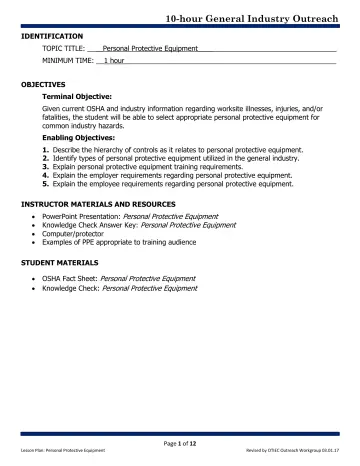
12 slidesPersonal Protective Equipment: Lesson Plan (OSHA 10-Hour General Industry Outreach)
Instructor lesson plan (objectives, timing, teaching steps) for the OSHA General Industry personal protective equipment outreach deck.
U.S. Department of Labor, OSHA (with the OTIEC Outreach Workgroup)Public domain
pdf
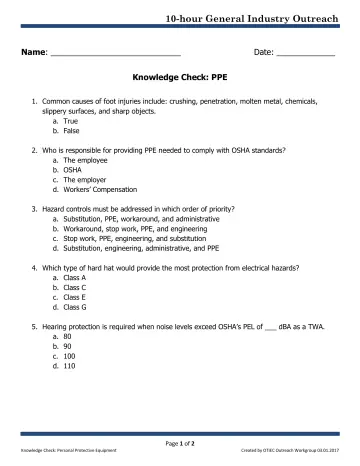
2 slidesPersonal Protective Equipment: Knowledge Check (OSHA 10-Hour General Industry Outreach)
Student knowledge-check quiz for the OSHA General Industry personal protective equipment outreach deck.
U.S. Department of Labor, OSHA (with the OTIEC Outreach Workgroup)Public domain