1 / 45Use ← → to flip
Module 13: Personal Protective Equipment
A module of TEEX's course on the general industry standards for the oil and gas industry. An archived deck: check it against the current standard before teaching from it.
Slide text
· 45 slides · by Texas Engineering Extension Service
The words on each slide as the author wrote them, read from the file by software so they can be searched. Layout, pictures and tables are not shown here: the slides above and the download are the original.
- Slide 1
Personal Protective Equipment
- MODULE 13
- Slide 2
Introduction
- Protective equipment = tools to do the job.
- Nearly 2 million disabling work-related injuries expected this year.
- More than ¼ will involve head, eyes, hands, feet
- Slide 3
PPE Statistics from BLS
- Hard hats were worn by only 16% of those workers who sustained head injuries
- Only 1% of approx 770 workers suffering face injuries were wearing face protection
- Only 23% of the workers with foot injuries wore safety shoes or boots
- About 40% of the workers with eye injuries wore eye protection
- Slide 4
Personal Protective Equipment in Oil and Gas
- What PPE is used in oil and gas?
- What injuries or illnesses does it protect against?
- Does it always succeed in protecting against these injuries or illnesses?
- Why or why not?
- Slide 5
1910.132 General Requirements
- (a) Protective equipment, including personal protective equipment for:
- Eyes,
- Face,
- Head, and extremities,
- Protective clothing,
- Respiratory devices, and
- Protective shields and barriers,
- Shall be
- provided,
- used, and
- maintained in a sanitary and reliable condition
- wherever it is necessary by reason of hazards of processes or environment
- Slide 6
1910.132 General Requirements
- Hazards of processes or environment include :
- Chemical hazards,
- Radiological hazards, or
- Mechanical irritants
- Encountered in a manner capable of causing injury or impairment in the function of any part of the body through absorption, inhalation or physical contact.
- Slide 7
1910.132(d) Hazard Assessment
- Assess workplace to determine if hazards are likely to necessitate the use of personal protective equipment (PPE)
- If hazards are present the employer shall:
- Select and have each affected employee use appropriate PPE for identified hazards
- Communicate selection decisions
- Select PPE that fits each employee
- Slide 8
1910 Subpart I Appendix B
- Compliance guidelines for hazard assessment & personal protective equipment selection (non-mandatory)
- Slide 9
1910.132(d) Hazard Assessment
- Written certification of hazard assessment identifies:
- Workplace evaluated
- Person certifying that the evaluation has been performed
- Date(s) of the hazard assessment
- Identification of document as a certification of hazard assessment
- Slide 10
1910.132(f) Training
- Employer must train employees before issuing PPE in at least these things:
- i. ii. iii. iv. v.
- When PPE is necessary
- What PPE is necessary
- How to properly don, doff, adjust, and wear PPE Limitations of the PPE
- Proper care, maintenance, useful life and disposal of the PPE
- Slide 11
1910.132(f) Training
- 2. Workers must demonstrate an understanding of the training and the ability to use PPE properly
- before being allowed to perform work requiring the use of PPE
- 4. Written certification, to verify that each employee has received and understood the required training, contains:
- Name of each employee trained
- Date(s) of training
- Subject of the certification
- Slide 12
1910.132(f) Training
- 3. Retraining necessary for employees without required understanding and skill:
- Changes in the workplace
- Changes in PPE used
- Inadequate knowledge or use of PPE
- Slide 13
- 1910.133
- Eye and Face Protection
- Slide 14
1910.133 Eye and face protection
- Employer assures that employee uses eye or face protection from hazards:
- Flying particles
- Molten metal
- Liquid chemicals, acids or caustic liquids
- Chemical gases or vapors
- Potentially injurious light radiation
- Slide 15
1910.133 Eye and face protection
- Side protection for flying objects
- Detachable side shields OK
- Slide 16
1910.133 Eye and face protection
- Employees with prescription lenses:
- Incorporate prescription in eye protection or
- Wear eye protection over prescription lenses
- Without disturbing proper position of prescription lenses or the protective lenses
- Slide 17
1910.133 Eye and face protection
- Each affected employee must wear appropriately shaded filter lenses for protection from injurious light radiation
- Tables in (a)(5)
- Slide 18
Protective eye and face devices shall comply with ANSI Z87.1-1989
- FOR EXAMPLE…
- Z 87.1-1989
- Subtitles & Transitions
- Slide 19
- 1910.134
- Respiratory Protection
- Slide 20
1910.134(a)(1) Permissible practice
- Primary objective: Prevent atmospheric contamination
- Respiratory hazards: dusts, mists, fogs, fumes, sprays, smokes or vapors
- 1st Priority: Engineering controls:
- Enclosure or confinement of the operation,
- General and local ventilation, and
- Substitution of less toxic materials
- Only where engineering controls are not feasible should respirators be used
- Slide 21
1910.134(c)(1) Respiratory protection program
- Where respirators are required, you need:
- Written program
- Worksite-specific procedures
- Required elements:
- Training
- Fit testing
- Medical evaluations
- Care and maintenance
- Procedures for respirator selection
- Procedures for routine & emergency use
- Slide 22
1910.134(c)(2) Where respirator use is not required
- If employer permits voluntary use:
- Provide information in Appendix D
- Implement elements of written program necessary to ensure
- Medical ability to use
- Cleaned, stored, maintained to not cause health hazard
- Exception: Voluntary use of dust masks
- Slide 23
1910.134(d) Selection of respirators
- Respirators must be NIOSH-certified
- Provide enough variety so user can find the right fit
- Cartridge change schedule for gases and vapors
- IDLH atmosphere = immediately dangerous to life and health
- Specific supplied-air respirators necessary for IDLH use
- Slide 24
1910.134(e) Medical evaluation
- Respirator use causes physiological burden, varying with
- Type of respirator
- Job and workplace conditions
- Medical status of employee
- Medical evaluation provided before:
- Fit testing
- Worker respirator use
- Slide 25
1910.134(e) Medical evaluation
- Conducted by physician or other licensed health care professional (PLHCP)
- Additional evaluations if:
- Employee reports related symptoms
- PLHCP, supervisor, administrator recommends
- Program information shows need
- Change in workplace conditions increases physiological burden
- Slide 26
- 1910.135
- Head Protection
- Slide 27
1910.135(a) General requirements
- a. Ensure that each affected employee wears a protective helmet where there is a potential for head injury from falling objects
- Slide 28
Classes and Types of Hard Hats
- Type I hard hats - reduce force of impact from a blow to the top of the head
- Type II hard hats - provide protection against both side impact (lateral) and blows to the top of the head
- Slide 29
Classes and Types of Hard Hats
- Class G (old A) – General
- Tested to withstand 2200 volts
- Class E (old B) – Electrical
- Tested to withstand 20,000 volts
- Class C (old C) – Conductive
- No electrical protection
- Slide 30
1910.135(a) General requirements
- b. Ensure that each affected employee wears a protective helmet designed to reduce electrical shock hazard when near exposed electrical conductors which could contact the head
- Slide 31
1910.135(b) Criteria for protective helmets
- Protective helmets shall comply with ANSI Z89.1-1986
- Slide 32
- 1910.136
- Foot Protection
- Slide 33
1910.136(a) General requirements
- Each affected employee must use protective footwear where there is danger of:
- Falling or rolling objects
- Objects piercing sole
- Feet exposed to electrical hazards
- Protective footwear shall comply with ANSI Z41-1991
- Slide 34
- 1910.138
- Hand Protection
- Slide 35
1910.138(a) General requirements
- a. Appropriate hand protection required for employee hand exposure to hazards such as:
- Skin absorption of harmful substances
- Severe cuts or lacerations
- Severe abrasions
- Punctures
- Chemical burns
- Thermal burns
- Harmful temperature extremes
- Slide 36
1910.138(b) Selection
- Employer selects based on:
- Performance characteristics of the hand protection relative to the task(s) to be performed
- Conditions present
- Duration of use
- Hazards and potential hazards identified
- Slide 37
Common Types of Gloves
- Disposable: light-weight plastic; can help guard against mild irritants.
- Fabric: cotton or fabric blend; improve grip or insulate from heat or cold.
- Leather: guard against injuries from sparks or scraping against rough surfaces. Combine with an insulated liner when working with electricity.
- Chemical Resistance: nitrile, neoprene, vinyl, etc; protect hands from chemical exposure
- Metal Mesh: protect hands from cuts and scratches; used commonly with sharp instruments.
- Aluminized Fabric: insulate hands from intense heat; commonly used with molten materials
- Slide 38
- 1910.95
- Hearing Protection
- Slide 39
1910.95 Occupational Noise Exposure
- OSHA measures noise in decibels in A scale (dBA) – calculation of one number for multiple frequencies
- TWA calculation, but nonlinear scale
- Permissible TWA: 90 dBA for 8 hours
- Table G-16: higher exposure, shorter time allowable
- Slide 40
1910.95(c) Hearing conservation program
- Required for any employees exceeding 8-hour TWA of 85 dBA or 50% dose
- Action level
- Monitoring, employee notification
- Audiometric testing
- Baseline and annual
- Evaluated for standard threshold shift (STS) (change in hearing sensitivity)
- Slide 41
1910.95(i) Hearing protectors
- Available to all employees exposed over 85 dBA
- Replaced as necessary
- Must be worn by workers exposed >90 dBA, or before baseline or with STS
- Employees choose from variety
- Training, supervision of correct use
- Proper initial fitting
- Slide 42
1910.95(j) Hearing protector attenuation
- Calculations in Appendix B
- Cannot simply subtract Noise Reduction Rating (NRR) from dBA
- Poor fit decreases attenuation
- Must attenuate to 90 dBA
- If STS has occurred, attenuate to 85 dBA
- Re-evaluate when noise levels increase
- Slide 43
- Other Regulations
- Slide 44
Other Regulations
- 29 CFR 1926 Subpart E: Personal Protective and Life Saving Equipment
- Construction operations only
- If employees supply their own, employer assures adequacy and maintenance
- Includes safety belts, lifelines, lanyards
- Slide 45
Other Regulations
- API RP 54 section 5
- Includes fall protection
- Hearing protection includes 12-hour shift
- No loose or poorly fitted clothing
- Do not work in clothing saturated in hazardous substance – wash and/or treat skin and change clothes
More on PPE
pptx
65 slidesPersonal Protective Equipment (OSHA 10-Hour General Industry Outreach)
OSHA's general industry outreach PPE deck (2017).
U.S. Department of Labor, OSHAPublic domain
pdf
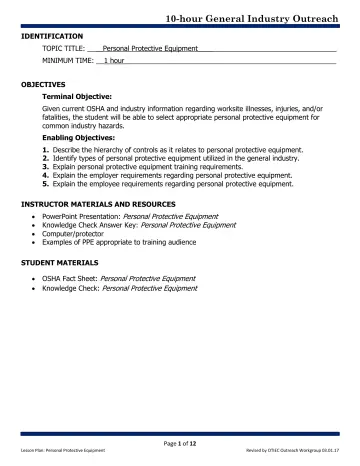
12 slidesPersonal Protective Equipment: Lesson Plan (OSHA 10-Hour General Industry Outreach)
Instructor lesson plan (objectives, timing, teaching steps) for the OSHA General Industry personal protective equipment outreach deck.
U.S. Department of Labor, OSHA (with the OTIEC Outreach Workgroup)Public domain
pdf
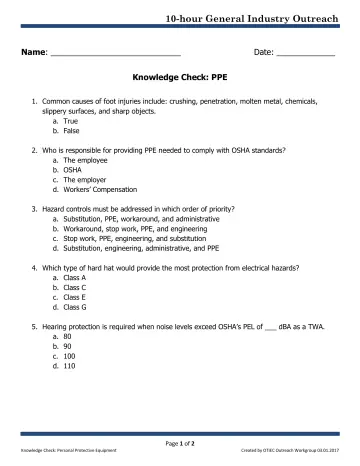
2 slidesPersonal Protective Equipment: Knowledge Check (OSHA 10-Hour General Industry Outreach)
Student knowledge-check quiz for the OSHA General Industry personal protective equipment outreach deck.
U.S. Department of Labor, OSHA (with the OTIEC Outreach Workgroup)Public domain