1 / 51Use ← → to flip
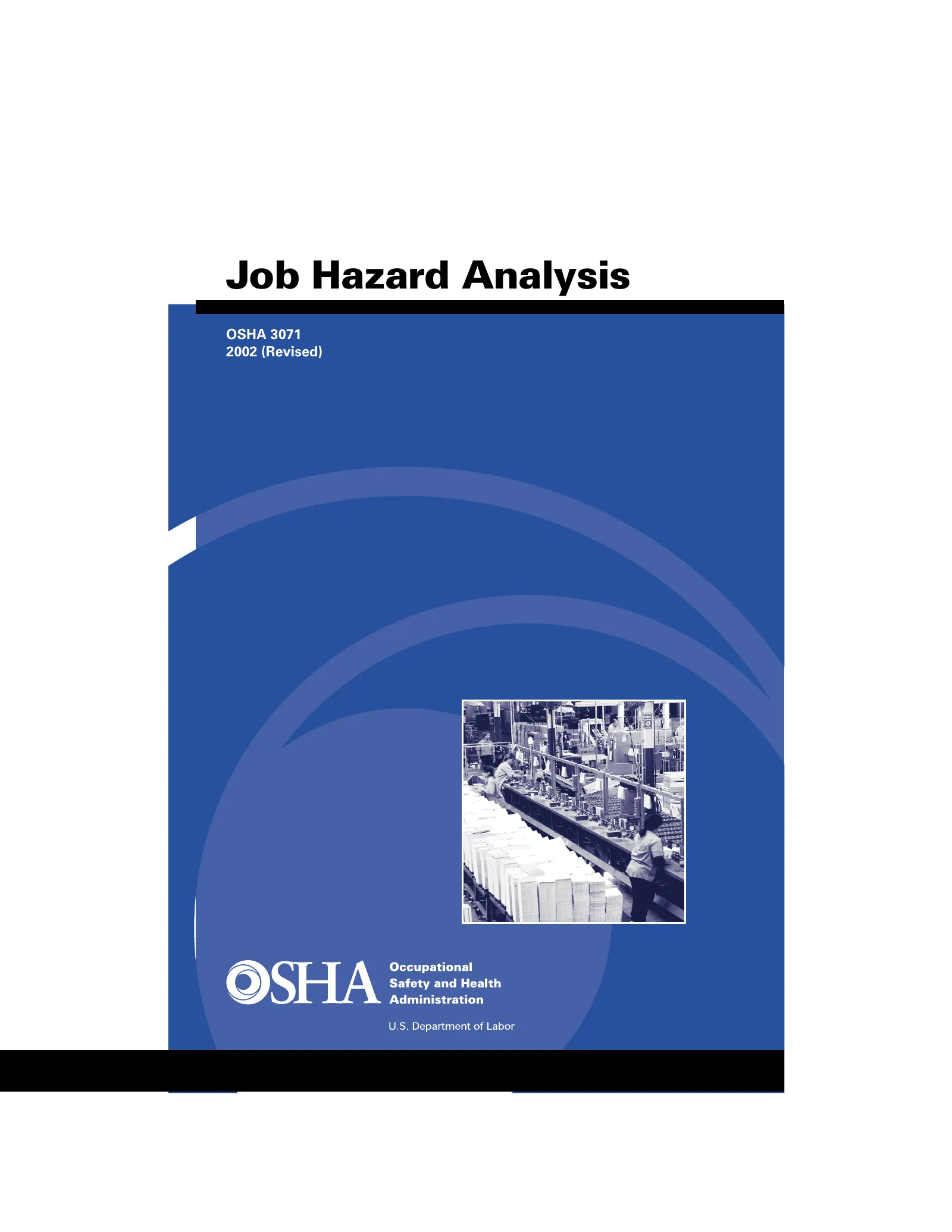
Job Hazard Analysis Guide (OSHA 3071)
OSHA's Job Hazard Analysis booklet with worked examples and blank forms.
Page text
· 49 of 51 pages · by U.S. Department of Labor, OSHA
The words on each page as the author wrote them, read from the file by software so they can be searched. Layout, pictures and tables are not shown here, and long pages are shortened: the pages above and the download are the original.
- Page 1
Job Hazard Analysis
- OSHA 3071
- 2002 (Revised)
- Page 2
Job Hazard Analysis
- U.S. Department of Labor
- Occupational Safety and Health Administration OSHA 3071
- 2002 (Revised)
- Page 4
Contents
- Who needs to read this booklet? … 1
- What is a hazard? … 1
- What is a job hazard analysis? … 1
- Why is job hazard analysis important? … 2
- What is the value of a job hazard analysis? … 2
- What jobs are appropriate for a job hazard analysis? … 3
- Where do I begin? … 4
- How do I identify workplace hazards? … 6
- How do I correct or prevent any hazards? … 12
- What else do I need to know before starting a job hazard analysis? … 12
- Why should I review my job hazard analysis? … 13
- When is it appropriate to hire a professional to conduct a job hazard analysis? … 14
- OSHA Assistance, Services, and Programs … 15
- …
- Page 5
- Can an employer be cited for violations after receiving consultation assistance? … 18
- Does OSHA provide any incentives for seeking consultation assistance? … 18
- What are the Voluntary Protection Programs? … 18
- How does VPP work? … 19
- How does VPP help employers and employees? … 19
- How does OSHA monitor VPP sites? … 20
- Can OSHA inspect an employer who is participating in the VPP? … 20
- How can a partnership with OSHA improve worker safety and health? … 21
- What is OSHA’s Strategic Partnership
- Program (OSPP)? … 21
- What do OSPPs do? … 21
- What are the different kinds of OSPPs? … 22
- …
- Page 6
OSHA Regional and Area Office Directory … 27
- OSHA-Approved Safety and Health Plans … 32
- OSHA Consultation Projects … 36
- Appendix 1 —
- Hazard Control Measures … 41
- Appendix 2 —
- Common Hazards and Hazard Descriptions … 43
- Appendix 3 —
- Sample Job Hazard Analysis Form … 46
- iii
- Page 7
Who needs to read this booklet?
- This booklet is for employers, foremen, and supervisors, but we encourage employees to use the information as well to analyze their own jobs and recognize workplace hazards so they can report them to you. It explains what a job hazard analysis is and offers guidelines to help you conduct your own step-by-step analysis.
- What is a hazard?
- A hazard is the potential for harm. In practical terms, a hazard often is associated with a condition or activity that, if left uncontrolled, can result in an injury or illness. See Appendix 2 for a list of common hazards and descriptions. …
- …
- Page 8
Why is job hazard analysis important?
- Many workers are injured and killed at the workplace every day in the United States. Safety and health can add value to your business, your job, and your life. You can help prevent workplace injuries and illnesses by looking at your workplace operations, establishing proper job procedures, and ensuring that all employees are trained properly.
- One of the best ways to determine and establish proper work procedures is to conduct a job hazard analysis. A job hazard analysis is one component of the larger commitment of a safety and health management system. …
- …
- Page 9
What jobs are appropriate for a job hazard analysis?
- A job hazard analysis can be conducted on many jobs in your workplace. Priority should go to the following types of jobs:
- Jobs with the highest injury or illness rates;
- Jobs with the potential to cause severe or disabling injuries or illness, even if there is no history of previous accidents;
- Jobs in which one simple human error could lead to a severe accident or injury;
- Jobs that are new to your operation or have undergone changes in processes and procedures; and
- Jobs complex enough to require written instructions.
- Page 10
Where do I begin?
- 1. Involve your employees. It is very important to involve your employees in the hazard analysis process. They have a unique understanding of the job, and this knowledge is invaluable for finding hazards. Involving employees will help minimize oversights, ensure a quality analysis, and get workers to “buy in” to the solutions because they will share ownership in their safety and health program.
- 2. Review your accident history. Review with your employees your worksite’s history of accidents and occupational illnesses that needed treatment, losses that required repair or replacement, and…
- …
- Page 11
- 4. List, rank, and set priorities for hazardous jobs. List jobs with hazards that present unacceptable risks, based on those most likely to occur and with the most severe consequences. These jobs should be your first priority for analysis.
- 5. Outline the steps or tasks. Nearly every job can be broken down into job tasks or steps. When beginning a job hazard analysis, watch the employee perform the job and list each step as the worker takes it. Be sure to record enough information to describe each job action without getting overly detailed. …
- …
- Page 12
How do I identify workplace hazards?
- A job hazard analysis is an exercise in detective work. Your goal is to discover the following:
- What can go wrong?
- What are the consequences?
- How could it arise?
- What are other contributing factors?
- How likely is it that the hazard will occur?
- To make your job hazard analysis useful, document the answers to these questions in a consistent manner. Describing a hazard in this way helps to ensure that your efforts to eliminate the hazard and implement hazard controls help target the most important contributors to the hazard.
- Good hazard scenarios describe:
- …
- Page 13
- contributing factors tend to line up in a certain way to create the hazard. Here is an example of a hazard scenario:
- In the metal shop (environment), while clearing a snag (trigger), a worker’s hand (exposure) comes into contact with a rotating pulley. It pulls his hand into the machine and severs his fingers (consequences) quickly.
- To perform a job hazard analysis, you would ask:
- What can go wrong? The worker’s hand could come into contact with a rotating object that “catches” it and pulls it into the machine.
- What are the consequences? The worker could receive a severe injury and lose fingers and hands.
- …
- Page 14
- How likely is it that the hazard will occur? This determination requires some judgment. If there have been “near-misses” or actual cases, then the likelihood of a recurrence would be considered high. If the pulley is exposed and easily accessible, that also is a consideration. In the example, the likelihood that the hazard will occur is high because there is no guard preventing contact, and the operation is performed while the machine is running. By following the steps in this example, you can organize your hazard analysis activities.
- …
- Page 15
Example Job Hazard Analysis Form
- Job Location:
- Metal Shop
- Analyst: Joe Safety
- Date:
- Task Description: Worker reaches into metal box to the right of the machine, grasps a 15-pound casting and carries it to grinding wheel. Worker grinds 20 to 30 castings per hour.
- Hazard Description: Picking up a casting, the employee could drop it onto his foot. The casting’s weight and height could seriously injure the worker’s foot or toes.
- Hazard Controls:
- 1. Remove castings from the box and place them on a table next to the grinder.
- 2. Wear steel-toe shoes with arch protection.
- …
- Page 16
Job Location:
- Metal Shop
- Analyst: Joe Safety
- Date:
- Task Description: Worker reaches into metal box to the right of the machine, grasps a 15-pound casting and carries it to grinding wheel. Worker grinds 20 to 30 castings per hour.
- Hazard Description: Castings have sharp burrs and edges that can cause severe lacerations.
- Hazard Controls:
- 1. Use a device such as a clamp to pick up castings.
- 2. Wear cut-resistant gloves that allow a good grip and fit tightly to minimize the chance that they will get caught in grinding wheel.
- Page 17
Job Location:
- Metal Shop
- Analyst: Joe Safety
- Date:
- Task Description: Worker reaches into metal box to the right of the machine, grasps a 15-pound casting and carries it to grinding wheel. Worker grinds 20 to 30 castings per hour.
- Hazard Description: Reaching, twisting, and lifting 15-pound castings from the floor could result in a muscle strain to the lower back.
- Hazard Controls:
- 1. Move castings from the ground and place them closer to the work zone to minimize lifting. Ideally, place them at waist height or on an adjustable platform or pallet.
- …
- Page 18
How do I correct or prevent hazards?
- After reviewing your list of hazards with the employee, consider what control methods will eliminate or reduce them. For more information on hazard control measures, see Appendix 1. The most effective controls are engineering controls that physically change a machine or work environment to prevent employee exposure to the hazard. The more reliable or less likely a hazard control can be circumvented, the better. If this is not feasible, administrative controls may be appropriate. This may involve changing how employees do their jobs.
- …
- Page 19
Why should I review my job hazard analysis?
- Twenty-four states and two territories operate their own OSHA-approved safety and health programs and may have standards that differ slightly from federal requirements. Employers in those states should check with the appropriate state agency for more information. A list of applicable states and territories and contact information is provided on page 32.
- Periodically reviewing your job hazard analysis ensures that it remains current and continues to help reduce workplace accidents and injuries. …
- …
- Page 20
When is it appropriate to hire a professional to conduct a job hazard analysis?
- If your employees are involved in many different or complex processes, you need professional help conducting your job hazard analyses. Sources of help include your insurance company, the local fire department, and private consultants with safety and health expertise. In addition, OSHA offers assistance through its regional and area offices and consultation services. Contact numbers are listed at the back of this publication.
- Even when you receive outside help, it is important that you and your employees remain involved in the…
- …
- Page 21
OSHA Assistance, Services, and Programs
- How can OSHA help me?
- OSHA can provide extensive help through a variety of programs, including assistance about safety and health programs, state plans, workplace consultations, Voluntary Protection Programs, strategic partnerships, training and education, and more.
- How does safety and health program management assistance help employers and employees?
- Effective management of worker safety and health protection is a decisive factor in reducing the extent and severity of work-related injuries and illnesses and their related costs. …
- …
- Page 22
What are state plans?
- The guidelines recommend specific actions under each of these general elements to achieve an effective safety and health program. The Federal Register notice is available online at www.osha.gov.
- State plans are OSHA-approved job safety and health programs operated by individual states or territories instead of Federal OSHA. The Occupational Safety and Health
- Act of 1970 (OSH Act) encourages states to develop and operate their own job safety and health plans and permits state enforcement of OSHA standards if the state has an approved plan. …
- …
- Page 23
Who can get consultation assistance and what does it cost?
- Comprehensive consultation assistance provided by OSHA includes a hazard survey of the worksite and an appraisal of all aspects of the employer’s existing safety and health management system. In addition, the service offers assistance to employers in developing and implementing an effective safety and health management system. Employers also may receive training and education services, as well as limited assistance away from the worksite.
- Consultation assistance is available to small employers (with fewer than 250 employees at a fixed site and no…
- …
- Page 24
Can an employer be cited for violations after receiving consultation assistance?
- If an employer fails to eliminate or control a serious hazard within the agreed-upon time frame, the Consultation Project Manager must refer the situation to the OSHA enforcement office for appropriate action. This is a rare occurrence, however, since employers request the service for the expressed purpose of identifying and fixing hazards in their workplaces.
- Does OSHA provide any incentives for seeking consultation assistance?
- Yes. Under the consultation program, certain exemplary employers may request participation in…
- …
- Page 25
How does VPP work?
- and OSHA’s Strategic Partnership Program (OSPP) — represents a cooperative approach which, when coupled with an effective enforcement program, expands worker protection to help meet the goals of the OSH Act.
- There are three levels of VPP recognition: Star, Merit, and Demonstration. All are designed to do the following:
- Recognize employers who have successfully developed and implemented effective and comprehensive safety and health management systems;
- Encourage these employers to continuously improve their safety and health management systems;
- …
- Page 26
How does OSHA monitor VPP sites?
- Further improvement and revitalization of already-good safety and health programs; and a
- Positive relationship with OSHA.
- OSHA reviews an employer’s VPP application and conducts a VPP Onsite Evaluation to verify that the safety and health management systems described are operating effectively at the site. OSHA conducts Onsite Evaluations on a regular basis, annually for participants at the Demonstration level, every 18 months for Merit, and every 3 to 5 years for Star. …
- …
- Page 27
How can a partnership with OSHA improve worker safety and health?
- OSHA has learned firsthand that voluntary, cooperative partnerships with employers, employees, and unions can be a useful alternative to traditional enforcement and an effective way to reduce worker deaths, injuries, and illnesses. This is especially true when a partnership leads to the development and implementation of a comprehensive workplace safety and health management system.
- What is OSHA’s Strategic
- Partnership Program (OSPP)?
- OSHA Strategic Partnerships are alliances among labor, management, and government to foster improvements in…
- …
- Page 28
What are the different kinds of OSPPs?
- There are two major types:
- Comprehensive, which focuses on establishing comprehensive safety and health management systems at partnering worksites; and
- Limited, which helps identify and eliminate hazards associated with worker deaths, injuries, and illnesses, or have goals other than establishing comprehensive worksite safety and health programs.
- OSHA is interested in creating new OSPPs at the national, regional, and local levels. OSHA also has found limited partnerships to be valuable. …
- …
- Page 29
Does OSHA have occupational safety and health training for employers and employees?
- Positive community recognition and interaction;
- Development of or improvement in safety and health management systems; and
- Positive interaction with OSHA.
- For more information about this program, contact your nearest OSHA office or go to the agency website at www.osha.gov.
- Yes. The OSHA Training Institute in Des Plaines, IL, provides basic and advanced training and education in safety and health for federal and state compliance officers, state consultants, other federal agency personnel, and privatesector employers…
- …
- Page 30
Does OSHA give money to organizations for training and education?
- OSHA awards grants through its Susan Harwood Training Grant Program to nonprofit organizations to provide safety and health training and education to employers and workers in the workplace. The grants focus on programs that will educate workers and employers in small business (fewer than 250 employees), train workers and employers about new OSHA standards or high-risk activities or hazards. Grants are awarded for 1 year and may be renewed for an additional 12 months depending on whether the grantee has performed satisfactorily.
- …
- Page 31
Does OSHA have other assistance materials available?
- Yes. OSHA has a variety of materials and tools available on its website at www.osha.gov. These include eTools, Expert Advisors, Electronic Compliance Assistance Tools (e-CATs), Technical Links, regulations, directives, publications, videos, and other information for employers and employees. OSHA’s software programs and compliance assistance tools walk you through challenging safety and health issues and common problems to find the best solutions for your workplace. …
- …
- Page 32
What do I do in case of an emergency or if I need to file a complaint?
- To report an emergency, file a complaint, or seek OSHA advice, assistance, or products, call (800) 321–OSHA or contact your nearest OSHA regional or area office listed beginning on page 27. The teletypewriter (TTY) number is (877) 889–5627.
- You can also file a complaint online and obtain more information on OSHA federal and state programs by visiting OSHA’s website at www.osha.gov.
- For more information on grants, training, and education, write: OSHA Training Institute, Office of Training and Education, 1555 Times Drive, Des Plaines, IL…
- …
- Page 33
OSHA Regional and Area Offices
- OSHA Regional Offices
- Region I
- Region VI
- (CT,* ME, MA, NH, RI, VT*)
- JFK Federal Building, Room E340
- Boston, MA 02203
- (617) 565–9860
- (AR, LA, NM,* OK, TX)
- 525 Griffin Street, Room 602 Dallas, TX 75202
- (214) 767–4731 or 4736 x224
- Region II
- Region VII
- (NJ,* NY,* PR,* VI*)
- 201 Varick Street, Room 670
- New York, NY 10014
- (212) 337–2378
- (IA,* KS, MO, NE)
- City Center Square
- 1100 Main Street, Suite 800
- Kansas City, MO 64105
- (816) 426–5861
- Region III
- (DE, DC, MD,* PA,* VA,* WV) The Curtis Center
- 170 S. Independence Mall West Suite 740 West
- Philadelphia, PA 19106-3309 (215) 861–4900
- …
- Page 34
OSHA Area Offices
- Birmingham, AL (205) 731–1534
- Jacksonville, FL
- (904) 232–2895
- Mobile, AL (251) 441–6131
- Tampa, FL
- (813) 626–1177
- Anchorage, AK
- (907) 271–5152
- Savannah, GA
- (912) 652–4393
- Little Rock, AR
- (501) 324–6291(5818)
- Smyrna, GA
- (770) 984–8700
- Phoenix, AZ
- (602) 640–2348
- Tucker, GA
- (770) 493–6644/6742/8419
- San Diego, CA
- (619) 557–5909
- Des Moines, IA
- (515) 284–4794
- Sacramento, CA (916) 566–7471
- Boise, ID
- (208) 321–2960
- Denver, CO
- (303) 844–5285
- Calumet City, IL (708) 891–3800
- Greenwood Village, CO
- (303) 843–4500
- Des Plaines, IL
- (847) 803–4800
- Bridgeport, CT
- (203) 579–5581
- Fairview Heights, IL
- …
- Page 35
Wichita, KS
- (316) 269–6644
- Jackson, MS
- (601) 965–4606
- Frankfort, KY
- (502) 227–7024
- Billings, MT
- (406) 247–7494
- Baton Rouge, LA
- (225) 389–0474 (0431)
- Raleigh, NC
- (919) 856–4770
- Braintree, MA
- (617) 565–6924
- Omaha, NE
- (402) 221–3182
- Methuen, MA
- (617) 565–8110
- Bismark, ND
- (701) 250–4521
- Springfield, MA
- (413) 785–0123
- Concord, NH
- (603) 225–1629
- Linthicum, MD
- (410) 865–2055/2056
- Avenel, NJ
- (732) 750–3270
- Bangor, ME
- (207) 941–8177
- Hasbrouck Heights, NJ (201) 288–1700
- Portland, ME
- (207) 780–3178
- Marlton, NJ
- (856) 757–5181
- August, ME
- (207) 622–8417
- Parsippany, NJ
- (973) 263–1003
- Lansing, MI
- (517) 327–0904
- …
- Page 36
New York, NY
- (212) 337–2636
- Pittsburgh, PA
- (412) 395–4903
- North Syracuse, NY
- (315) 451–0808
- Wilkes–Barre, PA (570) 826–6538
- Tarrytown, NY
- (914) 524–7510
- Guaynabo, PR
- (787) 277–1560
- Westbury, NY
- (516) 334–3344
- Providence, RI
- (401) 528–4669
- Cincinnati, OH
- (513) 841–4132
- Columbia, SC
- (803) 765–5904
- Cleveland, OH
- (216) 522–3818
- Nashville, TN
- (615) 781–5423
- Columbus, OH
- (614) 469–5582
- Austin, TX
- (512) 916–5783 (5788)
- Toledo, OH
- (419) 259–7542
- Corpus Christi, TX
- (361) 888–3420
- Oklahoma City, OK
- (405) 278–9560
- Dallas, TX
- (214) 320–2400 (2558)
- Portland, OR (503) 326–2251
- El Paso, TX
- (915) 534–6251
- Allentown, PA
- …
- Page 37
Salt Lake City, UT (801) 530–6901
- Eau Claire, WI
- (715) 832–9019
- Norfolk, VA
- (757) 441–3820
- Madison, WI
- (608) 264–5388
- Bellevue, WA
- (206) 553–7520
- Milwaukee, WI
- (414) 297–3315
- Appleton, WI
- (920) 734–4521
- Charleston, WV (304) 347–5937
- Page 38
OSHA-Approved Safety and Health Plans
- Alaska
- Connecticut
- Alaska Department of Labor and Workforce Development
- Connecticut Department of Labor
- Commissioner
- (907) 465–2700
- FAX: (907) 465–2784
- (860) 566–5123
- FAX: (860) 566–1520
- Program Director
- (907) 269–4904
- FAX: (907) 269–4915
- Conn-OSHA Director
- (860) 566–4550
- FAX: (860) 566–6916
- Arizona
- Hawaii
- Industrial Commission of Arizona
- Hawaii Department of Labor and Industrial Relations
- Director, ICA
- (602) 542–4411
- FAX: (602) 542–1614
- Director
- (808) 586–8844
- FAX: (808) 586–9099
- (602) 542–5795
- Administrator
- (808) 586–9116
- FAX: (808) 586–9104
- California
- Indiana
- …
- Page 39
Iowa
- Minnesota
- Iowa Division of Labor
- Minnesota Department of Labor and Industry
- Commissioner
- (515) 281–6432
- FAX: (515) 281–4698
- Administrator
- (515) 281–3469
- FAX: (515) 281–7995
- Kentucky
- Kentucky Labor Cabinet
- Secretary (502) 564–3070
- FAX: (502) 564–5387
- Federal\State Coordinator (502) 564–3070 ext.240 FAX: (502) 564–1682
- Maryland
- Maryland Division of Labor and Industry
- (410) 767–2999
- FAX: (410) 767–2300
- Deputy Commissioner
- (410) 767–2992
- FAX: (410) 767–2003
- (651) 296–2342
- FAX: (651) 282–5405
- Assistant Commissioner (651) 296–6529
- FAX: (651) 282–5293
- Administrative Director, OSHA Management Team
- …
- Page 40
New Mexico
- New Mexico Environment
- Department
- Secretary
- (505) 827–2850
- FAX: (505) 827–2836
- Chief
- (505) 827–4230
- FAX: (505) 827–4422
- New York
- New York Department of Labor
- Acting Commissioner
- (518) 457–2741
- FAX: (518) 457–6908
- Division Director
- (518) 457–3518
- North Carolina
- North Carolina Department of Labor
- Commissioner
- (919) 807–2900
- FAX: (919) 807–2855
- Deputy Commissioner, OSH Director
- (919) 807–2861
- OSH Assistant Director (919) 807–2863
- FAX: (919) 807–2856
- Oregon
- Oregon Occupational Safety and Health Division
- Administrator
- (503) 378–3272
- FAX: (503) 947–7461
- Deputy Administrator for Policy (503) 378–3272
- …
- Page 41
Tennessee
- Virginia
- Tennessee Department of Labor
- Virginia Department of Labor and Industry
- Commissioner
- (615) 741–2582
- FAX: (615) 741–5078
- Acting Program Director (615) 741–2793
- FAX: (615) 741–3325
- (804) 786–2377
- FAX: (804) 371–6524
- Director, Office of Legal Support (804) 786–9873
- FAX: (804) 786–8418
- Utah
- Utah Labor Commission
- Washington
- (801) 530–6901
- FAX: (801) 530–7906
- Washington Department of Labor and Industries
- Administrator
- (801) 530–6898
- FAX: (801) 530–6390
- Vermont
- Vermont Department of Labor and Industry
- (802) 828–2288
- FAX: (802) 828–2748
- Project Manager
- (802) 828–2765
- FAX: (802) 828–2195
- …
- Page 42
OSHA Consultation Projects
- Anchorage, AK
- (907) 269–4957
- Boise, ID
- (208) 426–3283
- Tuscaloosa, AL (205) 348–3033
- Chicago, IL
- (312) 814–2337
- Little Rock, AR
- (501) 682–4522
- Indianapolis, IN (317) 232–2688
- Phoenix, AZ
- (602) 542–1695
- Topeka, KS
- (785) 296–2251
- Sacramento, CA (916) 263–2856
- Frankfort, KY
- (502) 564–6895
- Fort Collins, CO (970) 491–6151
- Baton Rouge, LA (225) 342–9601
- Wethersfield, CT (860) 566–4550
- West Newton, MA (617) 727–3982
- Washington, DC (202) 541–3727
- Laurel, MD
- (410) 880–4970
- Wilmington, DE (302) 761–8219
- Augusta, ME
- (207) 624–6400
- Tampa, FL
- (813) 974–9962
- Lansing, MI
- (517) 322–1809
- …
- Page 43
Raleigh, NC
- (919) 807–2905
- Columbia, SC
- (803) 734–9614
- Bismarck, ND
- (701) 328–5188
- Brookings, SD
- (605) 688–4101
- Lincoln, NE
- (402) 471–4717
- Nashville, TN
- (615) 741–7036
- Concord, NH
- (603) 271–2024
- Austin, TX
- (512) 804–4640
- Trenton, NJ
- (609) 292–3923
- Salt Lake City, UT (801) 530–6901
- Santa Fe, NM
- (505) 827–4230
- Montpelier, VT
- (802) 828–2765
- Albany, NY
- (518) 457–2238
- Richmond, VA
- (804) 786–6359
- Henderson, NV
- (702) 486–9140
- Christiansted St. Croix, VI (809) 772–1315
- Columbus, OH
- (614) 644–2631
- Olympia, WA
- (360) 902–5638
- Oklahoma City, OK
- (405) 528–1500
- Madison, WI
- (608) 266–9383
- Salem, OR
- (503) 378–3272
- …
- Page 44
Appendices
- Page 45
Hazard Control Measures
- Appendix 1
- Information obtained from a job hazard analysis is useless unless hazard control measures recommended in the analysis are incorporated into the tasks. Managers should recognize that not all hazard controls are equal. Some are more effective than others at reducing the risk.
- The order of precedence and effectiveness of hazard control is the following:
- 1. Engineering controls.
- 2. Administrative controls.
- 3. Personal protective equipment.
- Engineering controls include the following:
- Elimination/minimization of the hazard — Designing the facility, equipment, or process to…
- …
- Page 46
Administrative controls include the following:
- Written operating procedures, work permits, and safe work practices;
- Exposure time limitations (used most commonly to control temperature extremes and ergonomic hazards);
- Monitoring the use of highly hazardous materials;
- Alarms, signs, and warnings;
- Buddy system; and
- Training.
- Personal Protective Equipment — such as respirators, hearing protection, protective clothing, safety glasses, and hardhats— is acceptable as a control method in the following circumstances:
- When engineering controls are not feasible or do not totally eliminate the hazard;
- …
- Page 47
Common Hazards and Descriptions
- Appendix 2
- Hazards
- Hazard Descriptions
- Chemical
- (Toxic)
- A chemical that exposes a person by absorption through the skin, inhalation, or through the blood stream that causes illness, disease, or death. The amount of chemical exposure is critical in determining hazardous effects. Check Material Safety Data Sheets (MSDS), and/or OSHA 1910.1000 for chemical hazard information.
- Chemical
- (Flammable)
- A chemical that, when exposed to a heat ignition source, results in combustion. Typically, the lower a chemical’s flash point and boiling point, the more flammable the chemical. …
- …
- Page 48
Hazards
- Hazard Descriptions
- Electrical
- (Fire)
- Use of electrical power that results in electrical overheating or arcing to the point of combustion or ignition of flammables, or electrical component damage.
- Electrical
- (Static/ESD)
- The moving or rubbing of wool, nylon, other synthetic fibers, and even flowing liquids can generate static electricity. This creates an excess or deficiency of electrons on the surface of material that discharges (spark) to the ground resulting in the ignition of flammables or damage to electronics or the body’s nervous system.
- Electrical
- …
- Page 49
Hazards
- Hazard Descriptions
- Mechanical
- Failure
- Self explanatory; typically occurs when devices exceed designed capacity or are inadequately maintained.
- Mechanical
- Skin, muscle, or body part exposed to crushing, caught-between, cutting, tearing, shearing items or equipment.
- Noise
- Noise levels (>85 dBA 8 hr TWA) that result in hearing damage or inability to communicate safety-critical information.
- Radiation (Ionizing)
- Alpha, Beta, Gamma, neutral particles, and X-rays that cause injury (tissue damage) by ionization of cellular components.
- Radiation
- (Non-Ionizing)
- …
- Page 50
Sample Job Hazard Analysis Form
- Appendix 3
- Job Title:
- Job Location:
- Task #
- Task Description:
- Hazard Type:
- Hazard Description:
- Consequence:
- Hazard Controls:
- Rational or Comment:
- Analyst
- Date
More on Managing Safety
pptx
41 slidesHazard Identification Plan
Construction Safety Improvement Program module on how to find and document jobsite hazards, from the Building Industry Association of Hawaii.
Building Industry Association - HawaiiOSHA Harwood grant
pptx
31 slidesIncident Investigation Procedure
Construction Safety Improvement Program module on incident and near-miss investigation and root causes, from the Building Industry Association of Hawaii.
Building Industry Association - HawaiiOSHA Harwood grant
pptx
24 slidesLeadership Commitment to Operational Safety
Construction Safety Improvement Program module on management leadership and commitment to safety, from the Building Industry Association of Hawaii.
Building Industry Association - HawaiiOSHA Harwood grant