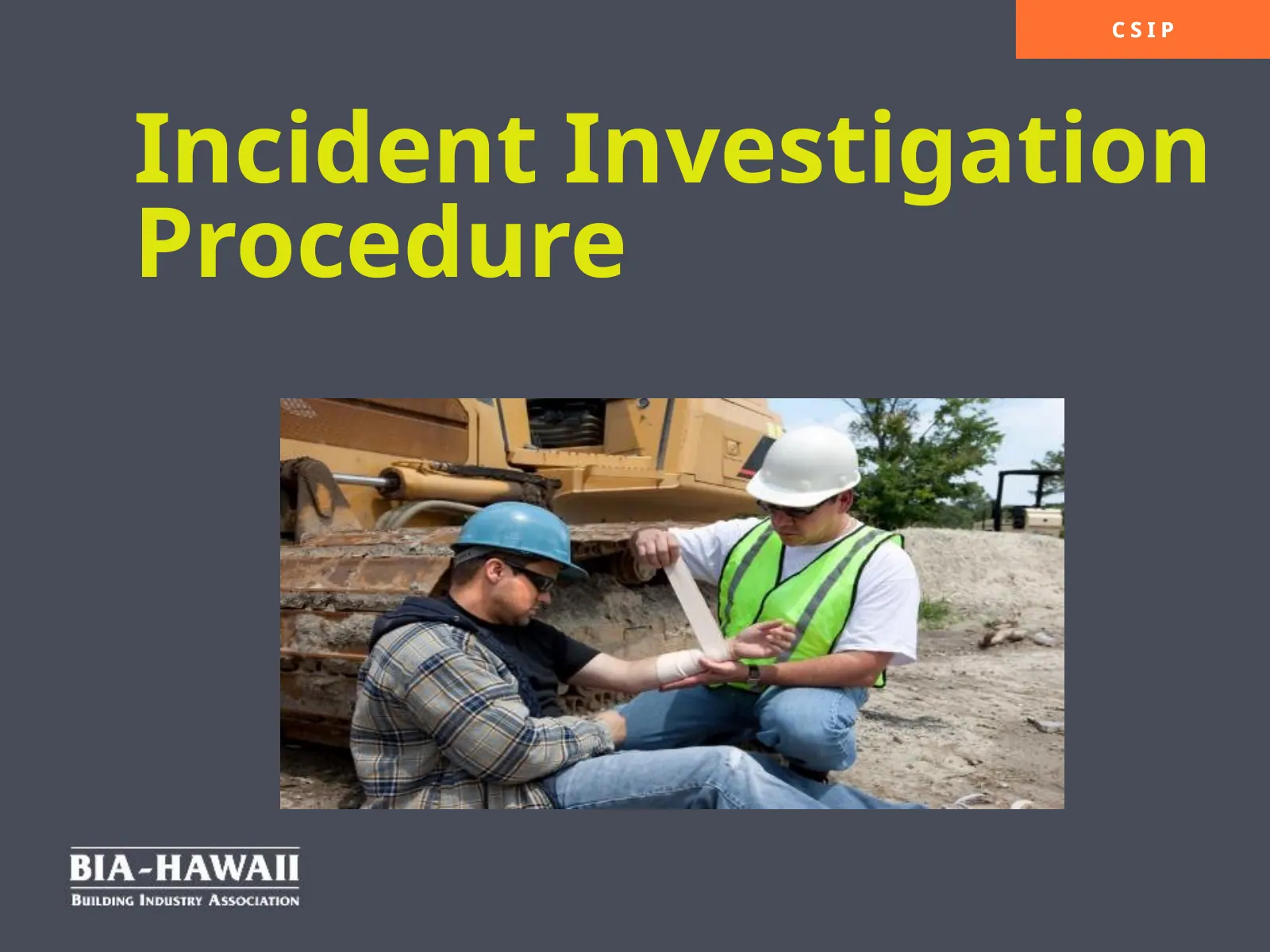
Incident Investigation Procedure
Construction Safety Improvement Program module on incident and near-miss investigation and root causes, from the Building Industry Association of Hawaii.
Slide text
· 31 slides · by Building Industry Association - Hawaii
The words on each slide as the author wrote them, read from the file by software so they can be searched. Layout, pictures and tables are not shown here: the slides above and the download are the original.
- Slide 1
Incident Investigation Procedure
- Slide 2
Overview
- Investigation
- Guidelines
- Plan
- Slide 3
Incident Investigation
- Purpose
- Prevent injuries & Illnesses
- Save Lives
- Save money
- Demonstrate commitment to
- Health & safety
- Promote positive workplace morale
- Improve management
- Slide 4
Incident Investigation
- Purpose
- Effective incident investigations are the right thing to do, not only because they help employers prevent future incidents, but because they help employers to identify hazards in their workplaces and shortcomings in their safety and health management programs.
- The National Safety Council estimates that, on average, preventing a workplace injury can save $39,000, and preventing a fatality more than $1.4 million.
- Slide 5
Incident Investigation
- Purpose
- Investigating a worksite incident— a fatality, injury, illness, or close call— provides employers and workers the opportunity to identify hazards in their operations and shortcomings in their safety and health programs.
- Most importantly, it enables employers and workers to identify and implement the corrective actions necessary to prevent future incidents.
- Incident investigations focus on identifying and correcting root causes, not on finding fault or blame, also improve workplace morale and increase productivity, by demonstrating an employer’s commitment to a safe and healthful workplace.
- Slide 6
Incident Investigation
- Terms
- Incident
- Root Causes
- Close Call
- A work-related event in which an injury or ill‐ health (regardless of severity) or fatality occurred, or could have occurred.
- Underlying reason(s) for unsafe conditions.
- Root causes generally reflect management, design, planning, organizational or operational failings
- An incident that could have caused serious injury or illness but did not; also called a “near miss.”
- Slide 7
Incident Investigation
- Incident Occurred
- Close Calls
- Incident Investigator that follow a systems approach are based on the principle that the root causes of an incident can be traced back to failures of the programs that manage safety and health in the workplace.
- Slide 8
Incident Investigation
- Incident Occurred
- Now what?
- Investigate all incidents, including “close calls”
- React quickly with the established investigation procedure to find the root causes and implement corrective actions.
- Quick and planned actions demonstrate your company’s commitment to the safety and health of your workers.
- Your willingness to improve your safety and health management program can help to prevent future incidents.
- Slide 9
Incident Investigation
- Incident Occurred
- Approaches
- Behavioral Safety
- Approach:
- Incorrectly assumes that the majority of workplace incidents are simply the result of “human error” or “behavioral” failures.
- Systems Approach:
- Concludes that carelessness or failure to follow a procedure alone was NOT the cause of an incident.
- Slide 10
Incident Investigation
- Incident Occurred
- Approaches
- When a shortcoming is identified, it is important to ask why it exists and why it was not previously addressed.
- Otherwise, you may fail to discover the underlying or root causes of the incident, and therefore fail to identify the systemic changes and measures needed to prevent future incidents.
- Slide 11
Incident Investigation
- Investigate Programs, Not Behaviors
- Examples
- Was the procedure or safety rule followed?
- Did production pressures play a role?
- Was the procedure out-of-date or safety training inadequate?
- Slide 12
Incident Investigation
- Identifying Root Causes
- The GOAL is to change the conditions under which people work by eliminating or reducing the factors (program deficiencies, root causes) that create unsafe conditions.
- This is typically done by implementing adequate barriers and safeguards against the factors that cause unsafe conditions or actions.
- Slide 13
Incident Investigation
- Identifying Root Causes
- Root causes often involve multiple deficiencies in the safety and health management programs. These deficiencies may exist in areas such as workplace design, cultural and organizational factors, equipment maintenance and other technical matters, operating systems and procedures, staffing, supervision, training, and others.
- Eliminating the immediate cause(s) is like cutting weeds, while eliminating the root cause(s) is equivalent to pulling out the roots of the weed.
- Slide 14
Incident Investigation
- Establish an Incident Investigation Program
- Guidelines
- How and when management is to be notified of the incident
- Notifying OSHA, which must comply with reporting requirements:
- All work-related fatalities within 8 hours
- All work-related inpatient hospitalizations, all amputations and all losses of an eye within 24 hours.
- Slide 15
Incident Investigation
- Establish an Incident Investigation Program
- Guidelines
- Who is authorized to notify outside agencies (i.e., fire, police, etc.)?
- Who will conduct investigations and what training they should have received?
- Timetables for completing the investigation and developing & implementing recommendations.
- Who will receive investigation recommendations? Who will be responsible for implementing corrective actions?
- Slide 16
Incident Investigation
- Establish an Incident Investigation Program
- A Four-Step Systems Approach
- Preserve
- Document
- Scene
- Collect
- Informatio n
- Determin e Root
- Cause
- Implemen t Corrective Actions
- Slide 17
Incident Investigation
- Establish an Incident Investigation Program
- STEP 1: Preserve & Document the Scene
- Preserve the scene to prevent material evidence from being removed or altered
- Use cones, tape, and/or guards, etc.
- Document the incident facts such as the date of the investigation and who is investigating.
- Essential to documenting the scene is capturing the injured employee’s name, injury description, whether they are temporary or permanent, and the date and location of the incident.
- Investigators can also document the scene by video recording, photographing and sketching.
- Slide 18
Incident Investigation
- Establish an Incident Investigation Program
- STEP 2: Collect Information
- Incident information is collected through interviews, document reviews, and other means.
- Slide 19
Incident Investigation
- Establish an Incident Investigation Program
- STEP 2: Collect Information, cont’d
- In addition to interviews, investigators may find other sources of useful information, such as:
- Equipment manuals
- Industry guidance documents
- Company policies & records
- Maintenance schedules, records, & logs
- Training records (and any communication to employees)
- Audit & follow-up reports
- Enforcement policies & records
- Previous corrective action recommendations
- Slide 20
Investigation Procedure
- Establish an Incident Investigation Program
- STEP 2: Collect Information: INTERVIEWING
- When interviewing injured workers and witnesses it is crucial to reduce their possible fear and anxiety, and to develop a good rapport. When conducting interviews, investigators should:
- Conduct the interview in the language of the employee/interviewee; use a translator if needed.
- Clearly state that the purpose of the investigation and interview is fact-finding, not fault-finding.
- Emphasize that the goal is to learn how to prevent future incidents by discovering the root causes of what occurred.
- Slide 21
Investigation Procedure
- Establish an Incident Investigation Program
- STEP 2: Collect Information: INTERVIEWING, cont’d
- Establish a climate of cooperation; avoid anything that may be perceived as intimidating or in search of someone to blame.
- Let employee know that they can have an employee representative (e.g., labor representative), if available and/or appropriate.
- Ask the individuals to recount their version of what happened.
- Do not interrupt the interviewee.
- Take notes and/or record the responses; interviewee must give permission prior to being recorded.
- Slide 22
Investigation Procedure
- Establish an Incident Investigation Program
- STEP 2: Collect Information: INTERVIEWING, cont’d
- Have blank paper and or sketch available for interview to use for reference.
- Ask clarifying questions to fill in missing information.
- Reflect back to the interviewees factual information obtained; correct any inconsistencies.
- Ask what they think could have prevented the incident, focusing on conditions and events preceding the injury.
- Slide 23
Investigation Procedure
- Establish an Incident Investigation Program
- STEP 3: Determine the Root Cause
- The root causes are the underlying reasons why the incident occurred. Root causes generally reflect:
- Management
- Design
- Planning
- Organization and/or operational failings
- Slide 24
Investigation Procedure
- Establish an Incident Investigation Program
- STEP 3: Determine the Root Cause, cont'd
- Determining the root cause is the result of persistently asking “why”
- Determining the root cause is the most effective way to ensure the incident does not happen again.
- Conclusions such as “worker was careless” or “employee did not follow safety procedures” don’t get at the root causes of the incident.
- Slide 25
Investigation Procedure
- Establish an Incident Investigation Program
- STEP 3: Determine the Root Cause, cont'd
- Avoid the Incomplete or Misleading
- To avoid these these incomplete and misleading conclusions in the investigative process, investigators need to continue to ask “why?” as in, “Why did the employee not follow safety procedures?”
- If the answer is “the employee was in a hurry to complete the task and the safety procedures slowed down the work”, then ask, “Why was the employee in a hurry?”
- The more and deeper “why?” questions asked, the more contributing factors are discovered and the closer the investigator gets to the root causes.
- Slide 26
Investigation Procedure
- Establish an Incident Investigation Program
- STEP 3: Determine the Root Cause, cont'd
- If a procedure or safety rule was not followed, why was the procedure or rule not followed?
- Did production pressures play a role, and, if so, why were production pressures permitted to jeopardize safety?
- Was the procedure out‐of‐date or safety training inadequate? If so, why had the problem not been previously identified, or, if it had been identified, why had it not been addressed?
- Slide 27
Investigation Procedure
- Establish an Incident Investigation Program
- STEP 4: Implement Corrective Action
- The investigation is not not complete until corrective actions are implemented that address the root causes of the incident.
- Implementation should entail program level improvements and should be supported by senior management.
- Superficial conclusions such as "Bob should have used common sense," and weak corrective actions such as “Employees must remember to wear PPE”, are unlikely to improve safety culture or prevent future incidents.
- Slide 28
Investigation Procedure
- Establish an Incident Investigation Program
- STEP 4: Implement Corrective Action, cont'd
- Some corrective corrective actions can be general, across‐ the‐board improvements to workplace safety environment. Consider:
- Strengthen & develop written comprehensive safety and health plan.
- Revise safety policies to establish responsibility and accountability.
- Revise purchasing/contracting policies to include safety considerations.
- Changing safety inspection process to include line employees along with management representatives.
- Slide 29
Investigation Procedure
- Establish an Incident Investigation Program
- STEP 4: Implement Corrective Action, cont'd
- In planning corrective actions and how best to implement them, employers may find that some root causes will take time and perseverance to fix. Persisting in implementing substantive corrective actions, however, will not only reduce the risk of future incidents but also improve the company’s safety, morale and its bottom line.
- Slide 30
Questions
- Slide 31
OSHA Disclaimer
- This material was produced under grant SH29640SH6 from the Occupational Safety and Health Administration, U.S. Department of Labor. It does not necessarily reflect the views or policies of the U.S. Department of Labor, nor does mention of trade names, commercial products, or organizations imply endorsement by the U.S. Government.
More on Managing Safety
Hazard Identification Plan
Construction Safety Improvement Program module on how to find and document jobsite hazards, from the Building Industry Association of Hawaii.
Leadership Commitment to Operational Safety
Construction Safety Improvement Program module on management leadership and commitment to safety, from the Building Industry Association of Hawaii.
Safety Inspection Procedure
Construction Safety Improvement Program module on planning and running jobsite safety inspections, from the Building Industry Association of Hawaii.