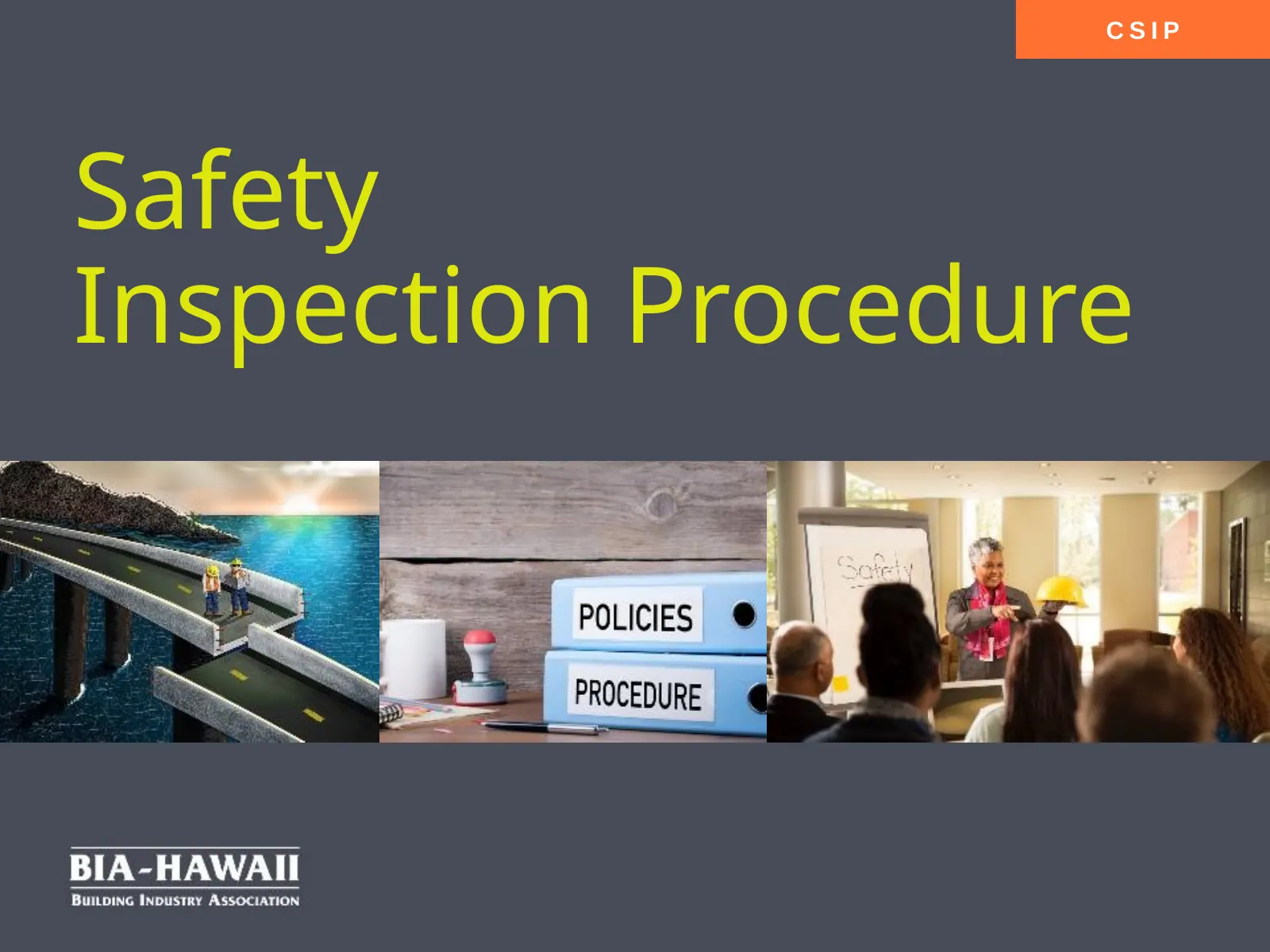
Safety Inspection Procedure
Construction Safety Improvement Program module on planning and running jobsite safety inspections, from the Building Industry Association of Hawaii.
Slide text
· 49 slides · by Building Industry Association - Hawaii
The words on each slide as the author wrote them, read from the file by software so they can be searched. Layout, pictures and tables are not shown here: the slides above and the download are the original.
- Slide 1
Safety
- Inspection Procedure
- Slide 2
Overview
- Workplace Inspections
- Post-Inspection
- Inspection
- Requirements
- Slide 3
Inspection
- Process & Goals
- Create a better understanding of the inspection process.
- Learn how to identify safety hazards.
- Learn how to control identified hazards.
- Slide 4
Inspection
- Workplace Hazards
- Did you Know?
- Hazards
- Death
- Injury
- Damage to equipment
- Slide 5
Inspection
- Identifying and Evaluating Potential Hazards
- Purpose
- Inspection of work areas and audits of safety programs are tools that can be used to identify problems and hazards before these conditions result in accidents or injuries.
- Audits also help to identify the effectiveness of safety program management and can be used as a guide to assure regulatory compliance and a safe workplace.
- Slide 6
Inspection
- Types of Inspections
- Special Function
- Inspections
- Formal Inspections
- Daily/Weekly Inspections
- Slide 7
Inspection Requirements
- Frequency
- Guidelines depend on several factors
- Frequency of planned formal inspections
- Number, size, and potential risk of different work operations or equipment
- Team building/employee involvement/safety committee activities
- Number of shifts; the activity of each shift may vary
- Slide 8
Inspection Requirements
- Frequency
- Guidelines depend on several factors, contin.
- Number of hours worked by the team
- Introduction of new processes, equipment, or workers
- Historical patterns of at-risk activity
- Past incidents/near-miss records
- Slide 9
Inspection
- Types/ Frequency of Inspections
- Supervisor/ Mgt Daily Walk-through
- Undocumented inspection made daily prior to startup and shift change to ensure the facility and equipment are in safe conditions. All noted unsafe areas are placed in a safe condition prior to Employees working in the area.
- Slide 10
Inspection
- Types/Frequency of Inspections
- Weekly Supervisor Inspections
- Conducted and recorded with an employee.
- Ensures current hazard controls are still effective, equipment is in safe condition, and safe work practices are in use.
- Discrepancies are listed and recorded on work orders for correction.
- Inspection sheet is forwarded to Safety Manager for review and to track corrections.
- Slide 11
Inspection
- Types/ Frequency of Inspections
- Monthly Safety Committee Inspection
- Safety Committee tours the entire facility with the Safety Manager.
- Ensures Safety Committee Members are familiar with all areas of the operation.
- Record of problem areas, committee recommendations, and deficiencies will be recorded and provided to management
- Slide 12
Inspection
- Types/Frequency of Inspections
- Equipment
- Daily, prior to use:
- All construction equipment
- Respirator Inspections
- (before/after use)
- Hand tools
- Scaffolding
- Monthly:
- Sprinkler Inspection
- Emergency Lighting Test
- Fire Extinguisher Inspections
- Safety Equipment Inventories
- Emergency Lighting 90 Min. Test
- Check regularly (daily, weekly, monthly, annually): Boiler
- Slide 13
Inspection
- Safety Audits
- The following shall be conducted annually:
- Accident Prevention
- Asbestos Controls
- Fire Prevention
- Boiler Safety
- Material Handling
- Bloodborne Pathogens
- Flammable Material Storage
- Contractor Safety
- Lockout-Tagout
- Electrical Safety
- Hazard Communication
- Tool Safety
- Personal Protective Equipment
- Hot Work
- Confined Space Entry
- Respiratory Protection
- Slide 14
Inspection
- Report Immediately
- It is every employees’ responsibility to be on the lookout for possible hazards.
- Slippery floors and walkways / open holes in floors
- Tripping hazards, i.e. hose links, piping, extension cords, etc.
- Missing/inoperative entrance and exit signs and lighting
- Poorly lit stairs
- Loose handrails or guard rails
- Open, loose or broken windows
- Dangerously piled supplies or equipment
- Unlocked doors and gates
- Slide 15
Inspection
- Report Immediately
- It is every employees’ responsibility to be on the lookout for possible hazards.
- Electrical equipment left operating, frayed cords
- Panel doors left open, blocked access to electrical panels
- Leaks of steam, water, oil other liquids; roof leaks
- Blocked aisles; blocked fire doors
- Blocked fire extinguishers, sprinkler heads,
- Evidence of smoking in non-smoking areas
- Evidence of any equipment running hot or overheating
- Safety devices not operating properly – Warning Signs Not In Place
- Machine, power transmission, or drive guards missing, damaged, loose or improperly placed
- Slide 16
Inspection
- I nspect ions help t o:
- Maintain a safe work environment
- Control unsafe acts and conditions
- Ensure operational efficiency
- Slide 17
Inspection
- What to Inspect?
- The entire workplace
- Interior & exterior work environments.
- Slide 18
Inspection
- Checklist Categories
- Building Safety
- Electrical
- Safety
- Office Safety
- Emergency Equipment
- Fire Safety
- Storage Methods
- Slide 19
Inspection
- What to look for
- Indoor air quality
- NFPA- Life Safety 101 Compliance
- Housekeeping practices
- Slide 20
Inspection
- More of What to Look for…
- Equipment operation and maintenance practices
- Unsafe conditions
- Unsafe acts (practices)
- Slide 21
Inspection
- Responsibilities
- Management
- Supervisors
- Design and schedule audit and inspection procedures for all work areas, processes, and procedures.
- Conduct routine audits and inspections
- Ensure audits are conducted by employees who understand the safety program and policies
- Conduct informal daily safety inspections and ensure all unsafe conditions are corrected
- Conduct documented weekly inspections and ensure all unsafe conditions are corrected
- Slide 22
Inspection
- Who Can Conduct Inspections
- Employees
- Supervisors
- Safety Coordinators
- Management
- Safety Committee Members
- Outside Vendors/insurance companies
- Slide 23
Inspection
- Written Inspection
- Include in operational safety plan/manual
- Include procedures to identify & correct hazards
- Cover “good” housekeeping
- Slide 24
Inspection
- Emergency Equipment
- Slide 25
Inspection
- Can you…
- SPOT
- THE HAZARD?!?
- Slide 26
Inspection
- Office Safety: Potential Hazards
- Slide 27
- Tripping hazard
- Slide 28
Uncovered florescent light
- Slide 29
Containers of hazardous materials
- Slide 30
Hazards include…
- Slide 31
- Water stained ceiling tile
- Slide 32
Poor Housekeeping
- Slide 33
- Dirty Air Vent
- Slide 34
Inspection
- Electrical Safety
- Slide 35
Inspection
- Building Safety
- Slide 36
Post-Inspection
- Your inspection is complete; now what?
- Slide 37
Post-Inspection
- Document Findings
- Unsafe
- Conditions
- Unsafe Acts
- Document
- Slide 38
Post-Inspection
- Address Findings
- Safety deficiencies found during audits and inspections should be corrected as soon as possible.
- Documentation of corrections should be made on the audit or inspection sheet.
- Conditions that present a hazards are to be corrected or controlled immediately.
- Slide 39
Post-Inspection
- Implementing Controls
- Engineering
- Controls
- Administrative Controls
- Protective
- Equipment
- Slide 40
Post-Inspection
- Document Your Findings
- Document your corrective action
- Document your controls
- Slide 41
Post-Inspection
- The “Inspection Effect”
- Increased employee engagement
- Encourages employees
- Reinforces importance of safety & management’s commitment
- Slide 42
Inspection Requirements
- Documentation
- Checklists/Written Documentation
- Should be:
- Systematic
- Site-specific
- Revise as needed
- Should include:
- Person & Date
- Concerns Identified
- Corrective Action
- Building/Area inspected
- Slide 43
Inspection Requirements
- Hazard Control Logs
- Location
- Posted in the workplace, accessible to ALL employees
- Purpose
- For employees to “report” unsafe conditions
- Slide 44
Inspection Requirements
- Hazard Control Logs
- Implementation
- Train employees
- Review routinely
- Maintain on file at least three years.
- Slide 45
Inspection Requirements
- Hazard Control Log Responsibilities
- Duties for Supervisor or Loss Prevention Rep
- Checks HCL
- Takes temporary control
- Reports to next level, if uncontrolled
- Slide 46
Inspection Requirements
- Hazard Control Log
- Effective
- Appropriate
- Timely
- Corrective
- Action
- Slide 47
Inspection Requirements
- Record-keeping
- Keep all for 3 years minimum
- Inspection Checklists
- Hazard Control Logs
- State Fire Marshal Reports
- Slide 48
Questions?
- Slide 49
OSHA Disclaimer
- This material was produced under grant SH29640SH6 from the Occupational Safety and Health Administration, U.S. Department of Labor. It does not necessarily reflect the views or policies of the U.S. Department of Labor, nor does mention of trade names, commercial products, or organizations imply endorsement by the U.S. Government.
More on Managing Safety
Hazard Identification Plan
Construction Safety Improvement Program module on how to find and document jobsite hazards, from the Building Industry Association of Hawaii.
Incident Investigation Procedure
Construction Safety Improvement Program module on incident and near-miss investigation and root causes, from the Building Industry Association of Hawaii.

Leadership Commitment to Operational Safety
Construction Safety Improvement Program module on management leadership and commitment to safety, from the Building Industry Association of Hawaii.