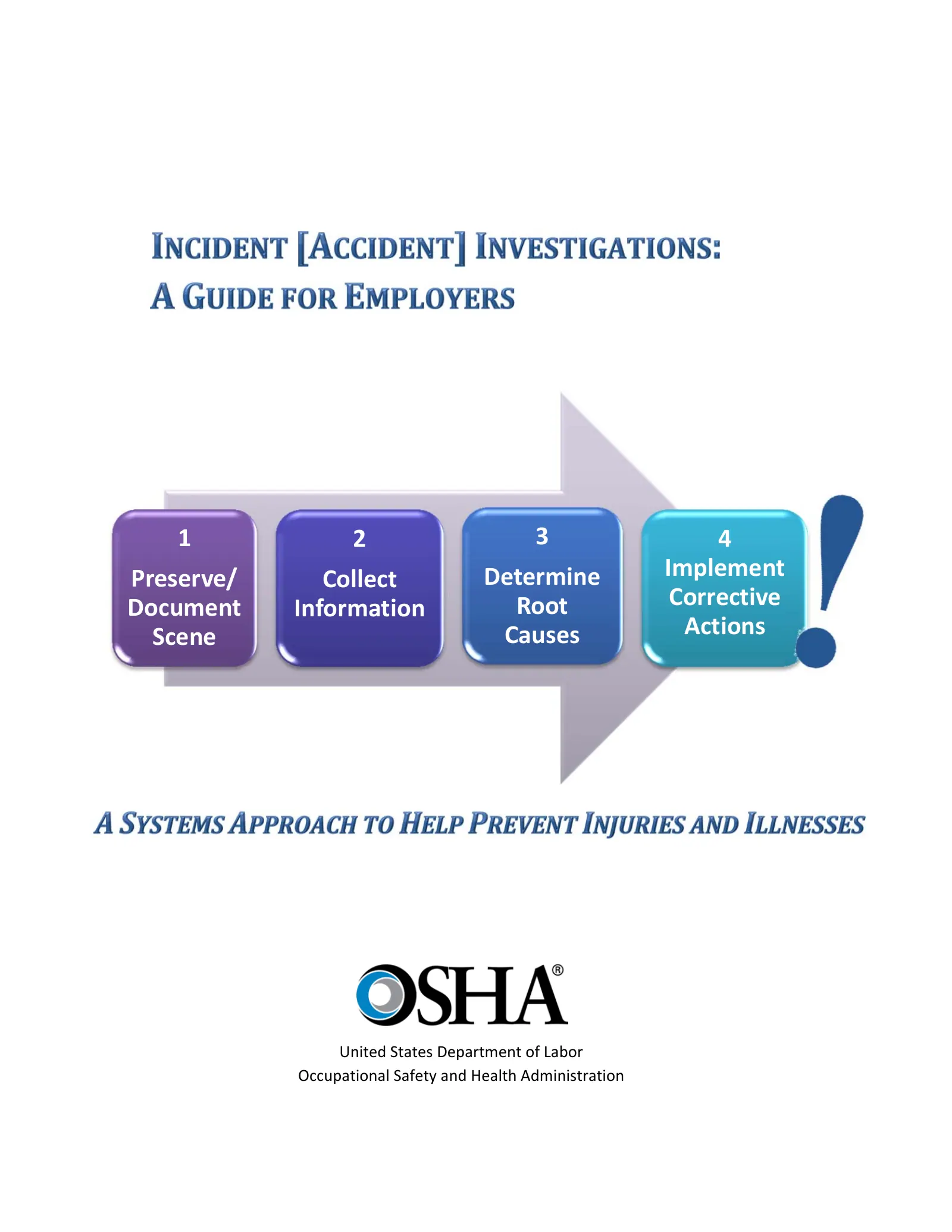
Incident [Accident] Investigations: A Guide for Employers (OSHA)
OSHA guide to a systems approach to incident investigation, with forms and a root-cause checklist.
Page text
· 24 pages · by U.S. Department of Labor, OSHA
The words on each page as the author wrote them, read from the file by software so they can be searched. Layout, pictures and tables are not shown here, and long pages are shortened: the pages above and the download are the original.
- Page 1
- 2
- 3
- Preserve/
- Document
- Scene
- Collect
- Information
- Determine
- Root
- Causes
- United States Department of Labor
- Occupational Safety and Health Administration
- 4
- Implement
- Corrective
- Actions
- Page 2
TABLE OF CONTENTS
- PURPOSE OF THE GUIDE – WHY INVESTIGATE ? … 1
- P RINCIPLES OF I NCIDENT I NVESTIGATIONS … 1
- The Language of Incident Investigations … 1
- Investigate All Incidents, Including “Close Calls” … 2
- Investigate Programs, Not Behaviors … 3
- Focus on the Root Causes, Not Blame or Fault … 4
- E STABLISH AN I NCIDENT I NVESTIGATION P ROGRAM … 4
- CONDUCT INCIDENT INVESTIGATIONS – A FOUR ‐STEP SYSTEMS APPROACH … 6
- Step 1. Preserve/Document the Scene … 7
- Step 2. C OLLECT I NFORMATION … 8
- Step 3. DETERMINE ROOT CAUSES … 9
- Step 4. I MPLEMENT C ORRECTIVE A CTIONS … 10
- R ESOURCES … 12
- R EFERENCES … 14
- A PPENDIX A: I NCIDENT I NVESTIGATION F ORM … A‐1
- A PPENDIX B: I NCIDENT I NVESTIGATOR ’ S K IT … B‐1
- APPENDIX C: TIPS FOR VIDEO /PHOTO DOCUMENTATION … C‐1
- APPENDIX D: SKETCH THE SCENE TECHNIQUES … D‐1
- APPENDIX E: COLLECT INFORMATION CHECKLIST … E‐1
- APPENDIX F: SAMPLE QUESTIONS FOR IDENTIFYING INCIDENT ROOT CAUSES … F‐1
- D ISCLAIMER :
- This guide was developed by OSHA's Directorate of Training and Education and is intended to assist employers, workers, and others as they strive to improve workplace health and safety. This guide is advisory in nature and informational in content. …
- …
- Page 3
Incident [Accident] Investigations: A Guide for Employers
- Your company experienced an incident that resulted (or almost resulted) in a worker injury or illness…Now what?
- As a responsible employer, you need to react quickly to the incident with a prescribed investigation procedure for finding the root causes and implementing corrective actions.
- Quick and planned actions demonstrate your company’s commitment to the safety and health of your workers, and your willingness to improve your safety and health management program to prevent future incidents.
- PURPOSE OF THE GUIDE – WHY INVESTIGATE ?
- The purpose of this Incident Investigation Guide is to provide employers a systems approach to help them identify and control the underlying or root causes of all incidents in order to prevent their recurrence.
- W HY I NVESTIGATE ? Incident investigations The Bureau of Labor Statistics reports that more than a dozen help employers: workers died every day in American workplaces in 2013, and nearly 4
- Prevent injuries and million Americans suffered a serious workplace injury. And tens of illnesses
- thousands are sickened or die from diseases resulting from their
- Save lives chronic exposures to toxic substances or stressful workplace
- …
- Page 4
- happened” and could not have been prevented. However, the vast majority of harmful workplace events do not “just happen.” On the contrary, most harmful workplace incidents are wholly preventable.
- In short, the basic principle is that incidents do not have to occur; they can be prevented by addressing the shortcomings in the programs that manage health and safety in the workplace.
- The following are the key terms that are used throughout this guide:
- Incident: A work‐related event in which an injury or ill‐health (regardless of severity) or fatality occurred, or could have occurred.
- Root Causes: The underlying reasons why unsafe conditions exist or if a procedure or safety rule was not followed in a workplace. Root causes generally reflect management, design, planning, organizational or operational failings (e.g., a damaged guard had not been repaired; failure to use the guard was routinely overlooked by supervisors to ensure the speed of production).
- Close Call: An incident that could have caused serious injury or illness but did not; also called a “near miss.”
- Investigating a worksite incident— a fatality, injury, illness, or close call— provides employers and workers the opportunity to identify hazards in their operations and…
- …
- Page 5
Investigate Programs, Not Behaviors
- costs of incidents. The indirect costs are less obvious, but very commonly greater, and include lost production, schedule delays, increased administrative time (for emergency response, investigations, claim processing and others), lower morale, training of new or temporary personnel, increased absenteeism, and damaged customer relations and corporate reputation.
- As stated previously, incident investigations that follow a systems approach are based on the principle that the root causes of an incident can be traced back to failures of the programs that manage safety and health in the workplace. This approach is fundamentally different from a behavioral safety approach, which incorrectly assumes that the majority of workplace incidents are simply the result of “human error” or “behavioral” failures. Under a systems approach, one would not conclude that carelessness or failure to follow a procedure alone was the cause of an incident. To do so fails to discover the underlying or root causes of the incident, and therefore fails to identify the systemic changes and measures needed to prevent future incidents. …
- …
- Page 6
- staffing, supervision, training, and others. Eliminating the immediate causes is like cutting weeds, while eliminating the root causes is equivalent to pulling out the roots so that the weed cannot grow back.
- Focus on the Root Causes, Not Blame or Fault
- A successful incident investigation must always focus on discovering the root causes. If an investigation is focused on finding fault, it will always stop short of discovering the root causes. It is essential to discover and correct all the factors contributing to an incident, which nearly always involve equipment, procedural, training, and other safety and health program deficiencies.
- Eliminating the immediate causes is like cutting weeds, while eliminating the root causes is equivalent to pulling out the roots so that the weed cannot grow back.
- Addressing underlying or root causes is necessary to truly understand why an incident occurred, to develop truly effective corrective actions, and to minimize or eliminate serious consequences from similar future incidents.
- Moreover, if an investigation is understood to be a search for “someone to blame,” both management and labor will be reluctant to participate in an open and forthright manner. …
- …
- Page 7
Who will be responsible for implementing corrective actions
- Although a supervisor sometimes conducts incident investigations, to be most effective investigations should be conducted by a team in which managers and employees work together, since each brings different knowledge, understanding, and perspectives to an investigation. Working together will also encourage all parties to “own” the conclusions and recommendations and to jointly ensure that corrective actions are implemented in a timely manner.
- Where the incident involves a temporary worker provided by a staffing agency, both the staffing agency and the host employer should conduct an incident investigation. Where the incident involves a multi‐ employer worksite, the incident investigation should be shared with each employer at the worksite. It is a fundamental principal that temporary workers are entitled to the same protections under the OSH Act as all other covered workers. Therefore, if a temporary worker is injured and the host employer knows about it, the staffing agency should be informed promptly, so the staffing agency knows about the hazards facing its workers. …
- …
- Page 8
CONDUCT INCIDENT INVESTIGATIONS – A FOUR ‐STEP SYSTEMS APPROACH
- “Human error is not the
- One of the biggest challenges facing the investigators is to conclusion of an investigation.
- determine what is relevant to what happened, how it happened,
- It is the starting point.” and especially why it happened. This involves conducting a systems
- ‐Sidney Dekker (2006)
- approach incident investigation
- “Errors are seen as that focuses on the root causes consequences rather than of the incident to really help prevent them from happening again.
- causes”
- ‐James Reason (2000)
- This section of the guide assists the employer to implement a four‐ step approach to conduct a successful incident investigation. Included is a set of appendices that can serve as tools for employers to use when conducting investigations. They are:
- Appendix A: Incident Investigation Form – previously introduced; will be used to walk the employer through the four incident investigation steps
- Appendix B: Incident Investigator’s Kit – lists the equipment recommended to have ready at all times to be prepared to conduct the investigation
- Appendix C: Tips for Video/Photo Documentation
- Appendix D: Sketch the Scene Techniques
- Appendix E: Collect Information Checklist
- …
- Page 9
Step 1. Preserve/Document the Scene
- With an effective safety and health management program in place, all the involved parties are aware of the roles they play during the investigation. This helps the transition from emergency response and site safety to preserving the scene and documenting the incident.
- Now is the time an employer’s incident investigation program’s written plan goes into effect and the incident investigation begins.
- Preserve the Scene:
- Preserve the scene to prevent material evidence from being removed or altered; investigators can use cones, tape, and/or guards.
- Document the Scene:
- Document the incident facts such as the date of the investigation and who is investigating. Essential to documenting the scene is capturing the injured employee’s name, injury description, whether they are temporary or permanent, and the date and location of the incident. Investigators can also document the scene by video recording, photogaphing and sketching.
- Tools provided to help with Step 1 are:
- Appendix A: Incident Investigation Form [applicable sections pictured at all steps]
- Appendix B: Incident Investigator’s Kit
- Appendix C: Tips for Video/Photo Documentation
- Appendix D: Sketch the Scene Techniques
- Page 10
Step 2. C OLLECT I NFORMATION
- Incident information is collected through interviews, document reviews and other means. Appendix E provides a checklist to use to help ensure all information pertinent to the incident is collected.
- In addition to interviews, investigators may find other sources of useful information. These include:
- Equipment manuals
- Industry guidance documents
- Company policies and records
- Maintenance schedules, records and logs
- Training records (including communication to employees)
- Audit and follow‐up reports
- Enforcement policies and records
- Previous corrective action recommendations
- Interviews can often yield detailed, useful information about an incident. Since memories fade, interviews must be conducted as promptly as possible: preferably as soon as things have settled down a bit and the site is both secure and safe. The sooner a witness is interviewed, the more accurate and candid his/her statement will be.
- An incident investigation always involves interviewing and possibly re‐interviewing some of the same or new witnesses as more information becomes available, up to and including the highest levels of management. Carefully question witnesses to solicit as much information as possible related to the incident.
- …
- Page 11
Step 3. DETERMINE ROOT CAUSES
- Take notes and/or record the responses; interviewee must give permission prior to being recorded
- Have blank paper and or sketch available for interviewee to use for reference
- Ask clarifying questions to fill in missing information
- Reflect back to the interviewees the factual information obtained; correct any inconsistencies Ask the individuals what they think could have prevented the incident, focusing on the conditions and events preceding the injury
- The root causes of an incident are exactly what the term implies: The underlying reasons why the incident occurred in a workplace. Root causes generally reflect management, design, planning, organizational and/or operational failings (e.g., employees were not trained adequately; a damaged guard had not been repaired).
- Determining the root cause is the result of persistently asking “why”
- Determining the root cause is the most effective way to ensure the incident does not happen again
- Finding the root causes goes beyond the obvious proximate or immediate factors; it is a deeper evaluation of the incident. This requires persistent “digging”, typically by asking “Why” repeatedly. …
- …
- Page 12
- The questions listed below are examples of inquiries that an investigator may pursue to identify contributing factors that, in turn, can lead to root causes:
- If a procedure or safety rule was not followed, why was the procedure or rule not followed? Was the procedure out of date or safety training inadequate? Was there anything encouraging deviation from job procedures such as incentives or speed of completion? If so, why had the problem not been identified or addressed before?
- Was the machinery or equipment damaged or fail to operate properly? If so, why?
- Was a hazardous condition a contributing factor? If so, why was it present? (e.g., defects in equipment/tools/materials, unsafe condition previously identified but not corrected, inadequate equipment inspections, incorrect equipment used or provided, improper substitute equipment used, poor design or quality of work environment or equipment)
- Was the location of equipment/materials/worker(s) a contributing factor? If so, why? (e.g., employee not supposed to be there, insufficient workspace, “error‐prone” procedures or workspace design)
- Was lack of personal protective equipment (PPE) or emergency equipment a contributing factor? If so why? …
- …
- Page 13
- In planning corrective actions and how best to implement them, employers may find that some root causes will take time and perseverance to fix. Persisting in implementing substantive corrective actions, however, will not only reduce the risk of future incidents but also improve the company’s safety, morale and its bottom line.
- Specific corrective actions address root causes directly; however, some corrective actions can be general, across‐the‐board improvements to the workplace safety environment. Sample global corrective actions to consider are:
- Strengthening/developing a written comprehensive safety and health management program
- Revising safety policies to clearly establish responsibility and accountability
- Revising purchasing and/or contracting policies to include safety considerations
- Changing safety inspection process to include line employees along with management representatives
- Implementing a systems approach will help ensure all incident investigations are successful. Thank you for your commitment to the safety and health of the American workforce!
- Page 14
Incident [Accident] Investigations: A Guide for Employers
- R ESOURCES
- OSHA Training Institute Education Centers: http://www.osha.gov/otiec The OSHA Training Institute (OTI) Education Centers are a national network of non‐profit organizations authorized by OSHA to deliver occupational safety and health training to public and private sector workers, supervisors and employers on behalf of OSHA. Relevant courses are:
- OSHA #7500 Introduction to Safety and Health Management
- Description: This course covers the effective implementation of a company’s safety and health management system. The course addresses the four core elements of an effective safety and health management system and those central issues that are critical to each element’s proper management. This course is an interactive training session focusing on class discussion and workshops. Upon course completion students will have the ability to evaluate, develop, and implement an effective safety and health management system for their company. Minimum student contact hours: 5.5
- OSHA #7505 Introduction to Incident [Accident] Investigation
- Description: This course covers an introduction to basic incident investigation procedures and describes analysis techniques. …
- …
- Page 15
OSHA’s "$afety Pays" program
- This online tool can help employers assess the impact of occupational injuries and illnesses on their profitability. To learn more about OSHA’s "$afety Pays" program, visit http://www.osha.gov/dcsp/smallbusiness/safetypays/
- Other: UK Health and Safety Executive
- Investigating Accidents and Incidents: A Workbook for employers, unions, safety representatives, and safety professionals. 2004. http://www.hse.gov.uk/pubns/hsg245.pdf
- Page 16
R EFERENCES
- Center for Chemical Process Safety publication, Guidelines for Preventing Human Error in Process Safety, Center for Chemical Process Safety (CCPS), 1994.
- Conklin, T., Pre‐Accident Investigations: An Introduction to Organizational Safety, Ashgate Publishing Company; 1 edition (September 28, 2012), ISBN‐10: 1409447820, ISBN‐13: 978‐ 1409447825
- Dekker, S., The Field Guide to Understanding Human Error, Ashgate Publishing Company; 1 edition (June 30, 2006), English, ISBN‐10: 0754648265; ISBN‐13: 978‐0754648260 National Safety Council, http://www.nsc.org/pages/home.aspx
- Reason, J., Human error: models and management, BMJ 2000;320:768
- Page 17
A PPENDIX A: I NCIDENT I NVESTIGATION F ORM
- Form Section
- Section A: Information
- Company Name: ___
- Systems Approach
- Step 1
- Date: ___
- Investigator (or) Team Name (s) and Titles:
- Name
- Title
- Section B: Incident Description/Injury Information
- Step 1 and Step 2
- 1) Name and Age of Injured Employee: ___
- Employee’s first language: ___
- Employees Job Title: ___
- Job at time of injury: ___
- Type of employment: Full‐time Part‐time Temporary Seasonal Other: ___
- Length of time with Company: ___
- Length in current position at the time of the incident: ___
- Description and severity of injury: ___
- 2) Date and time of incident: ___
- 3) Location of Incident: ___
- NOTE: Items 4, 5, and 6 are used for both Step 1 and Step 2
- 4) Detailed description of incident: Include relevant events leading up to, during, and after the incident. (It is preferred that the information is provided by the injured employee.)
- Use additional pages if needed
- A‐1
- Page 18
- 5) Description of incident from eye witnesses, including relevant events leading up to, during and after the incident. Include names of persons interviewed, job titles and date/time of interviews.
- Use additional pages if needed
- 6) Description of incident from additional employees with knowledge, including relevant events leading up to, during and after the incident. Include names of persons interviewed, job titles and date/time of interviews.
- A‐2
- Page 19
- Section C: Identify the Root Causes: What Caused or Allowed the Incident to Happen? Step 3
- The Root Causes are the underlying reasons the incident occurred, and are the factors that need to be addressed to prevent future incidents. If safety procedures were not being followed, why were they not being followed? If a machine was faulty or a safety device failed, why did it fail? It is common to find factors that contributed to the incident in several of these areas: equipment/machinery, tools, procedures, training or lack of training, and work environment. If these factors are identified, you must determine why these factors were not addressed before the incident.
- Use additional pages if needed
- Section D: Recommended Corrective Actions to Prevent Future Incidents
- Step 4
- Section E: Corrective Actions Taken/ Root Causes Addressed
- Step 4
- A‐3
- Page 20
A PPENDIX B: I NCIDENT I NVESTIGATOR ’ S K IT
- Sample list of items to use to conduct the investigation:
- Camera
- Charged Batteries (for phones, cameras, equipment, etc.)
- Video / Audio recorder
- Measuring devices in various sizes
- Leveling rod
- Clipboard and writing pad
- Pens, pencils, markers
- Graph paper
- Straight‐edge ruler (Can be used as a scale reference in photos)
- Incident investigation forms
- Flashlight
- Strings, stakes, warning tape
- Photo marking cones
- Personal protective equipment: Gloves, hat, eyewear, ear plugs, face mask, etc.
- Magnifying glass
- High visibility plastic tapes to mark off area
- First aid kit
- Latex gloves
- Sampling [holding] containers with seals (Various types: bags, jars, containers, etc.)
- Identification tags
- Variety of tape: Scotch, masking, duct
- Compass
- Carpenters ruler
- Hammer
- Paint stick (yellow/black)
- Chalk (yellow/white)
- Protractor
- Clinometer
- B‐1
- Page 21
APPENDIX C: TIPS FOR VIDEO /PHOTO DOCUMENTATION
- Note: Interviewees must be aware that they are being video recorded and/or photographed. It is recommended that investigators obtain permission from the interviewee prior to the interview.
- Tips for Video Documentation:
- Video the scene as soon as possible; doing this early on will pick up details that may later add valuable information to the investigation
- Scan slowly 360 degrees left and right to establish location
- Narrate what is being taped, and describe objects, size, direction, location, etc.
- If vehicles were involved, record direction of travel, going and coming
- Tips for Photograph Documentation:
- Always make notes about the photos taken
- Start by taking distance shots first then move in to take closer photos of the scene Take photos at different angles (from above, 360 degrees of scene, left, right, rear) to show the relationship of objects and minute and/or transient details such as ends of broken rope, defective tools, drugs, wet areas, or containers
- Take panoramic photos to help present the entire scene, top to bottom ‐ side to side Take notes on each photo; these should be included in the incident investigation file with the photos
- …
- Page 22
APPENDIX D: SKETCH THE SCENE TECHNIQUES
- 1. Make sketches large; at least 8” x 10” and clear, be sure to print legibly
- 2. Include “Incident Details” (i.e., time, date, injured, location, conditions, etc.)
- 3. Include measurements (i.e. distances, heights, lengths, etc.) and use permanent points (e.g., telephone pole, building) to clearly present the measurements
- 4. Indicate directions – N= North; E= East; W= West; S= South
- 5. Make notes on sketch to provide additional information such as the photo location and/or where people were at the time of the incident
- Note: The sketch can be used during interviews to help interviewees identify their location before, during or after the incident
- D‐1
- Page 23
APPENDIX E: COLLECT INFORMATION CHECKLIST
- Investigators should be sure their investigation answers the following questions:
- WHO?
- WHERE?
- Who was injured?
- Who saw the incident?
- Who was working with the employee?
- Who had instructed/assigned the employee?
- Who else was involved?
- Who else can help prevent recurrence?
- Where did the incident occur?
- Where was the employee at the time?
- Where was the supervisor at the time?
- Where were fellow workers at the time?
- Where were other people who were involved at the time?
- Where were witnesses when incident occurred?
- WHAT?
- WHY?
- What was the incident?
- What was the injury?
- What was the employee doing?
- What had the employee been told to do?
- What tools was the employee using?
- What machine was involved?
- What operation was the employee performing? What instructions had the employee been given? What specific precautions were necessary?
- What specific precautions was the employee given? What protective equipment should have been used?
- What protective equipment was the employee using?
- What had other persons done that contributed to the incident?
- What problem or questions did the employee encounter?
- What did the employee or witnesses do when the incident occurred?
- …
- Page 24
APPENDIX F: SAMPLE QUESTIONS FOR IDENTIFYING INCIDENT ROOT CAUSES
- QUESTIONS
- 1. Did a written or well‐established procedure exist for employees to follow?
- 2. Did job procedures or standards properly identify the potential hazards of job performance?
- 3. Were there any hazardous environmental conditions that may have contributed to the incident?
- 4. Were the hazardous environmental conditions in the work area recognized by employees or supervisors?
- 5. Were any actions taken by employees, supervisors, or both to eliminate or control environmental hazards?
- 6. Were employees trained to deal with any hazardous environmental conditions that could arise?
- 7. Was sufficient space provided to accomplish the job task?
- 8. Was there adequate lighting to properly perform all the assigned tasks associated with the job?
- 9. Were employees familiar with job procedures?
- 10. Was there any deviation from the established job procedures?
- 11. Were the proper equipment and tools available and being used for the job?
- 12. Did any mental or physical conditions prevent the employee(s) from properly performing their jobs?
- 13. Were there any tasks in the job considered more demanding or difficult than usual (e.g., strenuous activities, excessive concentration…
- …
More on Managing Safety
Hazard Identification Plan
Construction Safety Improvement Program module on how to find and document jobsite hazards, from the Building Industry Association of Hawaii.
Incident Investigation Procedure
Construction Safety Improvement Program module on incident and near-miss investigation and root causes, from the Building Industry Association of Hawaii.
Leadership Commitment to Operational Safety
Construction Safety Improvement Program module on management leadership and commitment to safety, from the Building Industry Association of Hawaii.