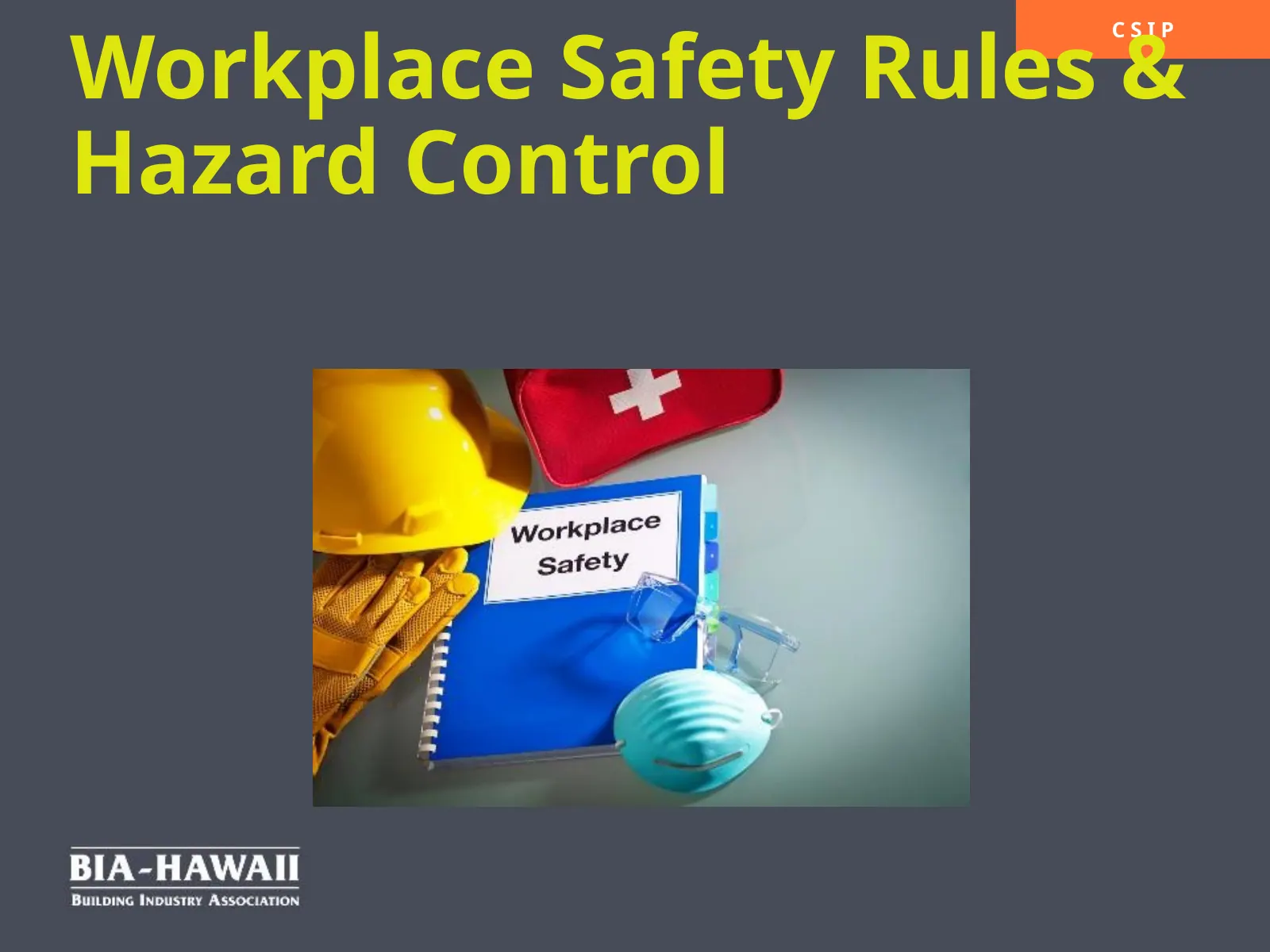
Workplace Safety Rules and Hazard Control
Construction Safety Improvement Program module on safety rules and the hierarchy of hazard controls, from the Building Industry Association of Hawaii.
Slide text
· 29 slides · by Building Industry Association - Hawaii
The words on each slide as the author wrote them, read from the file by software so they can be searched. Layout, pictures and tables are not shown here: the slides above and the download are the original.
- Slide 1
Workplace Safety Rules & Hazard Control
- Slide 2
Overview
- Workplace Safety Rules
- Hazard Control
- Training
- & Education
- Slide 3
Workplace Safety Rules
- Safe Workplace Mentality
- Workplace safety rules should be developed with company wide input (Managerial to Employees)
- Rules will address behaviors and practices on the job that can lead to accidents and injuries
- Employees are expected to be familiar with and follow safety rules
- Slide 4
Workplace Safety Rules
- Safe Workplace Mentality, continued
- Supervisors &
- Managers are expected to enforce safe work practices by consistently complying with safety rules.
- Safety rules are intended to prevent accidents and to ensure safe business operations.
- Slide 5
Workplace Safety Rules
- Safe Workplace Mentality
- Communicate Effectively
- Publish safety rules and expectations in New Hire Orientation and thoroughly discuss during Orientation
- Avoid conflicting management directives by ensuring the entire message is appropriate
- For example, safety completing a job takes precedence over quickly completing a job
- Managers should avoid statements such as, “Be safe, but hurry. We have finish this project ASAP”
- Slide 6
Workplace Safety Rules
- Safe Workplace Mentality
- Communicate Effectively
- Conflicting Messages are a major issue:
- Over a third of the employees surveyed by the National Safety Council claimed that workplace safety is secondary to performing tasks
- In total, 36% of respondents strongly or somewhat agreed that “safety takes a back seat to completing job tasks.”
- 30% agreed that “employees are resistant to working safely.”
- Slide 7
Workplace Safety Rules
- Safe Workplace Mentality
- Communicate Effectively
- Conflicting Messages are a major issue:
- 30% agreed that “employees are resistant to working safely.”
- Slide 8
Workplace Safety Rules
- Implement
- Conduct regular site inspections
- Establish daily work area inspection procedures
- Develop and use a checklist
- Provide a reliable hazard reporting system
- Employees notify management
- No fear or Reprisal
- Timely & appropriate responses
- Slide 9
Workplace Safety Rules
- Elements
- Element 1 - Management, Leadership, and Employee Involvement.
- Element 2 - Worksite Analysis.
- Element 3 - Hazard Prevention and Control.
- Element 4 - Safety and Health Training and Education.
- Slide 10
Hazard Control
- Element 2: Worksite Analysis
- Steps
- Analyze all workplace conditions to identify and eliminate existing or potential hazards.
- Have an outline for the procedure for reporting hazards
- Perform analysis on a regular and timely basis.
- Make certain all employees know and understand current hazard analysis for all jobs and processes.
- Slide 11
Hazard Control
- Element 2: Worksite Analysis
- Steps
- Focus workplace design on all physical aspects of the work environment, including:
- Size and arrangement of work space
- Physical demands of the tasks to be performed
- Design of tools and other devices people use
- Improve people’s ability to be productive, without error or accident, for extended time periods.
- Proper workplace design improves safety and productivity.
- Slide 12
Hazard Control
- Element 2: Worksite Analysis
- Steps
- We want to eliminate hazards during the design or planning stages of a project
- Review incident causes and inspection results to help identify trends
- Knowledge of Emergency Response Plans and procedures and participation in drills
- Slide 13
Hazard Control
- Element 3: Hazard Prevention & Control
- Steps
- Regularly and thoroughly maintain equipment, and vehicles
- Ensure that employees know how to use and maintain PPE
- Train employees in proper procedures for handling specific situations
- Monitor for air quality, heat stress, noise, ergonomics and other job hazards
- Emergency Action Plans and procedures - Fire, life safety and first aid issues
- Slide 14
Hazard Control
- Element 3: Hazard Prevention & Control
- Job Safety Analysis
- Break down a task into its component steps.
- Determine hazards connected with each key step.
- Identify methods to prevent or protect against the hazard.
- Slide 15
Hazard Control
- Element 3: Hazard Prevention & Control
- Job Safety Analysis
- Priorities:
- New Jobs
- Potential of Severe Injuries
- History of Disabling Injuries
- Frequency of Accidents
- Slide 16
Hazard Control
- Element 3: Hazard Prevention & Control
- Job Safety Analysis (JSA)
- Observation
- Select experienced worker(s) to participate in the JSA process.
- Explain purpose of JSA.
- Note any deviations (Very Important!).
- Observe the employee perform the job.
- Document observations!
- Slide 17
Hazard Control
- Element 3: Hazard Prevention & Control
- Job Safety Analysis (JSA)
- Search for Hazards:
- Produced by Work
- Produced by Environment
- Repeat job observation as many times as necessary to identify all hazards.
- Slide 18
Site Safety Inspections
- Date:
- Job No.(s):
- Location:
- Crew Member:
- Supervisor:
- ITEM
- Housekeeping (Garbage, cleanliness, electrical cords, ladders)
- Drinking water/ sanitation requirements/first aid kit
- Electrical (such as proper grounding, lock & tag and GFCI [good condition, inspected])
- Proper personal protective equipment (PPE)
- Walking/working surfaces (tripping hazards, slippery surfaces, floor holes)
- Electrical tools (guards in place; good condition, stored properly)
- Cranes/ rigging equipment (for example: slings, properly stored and inspected)
- Excavation (properly sloped or shored; permits; inspections; barricaded daily)
- COMMENTS/ ACTION
- Slide 19
Site Safety Inspections
- Check list for Safety Equipment
- Flammables/combustibles (fire extinguishers, welding and cutting equipment)
- Hot work (Personal Protective Equipment, permit, combustibles, flammables protected)
- Material Safety Data Sheets onsite with containers labeled
- Scaffold system fully assembled; tags; inspections; fully planked guardrails
- Proper barricading/ warning signs (trenches, fuel areas, storage construction sites)
- Fire extinguishers (monthly inspection, accessible, on mechanized equipment)
- COMMENTS:
- Slide 20
Hazard Control
- Develop Standard Operating Procedures
- Drug-free workplace
- Recognition and Awards
- Audits and Surveillances
- Incident Reporting & Investigation Lessons Learned
- General Safety SOP’s
- Slide 21
Hazard Control
- Protecting Employees from Workplace Hazards
- Employers must protect employees from hazards such as falling objects, harmful substances, and noise exposures that can cause injury.
- Slide 22
Hazard Control
- Protecting Employees from Workplace Hazards
- Employers must:
- Eliminate and reduce hazards.
- PPEs if the controls don’t eliminate the hazards.
- PPE is the last level of control!
- Slide 23
Hazard Control
- Protecting Employees from Workplace Hazards
- Identifying Potential Hazards
- Objects that might fall from above.
- Exposed pipes or beams at work level.
- Sources of heat, intense light, noise, or dust.
- Exposed liquid chemicals.
- Equipment or materials that could produce flying particles.
- Slide 24
Hazard Control
- Protecting Employees from Workplace Hazards
- Engineering Controls
- Engineering controls consist of substitution, isolation, ventilation and equipment modification.
- If . . .
- The work environment can be physically changed to prevent employee exposure to the potential hazard, Then . . .
- The hazard can be eliminated with an engineering control.
- Slide 25
Hazard Control
- Protecting Employees from Workplace Hazards
- Work Practice/Administrative Controls
- If . . .
- Employees can change the way they do their jobs and the exposure to the potential hazard is removed,
- Then . . .
- The hazard can be eliminated with a work practice or administrative control.
- Remember… PPE is the last level of control!
- Slide 26
Hazard Control
- Monitoring
- Define measures to determine if the actions are effective and efficient.
- The effectiveness of the program should be monitored.
- It gives you a feel for your liability, e.g., inspections reflect continuous non-compliance, injury rates are high, and performance measures show ineffectiveness. Update and revise as necessary
- Slide 27
Hazard Control
- Element 4: Safety & Health Education & Training
- All employees, management, supervisors, safety staff, etc. should receive regular Safety & Health Education Training.
- As part of this Training, management will create an individualized written Safety & Injury Prevention Plan
- Slide 28
Questions?
- Slide 29
OSHA Disclaimer
- This material was produced under grant SH29640SH6 from the Occupational Safety and Health Administration, U.S. Department of Labor. It does not necessarily reflect the views or policies of the U.S. Department of Labor, nor does mention of trade names, commercial products, or organizations imply endorsement by the U.S. Government.
More on Managing Safety
Hazard Identification Plan
Construction Safety Improvement Program module on how to find and document jobsite hazards, from the Building Industry Association of Hawaii.
Incident Investigation Procedure
Construction Safety Improvement Program module on incident and near-miss investigation and root causes, from the Building Industry Association of Hawaii.
Leadership Commitment to Operational Safety
Construction Safety Improvement Program module on management leadership and commitment to safety, from the Building Industry Association of Hawaii.