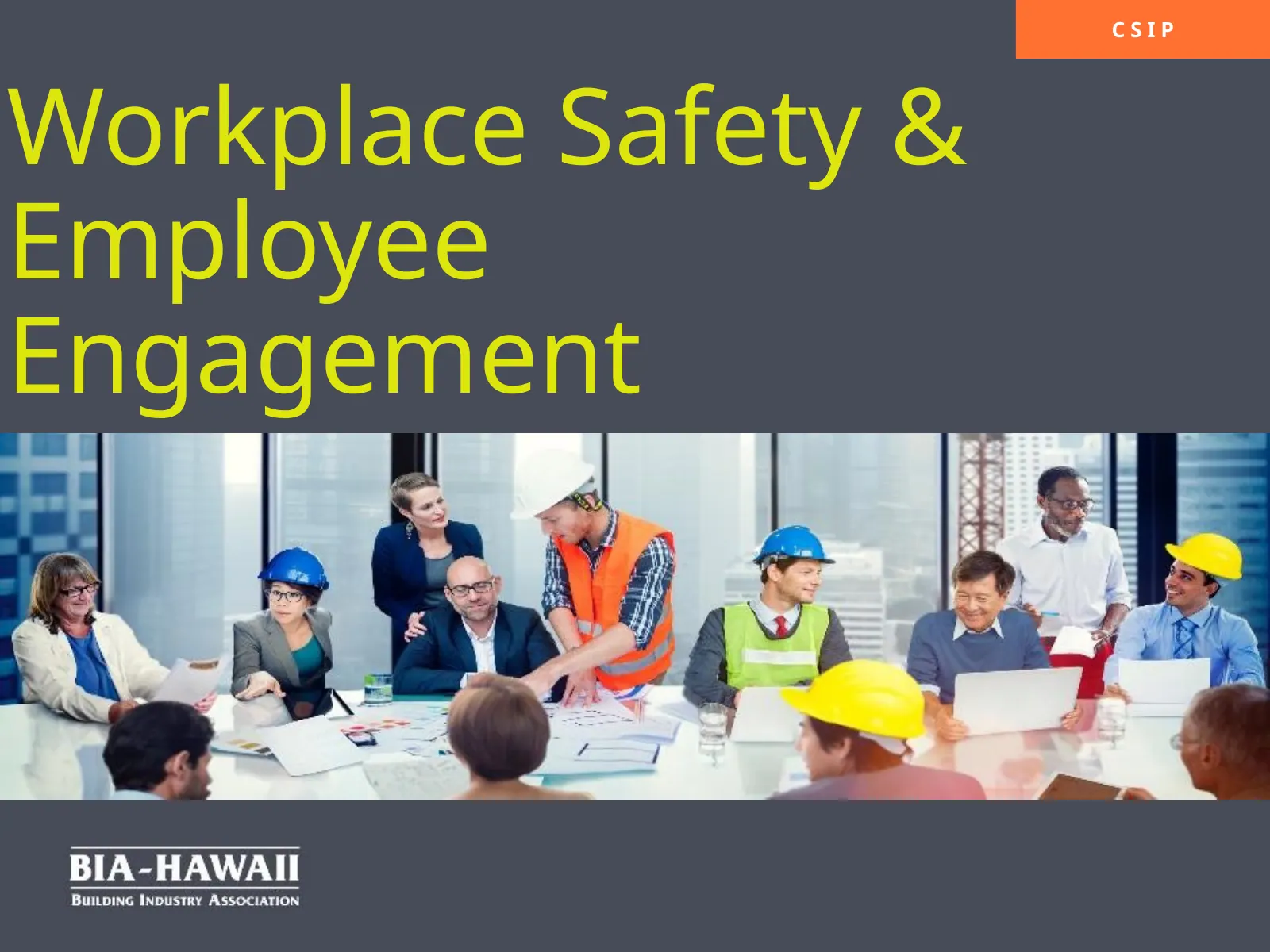
Workplace Safety: Employee Engagement
Construction Safety Improvement Program module on worker participation and engagement, from the Building Industry Association of Hawaii.
Slide text
· 33 slides · by Building Industry Association - Hawaii
The words on each slide as the author wrote them, read from the file by software so they can be searched. Layout, pictures and tables are not shown here: the slides above and the download are the original.
- Slide 1
Workplace Safety & Employee Engagement
- Slide 2
Overview
- Management &
- Leadership Involvement
- Implementing
- Your Plan
- Employee Engagement
- Slide 3
Workplace Safety Program: Elements
- Element 1 - Management, Leadership, and Employee Involvement.
- Element 2 - Worksite Analysis.
- Element 3 - Hazard Prevention and Control.
- Element 4 - Safety and Health Training and Education.
- Slide 4
Management/Leadership/ Employee Involvement
- [ELEMENT 1]
- Employer and employee involvement and communication on workplace-safety and health issues are essential.
- Post the company’s written safety and health policy for all to see.
- Involve all employees in policy making on safety and health issues.
- Everyone must take an active part in safety activities.
- Slide 5
Management & Leadership Involvement
- What Is Workplace Safety?
- DEFINITION: The process of protecting employees from work related illness and injury.
- It starts by developing a company Environmental, Safety and Health Policy statement and implementation of a work place safety plan and program.
- Slide 6
Involvement
- Accident [ak-si-duhnt]
- NOUN:
- An unexpected, unplanned, uncontrollable
- & undesirable event.
- Slide 7
Management & Leadership Involvement
- Accident [ak-si-duhnt]
- Noun:
- An unexpected, unplanned and undesirable event.
- Accidents can be controlled
- Slide 8
Management & Leadership Involvement
- Basic Principles of Good Safety Management
- Management Commitment
- Documented
- Safety
- Philosophy
- Safety Goals & Objectives
- Slide 9
Management & Leadership Involvement
- Basic Principles of Good Safety Management, continued
- Committee
- Organization for Safety
- Line
- Responsibility for Safety
- Supportive Safety Staff
- Slide 10
Management & Leadership Involvement
- Basic Principles of Good Safety Management, continued
- Rules &
- Procedures
- Audits
- Safety
- Communications
- Slide 11
Management & Leadership Involvement
- Basic Safety Philosophy
- Every incident can be avoided
- No job is worth getting hurt
- Every job will be done safely
- Incidents can be managed
- Safety is everyone’s responsibility
- Slide 12
Management & Leadership Involvement
- Basic Safety Philosophy
- Safety / Best workplace practices
- Safety standards, procedures and practices must be developed.
- Training: Everyone must understand and meet the requirements.
- Working safety is a condition of employment.
- Slide 13
Management & Leadership Involvement
- Minimal Incident Safety Policy
- DEFINITION: A company-wide policy that seeks to eliminate all events that result in injury (including lost workdays) and/or property damage.
- Having no incidents should be a company vision rather than a performance goal.
- Slide 14
Management & Leadership Involvement
- Minimal Incident Safety Policy
- Safety standards are communicated to all employees.
- Responsibilities for implementing standards are understood and accepted.
- Records will document how standards and best management practices are met.
- Internal management control.
- Cost avoidance.
- Slide 15
Management & Leadership Involvement
- Minimal Incident Safety Policy SCENARIO
- 1. Implement a new safety program to improve safety performance.
- 2. Communicate to all employees past incident rates.
- 3. Establish goals to achieve.
- 4. Post goals on safety bulletin board
- Slide 16
Management & Leadership Involvement
- Minimal Incident Safety Policy SCENARIO
- Last Year: Lost
- Work Days
- Goal: Lost Work
- Days
- 30
- 15
- Slide 17
Management & Leadership Involvement
- Minimal Incident Safety Policy
- Better productivity
- Team building through active employee engagement
- Unsafe behavior stands out
- Unsafe behavior is unacceptable
- Safe work is peer influenced
- Slide 18
Implementing Your Workplace Safety Program
- Purpose: To reduce work-related injury and illness.
- Content: The program should include any policy, procedure, training that protects workers from work-related injuries and illness while on the job.
- Concerns: Promote and reward safe practices at work, reducing injuries and illnesses at work and eliminating fatalities at work.
- Slide 19
Implementing Your Workplace Safety Program
- Minimal Incident Safety Policy: Company Culture
- 1. Define the need for change
- 2. Commit to the desired result
- 3. Assess current safety culture
- Slide 20
Implementing Your Workplace Safety Program
- Minimal Incident Safety Policy: Company Culture, contin.
- 4. Strategically plan for implementation
- 5. Focus on Incident Control
- 6. Implement and communicate
- 7. Evaluate and measure results
- Slide 21
Implementing Your Workplace Safety Program
- Minimal Incident Safety Policy: ROLES
- Management
- Safety Staff
- Employees
- Slide 22
Implementing Your Workplace Safety Program
- OSHA Covers Nearly All Employees
- The general duty clause [29 CFR, 1970] reads
- “Each employer shall furnish…a place of employment which is free from recognized hazards that are causing or are likely to cause death or serious physical harm to his employees.”
- Need to communicate employees rights under the OSHA Act, including the right to file a complaint free from discrimination and explain the elements of a valid complaint.
- Slide 23
Implementing Your Workplace Safety Program
- Leadership and Employee Involvement
- Your plan should include statements on the value of workplace safety and why management is committed to it.
- A list of locations where written safety and health policies are posted for all employees to see.
- Slide 24
Implementing Your Workplace Safety Program
- Leadership and Employee Involvement
- A schedule of when and where regular meetings are held that address employee safety and health issues.
- A stipulation that abiding by all safety and health rules is a condition of employment.
- Slide 25
Implementing Your Workplace Safety Program
- Result
- Staff training and education will pay off in a safer and healthier workforce.
- Employee health and safety is a result of their own actions and those of co-workers.
- Ensure that everyone is properly trained: managers, supervisors, all full and part time and temporary workers.
- Make sure no one does any job that appears unsafe.
- Slide 26
Implementing Your Workplace Safety Program
- Training Basics
- Emergency preparedness drills for workers.
- Ensure proper job skills and awareness of the hazards when employees learn new operations.
- Recognize hazards and understand responsibilities.
- Slide 27
Employee Engagement
- Safety Policy: PRINCIPLES
- Working safely is a condition of employment.
- Each employee is expected to give consideration to the prevention of injury to self and co-workers.
- Involvement and thinking of all people in the safety process is valued and expected.
- Slide 28
Employee Engagement
- Safety Policy: PRINCIPLES
- Continual improvement is the goal.
- Individuals and teams must be recognized for their adherence to and advancement of safety.
- Employees are encouraged to provide feedback and insight on safety.
- Slide 29
Employee Engagement
- Role of Senior Management
- Help employees manage hazards associated with their work (tasks or responsibilities).
- Be open to feedback and insight from employees.
- Slide 30
Employee Engagement
- Workers should be involved in the creation and use of the workplace safety program for it to succeed.
- Slide 31
Employee Engagement
- Safety Statement
- Craft a Safety Statement that emphasizes Employee Engagement, as well as Management Leadership.
- Slide 32
Questions?
- Slide 33
OSHA Disclaimer
- This material was produced under grant SH29640SH6 from the Occupational Safety and Health Administration, U.S. Department of Labor. It does not necessarily reflect the views or policies of the U.S. Department of Labor, nor does mention of trade names, commercial products, or organizations imply endorsement by the U.S. Government.
More on Managing Safety
Hazard Identification Plan
Construction Safety Improvement Program module on how to find and document jobsite hazards, from the Building Industry Association of Hawaii.
Incident Investigation Procedure
Construction Safety Improvement Program module on incident and near-miss investigation and root causes, from the Building Industry Association of Hawaii.
Leadership Commitment to Operational Safety
Construction Safety Improvement Program module on management leadership and commitment to safety, from the Building Industry Association of Hawaii.