One module of a small-business course on safety management systems. An archived deck: check it against the current standard before teaching from it.
Slide text
· 21 slides · by National Safety Council
The words on each slide as the author wrote them, read from the file by software so they can be searched. Layout, pictures and tables are not shown here: the slides above and the download are the original.
- Slide 1
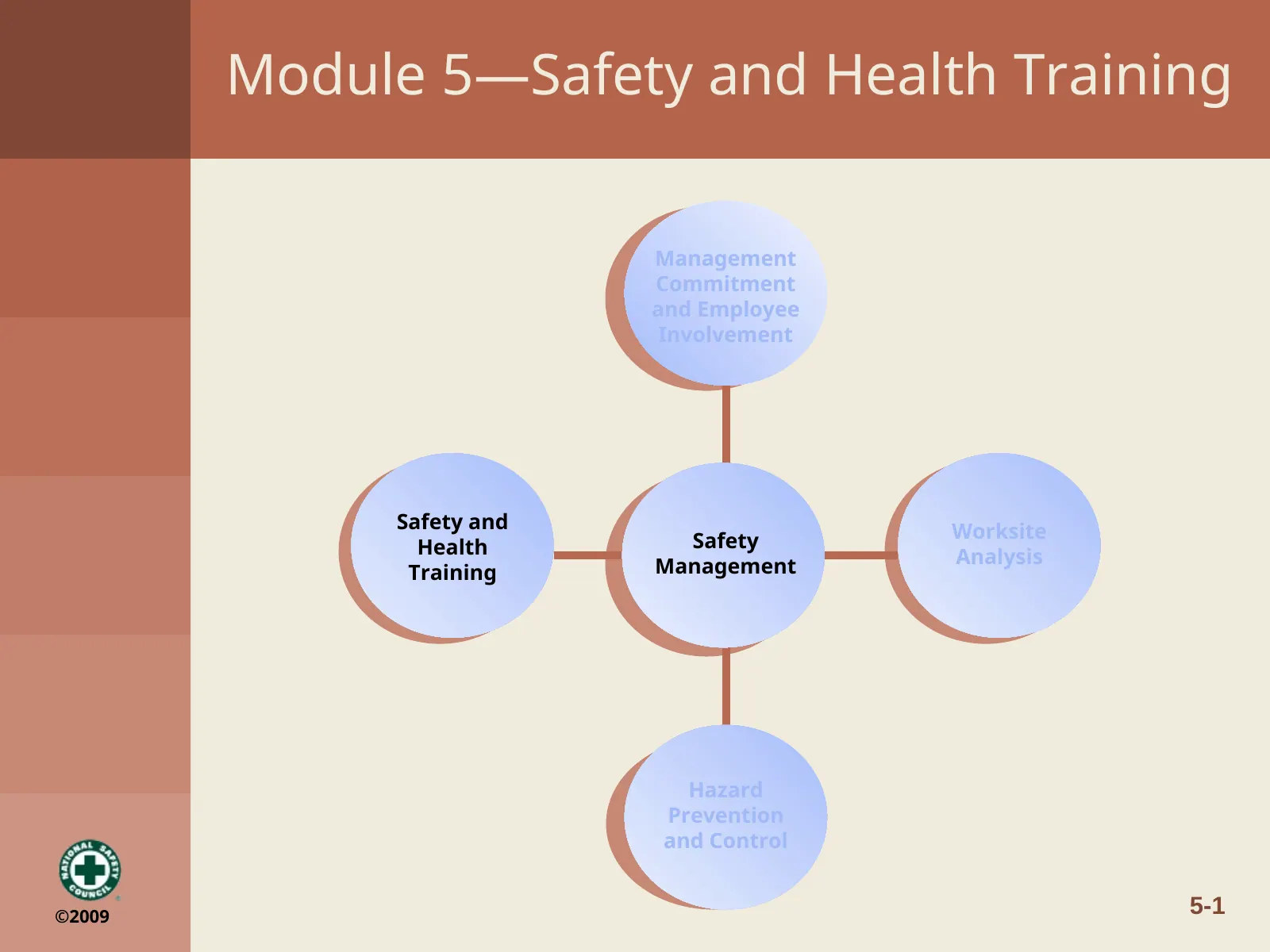
Module 5—Safety and Health Training
- Management Commitment and Employee Involvement
- Safety and Health
- Training
- Safety
- Management
- Worksite Analysis
- Hazard
- Prevention and Control
- Slide 2
Module 5 Objectives
- At the end of this module, you will be able to:
- Identify the factors OSHA includes under safety and health training.
- Identify the goal and function of safety and health training.
- Identify the scope of safety and health training.
- Identify the methods you can use to train, and determine when it is
- appropriate to use each.
- Slide 3
Module 5 Objectives—continued
- Use a process for providing on-the-job training.
- Use tailgate meetings as a method for training employees.
- Identify ways to integrate training into everyday job functions.
- Identify free or inexpensive ways to train employees.
- Identify the characteristics of effective training.
- Assess a case scenario to determine 5-3
- Slide 4
Activity Instructions
- Review the factors that demonstrate effective safety and health training, then check the items you feel your organization does well.
- Slide 5
Goal of Safety and Health Training
- The goal of safety and health training is to provide employees with the knowledge and skills necessary so that they can perform their work without injuring themselves or others.
- Slide 6
Goals for Top Management
- Integrate the safety and health program into business operations
- Brainstorm ideas for safety and health management
- Create a safety and health culture
- Manage performance to get excellent safety and health
- Slide 7
Goals for Supervisors
- Practice participative management
- Set safety and health goals
- Exercise good communication skills when employees offer ideas
- Recognize hazards on their own jobs and employees’ jobs
- Identify controls for their own jobs and employees’ jobs
- Manage safety and health performance of employees
- Correctly use regulations and safety policies and procedures
- Slide 8
Goals for Employees
- Perform their jobs safely and properly
- Recognize the hazards on their jobs
- Bring hazards and other safety concerns to the attention of management
- Brainstorm ideas for improving safety on the job
- Identify controls for their jobs
- Perform self inspections
- Remind co-workers of importance of working safely
- Correctly use regulations and safety policies and procedures
- Slide 9
Classroom Training
- Formal instruction that takes place away from the job in a classroom with an instructor or facilitator guiding the learning
- Slide 10
On-The-Job Training
- Training that occurs at a person’s job— the employee actually learns the job by doing it
- Slide 11
One-On-One Coaching
- Training that occurs when one person takes the responsibility of teaching or training another person
- Slide 12
Tailgate Sessions
- Training and communicatio
- that occurs at the beginning of each shift or during implementatio
- of large projects
- Slide 13
Meetings
- Informal training and communication that occurs in small groups, usually away from the worksite
- Slide 14
Individual Learning
- Informal training that individuals undertake on their own
- Slide 15
Process for On-The-Job Training
- 1. Explain big picture.
- 2. Explain process step-by-step.
- 3. Demonstrate the job.
- 4. Encourage questions and comments.
- Slide 16
Process for On-The-Job Training—continued
- 5. Have trainee perform job while you watch.
- 6. Observe and offer feedback.
- 7. Allow trainee to perform job on own.
- 8. Give trainee written procedures.
- Slide 17
Activity Instructions
- In your group, identify ways a leader can use the listed activity to inspire safety and health learning.
- Slide 18
The Importance of Repetition
- Slide 19
Lessons Learned
- Not everyone will retain the same learning
- No one will remember everything you teach them the first time
- By repeating and reinforcing important points, the lesson will eventually be learned
- The most important lessons should be the biggest
- Slide 20
When Training is Not the Answer
- Skills and Knowled ge
- Selection and assignmen t
- Environm ent
- Motivatio n
- Slide 21
Activity Instructions
- Training topic and type of training
- Who should receive the training
- Who should
- Trainin give the training