1 / 150Use ← → to flip
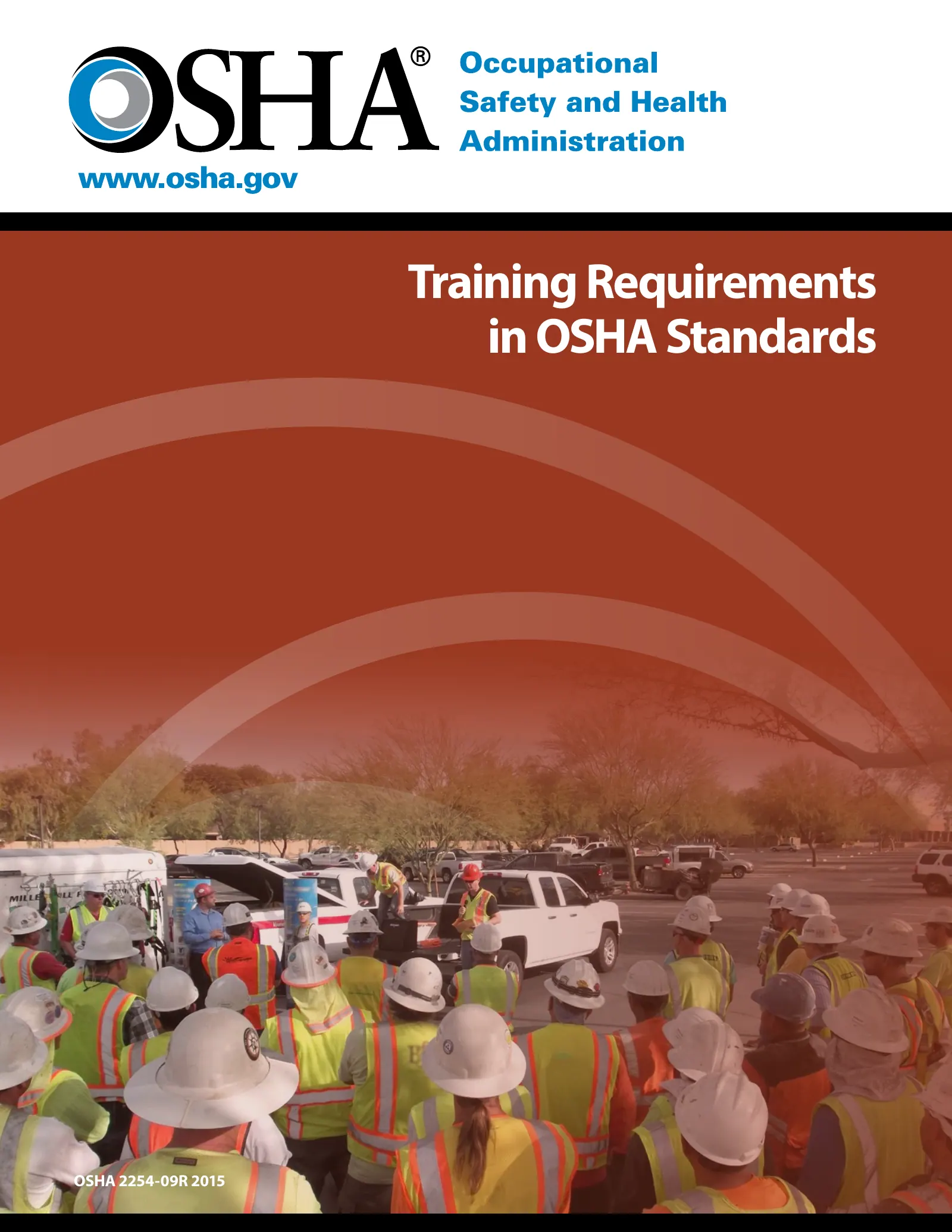
Training Requirements in OSHA Standards (OSHA 2254)
OSHA booklet, for General Industry classes.
Page text
· 150 pages · by U.S. Department of Labor, OSHA
The words on each page as the author wrote them, read from the file by software so they can be searched. Layout, pictures and tables are not shown here, and long pages are shortened: the pages above and the download are the original.
- Page 1
Training Requirements in OSHA Standards
- OSHA 2254-09R 2015
- Page 2
Occupational Safety and Health Act of 1970
- “To assure safe and healthful working conditions for working men and women; by authorizing enforcement of the standards developed under the Act; by assisting and encouraging the States in their efforts to assure safe and healthful working conditions; by…
- …
- Page 3
Training Requirements in OSHA Standards
- Occupational Safety and Health Administration
- U.S. Department of Labor
- OSHA 2254-09R 2015
- Page 4
Table of Contents
- INTRODUC TION … 1
- Training Requirements for Workplace Safety … 1
- OSHA Standards: Protection on the Job … 2
- Injury and Illness Prevention Programs … 2
- Educational Information … 3
- OSHA Training Institute (OTI) Education Centers … 3
- …
- Page 5
Subpart J – General Environmental Controls … 50 1910.142
- Temporary labor camps … 50 1910.145
- Specifications for accident prevention signs and tags … 50 1910.146
- Permit required confined spaces … 51 1910.147
- The control of hazardous energy (lockout/tagout) … 52
- …
- Page 6
Subpart S – Electrical Safety-Related Work Practices … 79 1910.332
- Training … 79
- Subpart T – Commercial Diving Operations … 80 1910.410
- Qualifications of dive team … 80
- Subpart Z – Toxic and Hazardous Substances … 82 1910.1001 Asbestos … 82 1910.1003 13 Carcinogens (4-Nitrobiphenyl, etc.) … 84…
- …
- Page 7
- 1915.13 1915.14 1915.15
- Cleaning and other cold work … 113 Hot work … 114 Maintenance of safe conditions … 114
- Subpart C – Surface Preparation and Preservation … 115 1915.35
- Painting … 115 1915.36
- Flammable liquids … 115
- Subpart D – Welding, Cutting and Heating … 116 1915.53
- …
- Page 8
29 CFR Part 1917 – Marine Terminals … 135
- Subpart Z – Toxic and Hazardous Substances … 129 1915.1001 Asbestos … 129 1915.1003 13 Carcinogens (4-Nitrobiphenyl, etc.) … 133 1915.1017 Vinyl chloride … 133 1915.1018 Inorganic arsenic … 133 1915.1025 Lead … 134 1915.1027 Cadmium … 134 1915.1028 Benzene ……
- …
- Page 9
Subpart H – Handling Cargo … 141 1918.85
- Containerized cargo operations … 141
- Subpart I – General Working Conditions … 141 1918.93
- Hazardous atmospheres and substances … 141 1918.94
- Ventilation and atmospheric conditions … 141 1918.97
- First aid and lifesaving facilities … 142 1918.98
- …
- Page 10
- 1926.103 1910.134
- Respiratory protection … 197 Respiratory protection … 197
- Subpart F – Fire Protection and Prevention … 200 1926.150
- Fire protection … 200 1926.155
- Definitions applicable to this subpart … 200
- Subpart G – Signs, Signals, and Barricades … 200 1926.200
- …
- Page 11
Subpart U – Blasting and the Use of Explosives … 214 1926.901
- Blaster qualifications … 214
- Subpart V – Power Transmission and Distribution … 214 1926.955
- Overhead lines … 214
- Subpart X – Stairways and Ladders … 215 1926.1060 Training requirements … 215
- …
- Page 12
Subpart M – Occupational Health … 240 1928.1027 Cadmium … 240
- FEDERAL EMPLOYEE PROGRAMS … 241
- 29 CFR 1960 … 241
- Subpart B – Administration … 241 1960.7
- Financial management … 241
- Subpart D – Inspection and Abatement … 241 1960.25 Qualifications of safety and health inspectors and agency inspections ……
- …
- Page 13
Training Requirements for Workplace Safety
- Introduction
- Under the Occupational Safety and Health Act of 1970, employers are responsible for providing a safe and healthful workplace. No person should ever have to be injured, become ill, or die for a paycheck.
- …
- Page 14
OSHA Standards: Protection on the Job
- In this booklet, the training requirements contained in OSHA’s standards are organized into five categories of OSHA standards: General Industry, Maritime, Construction, Agriculture, and Federal Employee Programs. …
- …
- Page 15
Educational Information
- Introduction
- OSHA has many types of educational materials in English, Spanish, Vietnamese and other languages available in print or online. These include:
- Brochures/booklets;
- Fact Sheets;
- Guidance documents that provide detailed examinations of specific safety and health…
- …
- Page 16
- Worker Participation in Developing Training Programs
- required by OSHA—nor does it fulfill any OSHA requirements. Still the outreach program can provide basic safety and health information and education. However, under the OSHA law, all required training must be provided by and paid for by employers. …
- …
- Page 17
TRAINING REQUIREMENTS
- Photo: Sheryl Quatermas, New Jersey State Plan
- General Industry
- The following training requirements have been excerpted from Title 29, Code of Federal Regulations Part 1910. Note that additional training requirements may appear in certain other standards (ANSI, NFPA, etc.)…
- …
- Page 18
- (3) Procedures to be followed by employees who remain to operate critical plant operations before they evacuate;
- (4) Procedures to account for all employees after evacuation;
- (5) Procedures to be followed by employees performing rescue or medical duties; and
- …
- Page 19
Subpart F – Powered Platforms, Manlifts, and Vehicle- Mounted Work Platforms
- (3) Procedures for regular maintenance of safeguards installed on heat-producing equipment to prevent the accidental ignition of combustible materials;
- …
- Page 20
- (iii) Training of employees in the operation and inspection of working platforms shall be done by a competent person.
- (iv) Written work procedures for the operation, safe use and inspection of working platforms shall be provided for employee training. …
- …
- Page 21
- (v) The platform shall not be operated in winds in excess of 25 miles per hour (40.2 km/hr) except to move it from an operating to a storage position. Wind speed shall be determined based on the best available information, which includes on-site anemometer readings and local weather forecasts which…
- …
- Page 22
Subpart G – Occupational Health and Environmental Control
- 1910.95
- Occupational noise exposure
- (i)(4);
- (k) and (l)
- (i) Hearing protectors
- (4) The employer shall provide training in the use and care of all hearing protectors provided to employees.
- (k) Training program
- …
- Page 23
Subpart H – Hazardous Materials
- 1910.106 Flammable liquids
- (b)(5)(vi)(v) (b) Tank storage
- (2) and (3)
- (5) Supports, foundations, and anchorage for all tank locations –
- (vi) Flood areas. Where a tank is located in an area that may be subjected to flooding, the applicable precautions outlined in this…
- …
- Page 24
(g) Blasting agents
- (3) Bulk delivery and mixing vehicles.
- (iii) Operation of bulk delivery vehicles shall conform to the requirements of this subdivision. These include the placarding requirements as specified by Department of Transportation.
- …
- Page 25
1910.111 Storage and handling of anhydrous ammonia
- (b)(13)(ii)
- (b) Basic rules. This paragraph applies to all paragraphs of this section unless otherwise noted.
- (13) Tank car unloading points and operations
- (ii) The employer shall insure that unloading operations are performed by reliable persons…
- …
- Page 26
(h) Contractors
- (3) Contract employer responsibilities.
- (i)
- The contract employer shall assure that each contract employee is trained in the work practices necessary to perform his/her job.
- (ii) The contract employer shall assure that each contract employee is instructed in the known potential fire…
- …
- Page 27
- (ii) Employees shall not be permitted to participate in or supervise field activities until they have been trained to a level required by their job function and responsibility.
- (2) Elements to be covered. The training shall thoroughly cover the following:
- (i)
- …
- Page 28
- characterization indicates that there are no health hazards or the possibility of an emergency developing, shall receive a minimum of 24 hours of instruction off the site and the minimum of one day actual field experience under the direct supervision of a trained, experienced supervisor.
- …
- Page 29
- (7) Emergency response. Employees who are engaged in responding to hazardous emergency situations at hazardous waste cleanup sites that may expose them to hazardous substances shall be trained in how to respond to such expected emergencies.
- …
- Page 30
- (7) Training Program.
- (i) New employees. The employer shall develop and implement a training program, which is part of the employer’s safety and health program, for employees exposed to health hazards or hazardous substances at TSD operations to enable the employees to perform their assigned duties…
- …
- Page 31
- that a sufficient number of employees who have responsibility to control emergencies have the training specified, and all other employees, who may first respond to an emergency incident, have sufficient awareness training to recognize that an emergency response situation exists and that they are…
- …
- Page 32
(q) Emergency response to hazardous substance releases
- (4) Skilled support personnel. Personnel, not necessarily an employer’s own employees, who are skilled in the operation of certain equipment, such as mechanized earth moving or digging equipment or crane and hoisting equipment, and who are needed…
- …
- Page 33
- responders at the awareness level shall have sufficient training or have had sufficient experience to objectively demonstrate competency in the following areas:
- (A) An understanding of what hazardous substances are, and the risks associated with them in an incident.
- …
- Page 34
- (C) An understanding of basic hazardous materials terms.
- (D) Know how to perform basic control, containment and/or confinement operations within the capabilities of the resources and personal protective equipment available to the unit.
- (E) Know how to implement basic decontamination procedures.
- …
- Page 35
- (iv) Hazardous materials specialist. Hazardous materials specialists are individuals who respond with and provide support to hazardous materials technicians. Their duties parallel those of the hazardous materials technician, however, those duties require a more directed or specific knowledge of the…
- …
- Page 36
- (A) Know and be able to implement the employer’s incident command system.
- (B) Know how to implement the employer’s emergency response plan.
- (C) Know and understand the hazards and risks associated with employees working in chemical protective clothing.
- …
- Page 37
(i)
- Meet all the requirements of paragraphs (b) through (o) of this section; or
- (ii) Where the clean-up is done on plant property using plant or workplace employees, such employees shall have completed the training requirements of the following: 29 CFR 1910.38, 1910.134, 1910.1200, and other…
- …
- Page 38
- The training programs for employees subject to the requirements of paragraph (p) of this standard should address:
- the employer’s safety and health program elements impacting employees;
- the hazard communication program;
- the medical surveillance program;
- …
- Page 39
- Specialist employees such as technical experts, medical experts or environmental experts that work with hazardous materials in their regular jobs, who may be sent to the incident scene by the shipper, manufacturer or governmental agency to advise and assist the person in charge of the incident…
- …
- Page 40
Suggested General Criteria
- Definitions:
- “Competent” means possessing the skills, knowledge, experience, and judgment to perform assigned tasks or activities satisfactorily as determined by the employer.
- “Demonstration” means the showing by actual use of equipment or procedures.
- …
- Page 41
- 3. Instructors.
- Instructors should be deemed competent on the basis of:
- previous documented experience in their area of instruction,
- successful completion of a “train-the-trainer” program specific to the topics they will teach,
- evaluation of instructional competence by the Training Director.
- …
- Page 42
- 5. Students.
- The program for accepting students should include:
- a. Assurance that the student is or will be involved in work where chemical exposures are likely and that the student possesses the skills necessary to perform the work.
- b. A policy on the necessary medical clearance.
- 6. Ratios.
- …
- Page 43
- 8. Course certificate.
- Written documentation should be provided to each student who satisfactorily completes the training course. The documentation should include:
- a. Student’s name.
- b. Course title.
- c. Course date.
- d. Statement that the student has successfully completed the course.
- …
- Page 44
Suggested Program Quality Control Criteria
- Factors listed here are suggested criteria for determining the quality and appropriateness of employee health and safety training for hazardous waste operations and emergency response.
- A. Training Plan.
- …
- Page 45
- 9. Availability and commitment of the training program of adequate human and equipment resources in the areas of
- a. Health effects,
- b. Safety,
- c. Personal protective equipment (PPE),
- d. Operational procedures,
- e. Employee protection practices/procedures.
- 10. Appropriateness of management controls.
- …
- Page 46
- 3. Adequacy of the minutes or reports of the advisory committee or outside reviewers’ meetings or written communication.
- 4. Adequacy and appropriateness of the quality control and evaluations program to account for instructor performance.
- …
- Page 47
6. What are the program’s main strengths?
- 7. What are the program’s main weaknesses?
- 8. What is recommended to improve the program?
- 9. Are instructors instructing according to their training outlines?
- 10. Is the evaluation tool current and appropriate for the program content?
- …
- Page 48
- (8) Review of other applicable standards including but not limited to those in the Construction standards (29 CFR part 1926).
- (9) Rights and responsibilities of employers and employees under applicable OSHA and EPA laws.
- b. Technical knowledge.
- …
- Page 49
- c.
- Technical skills.
- (1) Selection, use maintenance, and limitations of personal protective equipment including the components and procedures for carrying out a respirator program to comply with 29 CFR 1910.134.
- (2) Instruction in decontamination programs including personnel, equipment, and…
- …
- Page 50
- (b) Update on developments with respect to material covered in the 40-hour course.
- (c) Review of changes to pertinent provisions of EPA or OSHA standards or laws.
- (d) Introduction of additional subject areas as appropriate.
- …
- Page 51
- (1) Names of personnel and alternates responsible for site safety and health.
- (2) Safety and health hazards present on the site.
- (3) Selection, use, maintenance, and limitations of personal protective equipment specific to the site.
- …
- Page 52
- (6) PPE maintenance and storage.
- (7) Task duration as related to PPE limitations.
- d. The employer should instruct the employee about the site medical surveillance program relative to the particular site, including
- (1) Specific medical surveillance programs that have been adapted for the site.
- …
- Page 53
- (h) A review of hazard communication programs meeting the requirements of 29 CFR 1910.1200.
- (i) A review of medical surveillance programs meeting the requirements of
- 29 CFR 1910.120(p)(3) including the recognition of signs and symptoms of overexposure to hazardous substances including known…
- …
- Page 54
- (d) A review of the employer’s medical surveillance program including the recognition of signs and symptoms of exposure to relevant hazardous substance including known synergistic interactions.
- (e) A review of the employer’s decontamination program and procedures.
- …
- Page 55
- a. General considerations.
- Emergency response organizations are required to consider the topics listed in §1910.120(q)(6). Emergency response organizations may use some or all of the following topics to supplement those mandatory topics when developing their response training programs. …
- …
- Page 56
- (C) Review of the principles and practices for analyzing an incident to determine both the hazardous substances present and the basic hazard and response information for each hazardous substance present.
- (D) Review of procedures for implementing actions consistent with the local emergency response…
- …
- Page 57
- (G) Review of the expected hazards including fire and explosions hazards, confined space hazards, electrical hazards, powered equipment hazards, motor vehicle hazards, and walking-working surface hazards.
- (H) Awareness and knowledge of the competencies for the First Responder at the Operations Level…
- …
- Page 58
- (H) Awareness and knowledge of the competencies for the Hazardous Materials Technician covered in the National Fire Protection Association’s Standard No. 472, Professional Competence of Responders to Hazardous Materials Incidents.
- (4) Hazardous materials specialist.
- …
- Page 59
- (H) Review of the expected hazards including fire and explosions hazards, confined space hazards, electrical hazards, powered equipment hazards, motor vehicle hazards, and walking-working surface hazards.
- (I) Awareness and knowledge of the competencies for the Off-site Specialist Employee covered in…
- …
- Page 60
Subpart I – Personal Protective Equipment
- 1910.132 General requirements
- (f)(1) through (3)
- (f) Training
- (1) The employer shall provide training to each employee who is required by this section to use PPE. Each such employee shall be trained to know at least the following:
- (i)
- When PPE is necessary;
- …
- Page 61
1910.134 Respiratory protection
- (k)(1) (k) Training and information. This paragraph requires the employer through (6) to provide effective training to employees who are required to use respirators. The training must be comprehensive, understandable, and recur annually, and more often if necessary. …
- …
- Page 62
Subpart J – General Environmental Controls
- (5) Retraining shall be administered annually and when the following situations occur:
- (i)
- Changes in the workplace or the type of respirator render previous training obsolete;
- (ii) Inadequacies in the employee’s knowledge or use of the respirator indicate…
- …
- Page 63
1910.146 Permit required confined spaces
- (g) and (k)(1)(i) (g) Training through (iv)
- (1) The employer shall provide training so that all employees whose work is regulated by this section acquire the understanding, knowledge, and skills necessary for the safe performance of the duties assigned under…
- …
- Page 64
- (ii) Evaluate a prospective rescue service’s ability, in terms of proficiency with rescue-related tasks and equipment, to function appropriately while rescuing entrants from the particular permit space or types of permit spaces identified;
- …
- Page 65
- employee performing the servicing or maintenance; (7) the servicing or maintenance does not create hazards for other employees; and (8) the employer, in utilizing this exception, has had no accidents involving the unexpected activation or reenergization of the machine or equipment during servicing…
- …
- Page 66
- (A) Tags are essentially warning devices affixed to energy isolating devices, and do not provide the physical restraint on those devices that is provided by a lock.
- (B) When a tag is attached to an energy isolating means, it is not to be removed without authorization of the authorized person for it…
- …
- Page 67
- (8) Energy isolation. Lockout or tagout shall be performed only by the authorized employees who are performing the servicing or maintenance.
- (e) Release from lockout or tagout
- (3) Lockout or tagout devices removal. Each lockout or tagout device shall be removed from each energy isolating device by…
- …
- Page 68
Subpart L – Fire Protection
- 1910.155 Fire protection
- (c)(41) (c) Definitions
- (41) “Training” means the process of making proficient through instruction and hands-on practice in the operation of equipment, including respiratory protection equipment, that is expected to be used and in the performance…
- …
- Page 69
- (3) The quality of the training and education program for fire brigade members shall be similar to those conducted by such fire training schools as the Maryland Fire and Rescue Institute; Iowa Fire Service Extension; West Virginia Fire Service Extension; Georgia Fire Academy; New York State…
- …
- Page 70
1910.158 Standpipe and hose systems
- (e)(2)(iv)
- (e) Tests and maintenance
- (2) Maintenance.
- (vi) The employer shall designate trained persons to conduct all inspections required under this section.
- 1910.160 Fixed extinguishing systems
- (b)(10)
- (b) General requirements
- …
- Page 71
- instructed in correct procedures of servicing the type of wheel being serviced, and in the safe operating procedures described in paragraphs (f) and (g) of this section.
- (ii) Information to be used in the training program shall include at a minimum, the applicable data contained in the charts (rim…
- …
- Page 72
- (2) Tires shall be completely deflated by removing the valve core before a rim wheel is removed from the axle in either of the following situations:
- (i)
- When the tire has been driven underinflated at 80% or less of its recommended pressure, or
- …
- Page 73
- (g) Safe operating procedure — single piece rim wheels. The employer shall establish a safe operating procedure for servicing single piece rim wheels and shall assure that employees are instructed in and follow that procedure. The procedure shall include at least the following elements:
- …
- Page 74
1910.178 Powered industrial trucks
- (l)(1) through (7)
- (l) Operator training
- (1) Safe Operation.
- (i)
- The employer shall ensure that each powered industrial truck operator is competent to operate a powered industrial truck safely, as demonstrated by the successful completion of the training and…
- …
- Page 75
- (C) Truck controls and instrumentation: where they are located, what they do, and how they work;
- (D) Engine or motor operation;
- (E) Steering and maneuvering;
- (F) Visibility (including restrictions due to loading);
- (G) Fork and attachment adaptation, operation, and use limitations;
- …
- Page 76
(4) Refresher training and evaluation
- (i)
- Refresher training, including an evaluation of the effectiveness of that training, shall be conducted as required by paragraph (l)(4)(ii) to ensure that the operator has the knowledge and skills needed to operate the powered industrial truck safely.
- …
- Page 77
1910.179 Overhead and gantry cranes
- (n)(3)(ix) and (o)(3)
- (n) Handling the load
- (3) Moving the load.
- (ix) When two or more cranes are used to lift a load, one qualified responsible person shall be in charge of the operation. …
- …
- Page 78
(h) Presence sensing device initiation (PSDI)
- (13) Operator training.
- (i)
- The operator training required by paragraph (f)(2) of this section shall be provided to the employee before the employee initially operates the press and as needed to maintain competence, but not less than annually thereafter. …
- …
- Page 79
Subpart Q – Welding, Cutting, and Brazing
- 1910.252 General requirements
- (a)(2)(xiii)(C)
- (a) Fire prevention and protection
- (2) Special precautions. When the nature of the work to be performed falls within the scope of paragraph (a)(1)(ii) of this section certain additional precautions may be…
- …
- Page 80
Subpart R – Special Industries
- 1910.261 Pulp, paper, and paperboard mills
- (h)(3)(ii)
- (h) Bleaching
- (3) Liquid chlorine.
- (ii) Gas masks capable of absorbing chlorine shall be supplied, conveniently placed, and regularly inspected, and workers who may be exposed to chlorine gas shall be instructed in…
- …
- Page 81
- (iii) Recognition of safety and health hazards associated with the employee’s specific work tasks, including the use of measures and work practices to prevent or control those hazards;
- (iv) Recognition, prevention, and control of other safety and health hazards in the logging industry;
- …
- Page 82
- (ii) The employer shall assure that each employee receives first-aid training at least every three years and receives CPR training at least annually.
- (iii) The employer shall assure that each employee’s first-aid and CPR training and/or certificate of training remain current.
- …
- Page 83
- rinse or neutralizing packs may be substituted for the quick drenching or flushing facilities. Employees assigned to work with storage batteries shall be instructed in emergency procedures such as dealing with accidental acid spills.
- …
- Page 84
- (l) Cable fault locating and testing.
- (1) Employees involved in using high voltages to locate trouble or test cables shall be instructed in the precautions necessary for their own safety and the safety of other employees.
- …
- Page 85
- working alone, from entering for brief periods of time, a manhole where energized cables or equipment are in service, for the purpose of inspection, housekeeping, taking readings, or similar work if such work can be performed safely.
- (q) Tree trimming — electrical hazards
- (1) General.
- …
- Page 86
1910.269 Electric power generation, transmission, and distribution
- (a)(2); (b)(1);
- (d)(2)(vi) through (viii)
- (a) General
- (2) Training.
- (i)
- Employees shall be trained in and familiar with the safetyrelated work practices, safety procedures, and other safety requirements in this section that pertain to…
- …
- Page 87
- (B) If new technology, new types of equipment, or changes in procedures necessitate the use of safety-related work practices that are different from those which the employee would normally use, or
- (C) If he or she must employ safety-related work practices that are not normally used during his or her…
- …
- Page 88
- (ii) For fixed work locations such as generating stations, the number of trained persons available shall be sufficient to ensure that each employee exposed to electric shock can be reached within 4 minutes by a trained person. …
- …
- Page 89
- (B) Retraining shall also be conducted whenever a periodic inspection under paragraph (d)(2)(v) of this section reveals, or whenever the employer has reason to believe, there are deviations from or inadequacies in an employee’s knowledge or use of the energy control procedures.
- …
- Page 90
- (h) Entry into flat storage structures. For the purposes of this paragraph (h), the term “grain” means raw and processed grain and grain products in facilities within the scope of paragraph (b)(1) of this section.
- (i) Contractors
- …
- Page 91
Subpart S – Electrical Safety-Related Work Practices
- 1910.332 Training
- (a), (b) and (c)
- (a) Scope. The training requirements contained in this section apply to employees who face a risk of electric shock that is not reduced to a safe level by the electrical installation requirements of 1910.303…
- …
- Page 92
- Note 2: Qualified persons whose work on energized equipment involves either direct contact or contact by means of tools or materials must also have the training needed to meet 1910.333(C)(2).
- (c) Type of training. The training required by this section shall be of the classroom or on-the-job type. …
- …
- Page 93
- (3) All dive team members shall be trained in cardiopulmonary resuscitation and first aid (American Red Cross standard course or equivalent).
- (4) Dive team members who are exposed to or control the exposure of others to hyperbaric conditions shall be trained in divingrelated physics and physiology.
- …
- Page 94
Subpart Z – Toxic and Hazardous Substances
- 1910.1001 Asbestos
- (j)(7) and (m)(4) (j) Communication of hazards to employees
- (7) Employee information and training.
- (i)
- The employer shall train each employee who is exposed to airborne concentrations of asbestos at or above the PEL and/or excursion limit…
- …
- Page 95
- smoking cessation. The employer may distribute the list of such organizations contained in Appendix I to this section, to comply with this requirement.
- (J)
- The requirements for posting signs and affixing labels and the meaning of the required legends for such signs and labels.
- …
- Page 96
1910.1003 13 Carcinogens (4-Nitrobiphenyl, etc.)
- (e)(4)(i) and (ii)
- 4-Nitrobiphenyl
- 1910.1003
- Alpha-Napthylamine
- 1910.1004
- Methyl Chloromethyl Ether
- 1910.1006
- 3,3’-Dichlorobenzidine (and its salts)
- 1910.1007
- Bis-Chloromethyl Ether
- 1910.1008
- Beta-Naphthylamine
- 1910.1009
- Benzidine
- 1910.1010
- …
- Page 97
- (F) The employee’s specific role in emergency procedures;
- (G) Specific information to aid the employee in recognition and evaluation of conditions and situations which may result in the release of a carcinogen addressed by this section;
- …
- Page 98
1910.1018 Inorganic arsenic
- (o)(1) and (2) (o) Employee information and training
- (1) Training program.
- (i)
- The employer shall train each employee who is subject to exposure to inorganic arsenic above the action level without regard to respirator use, or for whom there is the possibility of skin or…
- …
- Page 99
Appendix A to 1910.1018 — Inorganic arsenic substance information sheet
- IX – Training and Notification
- Additional information on all of these items plus training as to hazards of exposure to inorganic arsenic and the engineering and work practice controls associated with your job will also be…
- …
- Page 100
- (D) The purpose and a description of the medical surveillance program, and the medical removal protection program including information concerning the adverse health effects associated with excessive exposure to lead (with particular attention to the adverse reproductive effects on both males and…
- …
- Page 101
- including those exposed below the action level, a copy of the standard and its appendices and must distribute to all employees any materials provided to the employer by the Occupational Safety and Health Administration (OSHA).
- …
- Page 102
1910.1027 Cadmium
- (m)(4) (m) Communication of cadmium hazards to employees
- (4) Employee information and training.
- (i)
- The employer shall train each employee who is potentially exposed to cadmium in accordance with the requirements of this section. …
- …
- Page 103
- (F) The purpose and a description of the medical surveillance program required by paragraph (l) of this standard;
- (G) The contents of this section and its appendices; and
- (H) The employee’s rights of access to records under
- 1910.1020(e) and (g).
- …
- Page 104
1910.1029 Coke oven emissions
- (k) (1)and(2); (k) Employee information and training
- Appendix A
- (1) Training program.
- (i)
- The employer shall train each employee who is employed in a regulated area in accordance with the requirements of this section. …
- …
- Page 105
(2) Access to training materials
- (i)
- The employer shall make a copy of this standard and its appendices readily available to all employees who are employed in the regulated area.
- (ii) The employer shall provide upon request all materials relating to the employee information and training program to…
- …
- Page 106
- (vi) Material appropriate in content and vocabulary to educational level, literacy, and language of employees shall be used.
- (vii) The training program shall contain at a minimum the following elements:
- (A) An accessible copy of the regulatory text of this standard and an explanation of its…
- …
- Page 107
- (L) Information on the post exposure evaluation and follow-up that the employer is required to provide for the employee following an exposure incident;
- (M) An explanation of the signs and labels and/or color coding required by paragraph (g)(1); and
- …
- Page 108
(C) The names and qualifications of persons conducting the training; and
- (D) The names and job titles of all persons attending the training sessions.
- (ii) Training records shall be maintained for 3 years from the date on which the training occurred.
- (3) Availability.
- (i)
- …
- Page 109
- (E) The purpose for and a description of the medical surveillance program required by paragraph (h) of this section and other information which will aid exposed employees in understanding the hazards of cotton dust exposure; and
- (F) The contents of the standard and its appendices.
- …
- Page 110
- (2) Access to training materials.
- (i)
- The employer shall make a copy of this standard and its appendices readily available to all affected employees.
- (ii) The employer shall provide, upon request, all materials relating to the employee information and training program to the Assistant Secretary and…
- …
- Page 111
- (2) Access to training materials.
- (i)
- The employer shall make a copy of this standard and its appendices readily available to all affected employees.
- (ii) The employer shall provide, upon request, all materials relating to the employee information and training program to the Assistant Secretary and…
- …
- Page 112
1910.1048 Formaldehyde
- (n)(1) through (4) (n) Employee Information and Training
- (1) Participation. The employer shall assure that all employees who are assigned to workplaces where there is exposure to formaldehyde participate in a training program, except where the employer can show, using objective…
- …
- Page 113
- (vii) A review of emergency procedures including the specific duties or assignments of each employee in the event of an emergency.
- (4) Access to training materials.
- (i)
- The employer shall inform all affected employees of the location of written training materials and shall make these materials…
- …
- Page 114
1910.1051 1,3-Butadiene
- (l)(2) and (3) (l) Communication of BD hazards to employees
- (2) Employee information and training.
- (i)
- The employer shall provide all employees exposed to BD with information and training in accordance with the requirements of the Hazard Communication Standard, 29 CFR…
- …
- Page 115
(1) medical examinations as required by paragraph
- (j) of this section at no cost to the employee;
- (2) the employee’s medical records required to be maintained by paragraph (m)(4) of this section; and
- (3) all air monitoring results representing the employee’s exposure to BD and required to be kept by…
- …
- Page 116
- (4) The employer shall train each affected employee as required under the Hazard Communication standard at 29 CFR 1910.1200, 29 CFR 1915.1200, or 29 CFR 1926.59, as appropriate.
- (5) The employer shall re-train each affected employee as necessary to ensure that each employee exposed above the action…
- …
- Page 117
- of this section for the protection of employees from exposure to radiation or radioactive materials; and shall be advised of reports of radiation exposure which employees must request pursuant to the regulations in this section.
- 1910.1200 Hazard Communication
- …
- Page 118
- (iv) The details of the hazard communication program developed by the employer, including an explanation of the labels received on shipped containers and the workplace labeling system used by their employer and the material safety data sheet, including the order of information and how employees can…
- …
- Page 119
(B) The physical and health hazards of chemicals in the work area; and
- (C) The measures employees can take to protect themselves from these hazards, including specific procedures the employer has implemented to protect employees from exposure to hazardous chemicals, such as appropriate work…
- …
- Page 120
- (c) Receiving and stockroom/storeroom personnel should know about hazards, handling equipment, protective apparel, and relevant regulations (217).
- (d) Frequency of Training: The training and education program should be a regular, continuing activity — not simply an annual presentation (15).
- …
- Page 121
Maritime
- The following training requirements have been excerpted from Title 29 Code of Federal Regulations Parts 1915 (Shipyard Employment), 1917 (Marine Terminals), and 1918 (Longshoring). *
- 29 CFR PAR T 1915 – SHIPYARD EMPLOYMENT
- Subpart A – General Provisions
- 1915.6
- Commercial diving operations
- …
- Page 122
- Maritime
- portions of the criteria set forth in paragraph (c) of this section as a competent person who is limited to performing testing to the following situations:
- (i)
- Repair work on small craft in boatyards where only combustible gas indicator tests are required for fuel tank leaks or when using…
- …
- Page 123
- (5) Ability to perform all required tests and inspections which are or may be performed by a competent person as set forth in subparts B, C, D, and H of this part;
- (6) Ability to inspect, test and evaluate spaces to determine the need for further testing by a Marine Chemist or a Certified Industrial…
- …
- Page 124
Maritime
- (v) Spaces containing materials or residues of materials that create an oxygen-deficient atmosphere.
- (b) Flammable atmospheres
- (1) The employer shall ensure that spaces and adjacent spaces that contain or have contained combustible or flammable liquids or gases are:
- (i)
- …
- Page 125
(4) The employer shall provide each employee with training:
- (i)
- Before the entrant begins work addressed by this section; and
- (ii) Whenever there is a change in operations or in an employee’s duties that present a hazard about which the employee has not previously been trained.
- …
- Page 126
Maritime
- (4) Testing shall be conducted by a competent person as often as necessary during cleaning or cold work to assure that air concentrations are below 10 percent of the lower explosive limit and within the PELs and below IDLH levels. …
- …
- Page 127
Subpart C – Surface Preparation and Preservation
- 1915.35
- (b)(1) and (8)
- Painting
- (b) Paints and tank coatings dissolved in highly volatile, toxic and flammable solvents. Several organic coatings, adhesives and resins are dissolved in highly toxic, flammable and explosive solvents with flash points…
- …
- Page 128
Subpart D – Welding, Cutting and Heating
- Maritime
- 1915.53
- Welding, cutting and heating in way of preservative coatings
- (b), (e)(1), (f)
- (b) Before welding, cutting or heating is commenced on any surface covered by a preservative coating whose flammability is not known, a test shall be made by a…
- …
- Page 129
- 1915.55
- Gas welding and cutting
- (d)(1) through (6)
- (d) Use of fuel gas. The employer shall thoroughly instruct employees in the safe use of fuel gas, as follows:
- (1) Before connecting a regulator to a cylinder valve, the valve shall be opened slightly and closed immediately. …
- …
- Page 130
Maritime
- 1915.56
- Arc welding and cutting
- (d)(1) through (4)
- (d) Operating instructions. Employers shall instruct employees in the safe means of arc welding and cutting as follows:
- (1) When electrode holders are to be left unattended, the electrodes shall be removed and the holders shall be so placed…
- …
- Page 131
Subpart F – General Working Conditions
- 1915.89
- (o)(1) through
- (7); (r)(1)
- Control of hazardous energy (lockout/tags-plus)
- (o) Information and training
- (1) Initial training. The employer shall train each employee in the applicable requirements of this section no later than October 31, 2011.
- …
- Page 132
Maritime
- (4) Additional training requirements for authorized employees. In addition to training authorized employees in the requirements in paragraphs (o)(2) and (o)(3) of this section, the employer also shall train each authorized employee so he/she knows:
- (i)
- …
- Page 133
- (6) Employee retraining.
- (i)
- The employer shall retrain each employee, as applicable, whenever
- (A) There is a change in his/her job assignment that presents new hazards or requires a greater degree of knowledge about the employer’s lockout/tags-plus program or procedures;
- …
- Page 134
Maritime
- Table to Paragraph (r)(1) of This Section— Retention of Records Required by 1915.89
- The employer must keep the following records . . .
- For at least . . .
- (i) Current lockout/tags-plus program and procedures
- Until replaced by updated program and procedures.
- (ii) Training records
- …
- Page 135
Subpart H – Tools and Related Equipment
- 1915.117 Qualifications of operators
- Paragraphs (a) and (d) of this section shall apply to ship repairing and shipbuilding only. Paragraphs (b) and (c) of this section shall apply to ship repairing, shipbuilding and shipbreaking.
- …
- Page 136
Subpart I – Personal Protective Equipment (PPE)
- Maritime
- 1915.136 Internal combustion engines, other than ships’ equipment
- (c) When internal combustion engines on vehicles, such as forklifts and mobile cranes, or on portable equipment such as fans, generators, and pumps, exhaust into the atmosphere…
- …
- Page 137
(i)
- Changes in occupation or work render previous training obsolete; or
- (ii) Changes in the types of PPE to be used render previous training obsolete; or
- (iii) Inadequacies in an affected employee’s knowledge or use of assigned PPE indicate that the employee has not retained the requisite…
- …
- Page 138
Subpart P – Fire Protection in Shipyard Employment
- Maritime
- 1915.508 Training
- (a) The employer must train employees in the applicable requirements of this section:
- (1) Within 90 days of December 14, 2004, for employees currently working;
- (2) Upon initial assignment for new employees; and
- …
- Page 139
- (3) Review fire response employee training programs and hands-on sessions before they are used in fire response training to make sure that fire response employees are protected from hazards associated with fire response training;
- …
- Page 140
Maritime
- (i)
- The basics of fire behavior, the different classes of fire and of extinguishing agents, the stages of fire, and methods for extinguishing fires;
- (ii) Extinguishing live fire scenarios whenever allowed by local and federal law;
- …
- Page 141
Subpart Z – Toxic and Hazardous Substances
- 1915.1001 Asbestos
- (k)(9) and (10); (k) Communication of hazards
- (o)(1) and (4);
- (9) Employee information and training.
- Appendix L
- (i)
- The employer shall train each employee who is likely to be exposed in excess of a PEL and each employee who performs Class…
- …
- Page 142
Maritime
- (C) For Class II operations not involving the categories of material specified in paragraph (k)(9)(iv)(A) of this section, training shall be provided which shall include at a minimum all the elements included in paragraph (k) (9)(viii) of this section and in addition, the specific work…
- …
- Page 143
- (viii) The training program shall be conducted in a manner that the employee is able to understand. In addition to the content required by the provisions in paragraphs (k)(9)(iii) through (vi) of this section, the employer shall ensure that each such employee is informed of the following:
- …
- Page 144
Maritime
- (10) Access to training materials.
- (i)
- The employer shall make readily available to affected employees without cost, written materials relating to the employee training program, including a copy of this regulation.
- …
- Page 145
- for the nature of the work, to include procedures for setting up glove bags and mini-enclosures, practices for reducing asbestos exposures, use of wet methods, the contents of this standard, and the identification of asbestos. …
- …
- Page 146
Maritime
- 1915.1025 Lead
- Note: The requirements applicable to shipyard employment under this section are identical to those set forth in 29 CFR 1910.1025.
- 1915.1027 Cadmium
- Note: The requirements applicable to shipyard employment under this section are identical to those set forth in 29 CFR 1910.1027.
- …
- Page 147
29 CFR PAR T 1917 – MARINE TERMINALS
- Subpart A – General Provisions
- 1917.1
- Scope and applicability
- (a)(2)
- (iii) Commercial diving operations
- Note: The requirements applicable to Marine Terminals under this section are identical to those set forth in 29 CFR 1910.410(a) (1); (2)(i) through (iii); (3)…
- …
- Page 148
Subpart B – Marine Terminal Operations
- Maritime
- (xiii) Toxic and hazardous substances
- Note: The requirements applicable to Marine Terminals under this section are identical to those set forth in 29 CFR 1910 Subpart Z.
- 1917.23
- Hazardous atmospheres and substances
- (b)(1) and (d)(3)
- …
- Page 149
- 1917.27
- (a)(1) and (b)(1) and (2)
- Personnel
- (a) Qualifications of machinery operators.
- (1) Only those employees determined by the employer to be competent by reason of training or experience, and who understand the signs, notices and operating instructions and are familiar with the signal code in…
- …
- Page 150
Subpart C – Cargo Handling Gear and Equipment
- Maritime
- (B) Whenever the employee’s responsibilities or designated actions under the plan change; and,
- (C) Whenever the plan is changed.
- (iii) The employer shall review with each employee upon initial assignment those parts of the plan that the employee…
- …
More on Managing Safety
ppt
16 slidesMulti-Employer Worksites
OSHA's multi-employer citation policy: creating, exposing, correcting and controlling employers.
Texas Engineering Extension ServiceArchivedOSHA Harwood grant
pdf
52 slidesResource for Development and Delivery of Training to Workers (OSHA 3824)
OSHA booklet, for General Industry classes.
U.S. Department of Labor, OSHAPublic domain
pdf
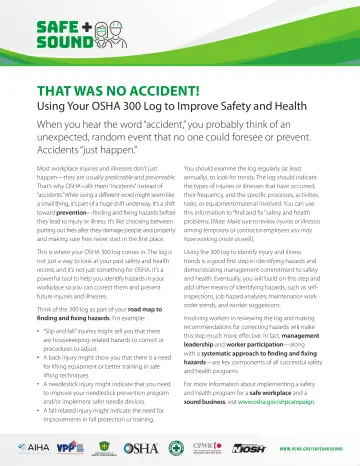
1 slidesThat Was No Accident! Using Your OSHA 300 Log to Improve Safety and Health
OSHA booklet, for General Industry classes.
U.S. Department of Labor, OSHAPublic domain