1 / 52Use ← → to flip
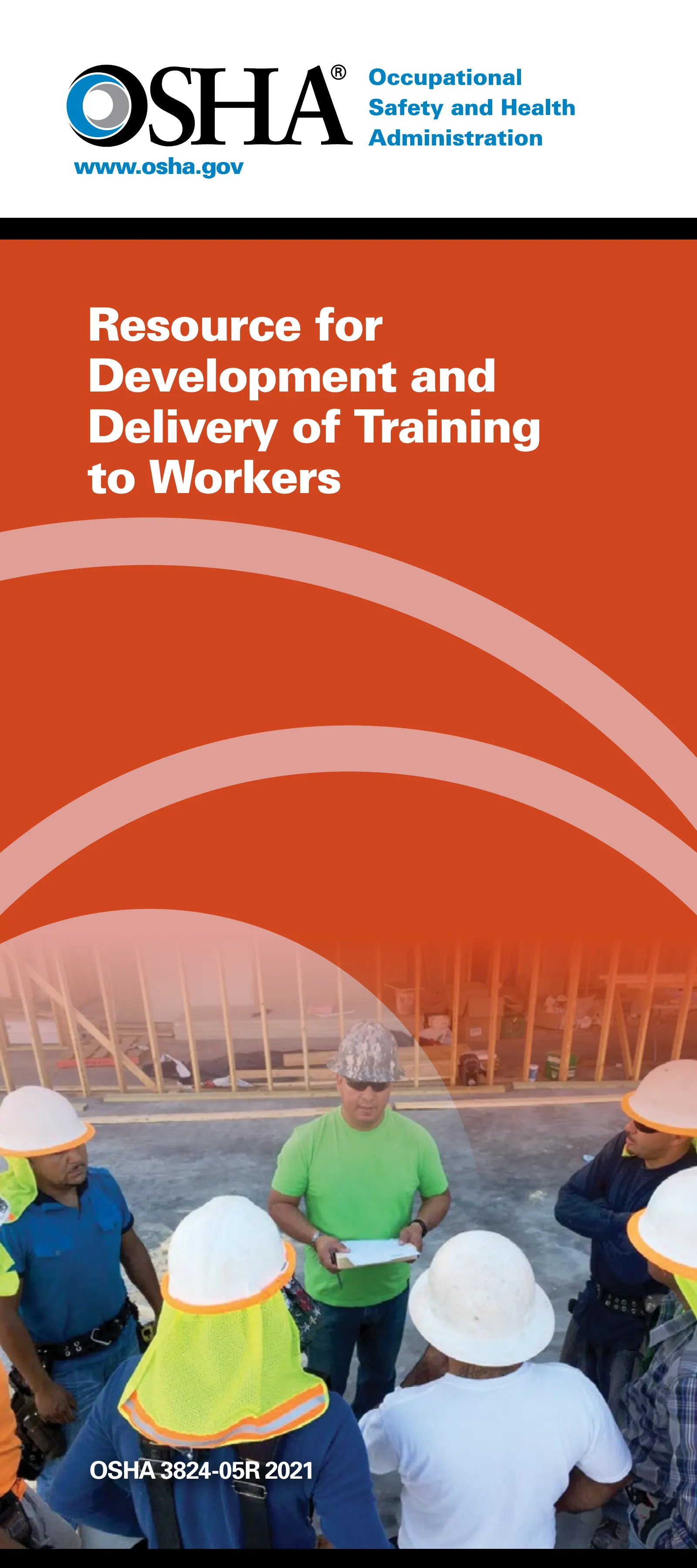
Resource for Development and Delivery of Training to Workers (OSHA 3824)
OSHA booklet, for General Industry classes.
Page text
· 49 of 52 pages · by U.S. Department of Labor, OSHA
The words on each page as the author wrote them, read from the file by software so they can be searched. Layout, pictures and tables are not shown here, and long pages are shortened: the pages above and the download are the original.
- Page 1
Resource for Development and Delivery of Training to Workers
- OSHA 3824-05R 2021
- Page 2
Occupational Safety and Health Act of 1970
- “To assure safe and healthful working conditions for working men and women; by authorizing enforcement of the standards developed under the Act; by assisting and encouraging the States in their efforts to assure safe and healthful working conditions; by providing for research, information, education, and training in the field of occupational safety and health...”
- Material contained in this publication is in the public domain and may be reproduced, fully or partially, without permission. Source credit is requested but not required.
- …
- Page 3
Resource for Development and Delivery of Training to Workers
- U.S. Department of Labor
- Occupational Safety and Health Administration
- OSHA 3824-05R 2021
- Page 4
Disclaimer
- This guidance document is not a standard or regulation and it creates no new legal obligations. The document is advisory in nature, informational in content, and is intended to assist employers in providing a safe and healthful workplace. The Occupational Safety and Health Act requires employers to comply with safety and health standards promulgated by OSHA or by a state with an OSHA-approved state plan.
- In addition, the Act’s Section 5(a)(1), the General Duty Clause, requires employers to provide their workers with a workplace free from recognized hazards likely to cause death or serious…
- …
- Page 5
Table of Contents
- Characteristics of
- Sound Training Programs … 2
- Overview of Best Practices for Training Adults … 3
- Principles of Adult Education … 5
- The Principles of Adult Education:
- A Checklist … 7
- Program Design, Delivery, and Evaluation Elements … 12
- Training Facilities and the Learning Environment … 12
- Training Course Materials and Content … 14
- Training and Overall Program Evaluation. . . 25
- Specific Populations to Consider … 27
- Appendix A … 29
- Multilingual Resources … 29
- Appendix B … 33
- Program Evaluation and
- Quality Control Resources … 33
- Evaluation Resources … 34
- Appendix C … 35
- References … 35
- …
- Page 7
- More than 100 of OSHA’s current standards contain requirements for training. Furthermore, a comprehensive workplace safety program needs to include training. This OSHA guide outlines information on developing and delivering effective training to workers.
- Quality safety and health training helps prevent work-related injuries and illnesses. Effective training also encourages workers by educating and empowering them to advocate for safer working conditions.
- Several factors contribute to successful training. One of the most important is ensuring that the training facilitator exhibits safety and health…
- …
- Page 8
Characteristics of Sound Training Programs
- Waste Operations and Emergency Response (HAZWOPER); HAZWOPER Supporting and All Hazards Prevention, Preparedness and Response.
- NIEHS: National Institute of Environmental Health Sciences
- WETP: Worker Education and Training Program
- A general review of training “best practices” reveals four characteristics that sound training programs have in common. The best training programs are accurate, credible, clear, and practical.
- Accurate. Training materials should be prepared by qualified individuals, updated as needed, and facilitated by appropriately qualified and…
- …
- Page 9
- Training materials should be written in the language and grammar of the everyday speech of the participants. Training developers should ensure that readability and language choices match the intended audience.
- If an employee does not speak or comprehend English, instruction must be provided in a language that the employee can understand. Similarly, if the employee’s vocabulary is limited or there is evidence of low literacy among participants, the training must account for this limitation. …
- …
- Page 10
- 2. Training techniques, methods and modes.
- Proven adult learning techniques should be at the core of training development and delivery.
- Peer-to-peer training with activitybased learning is one effective model for worker training. Effective development of peer trainers requires ongoing organizational support to the developing peer trainer.
- Activity-based learning should fill at least two-thirds of training hours (no more than one-third is lecture).
- Training must be provided in a way that workers receiving it can understand.
- In practical terms, this means that the training must be both in a language and…
- …
- Page 11
Principles of Adult Education
- The following are the basic principles of how adults learn, which is directly applicable to safety and health training programs:
- Adults are voluntary learners: Most adults learn because they want to. They learn best when they have decided they need to learn for a particular reason.
- Adults learn needed information quickly: Adults need to see that the subject matter and the methods are relevant to their lives and to what they want to learn. They have a right to know why the information is important to them.
- …
- Page 12
- Adults learn better when information is presented in different ways: They will learn better when an instructor uses a variety of teaching techniques.
- Three kinds of “learning exchanges”:
- Participant-to-Participant: “Participant-toparticipant” learning exchange recognizes that participants can learn from one another’s experiences. Participant-toparticipant exchanges should be a key feature of the training. Participant-to-Facilitator: Facilitators can learn as much from training sessions as participants do. …
- …
- Page 13
The Principles of Adult Education: A Checklist
- Material adapted from Teaching About Job Hazards, Nina Wallerstein and Harriet Rubenstein, American Public Health Association, 1993.
- General Principles
- The best training programs take advantage of the following characteristics of adult learners:
- Adults are self-motivated.
- Adults expect to gain information that has immediate application to their lives. Adults learn best when they are actively engaged.
- Adult learning activities are most effective when they are designed to allow students to develop both technical knowledge and general skills.
- …
- Page 14
- Does the social environment or atmosphere in the learning environment encourage people to participate?
- Are warm-up activities or “ice breakers” needed to put people at ease?
- Do trainers allow participants to say things in their own words, or do they translate what is said into other words or jargon?
- 2. Are participants encouraged to listen carefully to each other?
- Are they encouraged to respect different points of view?
- Are they encouraged to use humor and is the humor appropriate?
- 3. People learn in different ways. Do the learning activities in the training program provide participants with an…
- …
- Page 15
- Are the learning activities sensitive to cultural differences among the participants?
- Does the training engage participants in critical thinking and analysis about the subject being covered?
- 5. How effectively do the lectures in the program encourage participation?
- Are they combined with a participatory exercise?
- Are they brief?
- Are they well organized?
- Are audio-visual aids incorporated in the lecture?
- Does the lecturer rely too heavily on his or her notes?
- Was there enough time for questions and comments from others?
- Does the lecturer promote challenging questions about the content being delivered?
- …
- Page 16
- Are the participants given a clear summary of the main points they were expected to learn in the activity?
- 7. If case studies or role-playing is used, do the case studies and role-playing activities in the program encourage participation?
- Is the situation being discussed familiar to the participants?
- Does the situation evoke strong feelings in the participants?
- Does the situation lead to an in-depth analysis of the problem?
- Does the situation encourage people to consider a range of possible strategies for dealing with the problem?
- …
- Page 17
- Does the responsibility for leading and recording the discussion rotate among those willing to do the job?
- Are the groups supplied with guidelines about how to lead and report their discussions?
- Do the activities make allowances for anyone in the group who may have problems reading and writing?
- 9. Is the program sensitive to literacy differences?
- Do the trainers check privately with anyone having reading and writing difficulties?
- Is reading aloud or writing in front of the group only voluntary and never mandatory?
- Are all instructions and other required material read aloud?
- …
- Page 18
Program Design, Delivery, and Evaluation Elements
- This document categorizes the elements into four sections: Training Facilities and the Learning Environment; Training Course Materials and Content; Training and Overall Program Evaluation; and Specific Populations to Consider.
- Training Facilities and the Learning Environment
- Ideally, training facilities should have sufficient resources and equipment to perform classroom and activity-based learning in a setting conducive to effective learning.
- However, often such facilities are not available and instructors find themselves having to make do and adapt to…
- …
- Page 19
Training Facilities and Resources
- Adequate and appropriate facilities for supporting training include:
- Sufficient space for all attendees to sit comfortably during instruction; Sufficient room set-up for participants to interact with one another;
- Enough equipment for all attendees and demonstration equipment for the instructor/facilitator (if applicable); Space and facilities for small group exercises or hands-on training using equipment as part of activity-based learning; and
- Equipment, technical support, and resources sufficient to support training via technology, such as during instructor presentations…
- …
- Page 20
Training Course Materials and Content Training Development/Instructional Design
- Training courses should be developed and updated as necessary to be consistent with the recognized principles of training development/ instructional design. Training development should follow a systematic process that includes: a needs assessment, learning objectives, adult learning principles, course design, and evaluation. (Reference: ANSI Z-490.1-2009.)
- One such instructional design model is called “ADDIE.” This stands for the main components of the ADDIE process: Analysis, Design, Development, Implementation, and…
- …
- Page 21
Training Objectives
- Every instructor has objectives he/she wishes to accomplish during training. Instructional objectives should be student-focused and state the desired learning outcome.
- When constructing objectives, the main question that objectives answer is: What should the participant be able to do differently, or more effectively, after the training is completed?
- The SMART Model is one method used to construct practical objectives.
- “S” stands for Specific. Objectives should specify what they need to achieve.
- “M” stands for Measurable. You should be able to measure whether you are meeting the…
- …
- Page 22
Roger Mager’s Theory of Behavioral Objectives has three components:
- Behavior: The behavior should be specific and observable.
- Condition: The conditions under which the behavior is to be completed should be stated, including what tools or assistance is to be provided.
- Standard: The level of performance that is desirable should be stated.
- Note that training objectives emphasize what the participant will be able to do, not what the instructor intends to do. In each example, workers are expected to be able to accomplish specific goals by the end of the course.
- …
- Page 23
- Multiple training methods that require fewer literacy skills should be used with this population. Methods include the use of photos, pictures, short role-plays, case studies, demonstrations, hands-on practice, and small group activities with which workers can identify and easily understand.
- Training Techniques to Reach All Literacy Levels
- The following suggestions are designed to help trainers adapt training techniques to reach participants at all skill/literacy levels. These techniques will also be helpful in teaching participants for whom English is a second language (sometimes referred to as English…
- …
- Page 24
- Make it clear that you will not put people on the spot. Let them know that you are available during breaks to talk about any concerns.
- Let the group know that they will not necessarily be expected to read material by themselves during the training.
- Let people know that you will not be requiring them to read aloud. Ask for volunteers when reading aloud is part of an activity. Never call on someone who does not volunteer.
- Do not rely on printed material alone. When information is important, make sure plenty of time for discussion is built into the class so participants have the opportunity to really…
- …
- Page 25
- group and to develop solutions. There can also be valuable exchanges between workers and trainers about their lives and work.
- Participatory methods work quite well with people who have difficulty reading and writing. They also allow the instructor to observe who may be having difficulty with the concepts and to engage with them to ensure comprehension. Participatory methods (1) draw on the participants’ own knowledge and experience about safety and health issues; (2) emphasize learning through doing without relying on reading; and (3) create a comfortable learning experience for everyone.
- …
- Page 26
- needs. Keep in mind that visual aids—such as PowerPoint presentations, handouts, overheads, and flip charts—play a supportive role to the main teaching technique and are not a substitute for teaching.
- The following are some principles for creating the text for easy-to-read materials:
- Base the content on the workers’ most important needs.
- Identify the “priority message.” The priority message should convey the most important information about a problem and how it could be solved. It should be short, informative, and easy to remember. Don’t offer so much information that a reader could feel overwhelmed.
- …
- Page 27
Using PowerPoint
- PowerPoint is not a teaching technique—it is a visual aid that can be used to enhance learning, just like flip charts, overheads, and handouts. PowerPoint will not, in and of itself, improve student learning. It is the way that instructors use PowerPoint that can encourage learning. Deciding when, where, and how it can be used appropriately is the key.
- Many instructors mistakenly use PowerPoint as their main teaching technique. If an instructor teaches only by showing and reading a PowerPoint presentation, there is not much opportunity for participation.
- …
- Page 28
Design:
- One concept per slide.
- Use a simple design.
- Make sure you really understand how to create and design PowerPoint slides. It takes some knowledge and skill to develop a PowerPoint presentation. For instance, getting the animation correct can be tricky. Do not make the mistake of designing the PowerPoint with too many graphics and animation (a common error among instructors). This can result in a design that is too complicated and difficult to read. Go easy on the graphics. Simple graphics that are easily understood are best. …
- …
- Page 29
- A final note on technology: Using PowerPoint requires that you have all the technology you need, that it is in good working order, and that you know how to use it. The best prepared PowerPoint will fail if the technology fails, or if the instructor has trouble using it. Always have a back-up plan in place!
- Using Flip Charts
- Flip charts, like PowerPoints, are visual aids that are used to facilitate, enhance, or bring more clarity to the learning experience. It is an interactive and flexible aid that promotes interaction and engagement between the facilitator and the participants.
- …
- Page 30
- Print in large block letters. Do a “test” flip chart page before the workshop and make sure it can be read from the back of the room. Be sure not to crowd the flip chart with too much information. Only key points should be written.
- Watch your spelling. If you have problems with spelling, work on memorizing the correct spelling of words you are likely to use. But do not let spelling get in the way of using a flip chart. Creating a “spell-free” zone in the class may take some pressure off both you and the participants.
- Many facilitators prepare some flip charts in advance. Be sure to proofread any flip…
- …
- Page 31
Training and Overall Program Evaluation
- There are three types of training evaluation:
- (1) training session reaction assessments;
- (2) learning assessments; and (3) training impact assessments.
- Evaluating Program Effectiveness
- To make sure that the training program is accomplishing its goals, an evaluation of the training can be valuable. Training should have, as one of its critical components, a method for measuring the effectiveness of the training. When course objectives and content are developed for a training program, a plan for evaluating the training session(s) should be designed and integrated into…
- …
- Page 32
- However it is conducted, an evaluation of training can give employers the information necessary to decide whether or not workers have achieved the desired results, and whether the training session should be offered again at a future date.
- Improving the program
- If, after evaluation, it is clear that the training did not give workers the level of knowledge and skill that is expected, then it may be necessary to revise the training program or provide periodic retraining. At this point, it may help to pose certain questions to workers and those who conducted the training: (1) Were parts of the content already…
- …
- Page 33
7. Did the learning activity simulate the actual job?
- 8. Was the learning activity appropriate for the kinds of knowledge and skills required on the job?
- 9. When the training was presented, was the organization of the material and its meaning made clear?
- 10. Were the workers motivated to learn?
- 11. Were the workers allowed to participate in the training process?
- 12. Was the employer’s evaluation of the program thorough?
- A critical examination of the steps in the training process will help employers determine where course revision is necessary. …
- …
- Page 34
- 2. Limited English proficiency. Materials used with those who have limited English proficiency should be easy to understand or written in languages other than English. Favor those materials or curricula that encourage interaction, student input, and critical thinking. (Szudy and Gonzalez Arroyo). Consider using pictograms, visuals, and demonstrations or other methods that are non-verbal to convey information. Employ approaches similar to those used for low-literacy audiences.
- 3. Contingent workers, day laborers and temporary workers. Employ approaches similar to those used for low-literacy or non-English…
- …
- Page 35
Appendix A
- Multilingual Resources
- Below are resources to use when looking for (mostly) Spanish language safety and health material. Remember that simply translating English safety and health materials into Spanish or another language is not necessarily adequate for your target population to understand the material. There are many different terms and dialects in Spanish (and other languages) and you need to ensure that you are using the correct ones. Also, using the correct literacy level is just as important in other languages as it is in English. …
- …
- Page 36
OSHA Mobile-Friendly e-Books
- Select OSHA publications are available in e-Book format. OSHA e-Books are designed to increase readability on smartphones, tablets and other mobile devices. For access, go to www.osha.gov/ebooks.
- Susan Harwood Training Grant Products
- This web site features training materials such as PowerPoint presentations, instructor and student manuals, and test questions developed by Susan Harwood grantees. These resources are available in multiple languages at www.osha.gov/harwoodgrants/grantmaterials/bytopic.
- OSHA Safety Campaigns
- OSHA’s Campaign to Prevent Heat Illness
- …
- Page 37
OSHA’s Fall Prevention Campaign
- This campaign is part of OSHA’s nationwide effort to raise awareness among workers and employers about the hazards of falls from ladders, scaffolds, and roofs. The educational resources page gives workers and employers information about falls and how to prevent them. There are also training tools for employers to use and posters to display at their worksites. Many of the new resources target vulnerable workers with limited English proficiency.
- The Fall Prevention webpage has many resources available in English and Spanish at www.osha.gov/stopfalls.
- …
- Page 38
Other Foreign Language Safety and Health Resources
- National Institute for Occupational Safety and Health (NIOSH)
- This site includes links to NIOSH publications in Spanish on a variety of construction topics, and also provides links to other agencies and organizations that have Spanish language resources. Visit www.cdc.gov/spanish/niosh/ pubsnum-sp.html, for more information.
- Electronic Library of Construction Occupational Safety and Health (eLCOSH)
- This electronic library was developed and is maintained by CPWR—The Center for Construction Research and Training—and provides a wide range of materials on…
- …
- Page 39
Appendix B
- and are linked to information in the Cal/OSHA Pocket Guide for the Construction Industry. These cards are simple to use and designed to improve the quality of tailgates. View these resources at www.cdph.ca.gov/Programs/CCDPHP/DEODC/OHB/Pages/BuildSafe.aspx.
- Program Evaluation and Quality Control Resources
- Evaluation of Worker Training Programs
- It is important to periodically evaluate the training program to make sure that training is effective and that programs are achieving the intended results. …
- …
- Page 40
Evaluation Resources
- Identifying areas for program improvement; Measuring the short- and longer-term accomplishments of a worker training program; and
- Assessing whether, and to what extent, training has brought positive changes to the workplace.
- Examples of instruments developed and used by NIEHS WETP awardees to evaluate their worker training programs are displayed throughout the Guide.
- For copies of the Resource Guide, please contact the NIEHS National Clearinghouse for Worker Safety and Health Training at (202) 331- 7733, email [email protected], or visit tools.niehs.nih.gov/wetp/index.cfm?id=92.
- …
- Page 41
Appendix C
- Measuring and Evaluating the Outcomes of Training (1996)
- This is a collection of research papers that was presented at the 1996 NIEHS Spring meeting on measures and evaluation of safety and health training programs.
- References
- A Worker’s Sourcebook: Spanish Language Health and Safety Materials for Workers, University of California, Los Angeles, Labor and Occupational Safety and Health.
- Assessing Occupational Safety and Health Training: A Literature Review,
- U.S. Department of Health and Human Services, Public Health Service, Centers for Disease Control and Prevention, National Institute for…
- …
- Page 42
- Immigrant Worker Safety and Health Report, from a conference on research needs, draft NIOSH scientific information disseminated for peer review, NIOSH and University of Massachusetts Lowell, April 2010.
- Minimum Health and Safety Training Criteria: Guidance for Hazardous Waste Operations and Emergency Response (HAZWOPER) and HAZWOPER-Supporting Training and All-Hazards Disaster Prevention, Preparedness and Response, National Institute of Environmental Health Sciences (NIEHS) Worker Education and Training Program (WETP), January 2006, http://tools.niehs.nih.gov/wetp.
- …
- Page 43
- by the National Institute of Environmental Health Sciences and the Occupational Safety and Health Administration, Department of Health and Human Services, HHS (NIOSH) Publication No. 2004-132, February 2004.
- Robson L., Stephonson C., Schulte P., Amick B., Chan S., Bielecky A., Wang A., Heidotting T., Irvin E., Eggerth D., Peters R., Clarke J., Cullen K., Boldt L., Grubb P. A systematic review of the effectiveness of training & education for the protection of workers. Toronto: Institute for Work
- & Health, 2010; Cincinnati, OH: National Institute for Occupational Safety and Health, DHHS (NIOSH) Publication
- …
- Page 44
Appendix D
- No Cost On-Site Safety and Health Consultation Services for Small Business
- OSHA’s On-Site Consultation Program offers no‑cost and confidential advice to small and medium-sized businesses in all states, with priority given to high-hazard worksites. Each year, responding to requests from small business owners looking to create or improve their safety and health programs, OSHA’s On-Site Consultation Program conducts over 26,000 visits to small business worksites covering over 1 million workers across the nation.
- On-Site consultation services are separate from enforcement and do not result in…
- …
- Page 45
OSHA Educational Materials
- OSHA has many types of educational materials to assist employers and workers in finding and preventing workplace hazards.
- All OSHA publications are free at www.osha.gov/publications and www.osha.gov/ebooks.
- You can also call 1-800-321-OSHA (6742) to order publications.
- Employers and safety and health professionals can sign-up for QuickTakes, OSHA’s free, twicemonthly online newsletter with the latest news about OSHA initiatives and products to assist in finding and preventing workplace hazards. To sign up, visit www.osha.gov/quicktakes.
- Workers’ Rights
- Workers have the right to:
- …
- Page 46
OSHA Regional Offices
- Region 1
- Boston Regional Office
- (CT*, ME*, MA, NH, RI, VT*)
- JFK Federal Building
- 25 New Sudbury Street, Room E340 Boston, MA 02203
- (617) 565-9860 (617) 565-9827 Fax
- Region 2
- New York Regional Office
- (NJ*, NY*, PR*, VI*)
- Federal Building
- 201 Varick Street, Room 670
- New York, NY 10014
- (212) 337-2378 (212) 337-2371 Fax
- Region 3
- Philadelphia Regional Office
- (DE, DC, MD*, PA, VA*, WV)
- The Curtis Center
- 170 S. Independence Mall West, Suite 740 West Philadelphia, PA 19106-3309
- (215) 861-4900 (215) 861-4904 Fax
- Region 4
- Atlanta Regional Office
- …
- Page 47
Region 6
- Dallas Regional Office (AR, LA, NM*, OK, TX)
- A. Maceo Smith Federal Building 525 Griffin Street, Room 602 Dallas, TX 75202
- (972) 850-4145 (972) 850-4149 Fax
- Region 7
- Kansas City Regional Office
- (IA*, KS, MO, NE)
- Two Pershing Square Building 2300 Main Street, Suite 1010 Kansas City, MO 64108-2416
- (816) 283-8745 (816) 283-0547 Fax
- Region 8
- Denver Regional Office
- (CO, MT, ND, SD, UT*, WY*)
- Cesar Chavez Memorial Building 1244 Speer Boulevard, Suite 551 Denver, CO 80204
- (720) 264-6550 (720) 264-6585 Fax
- Region 9
- San Francisco Regional Office
- …
- Page 48
- *These states and territories operate their own OSHA-approved job safety and health plans and cover state and local government employees as well as privatesector employees. The Connecticut, Illinois, Maine, New Jersey, New York and Virgin Islands programs cover public employees only. (Private-sector workers in these states are covered by Federal OSHA). States with approved programs must have standards that are identical to, or at least as effective as, the Federal OSHA standards.
- Note: To get contact information for OSHA area offices, OSHA-approved state plans, and OSHA consultation projects, please visit…
- …
- Page 49
How to Contact OSHA
- Under the Occupational Safety and Health Act of 1970, employers are responsible for providing safe and healthful workplaces for their employees. OSHA’s role is to help ensure these conditions for America’s workers by setting and enforcing standards, and providing training, education and assistance. For more information, visit www.osha.gov or call OSHA at 1-800-321-OSHA (6742), TTY 1-877-889-5627.
- For assistance, contact us. We are OSHA. We can help.
- Page 52
U.S. Department of Labor
- For more information:
- Occupational
- Safety and Health Administration www.osha.gov (800) 321-OSHA (6742)
More on Managing Safety
ppt
16 slidesMulti-Employer Worksites
OSHA's multi-employer citation policy: creating, exposing, correcting and controlling employers.
Texas Engineering Extension ServiceArchivedOSHA Harwood grant
pdf
150 slidesTraining Requirements in OSHA Standards (OSHA 2254)
OSHA booklet, for General Industry classes.
U.S. Department of Labor, OSHAPublic domain
pdf
1 slidesThat Was No Accident! Using Your OSHA 300 Log to Improve Safety and Health
OSHA booklet, for General Industry classes.
U.S. Department of Labor, OSHAPublic domain