1 / 23Use ← → to flip
Module 4: Hazard Prevention and Control
One module of a small-business course on safety management systems. An archived deck: check it against the current standard before teaching from it.
Slide text
· 23 slides · by National Safety Council
The words on each slide as the author wrote them, read from the file by software so they can be searched. Layout, pictures and tables are not shown here: the slides above and the download are the original.
- Slide 1
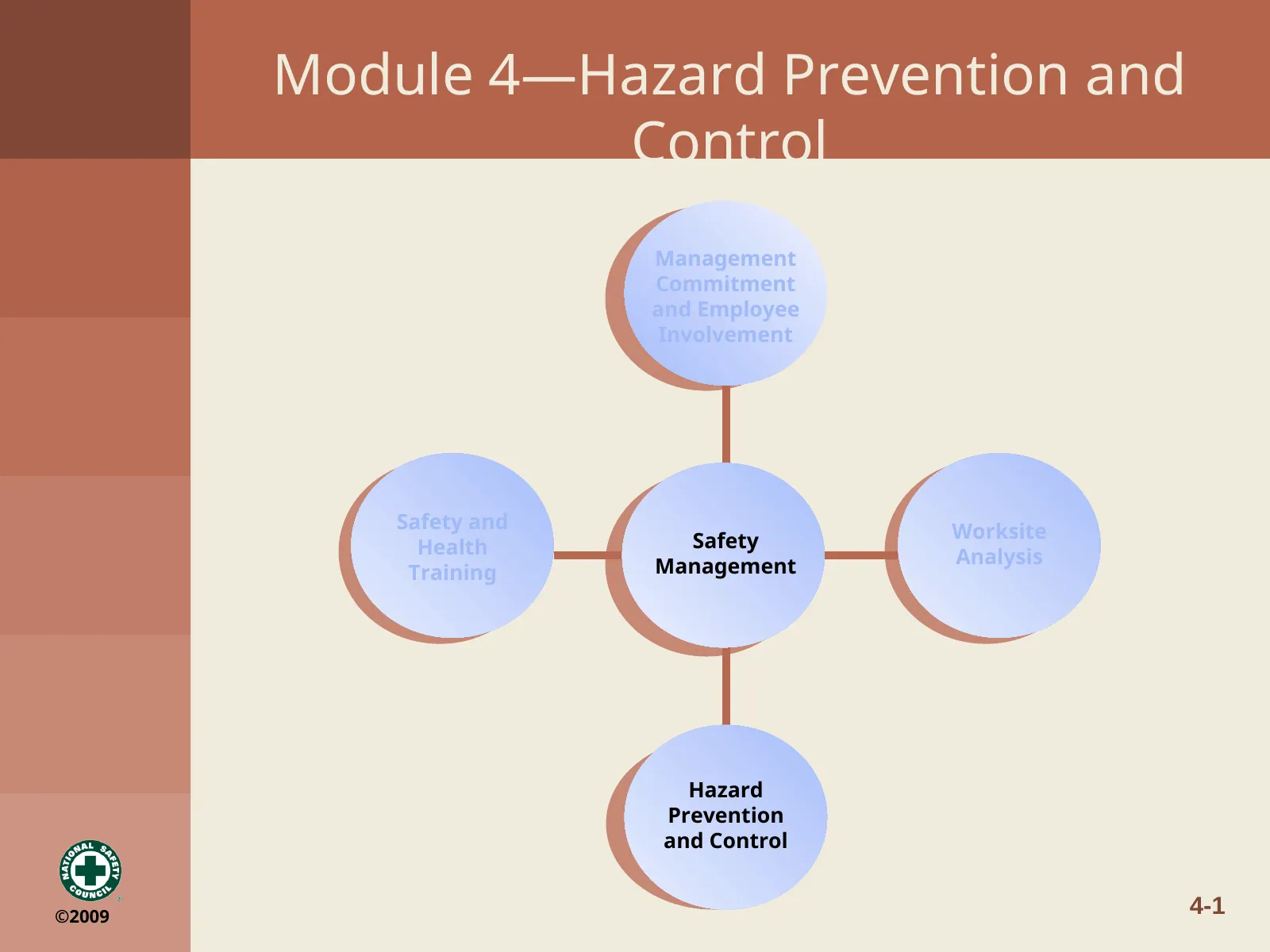
Module 4—Hazard Prevention and Control
- Management Commitment and Employee Involvement
- Safety and Health
- Training
- Safety
- Management
- Worksite Analysis
- Hazard
- Prevention and Control
- Slide 2
Module 4 Objectives
- At the end of this module, you will be able to:
- Identify the factors OSHA includes under hazard prevention and control in its voluntary Safety and Health Program
- Management guidelines.
- Understand the key aspects of an engineering design and start-up review.
- Slide 3
Module 4 Objectives—continued
- Consider other control methods when the hazard cannot be engineered out of the job.
- Recognize the key components of an emergency plan.
- Recognize the key components of a medical program.
- Slide 4
Prevention Versus Control
- Hazard
- Prevention
- The process of designing a job or operation so that hazards are completely eliminated
- Hazard
- Control
- The process of designing or finding ways to minimize the risk of a hazard that cannot be entirely eliminated
- Slide 5
The Safety Process
- Recogni ze
- Control
- Evaluate
- Slide 6
Activity Instructions
- Review the factors that demonstrate hazard prevention and control, then check the items you feel your organization does well.
- Slide 7
Engineering Controls
- Redesign of equipment
- Substitution of a material, equipment, or process
- Change of process to minimize or eliminate hazard
- Use of barriers or shields to isolate a hazard
- Use of barriers to isolate a person Ventilation
- Slide 8
Administrative Controls
- Training and education Procedures to limit exposure Increasing distance between hazard and employee Adjusting work schedules and rotating assignments to reduce exposure
- Maintenance
- Good housekeeping
- Wet work methods
- Slide 9
PPE Controls
- Protective clothing, headwear, footwear
- Eye and face protection
- Respiratory protection
- Hearing protection
- Fall protection
- Protection against electrical hazards
- Slide 10
Engineering Design and Start-Up Review
- Process
- An analysis of the processes involved in and the potential hazards associated with:
- A newly constructed building or facility.
- A remodeled or expanded building or facility.
- New tools or equipment.
- A new process or procedure.
- Slide 11
Engineering Design and Start-Up Review
- Process
- When to perform:
- During the design phase of any construction or installation project Ideally should precede any capital or operational purchasing decisions
- Slide 12
Engineering Design and Start-Up Review
- Process
- Why it’s
- Important:
- Can reduce injuries, illnesses and environmental damage.
- Prevents expensive retrofitting. Increases productivity.
- Lowers installation and operating costs.
- Slide 13
Engineering Design and Start-Up Review
- Process
- What it
- Assesses:
- Potential hazards during construction or installation Potential hazards during normal use
- Potential hazards during maintenance
- Slide 14
Engineering Design and Start-Up Review
- Process
- Who Should be on the Team:
- Design engineers
- Construction personnel
- Machinists
- Users of new facility or equipment People who will maintain new facility or equipment
- Safety personnel
- Slide 15
Engineering Design and Start-Up Review
- Process
- Engineering Qualifications:
- Knowledge of and familiarity with OSHA regulations
- Able to apply basic safety principles Able to listen to people who will use the design
- Concern for impact design will have on safety
- Attention to impact on environment
- Slide 16
Engineering Design and Start-Up Review
- Process
- Question for thought:
- In evaluating the performance of a project engineer, what criteria and benchmarks are generally used?
- Slide 17
Sustainability Considerations
- 1. Can this design protect employees from exposures to hazards?
- 2. Is the design friendly toward the environment?
- 3. Can this design effectively use energy and control emissions?
- 4. Can this design reduce water use?
- 5. Can this design recycle water or use recycled water?
- Slide 18
Sustainability Considerations
- 6. Can the materials used in this design be made from renewable resources?
- 7. Can the materials be non-toxic to employees and community members?
- 8. Will toxic substances be released into the air during construction, installation, or use?
- 9. When the materials are no longer useful, can they be discarded without harming the environment or using space in a landfill?
- Slide 19
Activity Instructions
- In your group, identify what you believe are the important components of an emergency plan, including:
- What should be included in an emergency plan?
- How should it be communicated to the organization?
- Slide 20
Activity Instructions
- Review the list of components that are an important part of a medical program. Check those that your organization already does, then check any you think it should
- Already DoShould Implement
- implement.
- Slide 21
Activity Instructions
- List the hazards you identified in the case study, then list controls that will either eliminate or control the hazards. Indicate whether
- each control is:
- Engineering.
- Administrative.
- PPE.
- Slide 22
Implementation Roles
- What is top management’s role in implementing these controls?
- The supervisor’s role?
- The employee’s role?
- Top Management
- Supervisors
- Employees
- Slide 23
Activity Instructions
- For each of the identified hazards, brainstorm the following:
- Ways to design the hazards out of the palletizer altogether.
- Ways to achieve sustainability with the new palletizer.
More on Managing Safety
ppt
16 slidesMulti-Employer Worksites
OSHA's multi-employer citation policy: creating, exposing, correcting and controlling employers.
Texas Engineering Extension ServiceArchivedOSHA Harwood grant
pdf
150 slidesTraining Requirements in OSHA Standards (OSHA 2254)
OSHA booklet, for General Industry classes.
U.S. Department of Labor, OSHAPublic domain
pdf
52 slidesResource for Development and Delivery of Training to Workers (OSHA 3824)
OSHA booklet, for General Industry classes.
U.S. Department of Labor, OSHAPublic domain