1 / 20Use ← → to flip
Module 3: Worksite Analysis
One module of a small-business course on safety management systems. An archived deck: check it against the current standard before teaching from it.
Slide text
· 20 slides · by National Safety Council
The words on each slide as the author wrote them, read from the file by software so they can be searched. Layout, pictures and tables are not shown here: the slides above and the download are the original.
- Slide 1
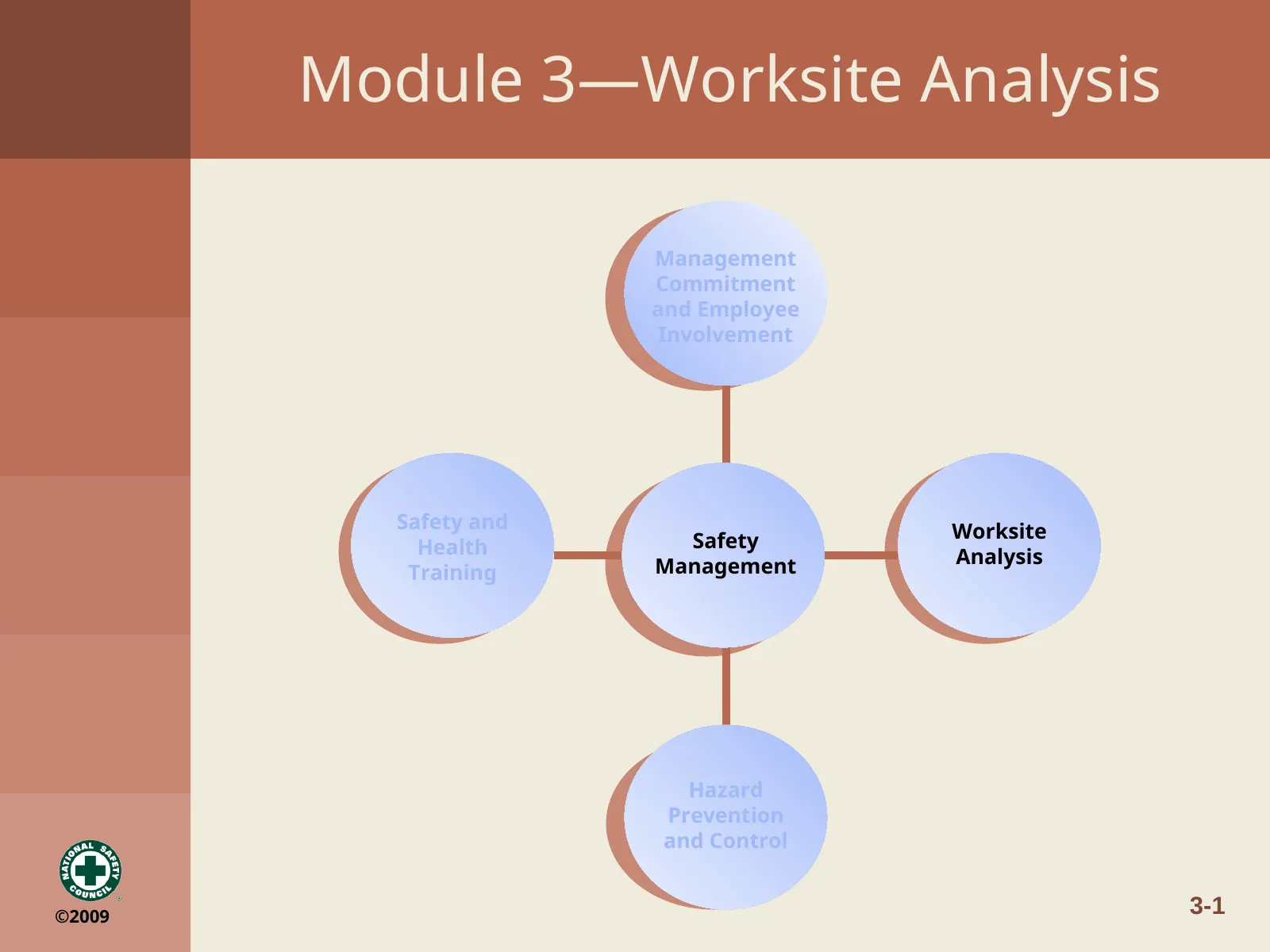
Module 3—Worksite Analysis
- Management Commitment and Employee Involvement
- Safety and Health
- Training
- Safety
- Management
- Worksite Analysis
- Hazard
- Prevention and Control
- Slide 2
Module 3 Objectives
- At the end of this module, you will be able to:
- Identify the factors OSHA includes under worksite analysis.
- Define and identify the relationship between safety, hazards, and incidents.
- Identify methods that can be used to conduct a worksite analysis.
- Slide 3
Module 3 Objectives—continued
- Prepare a hazard inventory as a part of worksite analysis.
- Describe hazards according to types/categories.
- Using a case study, review hazards found during a worksite analysis to determine what failure in the safety system permitted the hazards(s) to occur.
- Slide 4
Definition
- What is Worksite Analysis?
- Worksite analysis is any analysis performed by managers or employees or both to identify existing or potential hazards with the goal of eliminating or controlling them.
- Slide 5
The Safety Process
- Recogni ze
- Control
- Evaluate
- Slide 6
Activity Instructions
- Review the factors that indicate performance of worksite analysis, then check the items you feel your organization does well.
- Slide 7
Heinrich’s Triangle
- Disabling
- Injury or Fatality
- 29 Serious Injuries
- 300 Minor Injuries or Near Misses
- Substandard Practices/Conditions
- Slide 8
Heinrich’s Conclusions
- Incident investigation should include incidents that cause minor or no injuries.
- Reducing the number of no-injury incidents will also reduce the number of serious incidents.
- Disabling
- Injury or Fatality
- 29 Serious Injuries
- 300 Minor Injuries or Near Misses
- Substandard Practices/Conditions
- Slide 9
Comprehensive Baseline Survey
- Baseline Survey
- A survey conducted when an organization begins its safety and health management system
- Provides a baseline assessment of all the hazards and 3-9
- Slide 10
Job Hazard Analysis
- A step-by-step review of every job or task
- Each step is analyzed for current or potential hazards
- Slide 11
Change Analysis
- A step-by-step review whenever there are changes such as a new building, new equipment, a new process or new materials
- Ensures there are no new hazards as a result of the change
- Slide 12
Safety and Health Inspection
- A routine inspection of a worksite conducted a regular intervals
- To identify hazards that may appear after the baseline assessment
- The identified hazards should be corrected and tracked
- Slide 13
Incident Investigation
- An investigation conducted to determine how and why an occupational incident has occurred
- Examines people, the environment, equipment and work practices
- Identifies the root cause(s) of an incident or injury in order to
- prevent future incidents
- Slide 14
Employee Reports of Hazards
- A system in which employees report hazards they see on their jobs and make suggestions for controlling these hazards
- Ensures people closest to the job—employees—understand their role in identifying and reporting hazards
- Ensures employees are active
- Slide 15
Trend Analysis
- A systematic analysis of injury and illness trends over time
- To determine hazard trends and patterns so that common causes can be identified and corrected
- Slide 16
Case Study
- Palletizer with a partially complete pallet raised inside the hoist area
- Location of light curtain
- Location of pallet exit
- Hoist with partially completed pallet
- Pallet entrance and empty pallet
- Slide 17
Case Study—continued
- Palletizer with a complete pallet getting ready to exit the hoist area
- Slide 18
Case Study—continued
- Palletizer with a partially complete pallet raised inside the hoist area
- Location of light curtain
- Location of pallet exit
- Hoist with partially completed pallet
- Pallet entrance and empty pallet
- Slide 19
Case Study Instructions
- In your group, answer the case study questions.
- What hazards/substandard conditions were caused by management?
- What hazards/substandard conditions were caused by employees?
- Slide 20
Case Study Instructions— continued
- In your group, answer the case study questions.
- What hazards/substandard conditions were caused by equipment?
- What hazards/substandard conditions were caused by work practices?
- What hazards/substandard conditions were inherent in the environment?
More on Managing Safety
ppt
16 slidesMulti-Employer Worksites
OSHA's multi-employer citation policy: creating, exposing, correcting and controlling employers.
Texas Engineering Extension ServiceArchivedOSHA Harwood grant
pdf
150 slidesTraining Requirements in OSHA Standards (OSHA 2254)
OSHA booklet, for General Industry classes.
U.S. Department of Labor, OSHAPublic domain
pdf
52 slidesResource for Development and Delivery of Training to Workers (OSHA 3824)
OSHA booklet, for General Industry classes.
U.S. Department of Labor, OSHAPublic domain