1 / 74Use ← → to flip
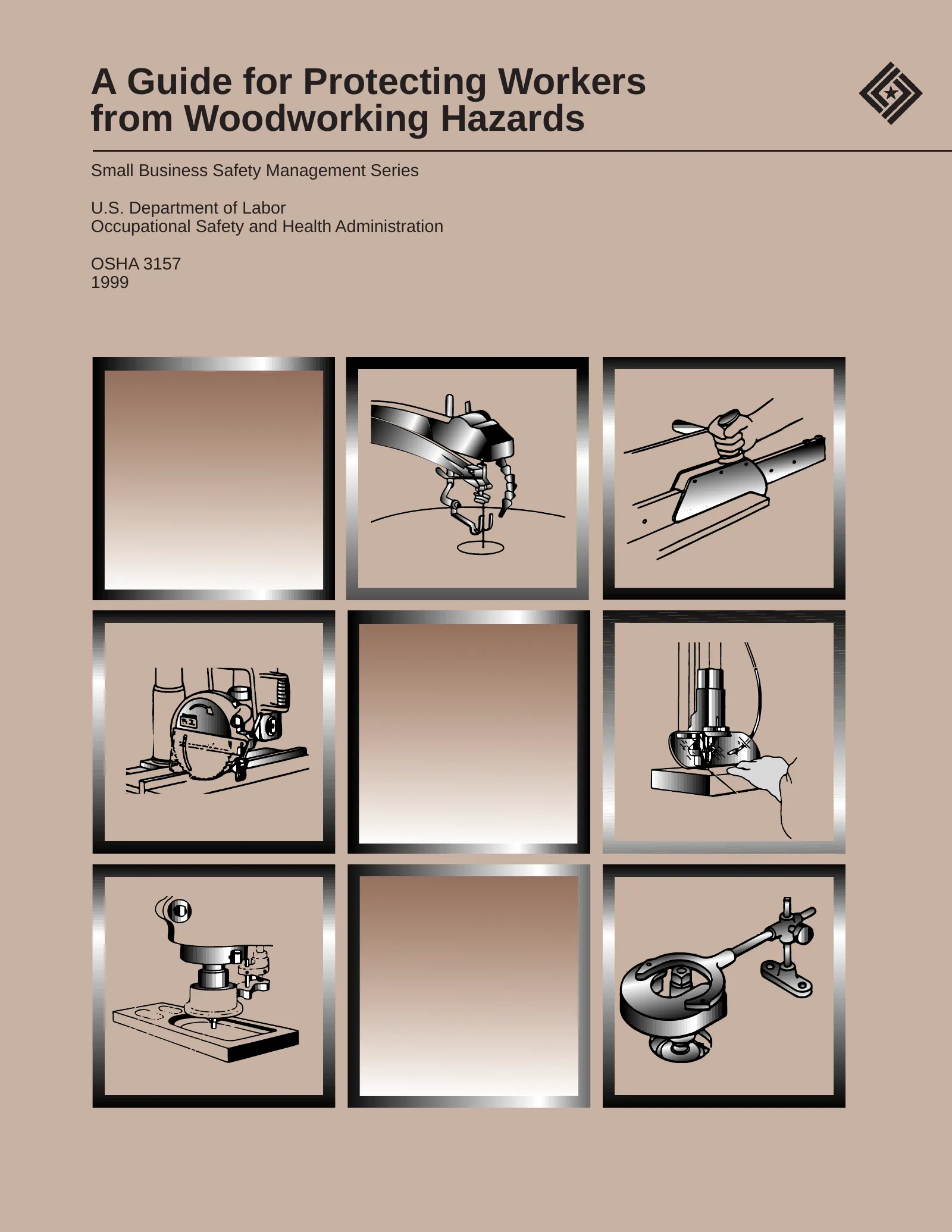
Woodworking: A Guide for Protecting Workers from Woodworking Hazards Small Business Safety Management Series (OSHA 3157)
OSHA booklet, for General Industry classes.
Page text
· 74 pages · by U.S. Department of Labor, OSHA
The words on each page as the author wrote them, read from the file by software so they can be searched. Layout, pictures and tables are not shown here, and long pages are shortened: the pages above and the download are the original.
- Page 1
A Guide for Protecting Workers from Woodworking Hazards
- Small Business Safety Management Series
- U.S. Department of Labor
- Occupational Safety and Health Administration
- OSHA 3157
- 1999
- Page 2
- This informational booklet is intended to provide a generic, nonexhaustive overview of a particular standards-related topic. This publication does not itself alter or detemine compliance responsibilities, which are set forth in OSHA standards themselves, and the Occupational Safety and Health Act. …
- …
- Page 3
A Guide for Protecting Workers from Woodworking Hazards
- Small Business Safety Management Series
- U.S. Department of Labor
- Occupational Safety and Health Administration
- OSHA 3157
- 1999
- Page 4
- Contents
- iii
- Introduction … 1 Who Should Read This Guide? … 1 How Will This Guide Help Protect My Employees? … 1 What Standards Cover Woodworking? … 1 What Are the Main Types of Hazards Associated with Woodworking Operations? … 2
- Principal Safety Hazards of Woodworking and Methods of Control … 3 How Can My Employees Recognize the Hazards of Woodworking Equipment? …
- …
- Page 5
iv Contents (continued)
- Personal Protective Equipment (PPE) … 35 What Is PPE? … 35 Once I Have Provided My Employees with the Necessary PPE, Is My Job Done? … 39
- Finishing Operations … 40 What Are the Hazards of the Chemicals Used in Finishing? … 40 How Can I Protect My Employees from the Chemicals Used in Finishing? … 40
- Appendix A: References and Standards … 43
- Appendix B: NIOSH Hazard Controls … 45
- …
- Page 6
Contents (continued)
- Figure 24: Chain Mortising Machine … 25 Figure 25: Auxiliary Ventilation System for Horizontal Belt Sanders … 46 Figure 26: Improved Head Configuration for Shapers … 47 Figure 27: Computer Controlled Jet Stripper System for Controlling Emmisssions from
- Automated Routers … 48 Figure 28: Jet Stripper System for Improving Dust Control from Disc Sanders … 49 Figure 29: Dust Control…
- …
- Page 7
Introduction
- Machines used in woodworking are dangerous, particularly when used improperly or without proper safeguards. Workers operating woodworking equipment suffer the following common injuries: laceration, amputation, severed fingers, and blindness. Wood dust and the chemicals used in finishing are health hazards, and workers in this industry can suffer from skin and respiratory diseases.
- …
- Page 8
2 Introduction
- In this document, “shall” and “must” are used to indicate when a control device or other safeguard is required by OSHA; “should” is used to indicate recommended safe work practices.
- What Are the Main Types of Hazards
- Associated with Woodworking
- Operations?
- The principal hazards of woodworking can be classified as either safety or health hazards. …
- …
- Page 9
Principal Safety Hazards of Woodworking and Methods of Control
- How Can My Employees Recognize the Hazards of Woodworking Equipment?
- It is important to train/teach your employees how to identify hazards related to their assigned job tasks. This section provides an overview of the major safety hazards associated with woodworking equipment. …
- …
- Page 10
4 and Methods of Control
- Principal Safety Hazards of Woodworking
- Reciprocating movement is back-and-forth or up-and-down motion. Operators can be caught and crushed by reciprocating movement when the moving part approaches or crosses a fixed part of the machine. (See Figure 1.)
- Nip Point
- Nip point
- Table
- Nip point
- Bed
- (stationary)
- Nip point
- Nip point
- Source: Concepts and Techniques of Machine
- …
- Page 11
Principal Safety Hazards of Woodworking and Methods of Control
- Tool Projection (Unbalanced Cutter Heads)
- Many pieces of woodworking equipment—such as routers, shapers, and molders—employ rotating cutter heads with multiple knives. Cutter heads that are not properly adjusted, or that are poorly mounted or have broken knives, can become unbalanced. …
- …
- Page 12
6 and Methods of Control
- Principal Safety Hazards of Woodworking
- What Engineering Controls Are Available to Help Protect My Employees from Machine Hazards?
- Machine Guarding
- Guards are now standard equipment on most woodworking machines. If you purchase a machine that does not come equipped with a guard, install one. …
- …
- Page 13
Principal Safety Hazards of Woodworking and Methods of Control
- Handle for extending or retracting guard over blade
- Saw blade
- Crank for height adjustment
- First guard
- Guard
- Second guard
- Source: Concepts and Techniques of Machine
- Safeguarding, OSHA
- F igure 6. Adjustable Guard on Table Saw
- Figure 8. Self-Adjusting Guard on Table Saw
- Adjustment knob
- Stock
- Guard
- Guard
- Blade
- …
- Page 14
8 and Methods of Control
- Principal Safety Hazards of Woodworking
- Table 2. Types of Machine Guards
- Types of Machine Guards
- Type
- Safeguarding
- Action
- Fixed
- Provides a barrier and is a permanent part of machine.
- Advantages
- Limitations
- Examples
- Can be constructed to suit many specific applications.
- Can provide maximum protection.
- Usually requires little maintenance.
- …
- Page 15
Principal Safety Hazards of Woodworking and Methods of Control
- Other Means of Safeguarding Machines
- Additional methods for safeguarding machines include guarding by location or distance, feeding methods, and appropriate placement of controls. None of these methods should replace machine guards, however. It is always important to provide a guard or barrier that prevents access to the danger area. …
- …
- Page 16
10 and Methods of Control
- Principal Safety Hazards of Woodworking
- What Procedural and Administrative
- Controls Are Needed to Protect
- Employees from Equipment Hazards?
- Use appropriate equipment for the job. Workers can be seriously injured if they do not use the correct equipment for a job. Use machines only for work within the rated capacity specified by the machine manufacturer. …
- …
- Page 17
- Principal Safety Hazards of Woodworking and Methods of Control
- be kept sharp, properly adjusted, and secured. Sharpening blades prevents kickback. You must also remove any cracked or damaged blades from service. Keep circular saw blades round and balanced. You must remove dull, badly set, improperly filed or improperly tensioned saws from service, and immediately clean saws to which gum has adhered.
- …
- Page 18
Specific Woodworking Equipment Hazards and Controls
- This section covers the major safety hazards of specific woodworking machinery, and discusses the engineering controls and work procedures for minimizing employee exposure to these hazards. References to applicable OSHA standards are provided in the text of this section in cases where the engineering controls or work practices are required by a…
- …
- Page 19
Specific Woodworking Equipment Hazards and Controls
- Use a push stick for small pieces of wood and for pushing stock past the blade. [1910.213(s)(9)]
- Avoid crosscutting long boards on table saws. Considerable hand pressure is required close to the saw blade, and the boards create a safety hazard to other people.
- Use a filler piece between the fence and the saw blade when necessary (e.g., when there is…
- …
- Page 20
Specific Woodworking Equipment Hazards and Controls
- Injuries can occur if the operator reaches to remove a section of board while the blade is coasting or idling, or if the operator tries to measure a board or position it while the saw is still running. Injuries can also occur if an improperly adjusted saw swings beyond its safe limits.
- Safety Hazards of Overhead Swing and Straight Line Pull Cutoff Saws
- …
- Page 21
Specific Woodworking Equipment Hazards and Controls
- Safety Hazards of Radial Saws
- Point of operation—Contact with the turning blade may occur.
- In-running nip points—Clothing, hair, or hands may be caught by and pulled into the in- running rolls of the automatic feed.
- Kickback—Stock caught in the blade or fed in the wrong direction may be thrown back at the operator.
- …
- Page 22
- Specific Woodworking Equipment Hazards and Controls
- operator’s hands may come close to the blade during cutting, and band saws cannot be completely guarded.
- Safety Hazards of Band Saws
- Point of operation—Contact with the moving blade may occur.
- In-running nip points—Clothing, hair, or hands may be caught by and pulled into feed rolls or the pulley mechanism.
- …
- Page 23
Specific Woodworking Equipment Hazards and Controls
- Jig Saws
- Jig saws are useful for precision-cutting intricate curves and patterns on thin stock. They have thin blades that move rapidly up and down through the opening in the saw table. The blade is held in upper and lower chucks that pull it tight and keep it from bending. A hold-down adjusts to the thickness of the wood being cut.
- Blade
- Safety guard
- …
- Page 24
Specific Woodworking Equipment Hazards and Controls
- Safety Hazards of Jointers
- Point of operation—Contact with the knives may occur, especially if a holding device is not used.
- In-running nip points—Clothing, hair, or hands may be caught by and pulled into the in- running rolls of the automatic feed.
- Kickbacks—Stock may be thrown back at the operator after being caught by the knives; this may also…
- …
- Page 25
Specific Woodworking Equipment Hazards and Controls
- Safety Hazards of Shapers
- Point of operation—Contact with the cutter head may occur, particularly if holding devices are not used.
- Tool projection—Knives may be flung if the cutter head is unbalanced.
- Kickback—Stock may be thrown back at the operator after being caught by the cutter head.
- …
- Page 26
Specific Woodworking Equipment Hazards and Controls
- Automatic feeding mechanisms make this equipment less hazardous. However, operators’ hands may be pulled into the cutting area, and can come in contact with the point of operation while adjusting blades. Operators’ hands also may be pinched between the stock and in-running rolls, if the feed system is not properly guarded.
- Operating controls
- …
- Page 27
Specific Woodworking Equipment Hazards and Controls
- The primary hazards of lathes are contact with rotating parts and contact at the point of operation. Operators’ hands, clothing, or jewelry may be caught on the rotating parts and pulled into the machine. The danger is greater with hand-fed lathes, because the operator works in such close proximity to the rotating stock and the cutting tool. …
- …
- Page 28
Specific Woodworking Equipment Hazards and Controls
- Sanders
- Sanders finish stock by using a coated abrasive surface to remove material. Figures 20 and 21 show the three general types of sanders: drum, belt, and disc. A belt sander uses a system of pulleys to move the abrasive material across the stock. …
- …
- Page 29
Specific Woodworking Equipment Hazards and Controls
- Work Practices
- Replace torn, frayed, or excessively worn belts or drums. A worn-out belt, disk, or drum can cause massive heat buildup, which can cause the belt, disk, or drum to tear or break and pelt the surrounding area with projected bits.
- Keep hands away from abrasive surfaces.
- Sand on the downward-moving side of the disk or belt.
- Routers
- …
- Page 30
Specific Woodworking Equipment Hazards and Controls
- Equip routers with a spindle braking system that gradually engages.
- Guard feed rolls [29 CFR 1910.213(b)(7)].
- Work Practices
- Properly attach and secure tools to the holder.
- Label cutting tools and holders with the maximum permissible spindle speed.
- Use tools only as intended.
- Tenoning Machine
- …
- Page 31
Specific Woodworking Equipment Hazards and Controls
- Dust hood
- Mortising chain
- Back fence
- Stock clamp
- Elevation crank
- Foot treadle
- Figure 24. Chain Mortising Machine
- Engineering Controls
- Use safety bit chucks with no projecting screws [29 CFR 1910.213(l)(1)].
- Enclose boring bits with a guard that encloses the bit and chuck above the material being worked [29 CFR 1910.213(l)(2)].
- …
- Page 32
Other Safety Hazards of Woodworking
- What Are Other Safety Hazards of Woodworking?
- A magnetic switch or other device to prevent automatic restarting of the machine after a power failure. Such an unexpected start-up could expose the worker to moving parts.
- An emergency stop device (panic bar or deadman switch) within reach of operators working in the normal operating position.
- …
- Page 33
- Other Safety Hazards of Woodworking
- be restored to the machine until the work is completed and the person performing the work removes the tag.
- All power sources—electrical, mechanical, pneumatic, hydraulic—must be shut off and locked out during machine maintenance. This includes power that is stored in a machine, such as compressed air in a cylinder, after the machine is turned off. …
- …
- Page 34
- 28 Other Safety Hazards of Woodworking
- escape from even the best exhaust system and will eventually accumulate on rafters and other out-ofthe-way spots. Also, it is extremely important to inspect and clean your exhaust ventilation system on a regular basis to maintain maximum efficiency.
- You must also:
- Ensure the proper use and storage of flammable materials, such as paints, finishes, adhesives, and…
- …
- Page 35
Health Hazards of Woodworking and Methods of Control
- What Are the Health Hazards of Wood
- Dust?
- practice controls. Where necessary, employers must provide PPE as a supplement to these controls.
- Exposure to wood dust has long been associated with a variety of adverse health effects, including dermatitis, allergic respiratory effects, mucosal and nonallergic respiratory effects, and cancer. …
- …
- Page 36
30 Health Hazards of Woodworking and Methods
- of Control
- LEV Recommendations for Individual
- Machines
- Circular Saws
- Exhaust the saw through the bottom of the table. Provide LEV under the blade slot. To decrease the open area between the table and the lower hood, attach a strip of flexible material to the machinery that will cover this area when the hood operates.
- …
- Page 37
Health Hazards of Woodworking and Methods of Control
- Other Sources of Information on Wood Dust Control
- NIOSH has published a series of “Hazard
- Controls” concerning wood dust control techniques. For details see Appendix B.
- A new dust control plenum has been designed for orbital sanders. The plenum fits between the sanding pad and the sander body and has a series of exhaust slots along its edges.
- …
- Page 38
Health Hazards of Woodworking and Methods of Control
- What Are My Options for Noise Control?
- Examples of source control steps include the following:
- Maintaining motors and all moving parts in top operating condition. Maintenance involves lubricating and cleaning; replacing worn parts; maintaining proper belt tensions and bolt torques; and properly balancing pulleys, blades, and other rotating parts.
- …
- Page 39
Health Hazards of Woodworking and Methods of Control
- Path Controls
- Effective path controls involve isolating, blocking, diverting, absorbing, or otherwise reducing noise intensity before it reaches your employees’ ears.
- Examples of path control steps include
- Segregating operations so as to limit, as far as possible, the number of employees exposed to excessive equipment noise.
- …
- Page 40
34 Health Hazards of Woodworking And Methods
- of Control
- to consider. A good rule of thumb, however, is that the damping layer should be the same thickness as the surfaces being treated.
- Work Practices
- Maintain machines in proper working order. Unbalanced rotating parts or unsharpened cutting tools can give off excessive vibration.
- …
- Page 41
Personal Protective Equipment
- The preceding sections of this guide discuss ways of recognizing and controlling health and safety hazards at your facility. Once you have implemented all relevant engineering and workpractice controls, ask yourself (and your employees) what potential hazards remain. …
- …
- Page 42
Personal Protective Equipment
- Table 6. Minimum Criteria for Selecting ANSI-Approved Eye Protection
- Provides adequate protection against the hazards of your workplace.
- Is reasonably comfortable for your employees to wear.
- Does not restrict your employees’ field or acuity of vision, nor their freedom of movement, except as necessary to provide protection.
- Is durable, and easy to clean and disinfect.
- …
- Page 43
- Personal Protective Equipment
- resistance, and knee pads/guards where kneeling on hard surfaces is a regular part of the task performed.
- Hand and Arm Protection
- Your workers’ hands and arms will need protection from burns, bruises, abrasions, cuts, and exposure to the chemicals used in finishing.
- Protective gloves are the primary means available for direct hand protection. …
- …
- Page 44
Personal Protective Equipment
- OSHA offers the following suggestions for selecting appropriate body protection:
- For general impact, abrasion, and laceration protection, heavy leather and/or padded aprons should provide the maximum protection without unnecessarily compromising mobility or ventilation.
- Full-body overalls made of cotton or synthetic fiber should provide adequate protection when engineering…
- …
- Page 45
Personal Protective Equipment
- The general steps to determining the need for hearing PPE for a given worker include
- Measuring the noise level (dBA) at each work location with a sound level meter and recording the hours per day spent there.
- Determining the allowable exposure duration limit for the noise level encountered at each location (see Table 4 on page 32).
- …
- Page 46
Finishing Operations
- What Are the Hazards of the Chemicals
- Used in Finishing?
- Finishing operations pose a wide range of health and safety hazards due to the volume and physical properties of the chemicals involved. A complete discussion of this topic is beyond the scope of this guide; however, a general discussion of common hazards and related control measures is provided below. …
- …
- Page 47
- Finishing Operations
- area. Dip coating should be ventilated with an enclosure or capture hood. Consult the OSHA standard on dip coating (open surface tanks), 29 CFR 1910.108, for detailed requirements on dipping operations.
- The OSHA standard for spray finishing operations, 29 CFR 1910.107, provides detailed requirements for the design and construction of spray booths and rooms, air filters, velocity…
- …
- Page 48
Finishing Operations
- Table 7. OSHA Standards Relevant to Finishing Operations
- Ventilation, 29 CFR 1910.94(c) and (d). These subsections of the standard establish ventilation design requirements for spray finishing and open surface tanks.
- Flammable and Combustible Liquids, 29 CFR 1910.106. This standard establishes provisions for the safe handling, storage, and use of flammable and combustible liquids.
- …
- Page 49
Appendix A: References and Standards
- References
- American Conference of Governmental Industrial Hygienists (ACGIH). 1996. Threshold Limit Values for Chemical Substances and Physical Agents— Biological Exposure Indices. 6th ed.
- ACGIH. Industrial Ventilation: a Manual of Recommended Practice. ACGIH Committee on Industrial Ventilation.
- …
- Page 50
44 Appendix A: References and Standards
- 1910.213—Woodworking machinery requirements
- 1910.219—Mechanical power transmission apparatus
- Subpart S—Electrical
- Subpart Z—Toxic and Hazardous Substances
- 1910.1200—Hazard communication
- Other Standards
- National Fire Protection Association:
- NFPA 10
- NFPA 33
- NFPA 70
- NFPA 644-1993
- Installation of Portable Fire Extinguishers
- …
- Page 51
Appendix B: NIOSH Hazard Controls
- The National Institute for Occupational safety and Health (NIOSH) has published a series of seven Hazard Controls fact sheets concerning wood dust control techniques. In this Appendix, NIOSH articles on controlling dust from woodworking machineries are consolidated for use as applicable. …
- …
- Page 52
Appendix B: NIOSH Hazard Controls
- Auxiliary Ventilation System
- Typically, belt sander emissions are controlled only by an exhaust hood covering the drive pulley. The new ventilation system reduced wood dust emitted into the workroom by more than 75% and can easily be built into new belt sanders or added to existing ones. …
- …
- Page 53
Appendix B: NIOSH Hazard Controls
- Control of Wood Dust from Shapers
- Hazard
- Wood shapers are a major source of wood dust emissions. Workers exposed to wood dusts have experienced a variety of adverse health effects such as eye and skin irritation, allergy, reduced lung function, asthma, and nasal cancer. NIOSH, therefore, recommends limiting wood dust exposures to prevent these health problems.
- Controls
- …
- Page 54
48 Appendix B: NIOSH Hazard Controls
- Control of Wood Dust from Automated
- Routers
- Hazard
- Automated routers have been found to create significant amounts of wood dust. Workers exposed to wood dusts have experienced a variety of adverse health effects such as eye and skin irritation, allergy, reduced lung function, asthma, and nasal cancer. …
- …
- Page 55
Appendix B: NIOSH Hazard Controls
- Control of Wood Dust from Large
- Diameter Disc Sanders
- Hazard
- The use of large diameter disc sanders creates significant amounts of wood dust. Workers exposed to wood dusts have experienced a variety of adverse health effects such as eye and skin irritation, allergy, reduced lung function, asthma, and nasal cancer. …
- …
- Page 56
Appendix B: NIOSH Hazard Controls
- Control of Wood Dust from Random
- Orbital Hand Sanders
- Additional Exhaust System
- Random orbital hand sanders are widely used in woodworking applications. The dust generated by these tools is sometimes controlled by an aspirator in combination with a perforated sanding pad. The aspirator creates a vacuum to draw wood dust up through holes in the sanding pad. …
- …
- Page 57
Appendix B: NIOSH Hazard Controls
- Control of Wood Dust from Orbital Hand
- Sanders
- Hazard
- Orbital hand sanders have been found to create significant amounts of wood dust. Workers exposed to wood dusts have experienced a variety of adverse health effects such as eye and skin irritation, allergy, reduced lung function, asthma, and nasal cancer. …
- …
- Page 58
Appendix B: NIOSH Hazard Controls
- Local Exhaust Hood
- Table saws are widely used in many types of woodworking operations. Although they are sometimes used only sporadically, they are found to generate significant amounts of dust. The traditional method of dust control for table saws is exhaust through the bottom of the table. …
- …
- Page 59
Appendix C: Sources of OSHA Assistance
- State and Local Government Resources
- Several states have developed relevant requirements, guidelines, or recommendations. These include California OSHA, CAL/OSHA Guidelines for Workplace Security, and Model Injury and Illness Prevention Program for Workplace Security; the State of Florida, Convenience Business Security Act, and Study of Safety and Security…
- …
- Page 60
- 54 Appendix C: Sources of OSHA Assistance
- more hazardous operations, state governments employing professional safety and health consultants provide the consultation service, on request, to those employers who ask for help. These consultants offer employers comprehensive assistance that includes an appraisal of all mechanical systems, physical work practices, and environmental hazards of the workplace…
- …
- Page 61
Appendix C: Sources of OSHA Assistance
- For more information on grants, training, and education, contact the OSHA Training Institute, Office of Training and Education, 1555 Times
- Drive, Des Plaines, IL 60018, phone (847)
- 297-4810 or fax (847) 297-4874. See also Programs and Services, Training and Education, on OSHA’s Home Page.
- Electronic Information
- Emergencies
- …
- Page 62
56 Appendix D: OSHA Office Directory
- Sates with Approved Plans
- Commissioner
- Alaska Department of Labor
- 1111 West 8th Street
- P.O. Box 24119
- Room 306
- Juneau, AK 99802-1149
- (907) 465-2700
- Director
- Industrial Commissioner of Arizona
- 800 W. Washington
- Phoenix, AZ 85007
- (602) 542-5795
- Director
- California Department of Industrial Relations
- 45 Fremont Street
- San Francisco, CA 94105
- (415) 972-8835
- …
- Page 63
Appendix D: OSHA Office Directory
- Commissioner
- New York Department of Labor
- W. Averell Harriman State Office Building - 12, Room 500 Albany, NY 12240
- (518) 457-2741
- Vermont Department of Labor and Industry
- National Life Building - Drawer 20
- 120 State Street
- Montpelier, VT 05620-3401
- (802) 828-2288
- North Carolina Department of Labor
- 4 West Edenton Street
- Raleigh, NC 27601-1092
- (919) 807-2900
- …
- Page 64
58 Appendix D: OSHA Office Directory
- OSHA Consultation Project Directory
- Alabama
- Safety State Program University of Alabama
- 425 Martha Parham West
- P.O. Box 870388
- Tuscaloosa, AL 35487
- (205) 348-7136
- Alaska
- Division of Consultation and Training
- ADOL/OSHA
- 3301 Eagle Street, Suite 305
- P.O. Box 107022
- Anchorage, AK 99510
- (907) 269-4957
- Arizona
- Consultation and Training
- …
- Page 65
Appendix D: OSHA Office Directory
- Hawaii
- Consultation and Training Branch
- Department of Labor and Industrial Relations
- 830 Punchbowl Street
- Honolulu, HI 96831
- (808) 586-9100
- Kentucky
- Division of Education and Training
- Kentucky Labor Cabinet
- 1047 U.S. Highway 127, South
- Frankfort, KY 40601
- (502) 564-6895
- Idaho
- Safety and Health Consultation Program
- Boise State University
- Department of Health Studies
- …
- Page 66
Appendix D: OSHA Office Directory
- Minnesota
- Department of Labor and Industry
- Conultation Divison
- 433 LaFayette Road
- Saint Paul, MN 55155
- (612) 297-2393
- New Hampshire
- New Hampshire Department of Health
- Divison of Public Health Services
- 6 Hazen Drive
- Concord, NH 03301-6527
- (603) 271-2024
- Mississippi
- Mississippi State University Center for Safety and Health 2906 North State Street Sutie 201
- …
- Page 67
Appendix D: OSHA Office Directory
- Ohio
- Division of Onsite Consultation Bureau of Employment Services 145 S. Front Street
- Columbus, OH 43216-1618 (614) 644-2246
- Oklahoma
- Oklahoma Department of Labor OSHA Division
- 4001 North Lincoln Boulevard Oklahoma City, OK 73105-5212 (405) 528-1500
- Oregon
- Department of Insurance and Finance
- Occupational Safety and Health Division
- Labor and Industries Building
- …
- Page 68
Appendix D: OSHA Office Directory
- Virginia
- Virginia Department of Labor and Industry
- Occupational Safety and Health Training and Consultation
- 13 South 13th Street
- Richmond, VA 23219
- (804) 786-6359
- Virgin Islands
- Division of Occupational Safety and Health
- Virgin Islands Department of Labor
- 3021 Golden Rock
- Christiansted
- St. Croix, VI 00840
- (809) 772-1315
- Wyoming
- Wyoming Department of Employment
- …
- Page 69
Appendix D: OSHA Office Directory
- OSHA Area Offices
- US Department of Labor - OSHA
- 2047 Canyon Road - Todd Mall
- Birmingham, AL 35216-1981
- Telephone: (205) 731-1534
- 3737 Government Boulevard, Suite 100
- Mobile, AL 36693-4309
- Telephone: (334) 441-6131
- US Department of Labor - OSHA 301 W. Northern Lights Boulevard Suite 407
- Anchorage, AK 99503-7571 Telephone: (907) 271-5152
- …
- Page 70
Appendix D: OSHA Office Directory
- US Department of Labor - OSHA
- La Vista Perimeter Office Park
- Building 7, Suite 110
- Tucker, GA 30084-4154
- Telephone: (770) 493-6644
- 300 Epic Center
- 301 N. Main
- Wichita, KS 67202
- Telephone: (316) 269-6644
- 300 Ala Moana Boulevard, Suite 5-146
- Honolulu, HI 96850
- Telephone: (808) 541-2685
- John C. Watts Federal Building, Room 108 330 W. Broadway
- Frankfort, KY 40601-7024
- …
- Page 71
Appendix D: OSHA Office Directory
- US Department of Labor - OSHA
- 801 South Waverly Road
- Suite 306
- Lansing, MI 48917-4200
- Telephone: (517) 377-1892
- US Department of Labor - OSHA 1030 Saint Georges Avenue
- Plaza 35, Suite 205
- Avenel, NJ 07001
- Telephone: (908) 750-3270
- US Department of Labor - OSHA 300 South 4th Street, Suite 1205 Minneapolis, MN 55401 Telephone: (612) 664-5460
- …
- Page 72
Appendix D: OSHA Office Directory
- US Department of Labor - OSHA
- 3300 Vikery Road
- Syracuse, NY 13212
- Telephone: (315) 451-0808
- 420 West Main, Suite 300
- Oklahoma City, OK 73102
- Telephone: (405) 231-5351
- 660 White Plaines Road
- 4th Floor
- Tarrytown, NY 10591-5107
- Telephone: (914) 524-7510
- US Department of Labor - OSHA 1220 S.W. 3rd Avenue, Room 640 Portland, OR 97294
- Telephone: (503) 326-2251
- …
- Page 73
Appendix D: OSHA Office Directory
- US Department of Labor - OSHA 380 Westminster Mall, Room 543 Providence, RI 02903
- Telephone: (401) 528-4669
- US Department of Labor - OSHA 1835 Assembly Street, Room 1468 Columbia, SC 29201-2453 Telephone: (803) 765-5904
- US Department of Labor - OSHA
- Green Hills Office Park
- 2002 Richard Jones Road
- Suite C-205
- Nashville, TN 37215-2809
- Telephone: (615) 781-5423
- …
- Page 74
Appendix D: OSHA Regional Offices
- U.S. Department of Labor
- Occupational Safety and Health Administration
- Regional Offices
- Region I
- (CT,* MA, ME, NH, RI, VT*)
- JFK Federal Building
- Room E-340
- Boston, MA 02203
- Telephone: (617) 565-9860
- Region VI
- (AR, LA, NM,* OK, TX) 525 Griffin Street
- Room 602
- Dallas, TX 75202 Telephone: (214) 767-4731
- Region II
- (NJ, NY,* PR,* VI*)
- 201 Varick Street
- Room 670
- …
More on Machine Guarding
pptx
54 slidesMachine Guarding (OSHA 10-Hour General Industry Outreach)
OSHA's own 10-hour General Industry Outreach deck on machine guarding (v. 03-01-17), editable PowerPoint with trainer notes.
U.S. Department of Labor, OSHA (with the OTIEC Outreach Workgroup)Public domain
pdf
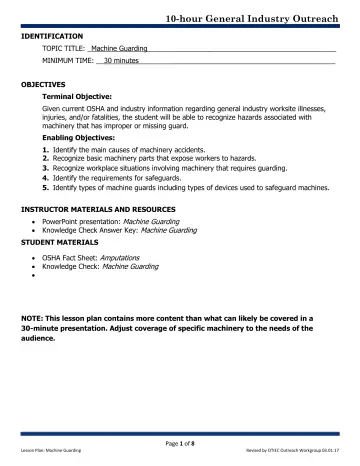
8 slidesMachine Guarding: Lesson Plan (OSHA 10-Hour General Industry Outreach)
Instructor lesson plan (objectives, timing, teaching steps) for the OSHA General Industry machine guarding outreach deck.
U.S. Department of Labor, OSHA (with the OTIEC Outreach Workgroup)Public domain
pdf
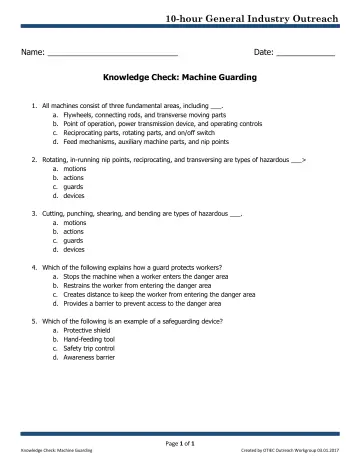
1 slidesMachine Guarding: Knowledge Check (OSHA 10-Hour General Industry Outreach)
Student knowledge-check quiz for the OSHA General Industry machine guarding outreach deck.
U.S. Department of Labor, OSHA (with the OTIEC Outreach Workgroup)Public domain