1 / 8Use ← → to flip
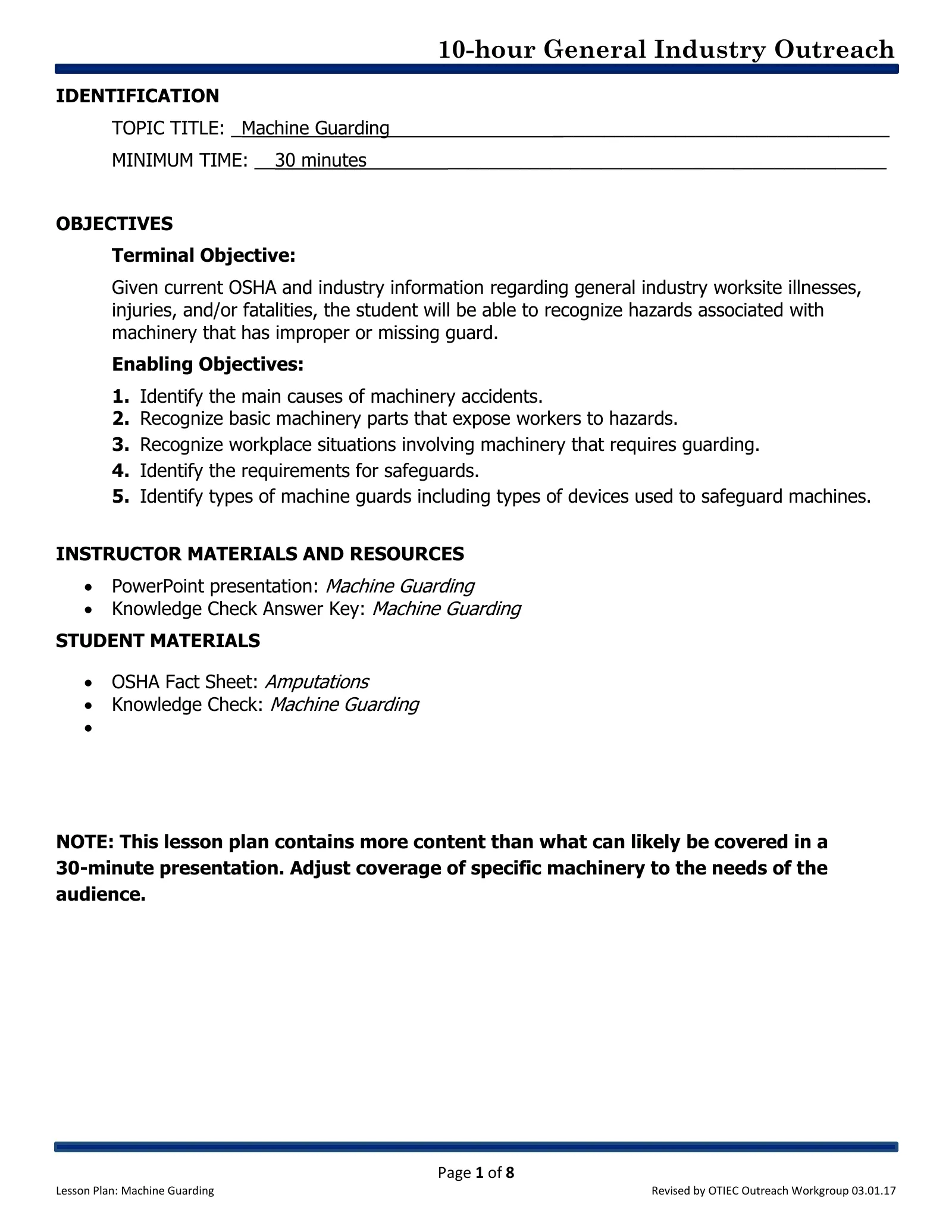
Machine Guarding: Lesson Plan (OSHA 10-Hour General Industry Outreach)
Instructor lesson plan (objectives, timing, teaching steps) for the OSHA General Industry machine guarding outreach deck.
Page text
· 8 pages · by U.S. Department of Labor, OSHA (with the OTIEC Outreach Workgroup)
The words on each page as the author wrote them, read from the file by software so they can be searched. Layout, pictures and tables are not shown here: the pages above and the download are the original.
- Page 1
IDENTIFICATION
- TOPIC T ITLE: _Machine Guarding
- MINIMUM TIME: __30 minutes
- OBJECTIVES
- Terminal Objective:
- Given current OSHA and industry information regarding general industry worksite illnesses, injuries, and/or fatalities, the student will be able to recognize hazards associated with machinery that has improper or missing guard.
- Enabling Objectives:
- 1. Identify the main causes of machinery accidents.
- 2. Recognize basic machinery parts that expose workers to hazards.
- 3. Recognize workplace situations involving machinery that requires guarding.
- 4. Identify the requirements for safeguards.
- 5. Identify types of machine guards including types of devices used to safeguard machines.
- INSTRUCTOR MATERIALS AND RESOURCES
- PowerPoint presentation: Machine Guarding
- Knowledge Check Answer Key: Machine Guarding
- STUDENT MATERIALS
- OSHA Fact Sheet: Amputations
- Knowledge Check: Machine Guarding
- NOTE: This lesson plan contains more content than what can likely be covered in a 30-minute presentation. Adjust coverage of specific machinery to the needs of the audience.
- Page 2
Crushed fingers or hands
- TEACHING PROCEDURES ---Preparation, Presentation, Application, Evaluation
- Anticipatory Set (Focus Attention/ Gain I nterest)
- Estim ated Tim e: 5 m inutes
- Key Points
- Methods
- Moving machine parts can cause severe injuries
- Amputations
- Burns
- Blindness
- Safeguards are essential
- Any machine part, function, or process that may cause injury must be safeguarded
- OSHA has a special emphasis program to identify and reduce workplace machinery and equipment hazards which are causing or likely to cause amputations.
- Review learning objectives
- Introduction
- Slides #1- #3
- National Emphasis Program on Amputations*. CPL 03-00-019, (August 13, 2015).
- P resentation (I nstruction)___
- Estim ated Tim e: ?? hours
- I.
- Main causes of machinery accidents
- Instructor-led discussion
- A. Examples of ways machine accidents could occur
- Slides #4 - #5
- Key Points
- Methods
- 1. Reaching-in to “clear” equipment
- 2. Not using LOTO
- 3. Unauthorized persons performing maintenance or using the machines
- 4. Missing or loose machine guards.
- B. Amputations occur most often in the following situations
- 1. Operating unguarded or inadequately safeguarded machinery https://www.osha.gov/Publications/amputationsqc.html
- 2. Materials handling, including during use of forklifts, compactors, powered and non-powered hand tools
- Page 3
- 3. During activities involving stationary machines
- a. Setting-up
- b. Threading
- c. Preparing
- d. Adjusting
- e. Cleaning
- f. Lubricating
- g. Maintaining
- h. Clearing jams
- II. Basic machinery parts and hazards
- Slides #6 - #19
- A. All machines consist of three fundamental areas
- 1. Point of operation
- a. Where work is performed on material https://www.osha.gov/SLTC/etools/machineguarding/intro.html
- b. Examples – cutting, shaping, boring, forming
- 2. Power transmission device
- a. Parts that transmit energy to the part of the machine performing work
- b. Examples – flywheels, pulleys, belts, connecting rods, couplings, cams, spindles, chains, cranks, gears
- 3. Operating controls
- B. Other moving parts
- 1. All parts of the machine which move while the machine is working
- 2. Examples
- a. Reciprocating, rotating, and transverse moving parts
- b. Feed mechanisms and auxiliary machine parts
- C. Hazardous motions and actions
- 1. Motions
- https://www.osha.gov/SLTC/etools/machineguarding/motions_actions.html
- a. Rotating
- b. In-running nip points
- c. Reciprocating
- d. Transversing
- Page 4
- 2. Actions
- a. Cutting
- b. Punching
- c. Shearing
- d. Bending
- III. Workplace situations with machinery that requires guarding
- Slide #20 - #25
- A. Machinery requiring point of operation guarding
- 1. Guillotine cutters
- 2. Shears
- 3. Alligator shears
- 4. Power presses
- 5. Milling machines
- 6. Power saws
- 7. Jointers
- 8. Portable power tools
- 9. Forming rolls and calenders
- B. Guarding requirements for machinery
- 1. Fan blades
- 2. Abrasive wheels – 29 CFR 1910.215
- 3. Revolving barrels, containers, and drums
- 4. Power-transmission apparatus
- C. Sources of amputations
- 1. Machinery ranked from those with most amputations to fewer:
- a. Mechanical power presses
- b. Power press breaks
- c. Powered and non-powered conveyors
- d. Printing presses
- e. Roll-forming and roll-bending machines
- f. Shearing machines
- g. Food slicers
- Page 5
- h. Meat grinders
- i. Meat-cutting band saws
- j. Drill presses
- k. Milling machines
- l. Grinding machines
- m. Slitters
- 2. Targeted industries with high amputation rates – see list in CPL 03-00-019
- IV. Requirements for safeguards
- Slide #26
- A. Prevent contact
- B. Secure
- C. Protect from falling objects
- D. Create no new hazards
- E. Create no interference
- F. Allow safe lubrication
- V. Types of machine guards
- Slides #27 - #46
- A. Guards
- 1. Barriers which prevent access to danger areas
- 2. Four general types
- https://www.osha.gov/SLTC/etools/machineguarding/guards.html
- a. Fixed
- b. Interlocked
- c. Adjustable
- d. Self-adjusting
- B. Devices
- 1. Perform one of several functions:
- a. Stop the machine if a hand or any part of the body is inadvertently placed in the danger area;
- https://www.osha.gov/SLTC/etools/machineguarding/devices.html
- b. Restrain or withdraw the operator’s hands from the danger area during operation;
- c. Require the operator to use both hands on machine controls, thus keeping both hands and body out of danger; or
- Page 6
- d. Provide a barrier which is synchronized with the operating cycle of the machine in order to prevent entry to the danger area during the hazardous part of the cycle.
- 2. Examples of devices
- a. Presence-sensing device
- i. Photoelectric (optical)
- ii. Radiofrequency (capacitance)
- iii. Electromechanical
- b. Pullback
- c. Restraint (holdback)
- d. Safety trip controls (pressure-sensitive body bar, safety tripod, safety tripwire)
- e. Two-hand control
- f. Two-hand trip
- g. Gate
- C. Additional Safeguarding
- 1. Location/distance
- 2. Feeding and ejection methods
- 3. Miscellaneous aids
- a. Awareness barriers
- b. Protective shields
- c. Hand-feeding tools
- Application (How students apply w hat they learn) __
- Estim ated Tim e: ?? hours
- View slides so that students can identify hazards being illustrated.
- Slides #47 - #48
- Key Points
- Methods
- Page 7
Evaluation/ Sum m ary
- Key Points
- Methods
- Summarize key points
- Slide #49
- Knowledge check
- Slides #50 - #54
- R eferences
- OSHA Standard
- 1910 Subpart O - Machinery and Machine Guarding
- 1910.211 - Definitions.
- 1910.212 - General requirements for all machines.
- 1910.213 - Woodworking machinery requirements.
- 1910.214 - Cooperage machinery. [Reserved]
- 1910.215 - Abrasive wheel machinery.
- 1910.216 - Mills and calenders in the rubber and plastics industries.
- 1910.217 - Mechanical power presses.
- 1910.217 App A - Mandatory requirements for certification/validation of safety systems for presence sensing device initiation of mechanical power presses
- 1910.217 App B - Nonmandatory guidelines for certification/validation of safety systems for presence sensing device initiation of mechanical power presses
- 1910.217 App C - Mandatory requirements for OSHA recognition of third-party validation organizations for the PSDI standard
- 1910.217 App D - Nonmandatory supplementary information
- 1910.218 - Forging machines.
- 1910.219 - Mechanical power-transmission apparatus.
- OSHA Publications
- Amputation Fact Sheet (2002) (English: PDF*)
- Amputation: Preventing Cuts and Amputations from Food Slicers and Meat Grinders Fact Sheet
- (OSHA FS 3794 - 2015) (English: PDF*)
- Amputations QuickCard ™ (OSHA 3204 - 2015) (English: PDF*)
- Amputations: Safeguarding Equipment and Protecting Employees from Amputations
- (OSHA 3170 - 2007) (English: HTML PDF*)
- Hazards Associated with Hand-Feeding Bar Straightening Machines
- (2004, May 20) (English: HTML PDF*)
- Hazards Associated with the "Unintended (Double) Cycling" of Mechanical Power Presses
- (2010, February 2) (English: HTML PDF*)
- Page 8
Limitations of Radiofrequency Presence Sensing Devices
- (1987, September 21) (English: HTML)
- Potential Hazards Associated with the Use of Replacement Materials for Machine Guarding
- (2000, June 23) (English: HTML HTML)
- OSHA References/Resources
- Machine Guarding eTool (2007) https://www.osha.gov/SLTC/etools/machineguarding/index.html
- Workbench Grinder Wheel Explodes , video (2005) https://www.osha.gov/video/shipyard_accidents/07_improper_equipment_use.html
More on Machine Guarding
pptx
54 slidesMachine Guarding (OSHA 10-Hour General Industry Outreach)
OSHA's own 10-hour General Industry Outreach deck on machine guarding (v. 03-01-17), editable PowerPoint with trainer notes.
U.S. Department of Labor, OSHA (with the OTIEC Outreach Workgroup)Public domain
pdf
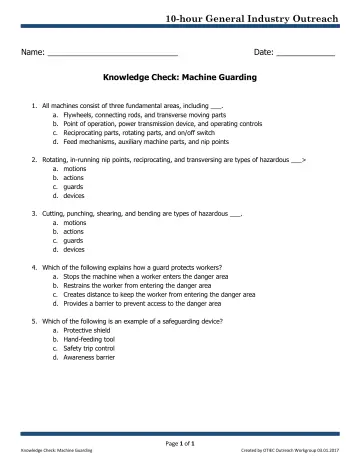
1 slidesMachine Guarding: Knowledge Check (OSHA 10-Hour General Industry Outreach)
Student knowledge-check quiz for the OSHA General Industry machine guarding outreach deck.
U.S. Department of Labor, OSHA (with the OTIEC Outreach Workgroup)Public domain
pdfes
54 slidesProtección de maquinaria (Capacitación de Extensión de 10 horas de OSHA, Industria General)
Spanish edition of OSHA's 10-hour General Industry Outreach deck on machine guarding (PDF slides; OSHA does not publish an editable Spanish PowerPoint).
U.S. Department of Labor, OSHA (with the OTIEC Outreach Workgroup)Public domain