1 / 54Use ← → to flip
Machine Guarding (OSHA 10-Hour General Industry Outreach)
OSHA's own 10-hour General Industry Outreach deck on machine guarding (v. 03-01-17), editable PowerPoint with trainer notes.
Slide text
· 54 slides · by U.S. Department of Labor, OSHA (with the OTIEC Outreach Workgroup)
The words on each slide as the author wrote them, read from the file by software so they can be searched. Layout, pictures and tables are not shown here: the slides above and the download are the original.
- Slide 1
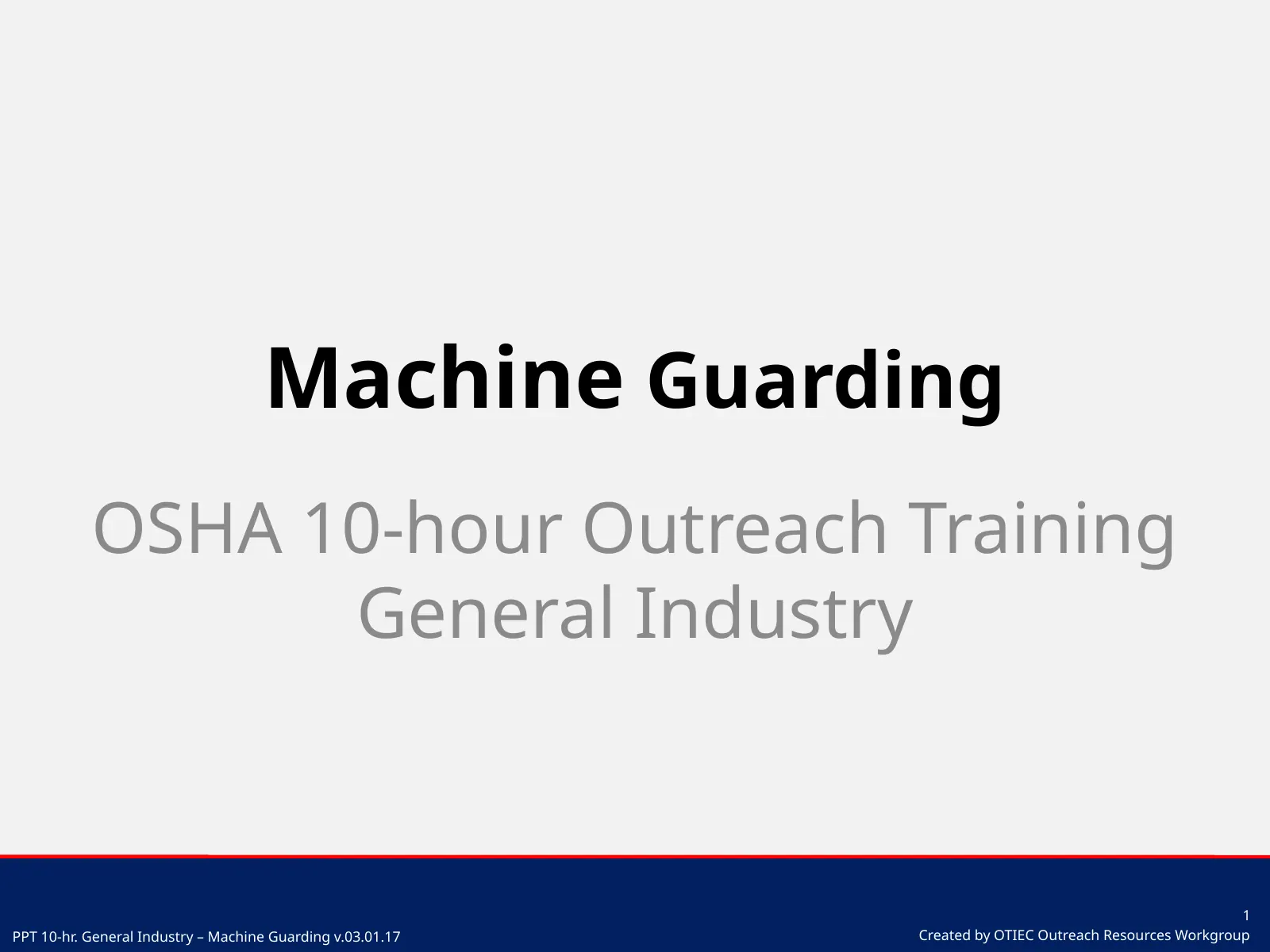
Machine Guarding
- OSHA 10-hour Outreach Training
- General Industry
- Slide 2
Introduction
- Possible machinery-related injuries include:
- Crushed fingers or hands
- Amputations
- Burns
- Blindness
- A good rule to remember is:
- Any machine part, function, or process which may cause injury must be safeguarded.
- Slide 3
Introduction
- Lesson objectives:
- 1. Identify the main causes of machinery accidents.
- 2. Recognize basic machinery parts that expose workers to hazards.
- 3. Recognize workplace situations involving machinery that requires guarding.
- 4. Identify the requirements for safeguards.
- 5. Identify types of machine guards including types of devices used to safeguard machines.
- Slide 4
Machinery Accidents
- Examples of how machine accidents can occur:
- Reaching-in to “clear” equipment
- Not using Lockout/Tagout
- Unauthorized persons doing maintenance or using the machines
- Missing or loose machine guards
- Slide 5
Machinery Accidents
- Amputations:
- Unguarded/inadequately safeguarded machinery
- Materials handling activities
- Activities involving stationary machines
- Source: OSHA
- Slide 6
Basic Machinery Parts and Hazards
- Three fundamental machine areas:
- Point of operation
- Power transmission device
- Operating controls – mechanical or electric power control
- Source: OSHA
- Slide 7
Basic Machinery Parts and Hazards
- Point of operation:
- Where work is performed on material
- Examples
- Cutting
- Shaping
- Boring
- Forming
- Source: OSHA DTE
- Slide 8
Basic Machinery Parts and Hazards
- Power transmission device:
- Parts that transmit energy to the part of the machine performing work
- Examples
- Flywheels
- Pulleys
- Belts
- Connecting rods
- Couplings
- Cams
- Spindles
- Chains
- Cranks
- Gears
- Slide 9
Basic Machinery Parts and Hazards
- Hazardous motions and actions:
- Motions
- How the machine part moves
- Examples: rotating, in-running nip points, reciprocating, and transversing
- Actions
- Operation that the machine part performs
- Examples: cutting, punching, shearing, bending
- Slide 10
Basic Machinery Parts and Hazards
- Rotating parts with hazardous projections
- Source of graphics: OSHA
- Slide 11
Basic Machinery Parts and Hazards
- Common nip points on rotating parts
- Source of graphics: OSHA
- Slide 12
Basic Machinery Parts and Hazards
- Nip points between rotating elements and parts with longitudinal motions
- Source of graphics: OSHA
- Slide 13
Basic Machinery Parts and Hazards
- Nip points between rotating machine components
- Source of graphics: OSHA
- Slide 14
Basic Machinery Parts and Hazards
- Reciprocating motions:
- Back-and-forth
- Up-and-down
- Source: OSHA
- Slide 15
Basic Machinery Parts and Hazards
- Transverse motion – movement in straight, continuous line
- Source of graphics: OSHA
- Slide 16
Basic Machinery Parts and Hazards
- Cutting action – may involve rotating, reciprocating, or transverse motion
- Slide 17
Basic Machinery Parts and Hazards
- Punching action – power applied to a slide (ram) for purpose of blanking, drawing, or stamping metal or other materials
- Slide 18
Basic Machinery Parts and Hazards
- Shearing action – applying power to a slide or knife in order to trim or shear metal or other materials.
- Slide 19
Basic Machinery Parts and Hazards
- Bending action – applying power to draw or stamp metal or other materials
- Source: OSHA
- Slide 20
Machinery That Requires Guarding
- Machines that require point of operation guarding:
- Guillotine cutters
- Shears
- Alligator shears
- Power presses
- Milling machines
- Power saws
- Jointers
- Portable power tools
- Forming rolls and calenders
- Source of graphics: OSHA
- Slide 21
Machinery That Requires Guarding
- Exposure of fan blades:
- Guard when periphery of blades is less than 7’ above the floor or working level
- Guards with openings no larger than ½”
- Source of graphics: OSHA
- Slide 22
Machinery That Requires Guarding
- Abrasive wheel machinery:
- Adjustable tongue guard to within ¼” of wheel
- Work rest with maximum opening of 1/8”
- Cover spindle end, nut, flange projections
- Source of graphics: OSHA
- Slide 23
Machinery That Requires Guarding
- Revolving barrels, containers, and drums:
- Guard by an enclosure which is interlocked with drive mechanism
- Guards with openings no larger than ½”
- Slide 24
Machinery That Requires Guarding
- Power-transmission apparatus:
- Unguarded belt and pulley
- Shafting, flywheels, pulleys, belts, chain drives, etc.
- Less than 7 feet from the floor or working platform must be guarded
- Source: OSHA
- Slide 25
Machinery That Requires Guarding
- Machinery associated with amputations – examples:
- 1. Mechanical power presses
- 2. Power press breaks
- 3. Powered and non-powered conveyors
- 4. Printing presses
- 5. Roll-forming and roll-bending machines
- 6. Shearing machines
- 7. Food slicers
- 8. Meat grinders
- 9. Meat-cutting band saws
- 10. Drill presses
- 11. Milling machines
- 12. Grinding machines
- 13. Slitters
- Source of graphics: OSHA
- Slide 26
Requirements for Safeguards
- Safeguards must meet these minimum general requirements:
- Prevent contact
- Be secured
- Protect from falling objects Create no new hazards Create no interference Allow safe lubrication
- Source: OSHA
- Slide 27
Types of Machine Safe Guards
- Safeguarding machinery:
- Primary methods
- Guards
- Devices
- Ensure employee protection
- Properly designed, constructed, and installed
- Used and maintained in good operating condition
- Slide 28
Types of Machine Safe Guards
- Secondary methods
- Probe detection and safety edge devices
- Awareness devices
- Safeguarding methods
- Safe distance
- Safe holding
- Safe opening
- Safe work practices
- Safe work procedures
- Complementary equipment
- Slide 29
Types of Machine Safe Guards
- Guards:
- Preferable to other control methods
- Provide physical barrier that prevents contact with dangerous machine parts
- Four general types
- Fixed
- Interlocked
- Adjustable
- Self-adjusting
- Source: OSHA
- Slide 30
Types of Machine Safe Guards
- Fixed guard:
- Provides a barrier
- Permanent part of the machine, preferable to all other types of guards.
- Source of photos: OSHA
- Slide 31
Types of Machine Safe Guards
- Interlocked guards:
- Shuts off or disengages power, stops moving parts, and prevents starting of machine when guard is open
- May use electrical, mechanical, hydraulic, or pneumatic power, or combination
- Source: OSHA
- Slide 32
Types of Machine Safe Guards
- Adjustable guards:
- Shuts off or disengages power
- Stops moving parts
- Prevents starting of machine when guard is open
- Slide 33
Types of Machine Safe Guards
- Self-adjusting guards:
- Openings of barriers determined by movement of the stock
- Places barrier between danger area and operator
- Source: OSHA
- Slide 34
Types of Machine Safe Guards
- Devices:
- Controls or attachments that prevent inadvertent access by employees to hazardous machine areas
- Examples
- Safety trip controls
- Presence sensing
- Photoelectric
- Radiofrequency
- Electromechanical
- Two-hand control
- Two-hand trip
- Gate
- Pullback
- Restraint
- Slide 35
Types of Machine Safe Guards
- Presence-sensing devices:
- Photoelectric
- Radiofrequency
- Electromechanical
- Slide 36
Types of Machine Safe Guards
- Pullback devices:
- Utilize a series of cables attached to operator
- Automatically withdraws hands from point of operation when slide/ram begins to descend
- Source: OSHA
- Slide 37
Types of Machine Safe Guards
- Source: OSHA
- Hands in die, feeding
- Point of operation exposed
- Pullback device attached and properly adjusted
- Die closed
- Hands withdrawn from point of operation by pullback device
- Slide 38
Types of Machine Safe Guards
- Restraint devices:
- Utilize cables/straps attached to operator’s hands and a fixed point
- No extending/retracting action involved
- Hand-feeding tools may be necessary
- Source of graphics: OSHA
- Slide 39
Types of Machine Safe Guards
- Safety trip controls:
- Deactivates the machine in an emergency situation
- Examples
- Pressure-sensitive bar
- Safety tripod
- Safety tripwire
- Positioning is critical; must stop machine before body reaches danger area
- Source of graphics: OSHA
- Slide 40
Types of Machine Safe Guards
- Two-hand controls:
- Deactivates the machine in an emergency situation
- Pressure-sensitive
- Positioning is critical; must stop machine before body reaches danger area
- Source of graphics: OSHA
- Slide 41
Types of Machine Safe Guards
- Gate devices:
- Moveable barrier that protects operator at point of operation before machine cycle can be started
- Must be interlocked so machine cannot begin cycle unless gate guard is in place
- Must be closed before machine can function
- Types
- “A” Gate
- “B” Gate
- Slide 42
Types of Machine Safe Guards
- Gate Open
- Gate devices:
- Moveable barrier that protects operator at point of operation before machine cycle can be started
- Must be interlocked so machine cannot begin cycle unless gate guard is in place
- Must be closed before machine can function
- Gate Closed
- Source of graphics: OSHA
- Slide 43
Types of Machine Safe Guards
- Type “A” Gate Operation
- Type “B” Gate Operation
- Source of graphics: OSHA
- Slide 44
Additional Safeguarding
- Location/distance:
- The dangerous moving part of a machine must be so positioned that those areas are not accessible or do not present a hazard
- Feeding process safeguarded by maintaining safe distance to protect worker
- Operator’s controls located safe distance from machine
- Source: OSHA
- Slide 45
Additional Safeguarding
- Feeding and ejection methods:
- Automatic/ semi-automatic feed
- Automatic/ semi-automatic ejection
- Robots
- Transp arent
- Enclos
- ure
- Stock
- Feed
- Guard
- Roll
- Complete d Work
- Source of graphics: OSHA
- Slide 46
Additional Safeguarding
- Miscellaneous aids:
- Awareness barriers
- Protective shields
- Hand-feeding tools
- Source of graphics: OSHA
- Slide 47
Identify the Hazard
- Unguarded lower blade and arbor end of radial saw.
- Slide 48
Identify the Hazard
- Guard removed from chain rail exposing pins on the spiked chain and sprocket mechanism.
- Slide 49
Summary
- Safeguards are essential for protecting workers from needless and preventable machinery-related injuries
- The point of operation, as well as all parts of the machine that move while the machine is working, must be safeguarded
- A good rule to remember is:
- Any machine part, function, or process which may cause injury must be safeguarded
- Slide 50
Knowledge Check
- 1. All machines consist of three fundamental areas, including __.
- a. Flywheels, connecting rods, and transverse moving parts
- b. Point of operation, power transmission device, and operating controls
- c. Reciprocating parts, rotating parts, and on/off switch
- d. Feed mechanisms, auxiliary machine parts, and nip points
- Answer: b. point of operation, power transmission device, and operating controls
- Slide 51
Knowledge Check
- 2. Rotating, in-running nip points, reciprocating, and transversing are types of hazardous ___.
- a. motions
- b. actions
- c. guards
- d. devices
- Answer: a. motions
- Slide 52
Knowledge Check
- 3. Cutting, punching, shearing, and bending are types of hazardous ___.
- a. motions
- b. actions
- c. guards
- d. devices
- Answer: b. actions
- Slide 53
Knowledge Check
- 4. Which of the following explains how a guard protects workers?
- a. Stops the machine when a worker enters the danger area
- b. Restrains the worker from entering the danger area
- c. Creates distance to keep the worker from entering the danger area
- d. Provides a barrier to prevent access to the danger area
- Answer: d. Provides a barrier to prevent access to the danger area
- Slide 54
Knowledge Check
- 5. Which of the following is an example of a safeguarding device?
- a. Protective shield
- b. Hand-feeding tool
- c. Safety trip control
- d. Awareness barrier
- Answer: c. Safety trip control
More on Machine Guarding
pdf
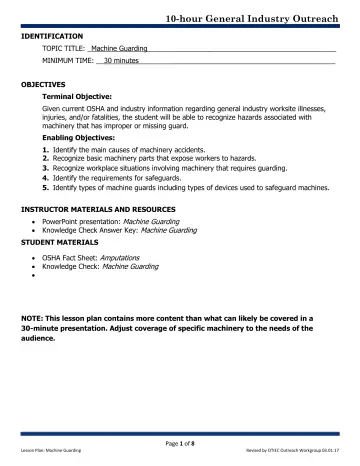
8 slidesMachine Guarding: Lesson Plan (OSHA 10-Hour General Industry Outreach)
Instructor lesson plan (objectives, timing, teaching steps) for the OSHA General Industry machine guarding outreach deck.
U.S. Department of Labor, OSHA (with the OTIEC Outreach Workgroup)Public domain
pdf
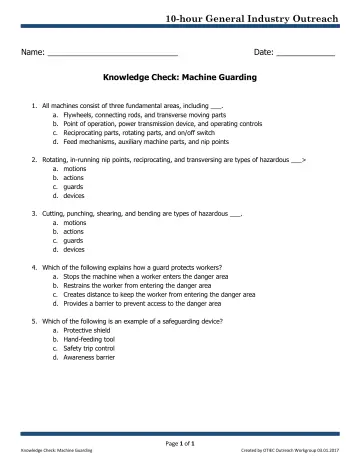
1 slidesMachine Guarding: Knowledge Check (OSHA 10-Hour General Industry Outreach)
Student knowledge-check quiz for the OSHA General Industry machine guarding outreach deck.
U.S. Department of Labor, OSHA (with the OTIEC Outreach Workgroup)Public domain
pdfes
54 slidesProtección de maquinaria (Capacitación de Extensión de 10 horas de OSHA, Industria General)
Spanish edition of OSHA's 10-hour General Industry Outreach deck on machine guarding (PDF slides; OSHA does not publish an editable Spanish PowerPoint).
U.S. Department of Labor, OSHA (with the OTIEC Outreach Workgroup)Public domain