1 / 60Use ← → to flip
Amputations: Safeguarding Equipment and Protecting Employees from Amputations (OSHA 3170)
OSHA guide to safeguarding machinery and preventing amputations.
Page text
· 57 of 60 pages · by U.S. Department of Labor, OSHA
The words on each page as the author wrote them, read from the file by software so they can be searched. Layout, pictures and tables are not shown here, and long pages are shortened: the pages above and the download are the original.
- Page 1
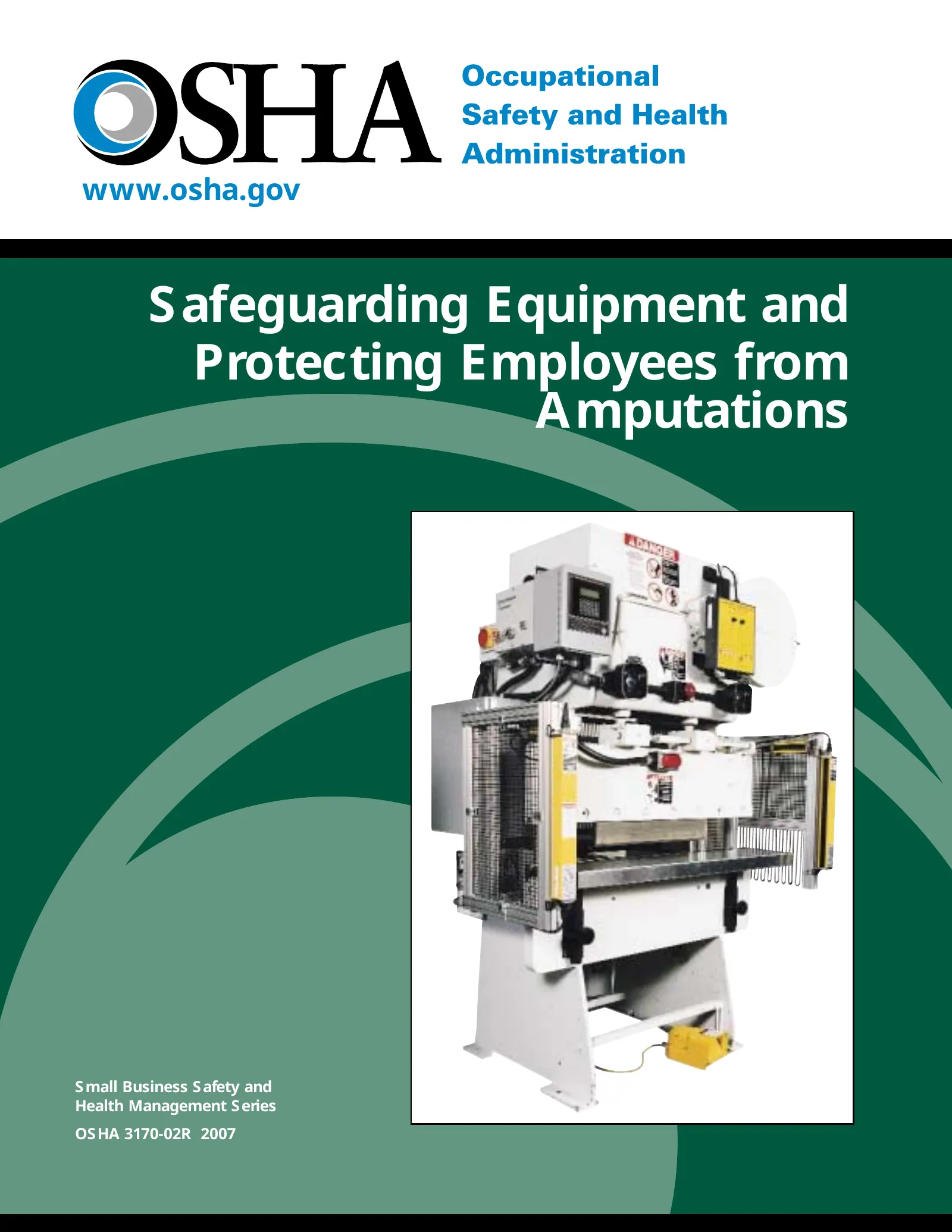
Safeguarding Equipment and Protecting Employees from Amputations
- www.osha.gov
- Small Business Safety and Health Management Series
- OSHA 3170-02R 2007
- Page 2
- Employers are responsible for providing a safe and healthful workplace for their employees. OSHA’s role is to assure the safety and health of America’s employees by setting and enforcing standards; providing training, outreach, and education; establishing partnerships; and encouraging continual improvement in workplace safety and health.
- This publication is in the public domain and may be reproduced, fully or partially, without permission. Source credit is requested, but not required.
- …
- Page 3
Safeguarding Equipment and Protecting Employees from Amputations
- Occupational Safety and Health Administration
- U.S. Department of Labor
- OSHA 3170-02R
- 2007
- Page 4
- This OSHA publication is not a standard or regulation, and it creates no new legal obligations. The publication is advisory in nature, informational in content, and is intended to assist employers in providing a safe and healthful workplace. The Occupational Safety and Health Act requires employers to comply with hazard-specific safety and health standards. …
- …
- Page 5
Contents
- Introduction
- OSHA Standards
- National Consensus Standards
- Safeguarding Roll-Forming and
- Roll-Bending Machines
- Other Controls for Roll-Forming and
- Recognizing Amputation Hazards
- Hazards of Shearing Machines
- Hazardous Mechanical Components
- Safeguarding Shearing Machines
- Hazardous Mechanical Motions
- Other Controls for Shearing Machines
- Hazardous Activities
- Hazards of Food Slicers
- Hazard Analysis
- Safeguarding and Other Controls for
- Hazards of Meat Grinders
- Food Slicers
- Controlling Amputation Hazards
- …
- Page 6
List of Tables
- Figure 22. Properly Guarded Foot Control
- Table
- 1. Commonly Used Machine Guards
- Table
- 2. Types of Safeguarding Devices
- Figure 23. Part Revolution Mechanical Power
- Press with a Two-Hand Control
- Figure 24. Hand-Feeding Tools Used in
- List of Figures
- Conjunction with Pullbacks
- Figure
- 1. Rotating Motion
- Figure
- 2. Reciprocating Motion
- Figure 25. Power Press Brake Bending Metal 25
- Figure
- Figure 26. Two-Person Power Press Brake
- Figure
- 4. Cutting Action
- Figure
- 5. Punching Action
- Figure 27.
- Transversing Motion
- …
- Page 7
Introduction
- Amputations are among the most severe and disabling workplace injuries that often result in permanent disability. They are widespread and involve various activities and equipment. (The U.S. Bureau of Labor Statistics 2005 annual survey data indicated that there were 8,450 non-fatal amputation cases
- involving days away from work – for all private industry. Approximately forty-four percent (44%) of all workplace amputations occurred in the manufacturing sector and the rest occurred across the construction…
- …
- Page 8
Concrete and Masonry Construction
- 29 CFR Part 1926, Subpart Q
- 1926.702 – Requirements for equipment and tools
- Consult these standards directly to ensure full compliance with the provisions as this publication is not a substitute for the standards. States with OSHA-approved plans have at least equivalent standards. For detailed information about machine guarding and lockout/tagout, see the following resources:
- Machine Guarding Safety and Health Topics Page (http://www.osha.gov/SLTC/machine guarding/index.html)
- …
- Page 9
Recognizing Amputation Hazards
- To prevent employee amputations, you and your employees must first be able to recognize the contributing factors, such as the hazardous energy associated with your machinery and the specific employee activities performed with the mechanical operation. Understanding the mechanical components of machinery, the hazardous mechanical motion that occurs at or near these components and specific employee activities performed in conjunction with machinery operation will help employees avoid injury.
- …
- Page 10
Figure 7 Bending Action Figure 5 Punching Action
- Punching Action (Figure 5) begins when power causes the machine to hit a slide (ram) to stamp or blank metal or other material. The hazard occurs at the point of operation where the employee typically inserts, holds, or withdraws the stock by hand.
- Bending Action (Figure 7) is power applied to a slide to draw or stamp metal or other materials in a bending motion. The hazard occurs at the point of operation where the employee typically inserts, holds, or withdraws the stock…
- …
- Page 11
Controlling Amputation Hazards
- Hazardous Activities
- Employees operating and caring for machinery perform various activities that present potential amputation hazards.
- Machine set-up/threading/preparation,*
- Machine inspection,*
- Normal production operations,
- Clearing jams,*
- Machine adjustments,*
- Cleaning of machine,*
- Lubricating of machine parts,* and Scheduled and unscheduled maintenance.*
- Safeguarding is essential for protecting employees from needless and preventable injury. A good rule to remember is:
- …
- Page 12
- available with safeguards installed by the manufacturer, but used equipment may not be.
- If machinery has no safeguards, you may be able to purchase safeguards from the original machine manufacturer or from an after-market manufacturer. You can also build and install the safeguards in-house. Safeguarding equipment should be designed and installed only by technically qualified professionals. …
- …
- Page 13
Figure 11 Self-Adjusting Guard on a Radial Saw
- remove them. Generally, guards are designed not to obstruct the operator’s view or to prevent employees from doing a job.
- In some cases, guarding may be used as an alternative to lockout/tagout because employees can safely service or maintain machines with a guard in place. For example, polycarbonate and wire-mesh guards provide greater visibility and can be used to allow maintenance employees to safely observe system components. …
- …
- Page 14
Table 1. Commonly Used Machine Guards
- Types of Machine Guards
- Type
- Method of Safeguarding
- Advantages
- Limitations
- Fixed
- Barrier that allows for stock feeding but does not permit operator to reach the danger area.
- Can be constructed to suit many applications.
- Permanently encloses the point of operation or hazard area.
- Provides protection against machine repeat.
- Allows simple, in-plant construction, with minimal maintenance.
- Sometimes not practical for changing production runs involving different size stock or feeding…
- …
- Page 15
Safeguarding Devices
- Safeguarding devices are controls or attachments that, when properly designed, applied and used, usually prevent inadvertent access by employees to hazardous machine areas by:
- Preventing hazardous machine component operation if your hand or body part is inadvertently placed in the danger area;
- Restraining or withdrawing your hands from the danger area during machine operation; Requiring the use of both of your hands on machine controls (or the use of one hand if the control is mounted at a safe…
- …
- Page 16
Table 2. Types of Safeguarding Devices (continued)
- Types of Machine Guards
- Type
- Method of Safeguarding
- Advantages
- Limitations
- Restraint Devices
- Wrists are connected by cords and secured to a fixed anchor point which limit operator’s hands from reaching the point of operation at any time.
- Simple, few moving parts; requires little maintenance.
- Operator cannot reach into the danger area.
- Little risk of mechanical failure; provides protection even in the event of mechanical repeat.
- …
- Page 17
Table 2. Types of Safeguarding Devices (continued)
- Types of Machine Guards
- Type
- Method of Safeguarding
- Advantages
- Limitations
- Two-
- Hand
- Control
- Requires concurrent and continued use of both hands, preventing them from entering the danger area.
- Operator’s hands are at a predetermined safety distance.
- Operator’s hands are free to pick up new parts after completion of first part of cycle.
- Requires a partial cycle machine with a brake and anti-repeat feature.
- Operator may make devices without anti-tiedown ineffective.
- …
- Page 18
Secondary Safeguarding Methods
- Figure 14 Restraint Device on a Power Press
- Figure 17 Power Press with a Gate
- Gate
- Figure 15 Presence-Sensing Device on a Power Press
- Control
- Box
- Emergency Stop
- Press
- Bed
- Light
- Curtain
- Guarded
- Foot Control
- Figure 16 Two-Hand Control
- Key Selector Capable of Being Supervised
- Top Stop
- Light Indicator
- Other safeguarding methods, such as those described in the Performance Criteria for Safeguarding (ANSI B11.19-2003), may also provide employees with some protection from machine hazards. …
- …
- Page 19
- ers because primary safeguarding methods are not possible. However, probe detection devices do not prevent inadvertent access to the point-of-operation danger area; rather, they serve as a warning mechanism and may prevent the initiation of or stop the machine cycle if an employee’s hand or finger(s) is too close to the hazard area.
- A safety edge device (sometimes called a bump switch) is another type of safeguard that detects the presence of an employee when they are in contact with the device’s sensing edge. …
- …
- Page 20
Emergency Stop Devices
- Emergency stop devices are designed to be used in reaction to an incident or hazardous situation and, as such, are not considered machine safeguarding. These devices, such as buttons, ropepulls, cable-pulls, or pressure-sensitive body bars, neither detect nor prevent employee exposure to machine hazards; rather they initiate an action to stop hazardous motion when an employee recognizes a hazard and activates them. (See Figure 20.)
- Figure 19 Shuttle Ejection Mechanism
- Point of Operation
- Guard
- Pan
- …
- Page 21
- ing or safeguarding devices and they need to be designed to allow employees’ hands to remain outside of the machine danger area. Using hand tools requires close supervision to ensure that the operator does not bypass their use to increase production. It is recommended that these tools be stored near the operation to promote their use.
- To prevent injury and repetitive trauma disorders, hand-feeding tools should be shatterproof and ergonomically designed for the specific task being performed. …
- …
- Page 22
Specific Machine Hazards and Safeguarding Methods
- tenance program needs to be established based upon the:
- As discussed earlier, 8,450 known non-fatal amputation cases (involving days away from work) occurred in 2005 for all of private industry. The most prevalent injury source was, by far, machinery, which accounted for approximately 60% (5,080 instances) of the amputation cases. …
- …
- Page 23
- is removed either automatically or manually, a new work-piece is fed into the die, and the process is repeated. (See Figure 23.) makes a single stroke. To stop the press, the reverse takes place. Thus, the part-revolution clutch can be disengaged at any time during the cycle to stop the cycle before it completes the downstroke.
- Figure 23 Part Revolution Mechanical Power Press with a Two-Hand Control
- Control
- Box
- Light
- Curtain
- Control
- Box
- Controls for Machines with Clutches
- …
- Page 24
- Controls of a single-operator press bypassed by having a coworker activate the controls while the operator positions or aligns parts in the die, or repairs or troubleshoots the press.
- Failure to properly disable, isolate press energy sources, and lockout/tagout presses before an employee performs servicing or maintenance work.
- Case History #1
- While using an unguarded, foot-pedal-operated, full-revolution mechanical power press that made trip collars for wood stoves, an employee used his hands to feed and remove finished…
- …
- Page 25
Figure 24 Hand-Feeding Tools Used in Conjunction with Pullbacks on a Power Press
- “No Hands-in-Die” Policy
- In general, a “no-hands-in-die” policy needs to be implemented and followed whenever possible
- that is, in the event the press is not designed for “hands-in-die” production work. Under this policy, operators must never place their hands in the die area (point-of-operation) while performing normal production operations. Adherence to this safety practice will reduce the risk of point of operation amputations.
- …
- Page 26
- need to integrate both point-of-operation safeguarding method(s) for slide positioning as well as LOTO procedures for the die setting operation.
- Additional power press energy control precautions (e.g., use of safety blocks; LOTO the press disconnect switch if re-energization presents a hazard) will be necessary if employees need to place their hands/arms in a press working area (the space between the bolster plate and the ram/slide) to perform the servicing and/or maintenance activity (such as adjusting, cleaning or…
- …
- Page 27
Power Press Brakes
- Power press brakes are similar to mechanical power presses in that they use vertical reciprocating motion and are used for repetitive tasks. Press brake operation is either mechanical or hydraulic. Press brakes are either general-purpose or special-purpose brakes, according to ANSI B11.3-2002, Safety Requirements for Power Press Brakes. General purpose press brakes have a single operator control station. …
- …
- Page 28
Figure 26 Two-Person Power Press Brake Operation with Pullbacks
- Point of Operation
- Other Controls for Power Press Brakes
- The following are some secondary safeguarding methods and complementary equipment that may be used to supplement primary safeguarding or alone or in combination when primary safeguarding methods are not feasible:
- Press Bed
- Safe distance safeguarding,
- Safe holding safeguarding,
- Safe work procedures,
- Work-holding equipment (such as back gauges), Properly designed and protected foot pedals, and
- …
- Page 29
Cleaning and maintaining a conveyor, especially when it is still operating.
- to the material conveyed, the location of the conveyor, and the proximity of the conveyer to the employees. Types include unpowered and powered, live roller, slat, chain, screw, and pneumatic. Conveyors eliminate or reduce manual material handling tasks, but they present amputation hazards associated with mechanical motion. (See Figures 27 through 30 for examples of common conveyors.)
- …
- Page 30
Figure 30 Slat Conveyor
- In-Running
- Nip Point
- medium. Secondary safeguarding methods for hazard control include the use of standard railings or fencing, or safeguarding by distance (location), and installing hazard awareness devices, such as pre-start-up signals and warning signs.
- Slats
- Fixed Guard
- Fixed Guard Over
- Power-Transmission
- Apparatus
- Safeguarding Conveyors
- As conveyor hazards vary depending on the application, employers need to look at each conveyor to evaluate and determine what primary safeguarding methods and…
- …
- Page 31
- Controls: Sometimes, moving chains cannot be enclosed without impairing the functioning of the conveyor. However, in some cases, barrier guards may be installed around the moving parts for hazard enclosure purposes or, in other instances, nip and shear points may be eliminated by placing a guard at the nip point or shear point. Other secondary safeguarding options include safeguarding by distance (location) and the use of awareness devices.
- Roller Conveyors
- …
- Page 32
- Perform servicing and maintenance under an energy control program in accordance with the Control of hazardous energy (lockout/tagout), 29 CFR 1910.147, standard. For example, instruct employees to lubricate, align, service, and maintain conveyors when the conveyor is locked or tagged out if the task would expose them to an area of the conveyor (or adjacent machinery) where hazardous energy exists.
- Minor Servicing
- At times, OSHA recognizes that some minor servicing may have to be performed during normal production…
- …
- Page 33
Figure 31 Roll-to-Roll Offset Printing Press
- Case History #8
- An employee was adding ink at the top of a printing press when he spotted a small piece of wood in the area of the moving rollers. He caught his hand in the moving rollers as he attempted to remove the wood and had to have his forearm surgically amputated.
- Case History #9
- An offset printing press operator lost his right hand while attempting to remove dried ink on a moving roller using a rag. …
- …
- Page 34
- and simultaneously access any unguarded danger area or otherwise reach into the danger zone while the press is operating.
- Other Controls for Printing Presses
- The following are some secondary safeguarding methods, work practices, and complementary equipment that may be used to supplement primary safeguarding or alone or in combination when primary safeguarding methods are not feasible:
- Make sure that printing presses attended by more than one operator or ones outside of the operator’s viewing area are equipped with visual…
- …
- Page 35
Hazards of Roll-Forming and Roll-Bending Machines
- Roll-forming and roll-bending machines primarily perform metal bending, rolling, or shaping functions. Roll-forming is the process of bending a continuous strip of metal to gradually form a predetermined shape using a self-contained machine. Roll-forming machines contain a series of rolls that may or may not have braking systems. …
- …
- Page 36
- not differ greatly from run to run, a fixed guard may be preferable. If the stock or end-product is variable, however, an adjustable guard may be more suitable.
- Install fixed point of operation guards to cover the sides of the rollers to prevent entry of clothing and parts of your body into the in-going nip points of the rollers.
- Install fixed or interlocked guards to cover any other rotating parts, such as power-transmission apparatus.
- Install and use properly applied presence-sensing safeguarding devices (light…
- …
- Page 37
Hazards of Shearing Machines
- Mechanical power shears contain a ram for their shearing action. The ram moves a non-rotary blade at a constant rate past the edge of a fixed blade. Shears may be mechanically, hydraulically, hydra-mechanically, pneumatically, or manually powered and are used to perform numerous functions such as squaring, cropping, and cutting to length.
- In the basic shear operation, stock is fed into the point of operation between two blades. A holddown may then be activated that applies pressure to the…
- …
- Page 38
Case History #13
- An employee was cutting material with a 50-inch guillotine shear equipped with two-hand trip buttons to prevent employees from reaching into the blade area. He had taped up one of the buttons and used his knee to trip the other button. With both hands under the blade, he inadvertently hit the free button with his knee. This activated a stroke of the blade which amputated both of his hands just below the wrists.
- Source: OSHA IMIS Accident Investigation Database.
- Safeguarding Shearing Machines
- …
- Page 39
- training under the direct supervision of experienced operators until they can work safely on their own.
- Instruct employees to perform routine maintenance on the clutch and braking systems. Instruct employees to inspect all guarding to ensure that it is in place properly before the machine is operated.
- Instruct supervisors to ensure that operators keep their hands out of the shear’s point of operation at all times while the machine is energized and not properly locked out.
- …
- Page 40
Hazards of Meat Grinders
- Case History #15
- An employee was cleaning a meat slicer that was turned off but was still plugged in. He inadvertently turned the machine on by bumping the on/off switch, resulting in an amputation of his right ring finger.
- Electric meat grinders typically have a feeding tray attached to a tubular throat, a screw auger that pushes meat to the cutting blade and through the cutting plate, an on/off switch, a reverse switch, and a plunger. (See Figure 38.)
- Figure 38 Stainless Steel Meat Grinder
- …
- Page 41
- she reassembled it. Also, she did not use the plunger provided for feeding the meat into the grinder. The machine pulled her hand into the 3-inch diameter auger and amputated it above the wrist.
- Control of hazardous energy (lockout/tagout), 29 CFR 1910.147, standard. You can avoid slicer lockout/tagout if the equipment is cord-and-plug connected equipment simply by having exclusive control over the attachment plug after you shut the slicer off and unplug it from the energy source.
- …
- Page 42
- Figure 39 Stainless Steel Meat-Cutting Band Saw
- moved too close to the saw blade. The employee was not using the pusher guard provided for the saw.
- Adjustable
- Point of Operation
- Guard
- Source: OSHA IMIS Accident Investigation Database.
- Fixed
- Power
- Transmission
- Apparatus
- Guard
- Safeguarding and Other Controls for Meat-Cutting Band Saws
- Primary safeguarding methods that you can use include the following:
- Blade
- Sliding
- Table
- Pushing
- Guard
- Operator
- Control
- …
- Page 43
- Instruct operators not to wear gloves, jewelry, or loose-fitting clothing while operating a band saw and to secure long hair in a net or cap. Prohibit operators from removing meat from the band saw while the saw blade is still moving. Instruct operators to turn off and unplug band saws when not in use or when left unattended for any period of time.
- Conduct periodic inspections of the saw operation to ensure compliance.
- Perform servicing and maintenance under an energy control program in accordance with the Control of…
- …
- Page 44
Case History #21
- A machinist amputated his left index finger at the first joint while drilling holes in a machined part. As he moved the part to begin drilling another hole, his gloved hand got caught in the drill bit.
- Source: OSHA IMIS Accident Investigation Database.
- Safeguarding and Other Controls for Drill Presses
- For drill presses, you must be protected from the rotating chuck and swarf that is produced by the drill bit. Guarding at the point-of-operation is difficult because of the nature of the drilling press. …
- …
- Page 45
Figure 41 Bed Mill
- Applicable Standards
- 29 CFR 1910.147, Control of hazardous energy (lockout/tagout).
- 29 CFR 1910.212, General requirements for all machines.
- 29 CFR 1910.213, Woodworking machinery requirements.
- 29 CFR 1910.219, Mechanical power-transmission apparatus.
- Control System
- Milling Cutter
- Milling
- Bed
- Sources of Additional Information
- OSHA Publication 3067, Concepts and Techniques of Machine Safeguarding (http://www.osha.gov/Publications/Mach_ Safeguard/toc.html)
- …
- Page 46
Case History #23
- An employee was using a milling machine to cut metal samples to length. After a part had been cut, the employee needed to gauge the part size. While he was checking the edge of the sample, the blade caught the tip of his glove, pulled his hand into the cutting area, and amputated his right ring finger and part of his middle finger.
- Source: OSHA IMIS Accident Investigation Database.
- Safeguarding and Other Controls for Milling Machines
- …
- Page 47
Sources of Additional Information
- OSHA Publication 3067, Concepts and Techniques of Machine Safeguarding (http://www.osha.gov/Publications/Mach_ Safeguard/toc.html)
- OSHA Machine Guarding eTool (http://www.osha.gov/SLTC/etools/machineguarding/index. html)
- OSHA Lockout/Tagout Interactive Training Program (http://www.osha.gov/dts/osta/ lototraining/index.htm)
- National Safety Council, Accident Prevention Manual for Industrial Operations: Engineering and Technology. 10th Ed. Itasca, IL
- …
- Page 48
Safeguarding and Other Controls for Grinding Machines
- You can help prevent employee accidents and injuries by using primary safeguarding methods.
- Here are some examples:
- Install safety guards that cover the spindle end, nut, and flange projections or otherwise ensure adequate operator protection;
- Install adjustable and rigid work rests on offhand grinding machines; and
- Install guards over power belts and drives.
- The following are some secondary safeguarding methods, work practices, and complementary equipment that may be…
- …
- Page 49
Figure 43 Paper Slitter
- Safeguarding and Other Controls for Slitters
- The following primary safeguards may be used to protect employees from the hazardous portions of the slitter and auxiliary equipment:
- Amputations often occur when clothing or body parts come in contact with slitter blades or get caught in the movement of coils and rolls. Here are some examples:
- Employees can inadvertently get their fingers and hands caught in the in-going nip points of the slitter or associated machinery such as rewinders.
- …
- Page 50
- Perform servicing and maintenance under an energy control program in accordance with the Control of hazardous energy (lockout/tagout), 29 CFR 1910.147, standard.
- Applicable Standards
- 29 CFR 1910.147, Control of hazardous energy (lockout/tagout)
- 29 CFR 1910.212, General requirements for all machines
- 29 CFR 1910.219, Mechanical power-transmission apparatus
- Sources of Additional Information
- OSHA Publication 3067, Concepts and Techniques of Machine Safeguarding
- (http://www.osha.gov/Publications/Mach_
- Safeguard/toc.html)
- …
- Page 51
OSHA Assistance
- OSHA can provide extensive help through a variety of programs, including technical assistance about effective safety and health programs, state plans, workplace consultations, voluntary protection programs, strategic partnerships, training and education, and more. An overall commitment to workplace safety and health can add value to your business, to your workplace, and to your life.
- Safety and Health Program Management Guidelines Effective management of employee safety and health protection is a decisive…
- …
- Page 52
- one-on-one relationships between OSHA and individual worksites, most strategic partnerships seek to have a broader impact by building cooperative relationships with groups of employers and employees. These partnerships are voluntary, cooperative relationships between OSHA, employers, employee representatives, and others (e.g., trade unions, trade and professional associations, universities, and other government agencies).
- For more information on this and other cooperative programs, contact your nearest OSHA office, or…
- …
- Page 53
References
- American National Standards Institute/ Conveyor Equipment Manufacturers
- Association
- American National Standards Institute
- ANSI B5.52M-1980 (R1994), Presses, General Purpose, Single Point, Gap Type, Mechanical Power (Metric)
- ANSI/CEMA 350-2003, Screw Conveyors for Bulk Material
- ANSI/CEMA 401-2003, Unit Handling
- Conveyors—Roller Conveyors—Non-powered
- ANSI B5.37—1970 (R1994), External Cylindrical
- Grinding Machines—Centerless
- ANSI/CEMA 402-2003, Unit Handling
- Conveyors—Belt Conveyors
- …
- Page 54
Occupational Safety and Health
- Administration Standards
- Administration Training Programs
- 29 CFR 1910.147—Control of hazardous energy
- (lockout/tagout).
- 29 CFR 1910.211—Definitions.
- 29 CFR 1910.212—General requirements for all machines.
- 29 CFR 1910.213—Woodworking machinery requirements.
- 29 CFR 1910.215—Abrasive wheel machinery.
- 29 CFR 1910.217—Mechanical power presses.
- 29 CFR 1910.219—Mechanical power-transmission apparatus.
- 29 CFR 1926.300—General requirements.
- 29 CFR 1926.301—Hand tools.
- …
- Page 55
Appendix A. Amputation Hazards Not Covered in this Guide
- Amputation Hazards Associated with Plastics Machinery
- The following amputation hazards and related activities are not specifically covered in detail in this document. They are either covered in other OSHA publications or specific OSHA standards. While you may find the general hazard recognition and machine guarding concepts presented in the Recognizing Amputations Hazards and Controlling Amputation Hazards sections of this document helpful, please refer to the…
- …
- Page 56
Appendix B. Amputation Hazards Associated with Other Equipment and Activities
- Although machinery is associated with amputations more frequently than any other source, amputations can result from other sources. This appendix briefly identifies other equipment and activities associated with amputations:
- Powered and Non-Powered Hand Tools. Portable hand tools, such as saws, grinders, shears, and bolt cutters are associated with amputations in the construction, retail trade, and services industries.
- …
- Page 57
Appendix C. OSHA Regional Offices
- Region I
- (CT,* ME, MA, NH, RI, VT*)
- JFK Federal Building, Room E340
- Boston, MA 02203
- (617) 565-9860
- Region VIII
- (CO, MT, ND, SD, UT,* WY*)
- 1999 Broadway, Suite 1690
- PO Box 46550
- Denver, CO 80202-5716
- (720) 264-6550
- Region II
- (NJ,* NY,* PR,* VI*)
- 201 Varick Street, Room 670
- New York, NY 10014
- (212) 337-2378
- Region IX
- (American Samoa, AZ,* CA,* HI,* NV,*
- Northern Mariana Islands)
- 71 Stevenson Street, Room 420
- San Francisco, CA 94105
- (415) 975-4310
- Region III
- (DE, DC, MD,* PA, VA,* WV)
- …
More on Machine Guarding
pptx
54 slidesMachine Guarding (OSHA 10-Hour General Industry Outreach)
OSHA's own 10-hour General Industry Outreach deck on machine guarding (v. 03-01-17), editable PowerPoint with trainer notes.
U.S. Department of Labor, OSHA (with the OTIEC Outreach Workgroup)Public domain
pdf
8 slidesMachine Guarding: Lesson Plan (OSHA 10-Hour General Industry Outreach)
Instructor lesson plan (objectives, timing, teaching steps) for the OSHA General Industry machine guarding outreach deck.
U.S. Department of Labor, OSHA (with the OTIEC Outreach Workgroup)Public domain
pdf
1 slidesMachine Guarding: Knowledge Check (OSHA 10-Hour General Industry Outreach)
Student knowledge-check quiz for the OSHA General Industry machine guarding outreach deck.
U.S. Department of Labor, OSHA (with the OTIEC Outreach Workgroup)Public domain