OSHA fact sheet or bulletin, for General Industry classes.
Page text
· 2 pages · by U.S. Department of Labor, OSHA
The words on each page as the author wrote them, read from the file by software so they can be searched. Layout, pictures and tables are not shown here: the pages above and the download are the original.
- Page 1
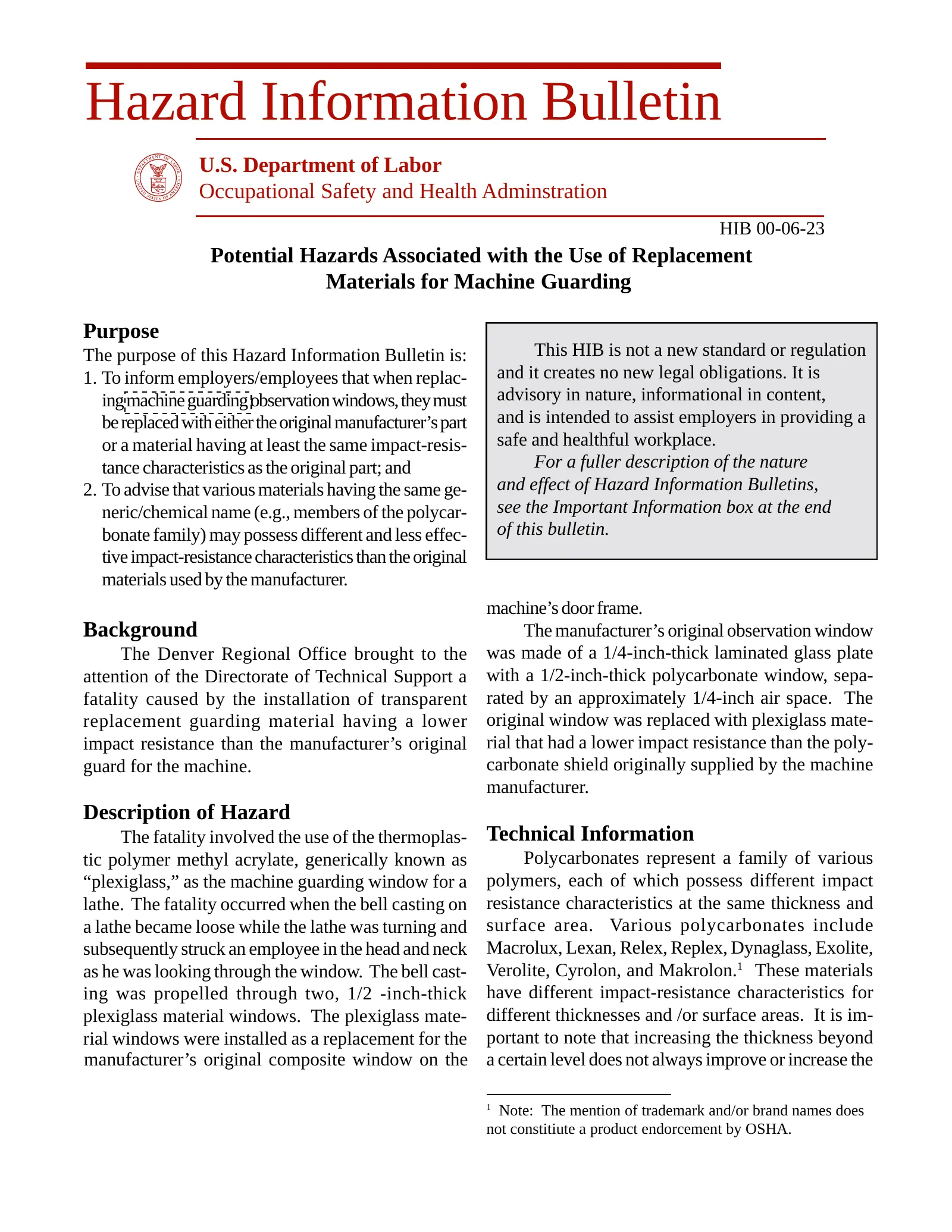
Hazard Information Bulletin
- U.S. Department of Labor
- Occupational Safety and Health Adminstration
- HIB 00-06-23
- Potential Hazards Associated with the Use of Replacement
- Materials for Machine Guarding
- Purpose
- This HIB is not a new standard or regulation and it creates no new legal obligations. It is advisory in nature, informational in content, and is intended to assist employers in providing a safe and healthful workplace.
- For a fuller description of the nature and effect of Hazard Information Bulletins, see the Important Information box at the end of this bulletin.
- The purpose of this Hazard Information Bulletin is:
- 1. To inform employers/employees that when replacing machine guarding observation windows, they must be replaced with either the original manufacturer’s part or a material having at least the same impact-resistance characteristics as the original part; and
- 2. To advise that various materials having the same generic/chemical name (e.g., members of the polycarbonate family) may possess different and less effective impact-resistance characteristics than the original materials used by the manufacturer.
- Background
- The Denver Regional Office brought to the attention of the Directorate of Technical Support a fatality caused by the installation of transparent replacement guarding material having a lower impact resistance than the manufacturer’s original guard for the machine.
- machine’s door frame.
- The manufacturer’s original observation window was made of a 1/4-inch-thick laminated glass plate with a 1/2-inch-thick polycarbonate window, separated by an approximately 1/4-inch air space. The original window was replaced with plexiglass material that had a lower impact resistance than the polycarbonate shield originally supplied by the machine manufacturer.
- Description of Hazard
- The fatality involved the use of the thermoplastic polymer methyl acrylate, generically known as “plexiglass,” as the machine guarding window for a lathe. The fatality occurred when the bell casting on a lathe became loose while the lathe was turning and subsequently struck an employee in the head and neck as he was looking through the window. The bell casting was propelled through two, 1/2 -inch-thick plexiglass material windows. The plexiglass material windows were installed as a replacement for the manufacturer’s original composite window on the
- Technical Information
- Polycarbonates represent a family of various polymers, each of which possess different impact resistance characteristics at the same thickness and surface area. Various polycarbonates include
- Macrolux, Lexan, Relex, Replex, Dynaglass, Exolite, Verolite, Cyrolon, and Makrolon. 1 These materials have different impact-resistance characteristics for different thicknesses and /or surface areas. It is important to note that increasing the thickness beyond a certain level does not always improve or increase the
- Note: The mention of trademark and/or brand names does not constitiute a product endorcement by OSHA.
- Page 2
Conclusions
- impact resistance characteristics.
- Replacement machine guard windows must meet or exceed the manufacturer’s original design specifications.
- Recommendations
- When replacing original equipment parts, it is recommended that employers review the specifications and ensure that the specifications of replacement materials meet or exceed the original design specifications.
- Important Information
- on the Nature and Effect
- of Hazard Information Bulletins
- The Directorate of Technical Support issues Hazard Information Bulletins (HIBs) in accordance with OSHA Instruction CPL 2.65 to provide relevant information regarding unrecognized or misunderstood health and safety hazards, as well as potential hazards associated with particular materials, devices, techniques, and engineering controls. HIBs are initiated based on information provided by the field staff, studies, reports, and concerns expressed by safety and health professionals, employers, employees and their representatives, and the public. HIBs are developed based on a thorough evaluation of available facts and in coordination with appropriate parties.
- The Occupational Safety and Health Act requires employers to comply with hazardspecific safety and health standards. In addition, employers must provide their employees with a workplace free from recognized hazards likely to cause death or serious physical harm under Section 5(a)(1), the General Duty Clause of the Act. Employers can be cited for violating the General Duty Clause if there is a recognized hazard and they do not take steps to prevent or abate the hazard. However, failure to implement HIB recommendations is not, in itself, a violation of the General Duty Clause. Citations can only be based on standards, regulations, and the General Duty Clause.
- Further information about this Bulletin may be obtained by contacting OSHA’s Directorate of Technical Support at 202-693-2300.