1 / 3Use ← → to flip
Amputation: Preventing Cuts and Amputations from Food Slicers and Meat Grinders Fact Sheet (OSHA FS 3794)
OSHA fact sheet or bulletin, for General Industry classes.
Page text
· 3 pages · by U.S. Department of Labor, OSHA
The words on each page as the author wrote them, read from the file by software so they can be searched. Layout, pictures and tables are not shown here: the pages above and the download are the original.
- Page 1
FactSheet
- Preventing Cuts and Amputations from Food Slicers and Meat Grinders
- Food slicers and meat grinders used in food service industries such as grocery stores, restaurants and delicatessens can cause serious cuts and amputations when workers operate, perform maintenance, or clean the machines. This fact sheet provides employers with the requirements of the Occupational Safety and Health Administration (OSHA) and ways to prevent cuts and amputations in workplaces with food slicers and meat grinders.
- Introduction
- Amputations are among the most severe workplace injuries and often result in permanent disability. In 2013, at least 4,000 incidents involving meat slicers occurred that resulted in lost workdays.
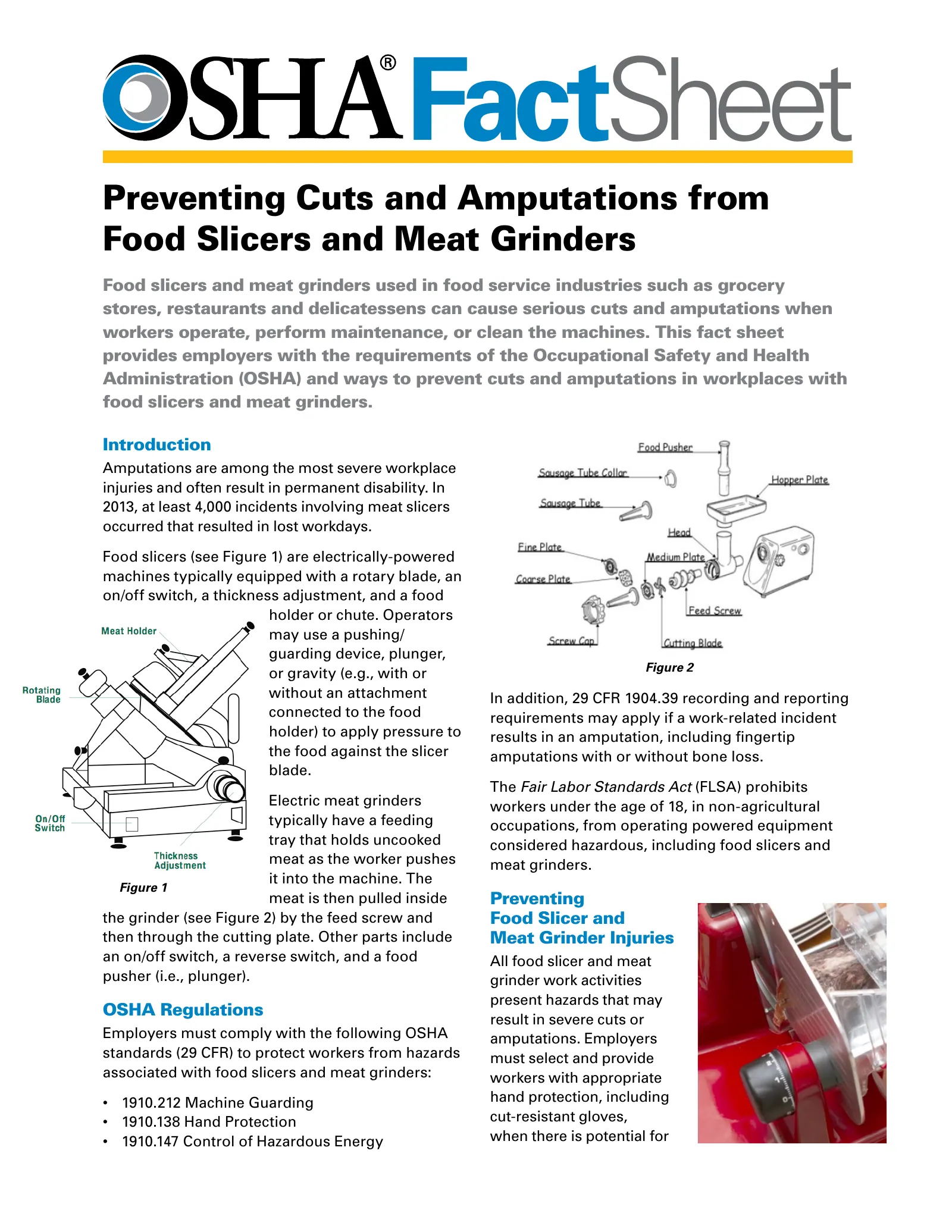
- Food slicers (see Figure 1) are electrically-powered machines typically equipped with a rotary blade, an on/off switch, a thickness adjustment, and a food holder or chute. Operators may use a pushing/ guarding device, plunger, or gravity (e.g., with or without an attachment connected to the food holder) to apply pressure to the food against the slicer blade.
- Electric meat grinders
- typically have a feeding
- tray that holds uncooked
- meat as the worker pushes it into the machine. The
- Figure 1
- meat is then pulled inside the grinder (see Figure 2) by the feed screw and then through the cutting plate. Other parts include an on/off switch, a reverse switch, and a food pusher (i.e., plunger).
- OSHA Regulations
- Employers must comply with the following OSHA standards (29 CFR) to protect workers from hazards associated with food slicers and meat grinders:
- 1910.212 Machine Guarding
- 1910.138 Hand Protection
- 1910.147 Control of Hazardous Energy
- Figure 2
- In addition, 29 CFR 1904.39 recording and reporting requirements may apply if a work-related incident results in an amputation, including fingertip amputations with or without bone loss.
- The Fair Labor Standards Act (FLSA) prohibits workers under the age of 18, in non-agricultural occupations, from operating powered equipment considered hazardous, including food slicers and meat grinders.
- Preventing
- Food Slicer and Meat Grinder Injuries
- All food slicer and meat grinder work activities present hazards that may result in severe cuts or amputations. Employers must select and provide workers with appropriate hand protection, including cut-resistant gloves, when there is potential for
- Page 2
Preventing Worker Injuries When Using a Food Slicer
- workers’ hands to come in contact with the blades. Safe work procedures also include fully retracting (zero) the blade when the slicer is not in use or when cleaning the blade. Employers should provide meat grinder operators with properly sized plungers to eliminate the need for their hands to enter the feed throat during operation.
- Operating and cleaning food slicers and meat grinders are two separate work activities that may require additional hazard controls.
- Worker training topics should include to:
- Only use a proper plunger when feeding meat into grinders.
- Operate grinders only when feeding trays and throats have been installed.
- Use the meat grinder only for its intended purpose.
- Turn off and unplug grinders when not in use or when left unattended for any period of time.
- Preventing Injuries When Maintaining/ Cleaning a Food Slicer or Meat Grinder
- When food slicers are in use, or turned off but still energized, the top and bottom of the slicer are hazardous areas where workers’ fingers and hands may contact the blade, causing serious cuts or amputations.
- Maintaining or cleaning a food slicer or meat grinder requires workers to remove protective guards. Employers must ensure that the food slicer or meat grinder will not unexpectedly start up and that workers’ hands are protected from severe cuts or amputations when guards are removed for maintenance or cleaning.
- Rotary blade food slicers must be used with guards that cover the unused portions of the slicer blade on both the top and bottom of the slicer. Employers should buy slicers already equipped with a feeding attachment on the food holder sliding mechanism or purchase this attachment separately and install it before use.
- A Lockout/Tagout (LO/TO) program is required under 29 CFR 1910.147 when the guards are removed unless the worker, maintaining or cleaning the unguarded machine, unplugs the food slicer from the energy source and has exclusive control of the plug to ensure that no one else can unexpectedly start the machine.
- A LO/TO program must include:
- Never put a hand behind the food chute guard.
- Never place food into the slicer by hand-feeding or hand pressure.
- Use a pushing/guarding device with chute-fed slicers.
- Use plungers to feed food into chute-fed slicers or use the feeding attachment located on the food holder.
- Turn off the food slicer when changing foods.
- Keep hands out of the danger zone on the back of the blade where the sliced food exits.
- Turn off and unplug slicers when not in use or when left unattended for any amount of time.
- Preventing Worker Injuries When Using a Meat Grinder
- Employers must ensure that meat grinders are retrofitted with a primary safeguard (e.g., properly designed tapered throat or fixed guard) if a worker’s hand may come into contact with the point-of-operation (i.e., the auger cutter area).
- Procedures for locking out or tagging out food slicers.
- Specific LO/TO training.
- Periodically review LO/TO procedures to ensure that all requirements are followed.
- The following safe maintenance/cleaning practices and procedures are explained in the manufacturer’s operating manual:
- Adding distance between the hand and sharp edges by using a cleaning device with a handle.
- Wiping the blade from the center outward to avoid contact with the blade edge.
- Never wiping toward the blade when cleaning the slicer table.
- Training Employers Should Provide
- Employers should ensure that all operators receive on-the-job training under the direct supervision of experienced operators until they can work safely on their own. Thorough operator training, including equipment-specific topics, should be based on the manufacturer’s recommendations and include the following safe operating and cleaning procedures for the equipment they will use:
- Page 3
Hazards associated with food slicers and meat grinders
- How to use the required safeguards and how they provide protection
- How and under what circumstances to remove safeguards (in most cases, by repair or maintenance personnel only)
- How to prevent unexpected start-up during cleaning or maintenance using appropriate LO/ TO procedures
- Hand protector usage and limitations
- What to do (e.g., contact the supervisor) if a safeguard is damaged, missing, or unable to provide adequate protection
- Training is necessary for new operators and maintenance or setup workers, when any new or altered safeguards are put in service, or when workers are assigned to a new machine or operation.
- Helpful Resources
- Youth Worker Safety in Restaurants eTool - Food Preparation, OSHA. www.osha.gov/SLTC/youth/restaurant/equipment_foodprep.html
- Safeguarding Equipment and Protecting
- Employees from Amputations, OSHA publication
- 3170-02R, 2007. www.osha.gov/Publications/
- OSHA3170/3170-02R-2007-English.html
- Meat Slicer Training and Safety, University of California Riverside. www.ehs.ucr.edu/safety/recipes/Meat Slicer Safety.pdf
- Additionally, many manufacturers have developed and posted videos on food slicer and meat grinder general use, cleaning, and safety. These videos are available on the manufacturer’s website or posted on popular video sharing websites.
- Contact OSHA
- For more information, to report an emergency, fatality or catastrophe, to order publications, to file a confidential complaint, or to request OSHA’s free on-site consultation service, contact your nearest OSHA office, visit www.osha.gov, or call OSHA at 1-800-321-OSHA (6742), TTY 1-877-889-5627.
- Workers’ Rights
- Workers have the right to:
- Working conditions that do not pose a risk of serious harm.
- Receive information and training (in a language and vocabulary the worker understands) about workplace hazards, methods to prevent them, and the OSHA standards that apply to their workplace.
- Review records of work-related injuries and illnesses.
- File a complaint asking OSHA to inspect their workplace if they believe there is a serious hazard or that their employer is not following OSHA’s rules. OSHA will keep all identities confidential.
- Exercise their rights under the law without retaliation, including reporting an injury or raising health and safety concerns with their employer or OSHA. If a worker has been retaliated against for using their rights, they must file a complaint with OSHA as soon as possible, but no later than 30 days.
- For more information, see OSHA’s
- Workers page.
- This is one in a series of informational fact sheets highlighting OSHA programs, policies or standards. It does not impose any new compliance requirements. For a comprehensive list of compliance requirements of OSHA standards or regulations, refer to Title 29 of the Code of Federal Regulations. This information will be made available to sensory-impaired individuals upon request. The voice phone is (202) 693-1999; teletypewriter (TTY) number: 1-877-889-5627.
- DTSEM FS-3794 05/2015
More on Machine Guarding
pptx
54 slidesMachine Guarding (OSHA 10-Hour General Industry Outreach)
OSHA's own 10-hour General Industry Outreach deck on machine guarding (v. 03-01-17), editable PowerPoint with trainer notes.
U.S. Department of Labor, OSHA (with the OTIEC Outreach Workgroup)Public domain
pdf
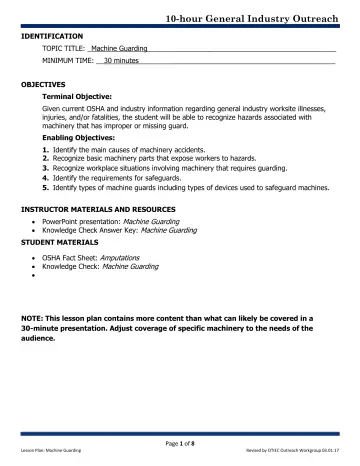
8 slidesMachine Guarding: Lesson Plan (OSHA 10-Hour General Industry Outreach)
Instructor lesson plan (objectives, timing, teaching steps) for the OSHA General Industry machine guarding outreach deck.
U.S. Department of Labor, OSHA (with the OTIEC Outreach Workgroup)Public domain
pdf
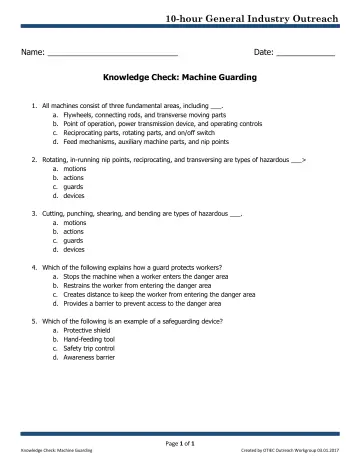
1 slidesMachine Guarding: Knowledge Check (OSHA 10-Hour General Industry Outreach)
Student knowledge-check quiz for the OSHA General Industry machine guarding outreach deck.
U.S. Department of Labor, OSHA (with the OTIEC Outreach Workgroup)Public domain