1 / 76Use ← → to flip
Module 19: Machine Guarding
A module of TEEX's course on the general industry standards for the oil and gas industry. An archived deck: check it against the current standard before teaching from it.
Slide text
· 76 slides · by Texas Engineering Extension Service
The words on each slide as the author wrote them, read from the file by software so they can be searched. Layout, pictures and tables are not shown here: the slides above and the download are the original.
- Slide 1
MODULE 19
- Machine Guarding
- Slide 2
What hazards exist?
- Crushed by or drawn into equipment
- Struck by moving parts
- Struck by failed components or particles
- Slide 3
Key parts of machines
- 1. Point of operation: where work is performed on the material, such as cutting, shaping, boring, or forming of stock.
- 2. Power Transmission Device: transmits energy to the part of the machine performing the work
- Includes flywheels, pulleys, belts, connecting rods, couplings, cams, spindles, chains, cranks, and gears.
- Slide 4
Key parts of machines
- 3. Operation Controls: Control mechanisms
- 4. Other moving parts: can include reciprocating, rotating, and transverse moving parts, feed mechanisms, and auxiliary parts of the machine
- Slide 5
Hazards to be Guarded
- Things to guard include
- In-running nip points
- Rotating equipment
- Flying chips or sparks
- Belts or gears
- Parts that impact or shear
- Slide 6
Rotating Parts
- Can grip hair or clothing
- Can force the body into a dangerous position
- Projecting pieces increase risk
- Slide 7
In-Running Nip Points
- Between 2 rotating parts
- Between rotating and tangential parts
- Between rotating and fixed parts which shear, crush, or abrade
- Slide 8
Reciprocating Parts
- Risk of being struck between stationary and moving part
- Slide 9
Transverse motion
- Continuous straight line motion
- Worker struck or caught in pinch or shear point
- Slide 10
Cutting action
- Direct injury from cutting action
- Flying chips or sparks
- Saws, drills, lathes, mills
- Slide 11
Punching action
- Ram stamps materials
- Danger at point of operation
- Slide 12
Shearing action
- Powered blade that shears materials
- Hazard at point of operation
- Slide 13
Bending action
- Power applied to a slide to stamp/shape materials
- Hazard at point of operation
- Slide 14
Guarding Principles
- Prevent contact between hazardous moving parts and body or clothing
- Secure guard: not easily removed
- Protect from objects falling into machinery
- No new hazards: sharp/rough edges
- No interference with job/comfort/speed
- Allow safe lubrication: without removing guards if possible
- Slide 15
Guarding Methods
- Location / distance
- Guards
- Fixed
- Interlocked
- Adjustable
- Self-adjusting
- Slide 16
Guarding Methods
- Devices
- Presence sensing
- Pullback
- Restraint
- Safety controls (tripwire cable, two-hand control, etc.)
- Gates
- Slide 17
Guarding Methods
- Feeding & ejection methods
- Automatic and/or semi-automatic feed and ejection
- Robots
- Miscellaneous aids
- Awareness barriers
- Protective shields
- Hand-feeding tools
- Slide 18
Fixed Guard
- Barrier is a permanent part of machine
- Preferable over other types
- Slide 19
Interlocked Guard
- Stops motion when guard is opened or removed
- Interlocked guard on revolving drum
- Slide 20
Adjustable Guard
- Barrier may be adjusted for variable operations
- What are the drawbacks?
- Bandsaw blade adjustable guard
- Slide 21
Self-Adjusting Guard
- Adjusts according to size/position of material
- Circular table saw self-adjusting guard
- Slide 22
Pullback Device
- Cables attached to operator’s hands or wrists
- Removes hands from point of operation during danger period
- What are the drawbacks?
- Slide 23
Restraint Device
- Cables attached to fixed point and wrists or hands
- Adjustable to let hands travel in predetermined area
- May be accompanied by hand-feeding tools
- Slide 24
Safety Tripwire Cable
- Device located around the perimeter of or near the danger area
- Operator must be able to reach the cable to stop the machine
- Slide 25
Two-Hand Control
- Requires constant pressure on both pads to activate the machine
- Hands on controls at safe distance while machine is in dangerous cycle
- Slide 26
Gate
- Must close fully to protect user before cycle will start
- Gate Open
- Gate Closed
- Slide 27
Safeguarding by Location/Distance
- Location of hazardous parts that is inaccessible or not a hazard during normal operation
- Must maintain safe distance
- Training, warning, communication necessary
- Slide 28
Protective Shields
- Protection from flying particles or splashing fluids
- Do not protect completely from machine hazards
- Slide 29
What regulations apply?
- 29 CFR 1910 Subpart O
- 29 CFR 1910 Subpart P for hand and portable power tools
- API RP 54 6.8 Machinery and Tools
- Slide 30
Machinery and Machine Guarding
- 29 CFR 1910 SUBPART O
- Slide 31
Organization
- 211.Definitions
- 212.General requirements for all machines 213.Woodworking machinery requirements 215.Abrasive wheel machinery
- 216.Mills and calenders in the rubber and plastics industries
- 217.Mechanical power presses
- 218.Forging machines
- 219.Mechanical power-transmission apparatus
- Slide 32
29 CFR 1910.212
- General Requirements
- Slide 33
1910.212(a) Machine guarding
- 1. One or more types of guarding to protect from hazards.
- Barrier guards
- Two-hand tripping devices Electronic safety devices Etc.
- 2. Affixed to machine where possible
- Guard must not cause its own hazard
- Slide 34
1910.212(a) Machine guarding
- Point of operation guarding:
- ii.
- Guarded if exposes employee to injury
- iii.
- iv.
- According to standards or
- Keep any part of body out of danger zone
- Hand tools to permit material handling – in addition to guards, not instead Examples of machines requiring guards on point of operation
- Slide 35
1910.212(a) Machine guarding
- 4. Revolving barrels, drums, containers guarded by interlocked enclosure (cannot turn without guard in place)
- 5. Exposure to fan blades: guard openings ≤1/2 inch
- Slide 36
1910.212(b) Anchoring fixed machinery
- Machines designed for fixed location must be anchored to prevent moving
- This pedestal grinder is designed for anchoring, but is not anchored
- Slide 37
Abrasive Wheel Machinery
- 29 CFR 1910.215
- Slide 38
1910.215(a) General requirements
- Abrasive wheels must be guarded, with exceptions
- Guard design dependent on type of work and type of wheel
- Slide 39
1910.215(a) General requirements
- Work rests:
- Rigid, clamped in place securely
- Adjusted to within 1/8 inch of wheel
- Never adjusted while in motion
- Work rest is closely adjusted
- Slide 40
1910.215(b)(9) Exposure adjustment
- For type where operator stands in front of opening: Adjustable for decreasing wheel size
- Adjustable tongue guard must never be more than ¼ inch from wheel
- Slide 41
1910.215(d) Mounting
- Inspect for damage and ring test immediately before mounting
- Tap with light nonmetallic implement (screwdriver, wooden mallet)
- If sound is dead, cracked ring may not be used
- Check spindle speed against maximum for wheel
- Slide 42
Ring Test
- Slide 43
29 CFR 1910.219
- Mechanical Power- Transmission Apparatus
- Slide 44
Organization of 1910.219
- (a) General requirements
- (b) Prime-mover guards
- (1) Flywheels
- (2) Cranks and connecting rods
- (3) Tail rods or extension piston rods
- (c) Shafting
- (d) Pulleys
- Slide 45
Organization of 1910.219
- (e) Belt, rope, and chain drives
- (f) Gears, sprockets, and chains
- (g) Guarding friction drives
- (h) Keys, setscrews, and other projections
- (i) Collars and couplings
- (j) Bearings and facilities for oiling
- (k) Guarding of clutches, cutoff couplings, and clutch pulleys
- Slide 46
Organization of 1910.219
- (l) Belt shifters, clutches, shippers, poles, perches, and fasteners
- (m) Standard guards-general requirements
- (o) Approved materials
- (p) Care of equipment
- Slide 47
Hazards on Oil and Gas Sites
- Machine Guarding
- Slide 48
Parts Requiring Guarding
- Drive belts and shafts – mud pumps and tank area
- Pony rods
- Rotating parts
- Shale shaker
- Agitator shafts & couplings
- Moving generator parts
- (explore)
- Slide 49
Mud Pumps
- Slide 50
Shale Shaker
- Slide 51
Generators
- Slide 52
Parts Requiring Guarding
- Air compressors
- Crown sheaves
- Kelly bushing – or controls
- Rotary chain drive
- Air hoist line
- Drawworks
- Bench grinder wheels
- Slide 53
Crown Sheaves
- Slide 54
Kelly and Bushing
- Alternative Abatement: STD 1-12.28 CH-1
- Slide 55
Drawworks
- Slide 56
Parts Requiring Guarding
- Belts, drive chains, gears and drives on power and hand tools
- Traveling blocks
- Sheaves
- Cathead?
- Slide 57
Drilling Line
- Slide 58
Traveling Block
- Slide 59
Hoisting Line
- Slide 60
Machine Guarding
- Safety Responsibilities
- Slide 61
Safety Responsibilities
- Management:
- Ensure all machinery is properly guarded
- Supervisors:
- Train employees on specific guard rules in their areas
- Ensure machine guards remain in place and are functional
- Immediately correct machine guard deficiencies
- Employees:
- Do not remove guards unless machine is locked and tagged
- Report machine guard problems to supervisors immediately
- Do not operate equipment unless guards are in place
- Slide 62
Training
- Operators/affected employees should receive training on:
- Hazards associated with particular machines
- How the safeguards provide protection and the hazards for which they are intended
- How and why to use the safeguards
- How and when safeguards can be removed and by whom
- What to do if a safeguard is damaged, missing, or unable to provide adequate protection
- Slide 63
Hand and Portable Power Tools
- 29 CFR 1910 Subpart P and 1926 Subpart I
- Slide 64
Construction vs. General Industry
- Construction, alteration, or repair?
- Applicable standard depends on type of operations:
- 1910 Subpart P: Hand and Portable Powered Tools and Other Hand-Held Equipment
- 1926 Subpart I: Tools – Hand and Power
- Slide 65
1910.242 General
- Employer is responsible for safe condition of tools and equipment
- Including equipment furnished by employee
- Compressed air must not be used for cleaning unless:
- Reduced to <30 p.s.i.
- Only with effective chip guarding and PPE
- Slide 66
1910.243(a) Portable powered tools
- Portable circular saws >2 in. guarded
- Switches and controls:
- Automatic return to covering position
- constant pressure control for circular and chain saws other controls for other tools as appropriate
- Slide 67
1910.243(a) Portable powered tools
- Portable belt sanding machine guarding
- Nip points
- Unused run of sanding belt
- Cracked saws: remove from service
- Grounding: Meet Subpart S
- Slide 68
1910.243(b) Pneumatic powered tools and hose
- Tool retainer to prevent ejection
- Airhose designed for applied pressure and service
- Slide 69
1910.243 Guarding of portable powered tools
- c. Portable abrasive wheels:
- Must be guarded
- Ring test and inspection
- d. Explosive actuated fastening tools
- e. Power lawnmowers
- Guarding
- Controls and shutoff device Labeling, manuals
- Design
- Slide 70
1910.244 Other portable tools and equipment
- a. Jacks
- Loading and marking Operation and maintenance
- b. Abrasive blast cleaning nozzles: operating valve and support
- Slide 71
1926.300 General requirements
- Maintained in safe condition whether furnished by employer or employee
- Shall be guarded when designed to accommodate guards
- Moving parts that create hazards shall be guarded by one or more methods
- Fan openings; anchoring machinery
- Slide 72
1926.300 General requirements
- Abrasive wheel guards
- PPE if necessary for objects, particles, gases
- Allowable switches by tool type
- Slide 73
1926.301 Hand tools
- Use of unsafe hand tools not permitted
- Wrenches shall not be used when jaws are sprung to the point of slippage
- Including adjustable, pipe, end & socket wrenches
- Impact tools shall be kept free of mushroomed heads
- Such as drift pins, wedges & chisels
- Wooden handles shall be kept
- Free of splinters or cracks
- Tight in the tool
- Slide 74
1926.302 Power-operated hand tools
- Electric power-operated tools
- Double-insulated or grounded
- Never hold by the cord
- Pneumatic power-operated tools
- Secure tools, attachments, and muzzle
- Compressed air use restrictions
- Never hold by the hose
- Reduce pressure in case of hose failure
- Slide 75
1926.302 Power-operated hand tools
- Fuel operated tools
- Stop while refueling or servicing
- Watch concentrations in enclosed spaces
- Hydraulic power tools
- Fire-resistant fluids
- Safe operating pressures
- Powder-actuated tools
- Slide 76
1926 Subpart I Organization
- 1926.303 Abrasive wheels and tools
- 1926.304 Woodworking tools
- 1926.305 Jacks
- 1926.306 Air receivers
- 1926.307 Mechanical power-transmission apparatus
More on Machine Guarding

pptx
54 slidesMachine Guarding (OSHA 10-Hour General Industry Outreach)
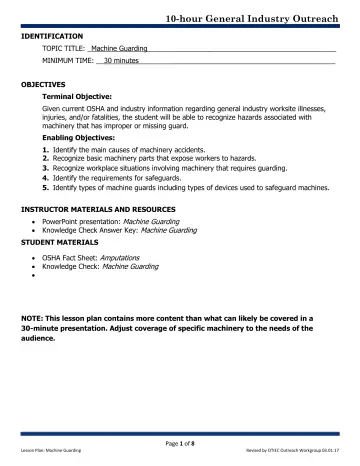
OSHA's own 10-hour General Industry Outreach deck on machine guarding (v. 03-01-17), editable PowerPoint with trainer notes.
U.S. Department of Labor, OSHA (with the OTIEC Outreach Workgroup)Public domain
pdf
8 slidesMachine Guarding: Lesson Plan (OSHA 10-Hour General Industry Outreach)
Instructor lesson plan (objectives, timing, teaching steps) for the OSHA General Industry machine guarding outreach deck.
U.S. Department of Labor, OSHA (with the OTIEC Outreach Workgroup)Public domain
pdf
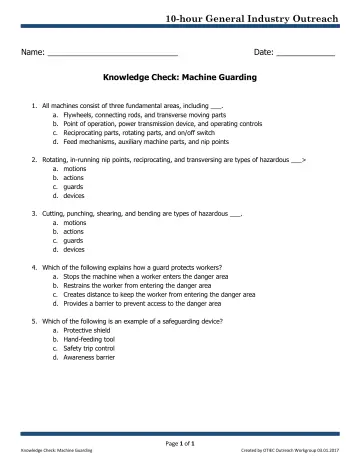
1 slidesMachine Guarding: Knowledge Check (OSHA 10-Hour General Industry Outreach)
Student knowledge-check quiz for the OSHA General Industry machine guarding outreach deck.
U.S. Department of Labor, OSHA (with the OTIEC Outreach Workgroup)Public domain