1 / 86Use ← → to flip
Machine Guarding (Subpart O) and Lockout/Tagout
Machine guarding (Subpart O) and lockout/tagout module from the Georgia Tech poultry and meatpacking course.
Slide text
· 85 of 86 slides · by Georgia Tech Research Institute
The words on each slide as the author wrote them, read from the file by software so they can be searched. Layout, pictures and tables are not shown here: the slides above and the download are the original.
- Slide 1
Subpart O -
- Machine Guarding
- Slide 2
Disclaimer
- This material was produced under grant number SH-29660-SH6 from the Occupational Safety and Health Administration, U.S. Department of Labor. It does not necessarily reflect the views or policies of the U.S. Department of Labor, nor does mention of trade names, commercial products, or organizations imply endorsement by the U.S. Government.
- Slide 3
What are your biggest machine guarding challenges?
- Slide 4
We Will Cover:
- Machine Guarding Principles
- Subpart O – Highlights
- 1910.147 – Lockout/Tagout Highlights
- Slide 5
Machine Guarding Requirements
- Prevent contact
- Be secure
- Protect from falling objects
- Create no new hazards
- No interference
- Maintainability and accessibility
- Slide 6
Where machine hazards occur:
- Point of operation
- Mechanical power transmission
- Other moving parts
- Slide 7
Machine Guarding
- Slide 8
Machine Guarding Hazardous Actions
- Cutting
- Shearing
- Bending
- Punching
- Slide 9
Methods of machine safeguarding
- Physical guards
- Devices
- Location/Distance
- Slide 10
Guards
- Fixed
- Interlocked
- Adjustable
- Self-adjusting
- Slide 11
Fixed Guard
- Provides a barrier - a permanent part of the machine, preferable to all other types of guards.
- Slide 12
Interlocked Guard
- When this type of guard is opened or removed, the tripping mechanism and/or power automatically shuts off or disengages, and the machine cannot cycle or be started until the guard is back in place.
- Interlocked guard on revolving drum
- Slide 13
Adjustable Guard
- Provides a barrier which may be adjusted to facilitate a variety of production operations.
- Bandsaw blade adjustable guard
- Slide 14
Self-Adjusting Guard
- Provides a barrier which moves according to the size of the stock entering the danger area.
- Circular table saw self-adjusting guard
- Slide 15
Gotcha Stick illustration
- Slide 16
Guard Distance Table
- Slide 17
Safeguarding devices
- Presence sensing
- Pullback
- Restraint
- Safety controls and trips
- Gates
- Slide 18
Some Examples of Guards/Safeguards
- Slide 19
Light Curtain
- Slide 20
Pullback Restraints
- Slide 21
Pullback Device (cont’d)
- Hands in die, feeding
- Point of operation exposed
- Pullback device attached and properly adjusted
- Die closed
- Hands withdrawn from point of operation by pullback device
- Slide 22
Two-Hand Controls
- Slide 23
Gate
- Movable barrier device which protects the operator at the point of operation before the machine cycle can be started
- If the gate does not fully close, machine will not function
- Gate Closed
- Gate Open
- Slide 24
Safety Tripwire Cables
- Device located around the perimeter of or near the danger area
- Operator must be able to reach the cable to stop the machine
- Slide 25
Safeguarding by Location/Distance
- Locate the machine or its dangerous moving parts so that they are not accessible or do not present a hazard to a worker during normal operation
- Maintain a safe distance from the danger area
- Slide 26
Holding Tools
- Used to place and remove stock in the danger area
- Not to be used instead of other machine safeguards, but as a supplement
- Slide 27
Pressure-
- Sensitive
- Mats
- Slide 28
Robots
- Machines that load and unload stock, assemble parts, transfer objects, or perform other tasks
- Best used in high-production processes requiring repeated routines where they prevent other hazards to employees
- Slide 29
Protective Shields
- These do not give complete protection from machine hazards, but do provide some protection from flying particles, splashing cutting oils, or coolants.
- Slide 30
Subpart O - Machinery and Machine Guarding
- 211 - Definitions
- 212 - General requirements
- 213 - Woodworking machinery
- 215 - Abrasive wheel machinery
- 216 - Mills and calendars
- 217 - Mechanical power presses
- 218 - Forging machines
- 219 - Mechanical power transmission
- Slide 31
- 1910.212
- General Requirements for all Machines
- Slide 32
1910.212(a)(1)
- One or more methods of machine guarding shall be provided to protect the operator and other employees in the machine area from hazards such as those created by the point of operation, in-going nip points, rotating parts, flying chips and sparks.
- Slide 33
1910.212(a)(3)(ii)
- The point of operation of machines whose operation exposes an employee to injury, shall be guarded.
- Slide 34
Point of Operation Guarded??
- Slide 35
Point of Operation Guarding
- Slide 36
Hand Tools
- Slide 37
1910.212(a)(5)
- When the periphery of the blades of a fan is less than seven (7) feet above the floor or working level, the blades shall be guarded. The guard shall have openings no larger than 1/2 inch.
- Slide 38
1910.212(b)
- Machines designed for a fixed location shall be securely anchored to prevent walking or moving.
- Slide 39
- 1910.213
- Woodworking Machinery Requirements
- Slide 40
Table Saws
- Slide 41
1910.213(c)(1)
- Each circular hand-fed ripsaw shall be guarded by a hood which shall completely enclose that portion of the saw above the table and that portion of the saw above the material being cut. The hood and mounting shall be arranged so that the hood will automatically adjust itself to the thickness of and remain in contact with the material being cut without considerable resistance.
- Slide 42
Table Saw
- Slide 43
1910.213(c)(2)
- Each hand-fed circular ripsaw shall be furnished with a spreader to prevent material from squeezing the saw or being thrown back on the operator.
- Slide 44
Table Saw
- Slide 45
1910.213(c)(3)
- Each hand-fed circular ripsaw shall be provided with non-kickback fingers or dogs so located as to oppose the thrust or tendency of the saw to pick up the material or throw it back toward the operator.
- Slide 46
Dogs
- Slide 47
1910.213(d)(1)
- Each circular crosscut table saw shall be guarded by a hood which shall meet all the requirements of 1910.213(c)(1) for hoods for circular resaws.
- Slide 48
Radial Arm Saws
- Slide 49
Partial guarding
- Slide 50
Radial arm saw
- Slide 51
1910.213(i)(1)
- All portions of the saw blade (bandsaws) shall be enclosed or guarded, except for the working portion of the blade between the bottom of the guide rolls and the table.
- Slide 52
Bank saw
- Slide 53
Metal cutting band saw
- Slide 54
- 1910.215
- Abrasive-Wheel Machinery
- Slide 55
1910.215(a)(4)
- Work rests shall be adjusted closely to the wheel with a maximum opening of one-eighth inch to prevent the work from being jammed between the wheel and the rest, which may cause wheel breakage.
- Work Rest
- Slide 56
1910.215(b)(9)
- The distance between the wheel periphery and the adjustable tongue or the end of the peripheral member at the top shall never exceed one-fourth inch.
- Tongue Guard
- Slide 57
1910.215(d)(1)
- Immediately before mounting, all wheels shall be closely inspected and sounded by the user (ring test) to make sure they have not been damaged.
- Slide 58
Grinder
- Slide 59
Unguarded grinder & other issues
- Slide 60
Tech Guide available @ www.oshainfo.gatech.edu
- Slide 61
- 1910.219
- Mechanical Power-Transmission Apparatus
- Slide 62
Back guard
- Slide 63
- Missing Guard
- Slide 64
1910.219(b)(1)
- Flywheels located so that any part is 7 feet or less above the floor or platform shall be guarded.
- Wherever flywheels are above working areas, guards shall be installed having sufficient strength to hold the weight of the flywheel in the event of a shaft or wheel mounting failure.
- Slide 65
1910.219(c)
- Horizontal, vertical, and inclined shafting must be enclosed.
- Projecting shaft ends shall present a smooth edge and end and shall not project more than 1/2 the diameter of the shaft unless guarded by non rotating cap or safety sleeves.
- Slide 66
Unguarded coupling
- Slide 67
Unguarded coupling
- Slide 68
Result of hair getting caught in rotating parts.
- Slide 69
1910.219(d)
- Pulleys 7ft. or less above the floor or platform must be guarded.
- Pulleys with cracks or pieces broken out of rims shall not be used.
- Slide 70
Gears need guarding
- Slide 71
Unguarded Chain/Sprocket
- Slide 73
Lockout/Tagout - What is covered?
- Servicing and maintenance
- Normal production operations where:
- Employees by-pass guard(s)
- Employees place any part of their body in a hazardous area
- Slide 74
What is not covered?
- Construction, agriculture, and maritime
- Normal production operations (subpart O)
- Cord-and-plug under the control of employee (written procedure still required)
- Exposure to electrical conductors (subpart S and electrical safety-related work practices)
- Slide 75
Locked Out?????????
- Slide 76
Lockout vs. Tagout
- If capable of being locked out:
- Prefer lockout
- Tags allowed, if employer can demonstrate FULL EMPLOYEE PROTECTION
- Machine Modifications
- Slide 77
Full employee protection?
- Tags attached at the same location as locks
- Full compliance with all tagout provisions in 29 CFR 1910.147
- Additional means when necessary (e.g. removal of a valve handle)
- Slide 78
Energy control procedure
- Notification of employees
- Preparation for shutdown
- Machine or equipment shutdown
- Machine or equipment isolation
- Lockout/tagout device application
- Stored energy
- Verification of isolation
- Release from lockout/tagout
- Slide 79
Periodic Inspection
- Performed at least annually
- Lockout – include review with authorized employees
- Tagout – include review with authorized and affected employees
- Certification record kept:
- Identify machine or equipment
- Date of inspection
- Employees performing and included in inspection
- Slide 80
Training and re-training
- Authorized employees
- Recognition of hazardous energy
- Type and magnitude of hazardous energy
- Methods of isolating energy
- How to verify isolation
- Affected – Purpose and use of procedure
- Other – Procedure and Prohibition from tampering
- Tagout provisions
- Slide 81
Re-training is required when:
- Change in job assignment
- Change in machine or process
- Change in lockout/tagout procedure
- Inadequacies revealed in periodic review
- Slide 82
Training certification
- Certify that the training has been conducted and kept up to date:
- Employee names
- Date(s) of training
- Slide 83
Testing or positioning machines
- Clear the machine of tools and materials
- Remove employees from the area
- Remove lockout/tagout devices
- Energize and proceed with testing/positioning
- De-energize and re-apply energy control measures
- Slide 84
Group lockout
- Personal lock or tag (usually)
- Lockbox or master tag system with principal authorized employee
- “Shall utilize a procedure which affords a level of protection equivalent to that provided by the implementation of a personal lockout or tagout device”
- Slide 85
Minor Servicing Exemption
- Activities which are routine, repetitive, and integral to the use of the equipment for production are not covered by this standard if alternative measures provide effective protection.
- Activity must be conducted during normal production operations
- Activity must be routine (regular course of procedure in accordance with established practices), repetitive (regularly repeated as part of production), and integral (essential to the production process).
- Slide 86
- Machine Guarding etool
More on Machine Guarding
pptx
54 slidesMachine Guarding (OSHA 10-Hour General Industry Outreach)
OSHA's own 10-hour General Industry Outreach deck on machine guarding (v. 03-01-17), editable PowerPoint with trainer notes.
U.S. Department of Labor, OSHA (with the OTIEC Outreach Workgroup)Public domain
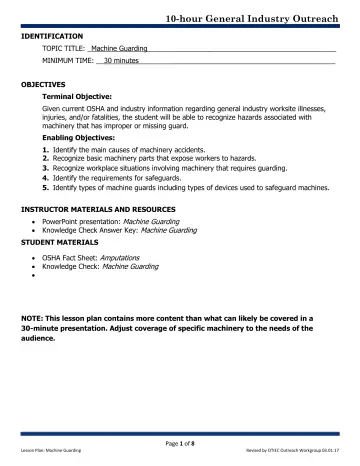
pdf
8 slidesMachine Guarding: Lesson Plan (OSHA 10-Hour General Industry Outreach)
Instructor lesson plan (objectives, timing, teaching steps) for the OSHA General Industry machine guarding outreach deck.
U.S. Department of Labor, OSHA (with the OTIEC Outreach Workgroup)Public domain
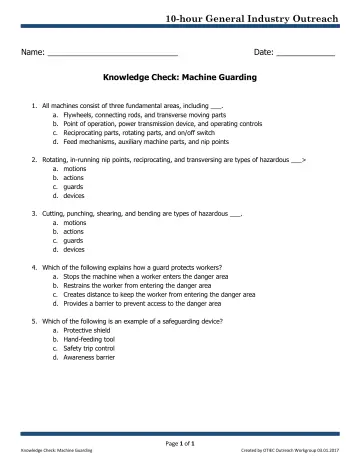
pdf
1 slidesMachine Guarding: Knowledge Check (OSHA 10-Hour General Industry Outreach)
Student knowledge-check quiz for the OSHA General Industry machine guarding outreach deck.
U.S. Department of Labor, OSHA (with the OTIEC Outreach Workgroup)Public domain