1 / 48Use ← → to flip
Machine Guarding and Amputation Hazards
Machine guarding and amputation hazards from Central Georgia Technical College.
Slide text
· 48 slides · by Central Georgia Technical College
The words on each slide as the author wrote them, read from the file by software so they can be searched. Layout, pictures and tables are not shown here: the slides above and the download are the original.
- Slide 1
Machine Guarding and Amputation
- Hazards
- Slide 2
Sponsorship
- This material was produced under grant number SH-22297-SH1 from OSHA. It does not necessarily reflect the views or policies of the U.S. Department of Labor, nor does mention of trade names, commercial products, or organizations imply endorsement by the U.S. Government.
- Revisions were made to this material under grant number SH-05059-SH8 from the Occupational Safety and Health Administration, U.S. Department of Labor.
- Slide 3
Introduction
- Crushed hands and arms, severed fingers, blindness - the list of possible machinery-related injuries is as long as it is horrifying. Safeguards are essential for protecting workers from needless and preventable injuries.
- A good rule to remember is: Any machine part, function, or process which may cause injury must be safeguarded.
- Where the operation of a machine can injure the operator or other workers, the hazard must be controlled or eliminated.
- Slide 4
Objectives
- Students will:
- Identify sources of amputation hazards
- Describe available protection and safeguarding methods
- Identify hazardous machine components and motions
- Interpret OSHA’s role and standards
- Slide 5
Causes of Machine Accidents
- Reaching in to “clear” equipment
- Not using Lockout/Tagout
- Unauthorized persons doing maintenance
- or using the machines
- Missing or loose machine guards
- Slide 6
Machine is not safeguarded because …
- Equipment came that way
- I bought it used and that part was missing
- Guard gets in the way
- Is easier to work around it
- It’s common sense: no one will put their hands in there
- I don’t know…
- Slide 7
Hazardous Machine Components
- Point of operation
- All parts of the machine which move, such as:
- flywheels, pulleys, belts, couplings, chains, cranks, gears, etc.
- feed mechanisms and auxiliary parts of the machine
- In-running nip points
- Slide 8
Hazardous Machine Motions
- Rotating – Circular motion
- Reciprocating – Back and forth motion
- Transverse – Straight continuous line
- Cutting – Sawing, boring, milling
- Punching – Metal Stamping
- Shearing – Metal Trimming
- Bending – Metal forming
- Slide 9
Hazardous Activities
- Employees operating and caring for machinery perform activities that present amputation hazards such as:
- Set up and preparation
- Maintenance
- Machine set up
- Clearing Jams
- Lubrication and Inspection
- Slide 10
Amputation
- Amputations are most serious and debilitating workplace injuries
- They are widespread and involve a variety of activities and equipment
- Amputations occur most often when workers
- operate unguarded or inadequately safeguarded mechanical equipment
- Slide 11
- Amputation – cont.
- Injuries also happen during materials handling when using equipment such as forklifts, doors or trash compactors
- When using powered and non-powered hand tools
- When performing maintenance or repairs to equipment that has not been properly locked and tagged out
- Slide 12
Any part of a machine, function, or process that may cause injury must be safeguarded
- Controlling Amputation Hazards
- Machine Safeguarding is essential for protecting employees from preventable injury
- A good rule to remember is:
- Safety is everyone's responsibility not just your supervisor
- Slide 13
Sources of Amputation
- Mechanical power presses
- Food slicers, meat
- Power press brakes
- grinders, meat-cutting
- Powered and non-powered
- band saws
- conveyors
- Printing presses
- Roll-forming and roll
- bending machines
- Drill presses and shears
- Lathes and milling
- machines
- Grinders
- Slitters
- Slide 14
Protection Methods
- Recognize and avoid amputation hazards through:
- Guarding
- Safe work practices
- Employee training
- Administrative controls
- Operating in a safe manner
- Slide 15
Preventive Measures
- Lock Out Tag Out:
- The best way to prevent amputations during maintenance, repair and clearing jams while the machine is energized is a program of hazardous energy control, known as Lock Out Tag Out (LOTO)
- Slide 16
Machine safeguarding
- Two methods of machine safeguarding:
- Guards and Safe Guarding Devices
- Guards are physical barriers that prevent access to danger area
- Devices help prevent contact with points of operation and may replace or supplement guards. These devices interrupt normal operation when workers hands are inside the machine
- Slide 17
Hand and Portable Power Tools
- Ensure guards are in place and working when using portable circular saws with a blade of 2” or more in diameter
- All portable power tools with a 2” or more diameter wheel should have a constant pressure switch
- Applies to grinders, belt sanders, reciprocating saws and drills
- Slide 18
Requirements for Safeguards
- Prevent contact - prevent worker’s body or clothing from contacting hazardous moving parts
- Secure - firmly secured to machine and not easily removed
- Protect from falling objects - ensure that no objects can fall into moving parts
- Create no new hazards - must not have shear points, jagged edges or unfinished surfaces
- Create no interference - must not prevent worker from performing the job quickly and comfortably
- Allow safe lubrication - if possible, be able to lubricate the machine without removing the safeguards
- Slide 19
Methods of Machine Safeguarding
- Guards
- fixed
- interlocked
- adjustable
- self-adjusting
- Devices
- presence sensing
- pullback
- restraint
- safety controls (tripwire cable, two-hand control, etc.)
- gates
- Location/distance
- Feeding and ejection methods
- Automatic and/or semi-automatic feed and ejection
- Robots
- Miscellaneous aids
- awareness barriers
- protective shields
- hand-feeding tools
- Slide 20
Point of Operation
- That point where work is performed on the material, such as cutting, shaping, boring, or forming of stock must be guarded.
- Slide 21
Rotating Parts
- Slide 22
In-Running Nip Points
- Slide 23
Fixed Guard
- Provides a barrier - a permanent part of the machine, preferable to all other types of guards.
- Slide 24
Interlocked Guard
- When this type of guard is opened or removed, the tripping mechanism and/or power automatically shuts off or disengages, and the machine cannot cycle or be started until the guard is back in place.
- Interlocked guard on revolving drum
- Slide 25
Adjustable Guard
- Provides a barrier which may be adjusted to facilitate a variety of production operations.
- Bandsaw blade adjustable guard
- Slide 26
Self-Adjusting Guard
- Provides a barrier which moves according to the size of the stock entering the danger area.
- Circular table saw self-adjusting guard
- Slide 27
Pullback Device
- Utilizes a series of cables attached to the operator’s hands, wrists, and/or arms
- Primarily used on machines with stroking action
- Allows access to the point of operation when the slide/ram is up
- Withdraws hands when the slide/ram begins to descend
- Slide 28
Restraint Device
- Uses cables or straps attached to the operator’s hands and a fixed point
- Must be adjusted to let the operator’s hands travel within a predetermined safe area
- Hand-feeding tools are often necessary if the operation involves placing material into the danger area
- Slide 29
Safety Tripwire Cables
- Device located around the perimeter of or near the danger area
- Operator must be able to reach the cable to stop the machine
- Slide 30
Two-Hand Control
- Requires constant, concurrent pressure to activate the machine
- The operator’s hands are required to be at a safe location (on control buttons) and at a safe distance from the danger area while the machine completes its closing cycle
- Slide 31
Gate
- Movable barrier device which protects the operator at the point of operation before the machine cycle can be started
- If the gate does not fully close, machine will not function
- Gate Open
- Gate Closed
- Slide 32
Safeguarding by Location/Distance
- Locate the machine or its dangerous moving parts so that they are not accessible or do not present a hazard to a worker during normal operation
- Maintain a safe distance from the danger area
- Slide 33
Automatic Feed
- Slide 34
Robots
- Machines that load and unload stock, assemble parts, transfer objects, or perform other tasks
- Best used in high-production processes requiring repeated routines where they prevent other hazards to employees
- Slide 35
Protective Shields
- These do not give complete protection from machine hazards, but do provide some protection from flying particles, splashing cutting oils, or coolants.
- Slide 36
Holding Tools
- Used to place and remove stock in the danger area
- Not to be used instead of other machine safeguards, but as a supplement
- Slide 37
Machine Guarding Examples
- Some Examples of OSHA Machine Guarding Requirements …
- Slide 38
Guarding Fan Blades
- When the periphery of the blades of a fan is less than 7 feet above the floor or working level, the blades must be guarded with a guard having openings no larger than 1/2 inch.
- Slide 39
Abrasive Wheel Machinery
- Work rests on offhand grinding machines must be kept adjusted closely to the wheel with a maximum opening of 1/8-inch to prevent the work from being jammed between the wheel and the rest, which may result in wheel breakage.
- Slide 40
- Abrasive Wheel Machinery – cont.
- The distance between the wheel periphery and the adjustable tongue must never exceed 1/4-inch.
- Slide 41
Power-Transmission Apparatus
- Power-transmission apparatus (shafting, flywheels, pulleys, belts, chain drives, etc.) less than 7 feet from the floor or working platform must be guarded.
- Unguarded belt and pulley
- Slide 42
Machine Safety Responsibilities
- Management
- ensure all machinery is properly guarded
- Supervisors
- train employees on specific guard rules in their areas
- ensure machine guards remain in place and are functional
- immediately correct machine guard deficiencies
- Employees
- do not remove guards unless machine is locked and tagged
- report machine guard problems to supervisors immediately
- do not operate equipment unless guards are in place
- Slide 43
Training
- Operators should receive training on the following:
- Hazards associated with particular machines
- How the safeguards provide protection and the hazards for which they are intended
- How and why to use the safeguards
- How and when safeguards can be removed and by whom
- What to do if a safeguard is damaged, missing, or unable to provide adequate protection
- Slide 44
OSHA Standards
- The following OSHA standards are a few of the regulations that protect employees from amputation hazards
- 29 CFR 1910 Sub Parts O and P: Machinery and machine safeguarding
- 29 CFR 1926 Subpart I covers hand tools
- Slide 45
Helpful OSHA Resources
- OSHA has many helpful programs, including assistance
- with safety and health programs, state plans, workplace consultations, voluntary protection programs, strategic partnerships, training and education
- Slide 46
Summary
- Safeguards are essential for protecting workers from needless and preventable machinery-related injuries
- The point of operation, as well as all parts of the machine that move while the machine is working, must be safeguarded
- A good rule to remember is: Any machine part, function, or process which may cause injury must be safeguarded
- Proper LOTO will prevent injuries while performing maintenance on equipment
- The use of guards and devices are safeguarding methods to prevent amputations
- Recognize dangerous machine motions
- OSHA is here to help. If in doubt refer to the standards and your supervisor
- Slide 47
OSHA Contact Numbers
- To report Unsafe Working Conditions, Safety and Health
- Violations Contact OSHA @:
- 1-800-321-OSHA (6742) / TTY1-877-889-5627
- To File a Complaint Form:
- To file an OSHA-7 report online, see how to file a complaint with
- OSHA (www.osha.gov)
- For more information regarding your rights, see Worker Rights
- Slide 48
- Questions?
More on Machine Guarding
pptx
54 slidesMachine Guarding (OSHA 10-Hour General Industry Outreach)
OSHA's own 10-hour General Industry Outreach deck on machine guarding (v. 03-01-17), editable PowerPoint with trainer notes.
U.S. Department of Labor, OSHA (with the OTIEC Outreach Workgroup)Public domain
pdf
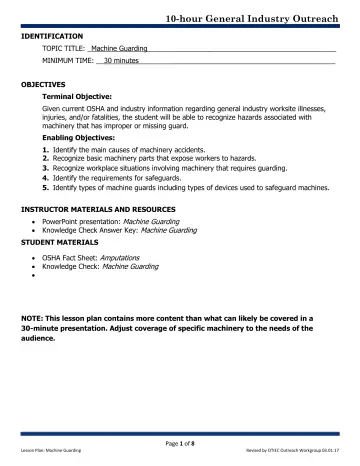
8 slidesMachine Guarding: Lesson Plan (OSHA 10-Hour General Industry Outreach)
Instructor lesson plan (objectives, timing, teaching steps) for the OSHA General Industry machine guarding outreach deck.
U.S. Department of Labor, OSHA (with the OTIEC Outreach Workgroup)Public domain
pdf
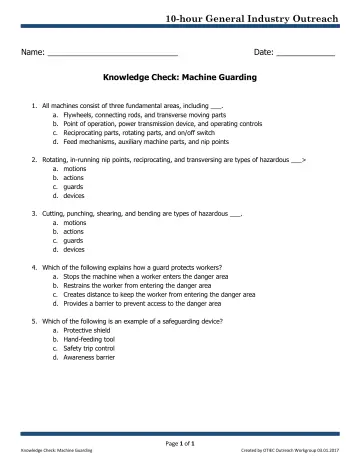
1 slidesMachine Guarding: Knowledge Check (OSHA 10-Hour General Industry Outreach)
Student knowledge-check quiz for the OSHA General Industry machine guarding outreach deck.
U.S. Department of Labor, OSHA (with the OTIEC Outreach Workgroup)Public domain