1 / 10Use ← → to flip
Machine Shop Safety: Drill Press (Trainer Script)
Trainer script for the drill press deck.
Page text
· 10 pages · by Northwestern University
The words on each page as the author wrote them, read from the file by software so they can be searched. Layout, pictures and tables are not shown here: the pages above and the download are the original.
- Page 1
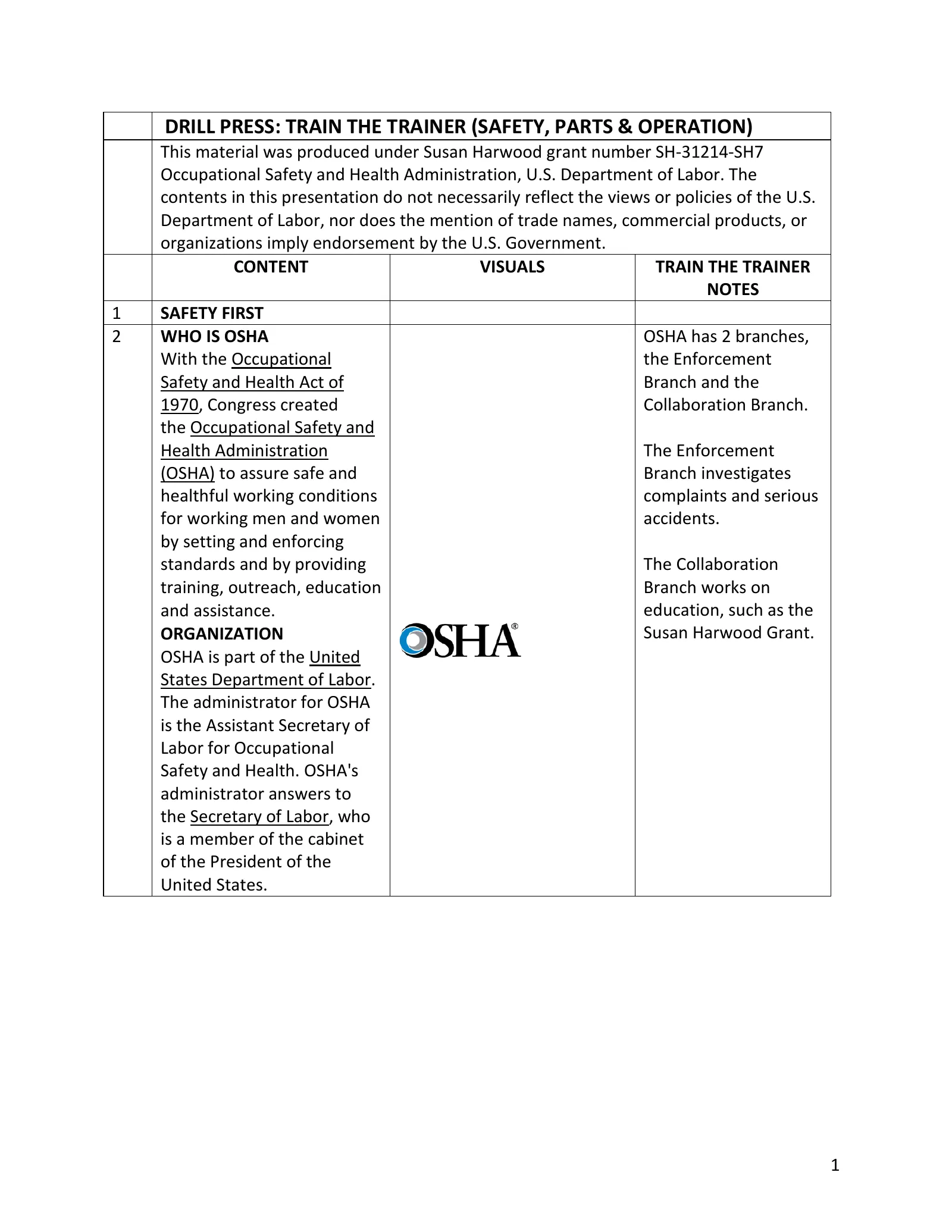
DRILL PRESS: TRAIN THE TRAINER (SAFETY, PARTS & OPERATION)
- 1 2
- This material was produced under Susan Harwood grant number SH-31214-SH7
- Occupational Safety and Health Administration, U.S. Department of Labor. The contents in this presentation do not necessarily reflect the views or policies of the U.S.
- Department of Labor, nor does the mention of trade names, commercial products, or organizations imply endorsement by the U.S. Government.
- CONTENT
- VISUALS
- TRAIN THE TRAINER
- NOTES
- SAFETY FIRST
- WHO IS OSHA
- OSHA has 2 branches,
- With the Occupational
- the Enforcement
- Safety and Health Act of
- Branch and the
- 1970, Congress created
- Collaboration Branch.
- the Occupational Safety and
- Health Administration
- Branch investigates
- (OSHA) to assure safe and healthful working conditions complaints and serious for working men and women accidents.
- by setting and enforcing
- standards and by providing
- The Collaboration
- training, outreach, education
- Branch works on education, such as the and assistance.
- Susan Harwood Grant.
- ORGANIZATION
- OSHA is part of the United
- States Department of Labor.
- The administrator for OSHA is the Assistant Secretary of
- Labor for Occupational
- Safety and Health. OSHA's administrator answers to the Secretary of Labor, who is a member of the cabinet of the President of the
- United States.
- Page 2
KNOW YOUR RIGHTS
- Under federal law, you are entitled to a safe workplace. Your employer must provide a workplace free of known health and safety hazards. If you have concerns, you have the right to speak up about them without fear of retaliation. You also have the right to:
- Be trained in a language you understand
- Work on machines that are safe
- Be provided required safety gear, such as gloves or a harness and lifeline for falls
- Be protected from toxic chemicals
- Request an OSHA inspection, and speak to the inspector
- Report an injury or illness, and get copies of your medical records
- See copies of the workplace injury and illness log
- Review records of workrelated injuries and illnesses
- Get copies of test results done to find hazards in the workplace
- INTRODUCTION TO THE DRILL PRESS
- (Machine Guarding)
- Many young or foreign workers are unaware of their rights as workers.
- There are still workplaces that have unguarded dangerous machinery and employees that are afraid to say anything. OSHA gives them that voice.
- Page 3
WHAT IS MACHINE GUARDING
- A means of shielding employees from moving or flying parts and preventing them from accidentally coming into contact with moving pieces of equipment
- Simply put, machine guarding protects the worker from the hazard. Machine guarding should not impede the lubrication or operation of the machine.
- MACHINE-RELATED INJURIES
- Possible machinery-related injuries include:
- Crushed fingers or hands
- Amputations
- Burns
- Blindness
- A good rule to remember is: Any machine part, function, or process which may cause injury must be safeguarded
- MACHINERY ACCIDENTS
- Examples of how machine accidents can occur:
- Hazardous conditions
- Missing or loose machine guards
- Human actions
- Reaching-in to “clear” equipment
- Unauthorized persons doing maintenance or using the machines
- Explain not to take the machines for granted. Accidents can happen very quickly. Machine users need to keep their fingers and hands away from the Point of Operation. Wear safety glasses to protect their eyes and closed toe sturdy shoes to protect their feet. Machine users need to put long hair up in a ponytail or bun and not wear loose clothing or dangling jewelry to protect themselves from getting caught up in rotational hazards.
- Explain to trainers that the following situations still exist in some work places. Some types of accidents are related to poor on non-existent machine guarding can be getting fingers caught where the work is being done (Point of Operation). Getting dangling jewelry, loose clothing, or hair caught in the
- Page 4
- drill chuck (rotational hazard). Or trying to grab something while the chuck is spinning ( reaching in)
- BASIC MACHINERY PARTS AND HAZARDS
- Three fundamental machine areas:
- Point of operation
- Power transmission device
- Other moving parts – Operating controls such as mechanical or electric power control
- These parts must be pointed out on the machine.
- The Point of Operation is where the work happens. IE the interface of the cutting tool and the workpiece.
- Power Transmission device. IE the motor.
- Operating controls IE the on / off switch.
- HAZARD TYPES
- Nip Points and Rotating
- Parts
- Flying Chips
- POTENTIAL HAZARDS
- The primary hazards of drill presses are contact at the point of operation and rotational hazards. An operator can risk serious hand injury when working too close to the drilling area, wearing gloves, loose clothing, loose hair, or jewelry.
- These hazards need to be pointed out because they are present each time the drill press is used and they may change depending on the operations being performed.
- When operating the drill press utilize a magnetic chip shield in between you and the point of operation. Demonstrate how the chip shield is to be used.
- Page 5
PREVENTING INJURIES AND AMPUTATIONS
- Know where the Emergency Stop button is.
- Do not remove the any guards, or other devices.
- Do not operate the drill press unless you are trained and authorized to operate the machine.
- Operators must clamp the work material to the table. Taking caution not to place hands near the rotating chuck or cutting tool.
- Always use a chip guard to protect one’s self from flying chips.
- Do not reach around the chuck or cutting tool to remove chips or material while the machine is in motion or not locked or tagged out.
- If performing service and maintenance activities follow lock out tag out procedures.
- SAFETY PRECAUTIONS I
- Verify that all
- machine guards are in place.
- All of the guards must be in place before operating the machine. If you need to open the Belt and Pulley guard, unplug the machine.
- Explain that if work pieces are not clamped to the table they can spin around and injure the operator or people around the machine.
- This is where you reinforce that guards are in place to protect the operator and other users in the shop.
- Page 6
SAFETY PRECAUTIONS II
- Keep machine clear
- of tools. Tools must
- not be placed on the drill press table.
- Stop the drill press before making any measurements, adjustments, or cleaning.
- SAFETY PRECAUTIONS III
- Work pieces must always be clamped with a vise or work holding equipment which then needs to be clamped to the table.
- SAFETY PRECAUTIONS IV Avoid touching the cutting edges of cutting tools they are very sharp.
- PROTECT YOURSELF WITH PPE
- Always wear safety glasses
- Always wear closed toe shoes that protect the top of your foot
- Do not wear any rings or dangling jewelry
- Long hair needs to be tied up or put into a bun
- Explain that a cluttered workspace is dangerous. Only the workpiece and work holding should be on the machine table.
- Emphasize that the drill press must be off before reaching in to make adjustments, measurements or cleaning to eliminate the risk of injury. Explain that unclamped work pieces can get thrown from the machine and injure the operator or users around the machine.
- Point out where the cutting edges are on twist drills, Forstner bits, and spade drill bits. Explain that they are very sharp in order to cut the work material and that the cutting edges should not be touched. Explain that PPE (Personal Protective Equipment) may not always be the most fashionable or comfortable, but it is used to keep users safe.
- Page 7
INTRODUCTION TO THE DRILL PRESS
- MAJOR COMPONENTS OF THE DRILL PRESS
- SAFE MACHINE OPERATIONS 1
- Make sure that all of the guards are in place.
- SAFE MACHINE OPERATIONS 2
- Adjusting spindle speed.
- SAFE MACHINE OPERATIONS 3
- Inserting cutting tool into drill chuck.
- Safety Note: Be cautious of the sharp cutting edges on the cutting tool they will cause cuts or scrapes if it comes in contact with a body part.
- The major components of the drill press are pointed out so that all the users can communicate on the same level.
- The guards on the Drill Press are the Pulley Guard and Magnetic Chip Shield.
- The Chip Shield must always be used when the spindle of the Drill Press is turning.
- The Pulley Guard should not be opened unless the Drill Press is unplugged.
- Demonstrate the proper loading of a drilling tool into the drill chuck.
- Point out to the students that it is very important that the drilling tool is centered in the drill chuck.
- Safety Note: Make sure not to place the palm of your
- Page 8
- hand too close to the area where the chuck key and chuck meet. This is a pinch point.
- Be sure to remove chuck key from chuck when finished tightening it otherwise it will be thrown from chuck when the spindle is turned on and can cause injury.
- SAFE MACHINE OPERATIONS 4
- Adjust table height so that the work piece fits under the cutting tool.
- Safety Note: Always make sure that the table is locked so that it cannot move during drilling operations.
- SAFE MACHINE OPERATIONS 5
- SAFE MACHINE OPERATIONS 6
- Drilling a hole
- Explain that that drill press table may need to be raised or lowered depending on the work and tool height.
- It is extremely important to always tighten the lock for the table so that it cannot move during the drilling operation.
- Demonstrate how a drill press vise is used on the drill press and how it needs to be clamped to the table using strap clamps or clamps. This holds true for larger flat pieces as well.
- Explain that the interface between the drilling tool and the work piece is the Point of Operation and that
- Page 9
- Safety Note: The drill bit point and the top of the work piece are the Point of Operation. Place the magnetic chip guard between the operator and the work piece for protection from the point of operation.
- Do not over reach, maintain good body position and firm footing.
- Do not reach around rotating spindle of cutting tool since this is a rotational hazard.
- Caution some work pieces may be very hot after drilling and could potentially cause burns.
- Sweep up chips and debris since these are slip hazards.
- Wipe up any cutting fluids that may have dripped onto the floor since this is a slip hazard as well.
- SAFE MACHINE OPERATIONS 7
- Deburring the work piece
- the operator needs to be shielded from that.
- Caution users not to reach around the chip guard while the spindle is turning since it is a rotational hazard.
- Explain that the chip guard needs to be in front of the drill chuck while the spindle is turning.
- Make sure that the drilling tool is secure in the drill chuck and that the work piece is secure.
- Tell the students the importance of letting the tool do the work. Do not force the drilling tool into the workpiece.
- Remind users that they need to clean up their work area and make sure that there is no oil or chips on the floor since they are slip hazards.
- Explain the importance of deburring the workpiece since the drill burrs and sharp edges are cut hazards.
- Page 10
- Caution, the work piece will have sharp edges. Use a deburring tool or file to remove the sharp edge from the work piece to remove the risk of cuts.
- You always want to make sure that a work piece has no sharp edges, unless they are required.
- Safety Note: Do not attempt to remove the work piece from the drill press or reach in until the spindle has stopped. This is a rotational hazard at the point of operation.
More on Machine Guarding
pptx
54 slidesMachine Guarding (OSHA 10-Hour General Industry Outreach)
OSHA's own 10-hour General Industry Outreach deck on machine guarding (v. 03-01-17), editable PowerPoint with trainer notes.
U.S. Department of Labor, OSHA (with the OTIEC Outreach Workgroup)Public domain
pdf
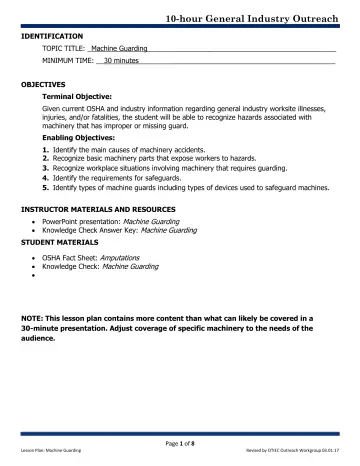
8 slidesMachine Guarding: Lesson Plan (OSHA 10-Hour General Industry Outreach)
Instructor lesson plan (objectives, timing, teaching steps) for the OSHA General Industry machine guarding outreach deck.
U.S. Department of Labor, OSHA (with the OTIEC Outreach Workgroup)Public domain
pdf
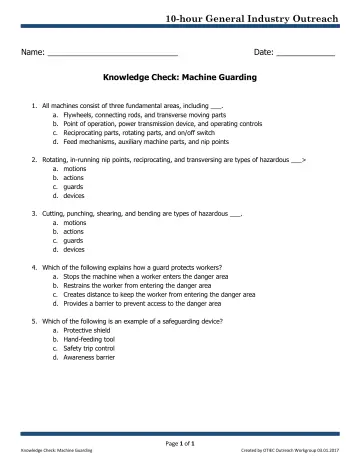
1 slidesMachine Guarding: Knowledge Check (OSHA 10-Hour General Industry Outreach)
Student knowledge-check quiz for the OSHA General Industry machine guarding outreach deck.
U.S. Department of Labor, OSHA (with the OTIEC Outreach Workgroup)Public domain