1 / 9Use ← → to flip
Machine Shop Safety: Belt Sander (Trainer Script)
Trainer script for the belt sander deck.
Page text
· 9 pages · by Northwestern University
The words on each page as the author wrote them, read from the file by software so they can be searched. Layout, pictures and tables are not shown here: the pages above and the download are the original.
- Page 1
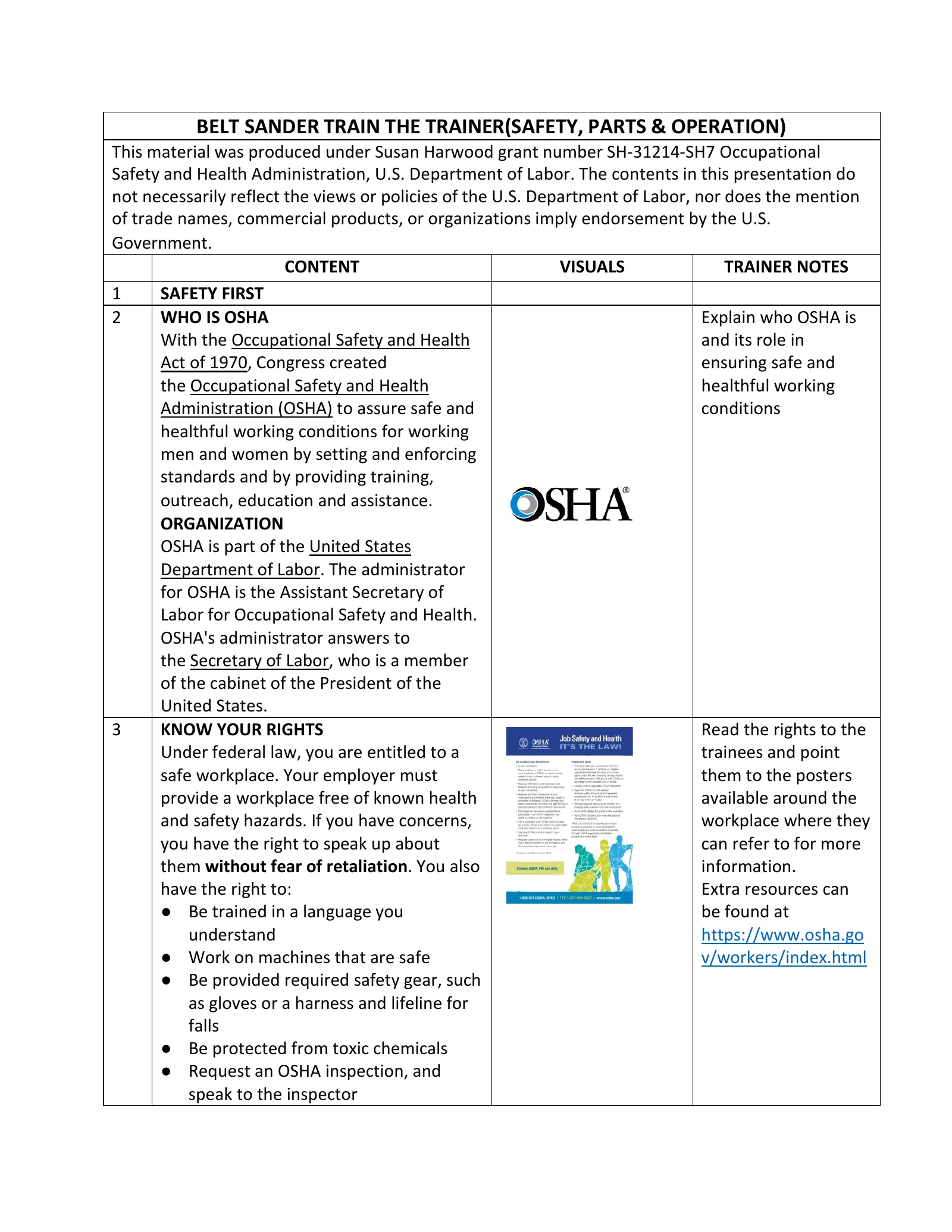
BELT SANDER TRAIN THE TRAINER(SAFETY, PARTS & OPERATION)
- This material was produced under Susan Harwood grant number SH-31214-SH7 Occupational
- Safety and Health Administration, U.S. Department of Labor. The contents in this presentation do not necessarily reflect the views or policies of the U.S. Department of Labor, nor does the mention of trade names, commercial products, or organizations imply endorsement by the U.S.
- Government.
- CONTENT
- VISUALS
- TRAINER NOTES
- SAFETY FIRST
- WHO IS OSHA
- Explain who OSHA is
- With the Occupational Safety and Health and its role in
- Act of 1970, Congress created ensuring safe and the Occupational Safety and Health healthful working
- Administration (OSHA) to assure safe and conditions healthful working conditions for working men and women by setting and enforcing standards and by providing training, outreach, education and assistance.
- ORGANIZATION
- OSHA is part of the United States
- Department of Labor. The administrator for OSHA is the Assistant Secretary of
- Labor for Occupational Safety and Health.
- OSHA's administrator answers to the Secretary of Labor, who is a member of the cabinet of the President of the
- United States.
- KNOW YOUR RIGHTS
- Read the rights to the
- Under federal law, you are entitled to a trainees and point safe workplace. Your employer must them to the posters provide a workplace free of known health available around the and safety hazards. If you have concerns, workplace where they you have the right to speak up about can refer to for more them without fear of retaliation. You also information.
- have the right to:
- Extra resources can
- Be trained in a language you be found at understand https://www.osha.go
- Work on machines that are safe v/workers/index.html
- Be provided required safety gear, such as gloves or a harness and lifeline for falls
- Be protected from toxic chemicals
- Request an OSHA inspection, and speak to the inspector
- Page 2
Report an injury or illness, and get copies of your medical records
- See copies of the workplace injury and illness log
- Review records of work-related injuries and illnesses
- Get copies of test results done to find hazards in the workplace INTRODUCTION TO BELT SANDER(Machine Guarding)
- WHAT IS MACHINE GUARDING
- A means of shielding employees from moving or flying parts and preventing them from accidentally coming into contact with moving pieces of equipment
- MACHINE-RELATED INJURIES
- Possible machinery-related injuries include:
- Crushed fingers or hands
- Amputations
- Burns
- Blindness
- A good rule to remember is: Any machine part, function, or process which may cause injury must be safeguarded
- Many accidents result from persons working on, or around, moving machinery. These accidents could have been prevented by the installation and proper maintenance of guarding. The goal of this training is to make the guarding of all equipment as easily understood as possible and reinforce the safe working procedures that must always be in place around dangerous equipment.
- This list of accidents is as long as it is horrifying.
- Safeguards are essential for protecting workers
- Page 3
- from needless and preventable injuries. Where the operation of a machine can injure the operator or other workers, the hazard must be controlled or eliminated.
- National Emphasis Program on Amputations*. CPL 03-00-019, (August 13, 2015). Describes policies and procedures for implementing a National Emphasis Program (NEP) to identify and to reduce workplace machinery and equipment hazards which are causing or likely to cause amputations. Resource: https://www.osha.gov/dte/outreach/cons truction_generalindus try/gi_outreach_tp.ht ml https://safetyresourcesblog.com/2014/08/16/osha-quickcardsdownload-here-allfreeenglishspanishother/
- MACHINERY ACCIDENTS
- Examples of how machine accidents can
- Missing, loose machine guards, or
- Page 4
occur:
- Hazardous conditions
- Missing or loose machine guards
- Human actions
- Reaching-in to “clear” equipment
- Unauthorized persons doing maintenance or using the machines
- BASIC MACHINERY PARTS
- AND HAZARDS
- Three fundamental machine areas:
- Point of operation
- Power transmission device
- Other moving parts – Operating controls such as mechanical or electric power control
- Figure 1
- miss aligned machine guards can cause injuries from nip points and in running nip points.
- An operator should not reach into a machine or the point of operation unless the machine is secured or unplugged. “All machines consist of three fundamental areas: the point of operation, the power transmission device, and the operating controls. Despite all machines having the same basic components, their safeguarding needs widely differ due to varying physical characteristics and operator involvement” (OSHA 2007).
- OSHA Machine Guarding eTool - https://www.osha.gov/SLTC/etools/machineguarding/intro.html
- HAZARD TYPES
- (4 slides)
- Nip Points and Rotating Parts
- Flying Chips
- Sparks
- These hazards exist on the Belt Sander and they need to be guarded.
- Explain that the Point of Operation is where the work is being done on the machine.
- Page 5
- In this case it is where the sanding belt contacts the work material or where the sanding belt runs past the table.
- POTENTIAL HAZARDS
- The primary hazards of belt sanders are contact with rotating parts and contact at the point of operation. An operators hand or fingers can be pulled into the sanding area from working too close, wearing gloves, loose clothing, loose hair, or jewelry, or wearing loose clothing. Nip points are also created between the sanding belt and the work rest. Projected parts or material such as unsecured workpieces or flying debris can also strike or present hazards to the operator.
- PREVENTING INJURIES AND AMPUTATIONS
- Do not remove the any guards, or other devices
- Do not operate the belt sander unless you are trained and authorized to operate the machine
- Operators must place the work piece table / work support. Taking caution not to place hands near the sanding belt.
- Machine users always need to check to make sure that all of the guards are in place and that the gap between the Table and the sanding belt does not exceed 1/8”. The Belt Sander seems to be an easy enough machine to
- Page 6
- If performing service and maintenance activities follow lock out tag out procedures or unplug the unit.
- SAFETY PRECAUTIONS I
- Verify that all machine guards are in place.
- SAFETY PRECAUTIONS II
- Keep machine clear of Excessive dust.
- SAFETY PRECAUTIONS III
- Grinding sparks are hot, do not try to catch them. The area that was being ground may be hot. Be careful not to touch this area.
- operate, but users still need to be trained on it.
- The work piece needs to be placed on the Table for safety and stability.
- Operators always need to be aware where their fingers are in relation to the sanding belt when sanding the work piece.
- Any machine malfunction needs to be reported to the shop staff. Machine operators cannot attempt to repair the machine.
- The belt guards and motor cover need to be in place and need to be secure before starting the machine. The gap between the sanding belt and the table cannot exceed 1/8”
- Dust is flammable and potentially explosive. Operators need to be aware of the dust that their project is creating and may need to intermittently clean up the area with a vacuum cleaner.
- It may be tempting to try to catch the sparks, but don’t because they are very hot and can cause
- Page 7
- burns. Also, the area that was being sanded will probably be hot.
- PROTECT YOURSELF WITH PPE
- Always wear safety glasses.
- If doing a lot of belt sanding wear a dust mask.
- Always wear closed toe shoes that protect the top of your foot.
- Do not wear any rings or dangling jewelry.
- Long hair needs to be tied up or put into a bun.
- 16 17
- INTRODUCTION TO THE BELT SANDER
- SAFE MACHINE OPERATIONS 1
- Make sure that all of the guards are in place.
- SAFE MACHINE OPERATIONS 2
- Breaking a sharp corner on a work piece.
- Safety Note: Make sure that the work area is clear of obstructions.
- Safety Note: Do not touch the sanded edge, it may be hot
- SAFE MACHINE OPERATIONS 3
- Smoothing a rough edge on a work piece.
- Personal Protective Equipment may be a bit uncomfortable or bulky, but needs to be worn to protect the user from injury.
- Make sure that the Belt Guards are intact. Verify that gap between the table and belt is no more than 1/8”.
- Turn the Belt Sander on by flipping the on/off switch to the On position.
- Place the work piece on the table at approximately 45 degrees and lightly press it into the rotating belt.
- Slightly rotate the work piece to the left and right to break the corner.
- Turn the Belt Sander off when done.
- Turn the Belt Sander on by flipping the on/off switch to the
- Page 8
- Safety Note: Make sure that the work area is clear of obstructions.
- Safety Note: Do not touch the sanded edge, it may be hot
- SAFE MACHINE OPERATIONS 4
- Clean the machine.
- On position.
- Put the work piece on the table and orient it perpendicular to the sanding belt.
- Lightly press the work piece into the rotating belt and move the piece horizontally from the left to right to minimize heat. Periodically check the sanded surface to see if the desired finish has been achieved. Do not touch the sanded surface since it will be hot.
- Repeat the process if the piece needs more sanding.
- The edges of the work piece will be sharp. Perform the corner breaking operation on both sides of the work piece.
- Turn off the Belt Sander by flipping the on/off switch down. Use a vacuum to suck up the dust and debris that was created on and around the Belt Sander
- Sweep up or vacuum up any debris that is on the floor.
- It is important to get the sanding dust off the floor since it is a
- Page 9
slip hazard and can cause injury.
More on Machine Guarding
pptx
54 slidesMachine Guarding (OSHA 10-Hour General Industry Outreach)
OSHA's own 10-hour General Industry Outreach deck on machine guarding (v. 03-01-17), editable PowerPoint with trainer notes.
U.S. Department of Labor, OSHA (with the OTIEC Outreach Workgroup)Public domain
pdf
8 slidesMachine Guarding: Lesson Plan (OSHA 10-Hour General Industry Outreach)
Instructor lesson plan (objectives, timing, teaching steps) for the OSHA General Industry machine guarding outreach deck.
U.S. Department of Labor, OSHA (with the OTIEC Outreach Workgroup)Public domain
pdf
1 slidesMachine Guarding: Knowledge Check (OSHA 10-Hour General Industry Outreach)
Student knowledge-check quiz for the OSHA General Industry machine guarding outreach deck.
U.S. Department of Labor, OSHA (with the OTIEC Outreach Workgroup)Public domain