1 / 41Use ← → to flip
Amputation Prevention & Machinery Safety
Amputation prevention and machinery safety for wood products plants, from Timber Products Manufacturers.
Slide text
· 41 slides · by Timber Products Manufacturers, Inc.
The words on each slide as the author wrote them, read from the file by software so they can be searched. Layout, pictures and tables are not shown here: the slides above and the download are the original.
- Slide 1
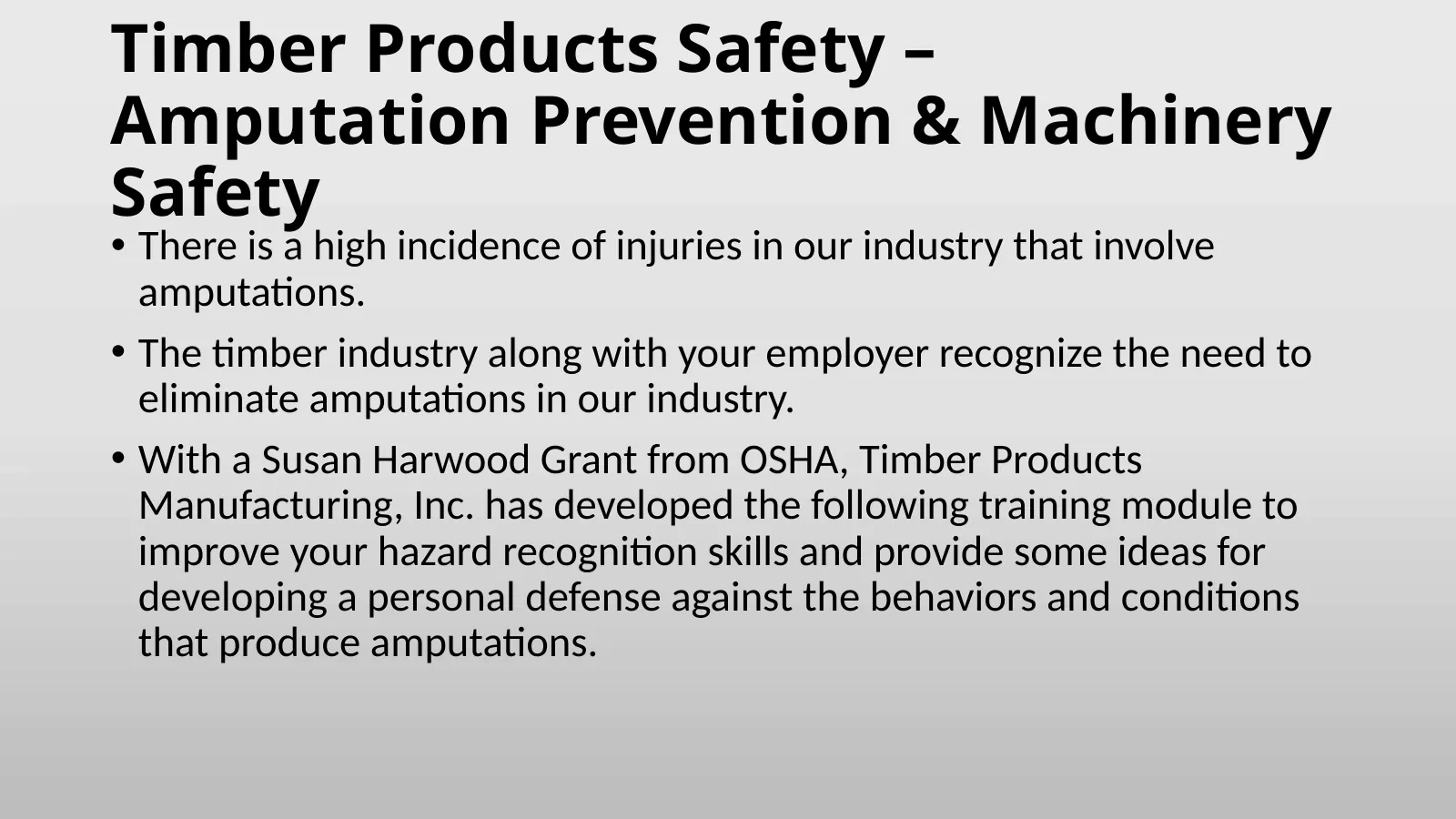
Timber Products Safety – Amputation Prevention & Machinery Safety
- There is a high incidence of injuries in our industry that involve amputations.
- The timber industry along with your employer recognize the need to eliminate amputations in our industry.
- With a Susan Harwood Grant from OSHA, Timber Products Manufacturing, Inc. has developed the following training module to improve your hazard recognition skills and provide some ideas for developing a personal defense against the behaviors and conditions that produce amputations.
- Slide 2
OSHA Susan Harwood Grant
- This material was produced under grant SH-05031-SH8 from the Occupational Safety and Health Administration, U.S. Department of Labor. It does not necessarily reflect the views or policies of the U.S. Department of Labor, nor does mention of trade names, commercial products, or organizations imply endorsement by the U.S. Government
- Slide 3
This Training Module Uses - - -
- Adult learning techniques
- Photos of actual practices at timber products manufacturing locations
- Knowledge obtained from interviews with experienced timber products manufacturing workers
- New techniques for recognizing hazards
- Slide 4
Training Module Worksheet
- Since adults learn the most by doing, a worksheet has been prepared to help you retain the most important information.
- You will complete the worksheet as we move through the material. This means that you will fill in the blanks or complete lists.
- You can keep the worksheet as a reference to the key points presented in the module.
- Slide 5
Building a Foundation For Improvement
- Safety
- Hazard
- Incident
- A Sequence of Events
- The Best Way to Prevent Amputations
- Slide 6
Safety:
- A process for reducing risk and preventing incidents by effectively managing the movement of people, equipment, material and energy.
- Slide 7
Hazard:
- Any source of danger.
- The two major types of hazard are:
- Unsafe conditions and
- Unsafe behaviors
- Slide 8
Incident:
- An unplanned event that happens after an unsafe behavior or unsafe condition that interrupts the normal progress of an activity and may result in injury or damage.
- Slide 9
A Sequence That Leads to Incidents
- The Hazards
- (Unsafe Behaviors and Unsafe Conditions)
- The Event
- (Movement)
- The Result (Incident)
- Slide 10
What is the Best Way to Prevent Incidents?
- Recognize the Hazards
- Manage the Movement of People, Equipment, Material and Energy
- Slide 11
Our Focus Today – Preventing
- Amputations
- Slide 12
Employers – Pay Attention!
- 1904.39(a)(2)
- Within twenty-four (24) hours after the in-patient hospitalization of one or more employees or an employee’s amputation or an employee’s loss of an eye, as the result of a work-related incident, you must report to OSHA.
- Slide 13
National Emphasis Program
- OSHA has had a National Emphasis Program to prevent amputations since 2001
- In 2013, US workers suffered 2,000 amputations
- What did we learn from those amputations?
- Nothing
- Slide 14
Demonstration
- Every amputation will impact the victims for the rest of their lives.
- Slide 15
Why do Amputations Happen?
- There are two primary reasons –
- 1. Machines or equipment are not guarded or they are inadequately guarded.
- 2. Lockout is not used when service or maintenance work is being performed.
- Slide 16
Machinery and Machine Guarding
- Slide 17
Worksite Objectives
- Participants will be able to -
- Identify guarding needs and deficiencies
- Identify specific guarding requirements
- Make recommendations for properly guarding machinery
- Slide 18
Where Mechanical Hazards Occur on Machines or Equipment
- Point of operation
- Power transmission apparatus
- Other moving parts
- Slide 19
Hazardous Motions
- Reciprocating
- Transverse
- Rotating
- Slide 20
Special Rotating Hazards
- In running nip points are the result of rotating parts on machinery.
- Slide 21
Hazardous Mechanical Movement
- Slide 22
OSHA Guarding Requirements (1)
- 1910.212(a)1
- One or more methods of machine guarding shall be provided to protect the operator and other employees in the machine area from hazards such as those created by point of operation, ingoing nip points, rotating parts, flying chips and sparks
- Slide 23
OSHA Guarding Requirements (2)
- 1910.219(d)(1) Pulleys
- Guarding. Pulleys, any parts of which are seven (7) feet or less from the floor or working platform, shall be guarded.
- Unguarded
- Guarded
- Slide 24
Compliance or not?
- Would this guard have prevented the injury described in Clean up Injury #1?
- Slide 25
Effective Guarding Characteristics
- Prevent contact
- Secure
- Protect from falling objects
- Create no new hazards
- Create no interference
- Allow safe lubrication
- Slide 26
Machine Guarding Summary
- We have learned
- Where mechanical hazards occur
- There are three types of hazardous motion
- We understand in-running nip points
- We know six characteristics of effective guards
- Slide 27
Lockout/Tagout What it is!
- Lockout prevents energy from getting to machines or equipment when workers are performing service or maintenance and unexpected energy, start-up or release of stored energy could cause injury.
- Service and maintenance activities include lubrication, cleaning, unjamming and making adjustments and tool changes.
- Slide 28
Understand the Difference
- Normal Production Operations (Guarding Protects You)
- Use of a machine or equipment to perform its intended production function.
- Servicing or Maintenance (Lockout Protects You)
- Includes activities such as lubrication, cleaning, unjamming, making adjustments or tool changes, etc.
- Slide 29
Lockout is Required Whenever
- Service or Maintenance is performed-
- If you are required to remove or bypass a guard or other safety device- LOCKOUT
- If you are required to place any part of your body into an area on a machine or piece of equipment where work is actually performed on material or where an associated danger zone exists during a machine cycle- LOCKOUT
- Slide 30
Point of Operation
- Slide 31
In the Northwest (Unjamming)
- A sawmill worker reached into a running planer to remove piecers of wood on the top head after a “crash”. His hand was pulled into the planer and his thumb, index and middle fingers were amputated.
- Slide 32
Similar Incident (Unjamming)
- The sawmill worker used lathe/stickers to “knock-out” chunks of wood from a planer “crash”. There were several chunks that remained. He reached into the planer to get the remaining debris and two fingers were amputated. Lockout was required and would have prevented another needless amputation loss.
- Slide 33
Making an Adjustment
- A worker was adjusting the guides on a head saw. Upon completing the adjustment, he reached across the rotating head saw blade and slapped the far side guide. While bringing his hand back, it crossed the point of operation and his middle finger was amputated.
- Slide 34
Cleaning Up
- A worker did not stop the planer or lock it out before he entered the area below the planer to clean up debris. His sweat shirt started to rotate around the rotating shaft. His right arm was fractured and amputated by the turning shaft.
- Slide 35
One Last Incident
- A maintenance worker had just finished a repair on a piece of equipment. He re-energized the equipment and was waiting for it to cycle to see if his repair was effective. As he was waiting, he rested his hand on an adjacent piece of equipment. The second piece of equipment cycled first and his index finger tip was amputated by a hydraulic piston.
- Use your Worksheet to answer the following Group questions
- Slide 36
Remember to Protect Yourself and Your Rights
- When machines stop or get jammed up, normal production operations stop and service and maintenance begin.
- Inadequate
- Machine Guarding
- Nearly all service and maintenance activities require lockout.
- Failure to Lock Out
- Slide 37
One Final Thought
- Every amputation that ever occurred because of failure to lockout or because of inadequate machine guarding was preventable.
- Lockout failures and machine guarding failures result in needless pain, suffering, loss of wages and expense to the organization.
- Any serious competitor to your business or market share will do a better job of machine guarding and perform lockout better than you do.
- Slide 38
Workers’ Rights Under OSH Act
- Workers are entitled to working conditions that do not pose a risk of serious harm. To help assure a safe and healthful workplace, OSHA also provides workers with the right to:
- Ask OSHA to inspect their workplace;
- Use their rights under the law without retaliation and discrimination;
- Receive information and training about hazards, methods to prevent harm, and the OSHA standards that apply to their workplace. The training must be in a language you can understand;
- Get copies of test results done to find hazards in the workplace;
- Review records of work-related injuries and illnesses;
- Get copies of their medical records.
- Slide 39
Employer Responsibilities
- Under the OSH law, employers have a responsibility to provide a safe workplace. This is a short summary of key employer responsibilities:
- Provide a workplace free from serious recognized hazards and comply with standards, rules and regulations issued under the OSH Act.
- Examine workplace conditions to make sure they conform to applicable OSHA standards.
- Make sure employees have and use safe tools and equipment and properly maintain this equipment.
- Use color codes, posters, labels or signs to warn employees of potential hazards.
- Establish or update operating procedures and communicate them so that employees follow safety and health requirements.
- Employers must provide safety training in a language and vocabulary workers can understand.
- Employers with hazardous chemicals in the workplace must develop and implement a written hazard communication program and train employees on the hazards they are exposed to and proper precautions (and a copy of safety data sheets must be readily available). See the OSHA page on Hazard Communication.
- Provide medical examinations and training when required by OSHA standards.
- Post, at a prominent location within the workplace, the OSHA poster (or the state-plan equivalent) informing employees of their rights and responsibilities.
- Report to the nearest OSHA office within 8 hours any fatal accident or one that results in the hospitalization of three or more employees. Call our toll-free number: 1-800-321-OSHA (6742); TTY 1-877-889-5627
- Keep records of work-related injuries and illnesses. (Note: Employers with 10 or fewer employees and employers in certain low-hazard industries are exempt from this requirement.
- Provide employees, former employees and their representatives access to the Log of Work-Related Injuries and Illnesses (OSHA Form 300). On February 1, and for three months, covered employers must post the summary of the OSHA log of injuries and illnesses (OSHA Form 300A).
- Provide access to employee medical records and exposure records to employees or their authorized representatives.
- Provide to the OSHA compliance officer the names of authorized employee representatives who may be asked to accompany the compliance officer during an inspection.
- Not discriminate against employees who exercise their rights under the Act. See our "Whistleblower Protection" webpage.
- Post OSHA citations at or near the work area involved. Each citation must remain posted until the violation has been corrected, or for three working days, whichever is longer. Post abatement verification documents or tags.
- Slide 40
Right to File a Complaint
- The Occupational Safety and Health Act of 1970 gives employees and their representatives the right to file a complaint and request an OSHA inspection of their workplace if they believe there is a serious hazard or their employer is not following OSHA standards. Further, the Act gives complainants the right to request that their names not be revealed to their employers.
- Complaints from employees and their representatives are taken seriously by OSHA. It is against the law for an employer to fire, demote, transfer, or discriminate in any way against a worker for filing a complaint or using other OSHA rights.
- OSHA will keep your information confidential.
- Slide 41
Whistleblower Protections
- OSHA's Whistleblower Protection Program enforces the whistleblower provisions of more than twenty whistleblower statutes protecting employees who report violations of various workplace safety laws.
- Protection from discrimination means that an employer cannot retaliate by taking "adverse action" against workers, such as:
- Firing or laying off
- Blacklisting
- Demoting
- Denying overtime or promotion
- Disciplining
- Denial of benefits
- Failure to hire or rehire
- Intimidation
- Making threats
- Reassignment affecting prospects for promotion
- Reducing pay or hours
More on Machine Guarding
pptx
54 slidesMachine Guarding (OSHA 10-Hour General Industry Outreach)
OSHA's own 10-hour General Industry Outreach deck on machine guarding (v. 03-01-17), editable PowerPoint with trainer notes.
U.S. Department of Labor, OSHA (with the OTIEC Outreach Workgroup)Public domain
pdf
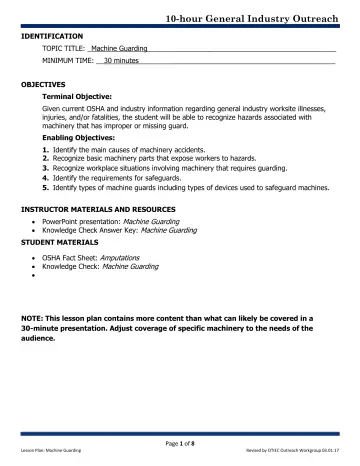
8 slidesMachine Guarding: Lesson Plan (OSHA 10-Hour General Industry Outreach)
Instructor lesson plan (objectives, timing, teaching steps) for the OSHA General Industry machine guarding outreach deck.
U.S. Department of Labor, OSHA (with the OTIEC Outreach Workgroup)Public domain
pdf
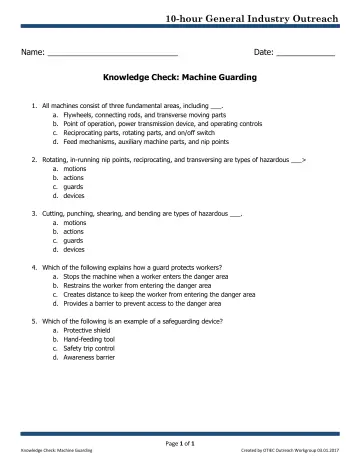
1 slidesMachine Guarding: Knowledge Check (OSHA 10-Hour General Industry Outreach)
Student knowledge-check quiz for the OSHA General Industry machine guarding outreach deck.
U.S. Department of Labor, OSHA (with the OTIEC Outreach Workgroup)Public domain