1 / 16Use ← → to flip
Amputation Prevention Instructor Notes
Instructor notes for the amputation prevention and machinery safety deck.
Page text
· 16 pages · by Timber Products Manufacturers, Inc.
The words on each page as the author wrote them, read from the file by software so they can be searched. Layout, pictures and tables are not shown here: the pages above and the download are the original.
- Page 1
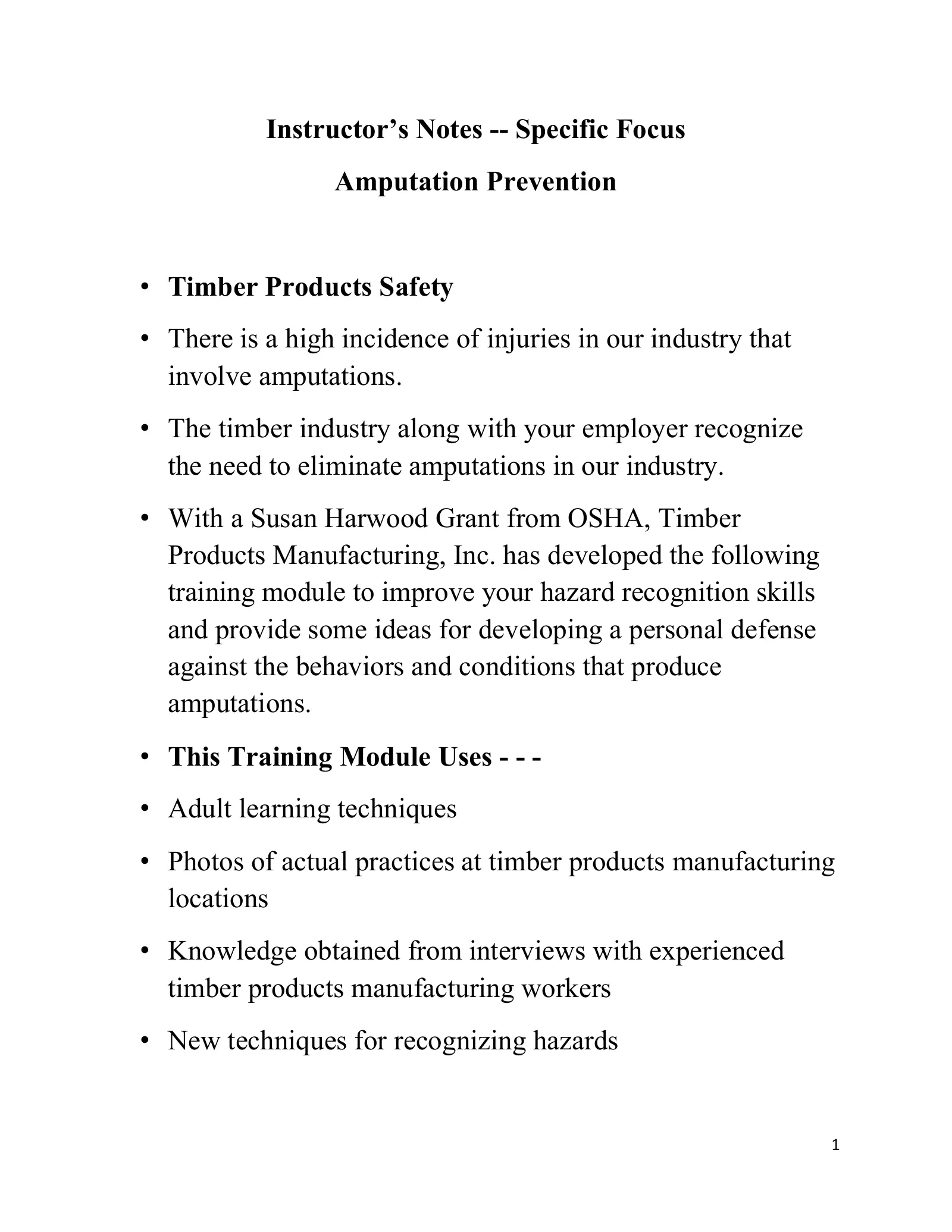
Instructor’s Notes -- Specific Focus
- Amputation Prevention
- Timber Products Safety
- There is a high incidence of injuries in our industry that involve amputations.
- The timber industry along with your employer recognize the need to eliminate amputations in our industry.
- With a Susan Harwood Grant from OSHA, Timber Products Manufacturing, Inc. has developed the following training module to improve your hazard recognition skills and provide some ideas for developing a personal defense against the behaviors and conditions that produce amputations.
- This Training Module Uses - - -
- Adult learning techniques
- Photos of actual practices at timber products manufacturing locations
- Knowledge obtained from interviews with experienced timber products manufacturing workers
- New techniques for recognizing hazards
- Page 2
Training Module Worksheet
- Hand out the worksheet
- Since adults learn the most by doing, a worksheet has been prepared to help you retain the most important information.
- You will complete the worksheet as we move through the material. This means that you will fill in the blanks or complete lists.
- You can keep the worksheet as a reference to the key points presented in the module.
- Building a Foundation for Improvement
- The foundation involves learning and understanding the definitions of safety, hazard, and incident. It also includes an understanding that incidents (bodily injury and property damage) are generated by a sequence of events. And finally, developing the ability to visualize the best way to prevent amputations.
- Safety
- (Whenever you see the words highlighted in red like these, it means it is time to fill in the worksheet)
- Let’s get started with a functional definition of safety. It is called a functional definition because it is easy to remember; it is fundamental to incident prevention and it is something that you can use. “Safety is a process for reducing risk and
- Page 3
- preventing incidents by effectively managing the movement of people, equipment, material and energy”. There are some key words in this definition. The first one is movement. No injury or incident has ever occurred without some form of movement. The other key words are people, equipment, material and energy. They are key because they are the only four things that can move.
- Hazard.
- A hazard may be defined as – any source of danger. There are two major types of hazard. The first type is an unsafe condition. The second type is an unsafe behavior. It should be pointed out that the term behavior is used in the scientific sense. That is, behavior is defined as an observable action. Therefore, by itself behavior is neither good nor bad – it is merely an observable action. On the other hand, an unsafe behavior, by definition, is an observable action that is a source of danger.
- Incident
- An incident is an unplanned event that happens after an unsafe behavior or unsafe condition that interrupts the normal progress of an activity and may result in injury or damage.
- Three bad things can happen when incidents occur. Someone may be injured, equipment may be damaged or the process may be interrupted. All three are unnecessary, expensive and in one way or another painful. The most important thing to remember
- Page 4
- is that before every incident there is an unsafe behavior or unsafe condition.
- A Sequence That Leads to Incidents
- There is a specific sequence that leads to every incident. Hazards must first occur in the work place. Either unsafe conditions or unsafe behaviors must be allowed to occur and remain uncontrolled. For instance, if a supervisor observes a worker stick his hand into an operating planer to retrieve debris and says nothing and does nothing about it, unsafe acts like this will continue to occur. Sooner or later there will be an event involving the movement of people, equipment, material or energy that will lead to an amputation incident. Incidents may be prevented when we are able to break the sequence.
- What is the Best Way to Prevent Incidents?
- Read and discuss
- First of all recognize the hazards. Once the hazards are recognized there is an opportunity to manage the movement of people, equipment, material and energy. The objective is to separate people from the hazards in an organized and controlled manner.
- Well, that is our foundation for improvement.
- Page 5
Our focus Today – Amputations
- Unfortunately, disabilities like this happen too often in our industry.
- Employers Pay Attention!
- Read and discuss
- This regulation is part of the Occupational Safety and Health Act. Why is in-patient hospitalization of one or more employees or an employee’s amputation or an employee’s loss of an eye, as the result of a work-related incident singled out by OSHA? For the most part, these incidents are serious and involve permanent loss and happen too often.
- National Emphasis Program
- Click through the slide (4 clicks) Read and discuss each click
- OSHA has had a National Emphasis Program on amputations since October 26, 2001. Over the years, the NEP has been expanded, modified, extended and so on. As a matter of fact, it has been extended until September 30, 2019. Guess what – I am certain it will be extended again because we have not used the knowledge and technology, we already have to stop amputations. As a country, as an industry we have everything
- Page 6
- necessary to stop amputations in the work place and we have it right now.
- In 2013 there were more than 2000 workplace amputations in the United States. Nearly every one of those amputations resulted from failure to guard machinery and equipment or failure to lockout when doing service or maintenance on machines or equipment (lockout).
- What did we learn from those amputations? NOTHING We are still making the same mistakes over and over. Amputations are permanent and they influence your ability to do things.
- Demonstration
- We are going to do a demonstration that will show how amputations impact the victims.
- You will need duct tape, scissors and a volunteer for this demonstration. Place a chair in the front of the room so everyone can see what is going to happen.
- Select a volunteer who is wearing lace up boots or shoes. While sitting in the demonstration chair, have the volunteer untie one of the laces and pull both ends through the first eyelets. This should go fairly well so congratulate the volunteer on his ability to perform a simple task.
- Now duct tape the volunteer’s thumb to the palm of his hand so the thumb cannot be used. Repeat the process for the other thumb.
- Page 7
- Ask the volunteer to lace up and tie the shoe. This should not go well. Encourage the volunteer to continue trying for a minute or until it is evident to everyone that this is a significant challenge.
- Emphasize that there are consequences for amputations. While the volunteer is still taped up, tell him he has been such a good sport that you have a reward for him. Spread a few dollars in dimes flat on the floor and tell him that he can keep all the dimes he is able to pick up in the next 15 seconds.
- The personal challenges resulting from an amputation last a life time. How do you want to live your life?
- Why do Amputations Happen?
- Read and discuss
- Machinery and Machine Guarding
- Machinery and machine guarding include the barriers or devices installed to prevent workers from coming in contact with moving parts of equipment during normal production operations. It is your right to not operate equipment that has missing, damaged or inadequate guards.
- Page 8
Worksite Objectives
- Since so many amputations happen because of no guards or inadequate guards, we are going to spend a little time on the subject. Read and discuss the slide
- Where Mechanical Hazards Occur on Machines or Equipment
- Read and discuss
- Point of operation –
- This is where work is performed on material such as planing, cutting, forming or shaping.
- Power transmission apparatus –
- These are the components of a mechanical system that transfer energy to the part of the machine that is performing the work. Belts, pulleys, couplings, connecting rods, flywheels, cams and gears are typical parts of power transmission apparatus.
- Other moving parts –
- These are the other parts of the machine that move while the machine is working. These may include the feed mechanism and auxiliary parts of the machine.
- Hazardous Motions
- There are three types of hazardous mechanical motion.
- Page 9
- The first type of hazardous motion is reciprocating. There is potential to be struck by a moving part or caught between a moving part and a stationary part from the up and down or back and forth motion.
- The second type of hazardous motion is transverse motion.
- This is movement in a continuous or straight line. There is potential here for being struck by or caught in a pinch or shear point from the moving part.
- The third type of hazardous motion is rotating – Shaft ends, collars, couplings horizontal and vertical shafts are examples of rotating mechanisms that may be hazardous. Even smooth slowly rotating shafts can grip clothing.
- Special Rotating Hazards
- In running nip points are the result of rotating parts on machinery. There are three primary types of in running nip points.
- Nip points may result from parts rotating in opposite directions while their axes a parallel to each other. Obvious examples include rolling mills and gears.
- Nip points result when rotating parts are temporarily and predictably in contact with other moving parts. Examples would include a chain and sprocket or a power transmission belt and its pulley. Nip points can occur between rotating parts and
- Page 10
- fixed parts creating shearing or crushing actions. Examples include screw conveyors, a grinding wheel and the steady rest.
- Once again, the three types of hazardous motion are, reciprocating, transverse and rotating.
- Hazardous Mechanical Movement
- Here are some examples of hazardous mechanical movement.
- OSHA Guarding Requirements (1)
- 1910.212(a)(1
- One or more methods of machine guarding shall be provided to protect the operator and other employees in the machine area from hazards such as those created by point of operation, ingoing nip points, rotating parts, flying chips and sparks.
- OSHA Guarding Requirements (2)
- Read and discuss – emphasize the guarded pulleys are fully enclosed
- Compliance or not?
- Do you have any situations like this in your facility?
- Effective Guarding Characteristics
- Six characteristics are necessary for a guard to be effective.
- Prevent contact -Effective guards prevent hands, arms or any other part of the body from coming in contact with
- Page 11
- hazardous moving parts.
- Secure – Effective guards are not easily removed or bypassed and are firmly attached to the machine. They are constructed of durable material strong enough to withstand normal usage.
- Protection from falling objects- Effective guards insure that no objects can fall into moving parts.
- Create no new hazards – Effective guards do not create other hazards such as sharp corners or objects that may be struck against.
- Create no interference – Effective guards do not interfere with performance or require additional actions to complete tasks.
- Allow for safe lubrication – Effective guards allow for lubrication without removing the guard.
- Machine Guarding Summary
- We have learned where mechanical hazards occur - Point of Operation, Power Transmission Apparatus and Other Moving Parts. We have also learned the three types of hazardous motion
- reciprocating, transverse and rotational. We learned about inrunning nip points and where they occur. We now have an understanding of the six characteristics of an effective guard. Just think, if all the hazardous mechanical motions in our work environment were effectively guarded – How many fingers,
- Page 12
- hands, arms and legs could we save in a year? I don’t know the answer to that question but it would be thousands. And, it could be even more if we addressed lockout and flawlessly executed our responsibilities as employees and managers. We will discuss lockout in the next segment.
- Lockout / Tagout
- What it is!
- Remember we discussed that machinery and machine guarding is designed to protect workers during normal production operations.
- On the other hand, the purpose of Lockout is to protect workers who service or maintain machines or equipment whenever unexpected energy, start-up or release of stored energy could cause injury.
- Just a question for the group. Raise your hand if you have had lockout training. (Ask more questions based on the response. Additional questions may provide valuable information about why so many amputations occur in our industry)
- Understand the Difference
- Read and discuss
- The engineers who designed a planer did not design it to jam up. Jam ups may happen frequently but they are not part of the intended production function. When machines stop or get
- Page 13
- jammed up, normal production functions end and service and maintenance begin. Nearly all service and maintenance activities require lockout. There is only one person in this room that is qualified to identify those service and maintenance activities that do not require lockout. (Hold up your hand presenter)
- Lockout is Required Whenever –
- Read and discuss
- Service or maintenance is performed.
- If you are required to remove or bypass a guard or other safety device. LOCKOUT
- If you are required to place any part of your body into an area on a machine or piece of equipment where work is actually performed on material or where an associated danger zone exists during a machine operating cycle. LOCKOUT
- There are no exceptions!
- Point of Operation
- This is a machine. It is an eating machine and his jaws are his point of operation. If the jaws of this eating machine were open, would you stick your hand in his mouth? Obviously, the answer is no. Would you stick your hand in his mouth to make your supervisor happy? The answer is still no. Then, tell me why
- Page 14
- your co-workers continue to stick their hands into operating planers to retrieve jammed material?
- In the Northwest (Unjamming)
- A sawmill worker reached into a running planer to remove pieces of wood on the top head after a “crash”. His hand was pulled into the planer and his thumb, index and middle fingers were amputated. This was a senseless loss, as are, all amputations.
- Listen to me. When a machine gets jammed up, what is required to remove the jam? Lockout is required. The law requires you to lock it out if you must place any part of your body in the point of operation. It is your right to protect your body with lockout. If you don’t demand your rights, who will.
- Similar Incident (Unjamming)
- The sawmill worker used lathe/stickers to “knock-out” chunks of wood from a planer “crash”. There were several chunks that remained. He reached into the planer to get the remaining debris and two fingers were amputated. Lockout was required and would have prevented another needless amputation loss.
- Making an Adjustment
- Read and discuss
- A worker was adjusting the guides on a head saw. Upon completing the adjustment, he reached across the rotating head
- Page 15
- saw blade and slapped the far side of the guide. While bringing his hand back, it crossed the point of operation and his middle finger was amputated.
- Cleaning Up
- A worker did not stop the planer or lock it out before he entered the area below the planer to clean up debris. His sweat shirt started to rotate around the rotating shaft. His right arm was fractured and amputated by the turning shaft.
- One Last Incident
- A maintenance worker had just finished a repair on a piece of equipment. He re-energized the equipment and was waiting for it to cycle to see if his repair was effective. As he was waiting, he rested his hand on an adjacent piece of equipment. The second piece of equipment cycled first and his index finger tip was amputated by a hydraulic piston.
- Group questions –
- Was this incident a lockout failure or was it machine guarding failure?
- What type of hazardous motion was involved?
- Did this incident occur at the point of operation, power transmission apparatus or other moving parts?
- How could this incident have been prevented?
- Page 16
Remember to Protect Yourself and Demand Your Rights
- Read and discuss
- During normal production operations, you are protected by guarding. During service or maintenance, you are protected by lockout. Both of these protections are your rights. Demand your rights.
- One Final Thought
- This material was produced under grant SH-05031-SH8 from the Occupational Safety and Health Administration, U.S. Department of Labor. It does not necessarily reflect the views or policies of the U.S. Department of Labor, nor does mention of trade names, commercial products, or organizations imply endorsement by the U.S. Government.
More on Machine Guarding
pptx
54 slidesMachine Guarding (OSHA 10-Hour General Industry Outreach)
OSHA's own 10-hour General Industry Outreach deck on machine guarding (v. 03-01-17), editable PowerPoint with trainer notes.
U.S. Department of Labor, OSHA (with the OTIEC Outreach Workgroup)Public domain
pdf
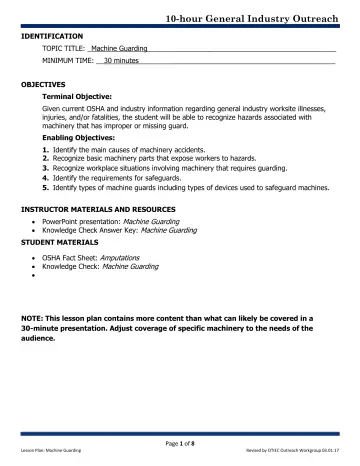
8 slidesMachine Guarding: Lesson Plan (OSHA 10-Hour General Industry Outreach)
Instructor lesson plan (objectives, timing, teaching steps) for the OSHA General Industry machine guarding outreach deck.
U.S. Department of Labor, OSHA (with the OTIEC Outreach Workgroup)Public domain
pdf
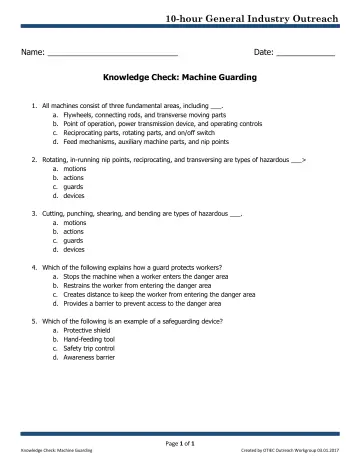
1 slidesMachine Guarding: Knowledge Check (OSHA 10-Hour General Industry Outreach)
Student knowledge-check quiz for the OSHA General Industry machine guarding outreach deck.
U.S. Department of Labor, OSHA (with the OTIEC Outreach Workgroup)Public domain