
Worker Rights and Anti-Retaliation
Worker rights and anti-retaliation module from the Building Industry Association of Hawaii construction safety program; supports the worker-rights portion of Intro to OSHA.
Slide text
· 25 slides · by Building Industry Association - Hawaii
The words on each slide as the author wrote them, read from the file by software so they can be searched. Layout, pictures and tables are not shown here: the slides above and the download are the original.
- Slide 1
Worker Rights
- & Anti-Retaliation
- Slide 2
Overview
- About OSHA
- Rights
- Resources
- Filing
- Complaints
- Slide 3
About OSHA
- Why is OSHA Important?
- 4,405 workers were killed on the job in 2013
- (3.2 per
- 100,000 full-time equivalent workers)
- An average of nearly 12 workers die every day
- Hispanic or Latino workers were killed from work-related injuries in 2013
- Nearly 3 million serious workplace injuries and illnesses were reported by private industry employers in 2012
- Slide 4
About OSHA
- Why is OSHA Important?
- OSHA Makes a Difference
- Worker deaths in America are down–on average, from about 38 worker deaths a day in 1970 to 12 a day in 2013.
- Worker injuries and illnesses are down–from 10.9 incidents per 100 workers in 1972 to 3.0 per 100 in 2012.
- Slide 5
About OSHA
- Mission
- The mission of OSHA is to assure safe and healthful working conditions for working men and women by setting and enforcing standards and by providing training, outreach, education, and assistance.
- Some of the things OSHA does to carry out its mission are:
- Developing job safety and health standards and enforcing them through worksite inspections
- Providing training programs to increase knowledge about occupational safety and health
- Slide 6
About OSHA
- Becoming the Law
- Act of 1970
- Worker Protection is Law: The Occupational Safety and Health Act of 1970 (OSH Act)
- OSHA was created to provide workers the right to a safe and healthful workplace
- It is the duty of the employers to provide workplaces that are free of known dangers that could harm their employees
- This law also gives workers important rights to participate in activities to ensure their protection from job hazards
- Slide 7
About OSHA
- OSHA’s Recordkeeping rule requires most employers with more than 10 workers to keep a log of injuries and illnesses
- Workers have the right to report an injury* and review current log
- Workers also have the right to view the annually posted summary of the injuries and illnesses (OSHA 300A)
- *It is against the OSHA law to retaliate or discriminate against a worker for reporting an injury or illness
- Slide 8
Rights & Resources
- Workers’ Rights
- Slide 9
Rights & Resources
- Your Rights Under OSHA
- You have the right to:
- A safe and healthful workplace
- Know about hazardous chemicals
- Report injury to employer
- Complain or request hazard correction from employer
- Training
- Hazard exposure and medical records
- File a complaint with OSHA
- Participate in an OSHA inspection
- Be free from retaliation for exercising safety and health rights
- Slide 10
Rights & Resources
- Your Right to Know About Hazardous Chemicals
- Employers must have a written, complete hazard communication program that includes information on:
- Container labeling,
- Safety Data Sheets (SDSs), and
- Worker training.
- The training must include
- the physical and health hazards of the chemicals and how workers can protect themselves
- The Hazard Communication
- Standard (HCS) requires chemical manufacturers, distributors, or importers to provide Safety Data
- Sheets (SDSs) (formerly known as Material Safety Data Sheets or MSDSs) to communicate the hazards of hazardous chemical products. As of June 1, 2015, the HCS will require new SDSs to be in a uniform format.
- Slide 11
Rights & Resources
- Your Right to Complain or Request Corrections
- Workers may bring up safety and health concerns in the workplace to their employers without fear of discharge or discrimination
- OSHA rules protect workers who raise concerns to their employer or OSHA about unsafe or unhealthful conditions in the workplace
- Slide 12
Rights & Resources
- Your Right to Train
- Some required training covers
- Workers have a topics such as, chemical hazards, equipment hazards, noise, confined
- right to get
- spaces, fall hazards in construction, training from personal protective equipment, employers on a with a variety of other
- variety of health along
- subjects
- and safety
- Training must be in a language and hazards and vocabulary workers can understand standards that employers must follow
- Slide 13
Rights & Resources
- Your Right to Examine Exposure & Medical Records
- 1910.1020: Right to examine & copy records
- Examples of toxic substances and harmful physical agents are:
- Metals and dusts, such as, lead, cadmium, and silica
- Biological agents, such as bacteria, viruses, and fungi
- Physical stress, such as noise, heat, cold, vibration, repetitive motion, and ionizing and non-ionizing radiation
- Slide 14
Rights & Resources
- Your Right to File a Complaint with OSHA
- Workers may file a confidential complaint with OSHA if they believe a violation of a safety or health standard, or an imminent danger situation, exists in the workplace
- Workers may request that their name not be revealed to the employer
- If a worker files a complaint, they have the right to find out OSHA’s action on the complaint and request a review if an inspection is not made
- Note:
- Often the best and fastest way to get a hazard corrected is to notify your supervisor or employer.
- Slide 15
Rights & Resources
- Your Right to Participate in an OSHA Inspection
- Employee representative can accompany OSHA inspector
- Workers can talk to the inspector privately
- Workers may point out hazards, describe injuries, illnesses or near misses that resulted from those hazards and describe any concern you have about a safety or health issue
- Workers can find out about inspection results, abatement measures and may object to dates set for violation to be corrected
- Slide 16
Rights & Resources
- Your Right to be Free from Retaliation
- Workers have the right to be free from retaliation for exercising safety and health rights
- Workers have 30 days to contact OSHA if they feel they have been punished for exercising their safety and health rights
- Workers have a right to seek safety and health on the job without fear of punishment
- This right is spelled out in Section 11(c) of the OSH Act
- Slide 17
Rights & Resources
- Where to Go for Help
- Sources within the workplace/ worksite
- Sources outside the workplace/ worksite
- How to file an OSHA complaint
- Slide 18
Rights & Resources
- Resources in the Workplace
- Employer or supervisor, co-workers and union representatives
- Safety Data Sheet (SDS) for information on chemicals
- Labels and warning signs
- Employee orientation manuals or other training materials
- Work tasks and procedures instruction
- Slide 19
Rights & Resources
- Resources in the Workplace
- OSHA website: http://www.osha.gov and OSHA offices (you can call or write)
- Other local, community
- -based resources
- Public libraries
- Compliance Assistance Specialists in the area offices
- Doctors, nurses, other health care providers
- National Institute for Occupational Safety and Health
- OSHA
- Training
- Institute
- Education
- Centers
- Slide 20
Filing a Complaint
- How to Raise a Concern
- Identifying Safety and Health Problems in the Workplace
- Review handout to become more aware of workplace hazards
- Discuss if anyone has discovered safety and/or health problems in the workplace/site
- Slide 21
Filing a Complaint
- The Process
- Download the OSHA complaint form from OSHA’s website
- Workers do not have to reveal their name
- File the complaint online
- Workers can file a complaint
- A worker representative can file a complaint
- OSHA determines if an inspection is necessary
- Telephone or visit local regional or area offices to discuss your concerns
- Complete the form – be specific and include appropriate details
- Slide 22
Filing a Complaint
- Group Activity
- General Industry
- Each group reviews the handout and discusses the industry-specific scenario
- Groups need to determine what information would be important to include in their complaint
- Have the class discuss the group’s results:
- What was included in the complaint?
- What was added to the complaint?
- Slide 23
Questions for Review
- What are some resources inside the workplace that will help you find information on safety and health issues?
- What are some resources outside the workplace that will help you find information on safety and health issues?
- Slide 24
Questions?
- Slide 25
OSHA Disclaimer
- This material was produced under grant SH29640SH6 from the Occupational Safety and Health Administration, U.S. Department of Labor. It does not necessarily reflect the views or policies of the U.S. Department of Labor, nor does mention of trade names, commercial products, or organizations imply endorsement by the U.S. Government.
More on Intro to OSHA
Introduction to OSHA Instructor Guide (2024)
OSHA's official instructor guide for the required 1-hour Introduction to OSHA module (worker rights, employer responsibilities, filing a complaint). Required content for every 10- and 30-hour Outreach class.
Introducción a OSHA: Guía del instructor (2024)
Spanish edition of OSHA's required Introduction to OSHA instructor guide for Outreach Training Program classes.
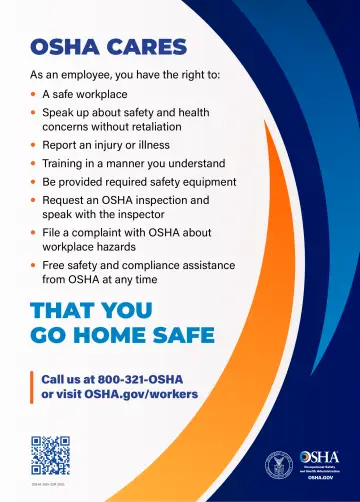
Job Safety and Health: It's the Law Poster (OSHA 3165)
The required OSHA workplace poster; used as a handout in the Introduction to OSHA module.