1 / 29Use ← → to flip
Introduction to OSHA Instructor Guide (2024)
OSHA's official instructor guide for the required 1-hour Introduction to OSHA module (worker rights, employer responsibilities, filing a complaint). Required content for every 10- and 30-hour Outreach class.
Page text
· 17 of 29 pages · by U.S. Department of Labor, OSHA
The words on each page as the author wrote them, read from the file by software so they can be searched. Layout, pictures and tables are not shown here: the pages above and the download are the original.
- Page 1
Introduction to OSHA
- Occupational Safety and Health Administration
- 1 hour presentation – Outreach Trainer Guide
- We are OSHA We can Help
- January 2024
- Page 2
Table of Contents
- Outreach Trainer Overview … 3
- Outreach Trainer Guidelines … 4
- Topic 1: OSHA's Mission … 5
- Topic 2: OSHA Standards … 5
- Topic 3: Employer Responsibilities … 6
- Topic 4: Workers Rights/Responsibilities … 7
- Topic 5: Enforcing Standards … 8
- Topic 6: Reporting Safety Hazards … 9
- Topic 7: Whistleblower Protections … 10
- Topic 8: Worker Resources … 11
- OPTIONAL Exercise … 12
- Appendix A: Outreach Trainer Reference Copies … 13
- Appendix B: Workers Rights Practice Worksheet … 25
- Appendix C: OPTIONAL Exercise Scenarios … 27
- Page 3
Outreach Trainer Guide Outreach Trainer Overview
- OSHA’s MESSAGE to WORKERS
- Workers need to trust OSHA to fully and faithfully carry out:
- The mission of OSHA is to save lives, prevent injuries, and protect the health of America’s workers.
- OSHA's History
- Until 1970, there were no national laws for safety and health hazards. The U.S. Congress created OSHA under the Occupational Safety and Health Act of 1970 (the OSH Act). Congress passed the law and established OSHA.
- OSHA's Mission
- The mission of OSHA is to save lives, prevent injuries, and protect the health of
- America's workers. The OSH Act states
- O S H A “ W e C a n H e l p!” that workers have the right to a safe workplace and the employer's responsibility to provide safe and healthy workplaces.
- Outreach Trainer's Role Outreach Trainers
- YOUR ROLE as
- of the "Introduction to OSHA" training need
- OSHA Outreach Trainer
- to review and understand OSHA's mission statements. They
- Emphasize OSHA’s mission statements should know as much about the training
- Know your audience; ensure the audience as possible to ensure the training meets training meets/exceeds the participant’s or exceeds their needs. Importantly, the needs
- Outreach Trainer should emphasize that OSHA
- Establish rapport with audience was established to protect workers.
- OSHA was established “to assure so far as possible every working man and woman in the nation safe and healthful working conditions and to preserve our human resources.”
- Convey message of trusting OSHA to protect workers
- DELIVERING the MESSAGE
- Ensure references to OSHA are positive and convey trust that OSHA was established to protect workers
- Streamline minimum 1-hour content presentation to best fit the learner’s needs; emphasize workers rights provided by OSHA
- Present OSHA standards as rules that are enforced on employers not workers
- Involve the participants in learning activities
- Training Topics [Delivery]
- 1. OSHA's Mission
- 2. OSHA Standards
- 3. Employer Responsibilities
- 4. Workers’ Rights/Responsibilities
- 5. Enforcing Standards
- 6. Reporting Safety Hazards
- 7. Whistleblower Protection
- 8. Worker Resources
- Page 4
Outreach Trainer Guide Outreach Trainer Guidelines
- Introduction
- This "Introduction to OSHA" is required in all OSHA Outreach Training Program 10-- and 30-hour classes for the construction, general, and maritime industries.
- Outreach Trainers should possess the following knowledge, skills, and attitudes regarding the importance and value of safety and health training for workers and the Occupational Safety and Health Administration (OSHA):
- Knowledge of OSHA background, mission, and current standards
- Skills in training facilitation include applying adult learning principles, conducting active training sessions, building rapport with the audience, relating to the workers by using industry-specific terminology, and explaining familiar workplace conditions.
- Attitude that is positive and supportive of OSHA and best work practices for a safe and healthful workplace
- Presenting the Training
- These materials are to be used as guidance for facilitating the one-hour presentation. The presentation should be geared towards the audience. There is enough time [one hour] to present the pertinent OSHA information and conduct the planned activities; however, depending on the number of participants, the Outreach Trainer may adjust the delivery strategies accordingly. One option is to practice each topic or conduct the Optional Exercise at the end of the training. To assist in planning the presentation, each topic is developed using the Prepare/Present/Practice format. Outreach Trainers should consider displaying the Job Safety and Health It's a Law! Poster throughout the training hour.
- Materials Needed
- Copies of course materials needed, including additional references, handouts, and worksheets from Appendices A, B, and C One OSHA "Job Safety and Health It's the
- Law" poster available online at: https://www.osha.gov/Publications/poster.html
- Training
- Preparation
- Review training materials provided Make copies of the materials needed
- Determine target audience to adjust training if needed Establish a plan to involve participants in the learning experience actively Practice training techniques to build rapport with the audience
- Outreach Trainer Reference Copies / Handouts
- In presentation order:
- 1. OSHA Poster
- 2. Employers Must Provide and Pay for PPE
- 3. OSHA "Your Rights as a Whistleblower Fact Sheet"
- 4. "We Are OSHA We Can Help" publication
- 5. Workplace Mental Health Fact Sheet
- Page 5
Outreach Trainer Guide Topic 1: OSHA's Mission
- Prepare:
- Review for understanding OSHA's mission statement.
- Present:
- Display/distribute the OSHA Poster [Handout #1, App. A]. The Occupational Safety and Health Act of 1970 (OSH Act) was passed to prevent workers from being killed or seriously harmed at work. The law requires employers to provide employees with working conditions free of known dangers. The Act created the Occupational Safety and Health Administration (OSHA), which sets and enforces protective workplace safety and health standards. OSHA also provides information, training, and assistance to workers and employers.
- The mission of OSHA is to save lives, prevent injuries, and protect the health of
- America's workers. The OSH Act states that workers have the right to a safe workplace and that the employer's responsible for providing safe and healthy workplaces.
- Practice:
- Lead a short discussion by asking participants to state why they think OSHA was created and what they believe OSHA's mission is, and then share and reiterate the true statements.
- Topic 2: OSHA Standards
- Prepare:
- Review OSHA standards.
- If possible, plan OSHA standards content according to the audience's needs
- Present:
- OSHA standards are rules that describe the methods that employers must use to protect their employees from hazards. There are OSHA standards for Construction work, Agriculture, Maritime operations, and General Industry, which are the standards that apply to most worksites. These standards limit the amount of hazardous chemicals workers can be exposed to, require using certain safe practices and equipment, and require employers to monitor hazards and keep records of workplace injuries and illnesses.
- Examples of OSHA standards include but are not limited to the list below. In a way that makes sense to the audience, briefly explain the standard and why OSHA has the standard.
- 29 CFR 1910, 1926, and 1928 (OSHA standards are online at www.osha.gov)
- They are in the Code of Federal Regulations. 29 is the book assigned to the
- Department of Labor; therefore, the OSHA standards are:
- 1910 is assigned to General Industry
- 1926 is assigned to Construction
- 1915 is assigned to Maritime
- General Duty Clause, Section 5(a)(1) explains that this is used when no specific
- OSHA standard applies to the situation.
- Noise (discuss that loud noise causes permanent hearing loss and OSHA limits the amount of noise in the workplace and has requirements for providing ear plugs/muffs at no cost, hearing exams, and engineering controls).
- Chemicals
- Protective equipment
- Fall protection
- Guarding of open-sided platform
- Page 6
Topic 3: Employer Responsibilities
- Scaffolding
- Right to know
- Practice:
- Lead discussion on how OSHA standards protect workers. Consider demonstrating the use of personal protective equipment and relate this to requirements in OSHA standards.
- Prepare:
- Review course materials and OSHA standards.
- Make copies of the Employers Must Provide and Pay for PPE [Handout #2, App. A]
- Present:
- OSHA standards mandate that employers must:
- Provide a workplace free from recognized hazards and comply with OSHA standards
- Provide training required by OSHA standards
- Keep records of injuries and illnesses
- Set up a reporting system; Provide copies of logs (i.e., OSHA 300) upon request;
- Post the annual summary; Report within 8 hours any work-related fatalities and, within 24 hours, all work-related inpatient hospitalizations, amputations, and losses of an eye.
- Provide medical exams when OSHA standards require and provide workers access to their exposure and medical records.
- Not discriminate against workers who exercise their rights under the Act
- Post-OSHA citations and abatement verification notices
- Provide and pay for most Personal Protective Equipment (PPE) [Handout #2]
- Practice:
- Discuss the requirements listed above that would be appropriate for your audience. Refer to Employers Must Provide and Pay for PPE handout #2.
- Page 7
Outreach Trainer Guide Topic 4: Workers Rights/Responsibilities
- Prepare:
- Review worker rights/responsibilities provided by OSHA.
- Make copies of the Worker's Rights Practice Worksheet to distribute.
- Present:
- Workers Rights:
- Most importantly, the creation of OSHA provided workers with the right to a safe and
- Healthful workplace. Section 5(a)(1) of the OSH Act states: "Each employer shall furnish to each of his employees employment and a place of employment which are free from recognized hazards that are causing or are likely to cause death or serious physical harm to his employees."
- A safe and healthful workplace means removing hazards and training workers. If a risk cannot be removed completely, protection (for example, respirators or earplugs) must be provided.
- Workers Responsibilities:
- Workers should know that OSHA holds employers responsible for workplace safety and health conditions and does not cite workers for violations. However, Section 5(b) of the OSH Act states that each employee shall comply with occupational safety and health standards and all applicable rules, regulations, and orders. Therefore, workers are encouraged to follow all appropriate safety and health rules and wear personal protective equipment while working.
- Practice:
- Distribute the "Workers' Rights" Practice Worksheet/Crossword Puzzle [App. B]; Allow students time to complete the puzzle and use the answers below to review finished puzzles with the class:
- Across: 4. Exposure; 6. Injuries; 7. Healthful; 8. Correction; 9. Inspection
- Down: 1. Hazardous; 2. Retaliation; 3. Training; 5. OSHA
- Page 8
Outreach Trainer Guide Topic 5: Enforcing Standards
- Prepare:
- Review OSHA inspection data, guidelines, and procedures.
- Present:
- OSHA enforces standards through inspections. The current budget is small —all together nationwide (with our State partners), there are only 2,400 inspectors for over 7 million workplaces. At this rate, it would take about 100 years for us to inspect every workplace once.
- Therefore, OSHA targets the most dangerous workplaces: industries with fatalities and serious injuries (e.g., grain handling in Colorado) and construction (i.e., falls).
- The OSHA inspection process consists of an opening conference, a walkthrough, and a closing conference with the employer. Results can take up to 6 months, after which OSHA may issue citations. These may include fines and dates by which hazard must be abated.
- When an OSHA inspection is conducted in the workplace, workers have the right to have a worker representative accompany the inspector on the inspection. Workers can talk to the inspector privately. They may point out hazards, describe injuries, illnesses, or near misses resulting from those hazards, and describe any concern about a safety or health issue. Workers also can find out about inspection results and abatement measures and get involved in any meetings or hearings related to the inspection.
- Workers may also object to the date set for the violation to be corrected and be notified if the employer files a contest.
- Practice:
- Share examples from personal inspection experiences where you have obtained better working conditions for workers, or ask experienced students to share a brief scenario.
- Page 9
Outreach Trainer Guide Topic 6: Reporting Safety Hazards
- Prepare:
- Review "Ways to Report Workplace Hazards" and "How OSHA Responds…" tables
- Present:
- Content to discuss is found in the Ways to Report Workplace Hazards table that follows. In your presentation, emphasize that the first action to report a safety hazard should be to contact your team leader, supervisor, manager, safety committee, etc. While anyone who knows about a workplace safety or health hazard may report unsafe conditions to OSHA, it's a good practice to try to abate the hazard and prevent further exposure before OSHA needs to be involved. The How OSHA Responds to a Complaint table provides information on how OSHA responds to how a complaint is reported.
- Practice:
- Ask participants general questions on how to report workplace hazards. A trainer can use the How OSHA Responds to a Complaint table to conduct "Speed Rounds" by quickly asking "If the Complaint is…" questions as soon as participants state the "Then OSHA will…" answer the previous one. Or ask participants to share an example when they (or a co-worker) have identified a hazard in their workplace and have them describe what happened.
- Page 10
Outreach Trainer Guide Topic 7: Whistleblower Protections
- Prepare:
- Provide copies of the OSHA Your Rights as a Whistleblower Fact Sheet [Handout #3, App. A]
- Present:
- The OSH Act protects workers who complain to their employer, OSHA, or other government agencies about unsafe or unhealthful working conditions in the workplace or environmental problems. Workers cannot be transferred, denied a raise, or have their hours.
- They were reduced, fired, or punished in any other way because they exercised any right given to them under the OSHA Act. Help is available from OSHA for whistleblowers.
- It is recommended that you announce or post the following:
- If you have been punished or discriminated against for using your rights, you must file a complaint with OSHA within 30 days of the alleged reprisal for most complaints. No form is required, but you must send a letter or call the OSHA Area Office nearest you to report the discrimination within 30 days of the alleged discrimination.
- Practice:
- Time permitting, ask participants if they have any stories to share or questions regarding the Whistleblower Protections information.
- Page 11
Outreach Trainer Guide Topic 8: Worker Resources
- Prepare:
- Review and gather a list of OSHA and other online resources at www.osha.gov. These include Fact Sheets, Bookmarks, Publications, etc., as well as other worker safety and health resources available
- Copies for all or a few of We Are OSHA We Can Help [Handout #4, 8-page brochure resized to 2 pages in App. A]
- Present:
- Many resources are available to workers who want to learn more about safety or health issues inside and outside their workplace.
- Because of the rights provided to workers, they can utilize some inside the workplace sources, such as Employer or supervisor, co-workers, and union representatives; Safety Data Sheet (SDS); Labels and warning signs; or Employee orientation manuals or other training materials.
- Samples of the outside-of-the-workplace worker safety and health resources are:
- Many at OSHA online at www.osha.gov, such as OSHA Compliance Assistance Specialists in the area offices.
- NIOSH is OSHA's sister agency. Workers can request that NIOSH conduct Health Hazard Evaluations (HHEs) of workplaces where workers get sick from an unknown cause or are exposed to an agent or working condition that OSHA does not regulate.
- Healthcare providers can be a resource on the health effects of toxic substances, proper medical and first aid treatment, and other health-related issues.
- Workplace Mental Health Fact Sheet
- Practice:
- Discuss the new OSHA publication We Are OSHA We Can Help [Handout #4, App. A]. This brochure sums up the basic approach suggested for this initiative. Currently, the publication is only available in English. Participants may have access to family/friends that could translate if necessary. In addition to the "We Are OSHA, We Can Help." www.osha.gov to share:
- We Can Help - Horizontal Wallet Card
- OSHA 3387 - 2010 (English: PDF); OSHA 3390 - 2010 (Spanish: PDF); OSHA 3399 - 2010 (Vietnamese: PDF)
- Worker Rights under the Occupational Safety and Health Act of 1970 - Fact Sheet (English: PDF); USTED TIENE EL DERECHO A UN LUGAR DE TRABAJO SEGURO. (Spanish: HTML PDF)
- Workers' Rights - Vertical Wallet Card
- OSHA 3392 - 2010 (English: PDF); OSHA 3393 - 2010 (Spanish: PDF); OSHA
- 3400 - 2010 (Vietnamese: PDF)
- Page 12
OPTIONAL Exercise
- The Introduction to OSHA is only planned for 1 hour, and to stay within the timeframe, the option is to practice each Topic as presented in this guide or to forego the individual Topic practices and conduct this OPTIONAL Exercise at the end of the course.
- The exercise consists of reviewing a scenario and discussing the reporting options with the class; therefore, the timing of this activity is flexible, and the 1-hour training should be completed, not added to the training.
- Directions
- Select one of the scenarios in Appendix C or present one from your experiences.
- Based on the scenario, ask the audience to discuss how they would follow the Ways to
- Report Workplace Hazards to determine the best reporting approach.
- Trainer should emphasize the order of reporting options as presented in the Ways
- to Report Workplace Hazards table, which is: Start with Contact Team Leader,
- Supervisor, Safety Manager; then Phone, Fax/Mail; or visit an OSHA Office inperson; and the last option of course is to File a Complaint with OSHA online.
- Read some of the questions listed below that, when answered, provide the information necessary to report workplace hazards and ask if any additional information is needed.
- Has anyone been injured or made ill due to this problem?
- How many employees work at the site, and how many are exposed to the hazard?
- How and when are workers exposed? On what shifts does the hazard exist?
- What work is performed in unsafe or unhealthful areas?
- What type of equipment is used? Is it in good condition?
- What materials or chemicals are used?
- Have employees been informed or trained regarding hazardous conditions?
- What process or operation is involved? What kinds of work are done nearby?
- How often and for how long do employees work at the task that leads to their exposure?
- How long (to your knowledge) has the condition existed?
- Have any attempts been made to correct the problem? Have there been any "near-
- miss" incidents?
- Page 13
Outreach Trainer Guide Appendix A: Outreach Trainer References
- #1 OSHA Poster
- #2 Employers Must Provide and Pay for PPE
- #3 Your Rights as a Whistleblower Fact Sheet
- #4 We are OSHA. We Can Help
- #5 Workplace Mental Health Fact Sheet
- All materials are available on OSHA’s Teaching Aids under Handout Training Materials.
- Page 25
Appendix B: Workers Rights Practice Worksheet
- Page 27
Outreach Trainer Guide Appendix C: OPTIONAL Exercise Scenarios
- Construction Industry Scenario
- You are a construction worker for ABC, Inc., 1000 Sweet Road, Anytown, USA,
- 40001. ABC does non-residential plumbing, heating, and air conditioning work. You have worked for ABC for three years. You and seven co-workers have been installing sheet metal ductwork in the lower level of the Anytown Shopping Mall, which is undergoing renovation, for the past few weeks. The site is located in the northwest quadrant, in the basement of the anchor store, at 555 Times Drive, in Anytown. One of your co-workers has been operating a 65-horsepower concrete cutting saw in the same area. The saw is being run in the propane mode. You and several co-workers get headaches from the fumes whenever the saw is used, and you have told your supervisor about the problem. The supervisor said that nothing could be done because the General
- Contractor, CAB Management, has control over the site, and this job will be completed in another month. You did some research and found out that exposure to propane in a confined, unventilated area can cause headaches, dizziness, difficulty breathing, and unconsciousness. There is no ventilation or monitoring of the air in the area. After talking with co-workers, you decide to report the hazards.
- Page 28
General Industry Scenario
- You have worked at Ben Brothers Woodworking for eight years as a janitor. Ben
- Brothers is at 88 Wren Street, Anytown, USA, 40001. The company makes and refinishes office furniture. You usually work the second shift but come in early sometimes. You and at least 3 of your co-workers have been getting headaches when you work in the warehouse, and the propane-operated forklift is running. You have had headaches over the past two months, at least twice a week. The forklift operator told you there are many problems with the forklift, and it needs to be replaced. You reported your headaches to your supervisor. She told you to go outside until you felt better and that there was nothing more she could do. You did some research and found out that exposure to propane in a confined, unventilated area can cause headaches, dizziness, difficulty breathing, and unconsciousness. There is no monitoring of the air in the warehouse. There is no union at the facility. You decide to report the hazards.
- Page 29
Maritime Industry Scenario
- You are a longshoreman who operates a propane-operated forklift truck for ABC, Inc.,
- 1000 Pier Street, Anytown, USA, 40001. ABC is involved in terminal operations and warehousing. You have worked for ABC for three years. For the past week, you have been transporting rolls of coiled steel from a storage area to a different section of the longshoring terminal due to hurricane damage to another part of the terminal. As a result, you have been working inside the terminal more than you usually do. The area you work in is confined and crowded due to extra storage. You have noticed that you are getting headaches and feeling dizzy. Two other co-workers working with you are also having the same symptoms. You are concerned that the forklift needs maintenance and have asked your supervisor to have it checked out, but he looked it over and said it didn't need service. You and your union representative requested air monitoring of the area, but your supervisor disagreed. There is limited ventilation in the area. You did some research and found out that exposure to propane in a confined, unventilated area can cause headaches, dizziness, difficulty breathing, and unconsciousness. After talking to your union representative, you decide to report the hazards.
More on Intro to OSHA
pdfes
27 slidesIntroducción a OSHA: Guía del instructor (2024)
Spanish edition of OSHA's required Introduction to OSHA instructor guide for Outreach Training Program classes.
U.S. Department of Labor, OSHAPublic domain
pdf
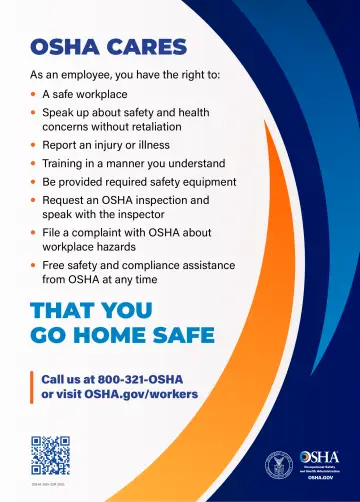
1 slidesJob Safety and Health: It's the Law Poster (OSHA 3165)
The required OSHA workplace poster; used as a handout in the Introduction to OSHA module.
U.S. Department of Labor, OSHAPublic domain
pdfes
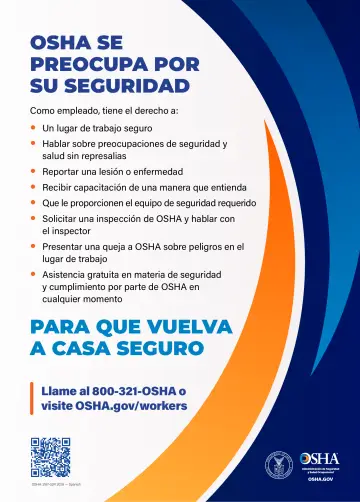
1 slidesSeguridad y Salud en el Trabajo: ¡Es la Ley! (OSHA 3167)
Spanish version of the OSHA "It's the Law" poster, used as an Introduction to OSHA handout.
U.S. Department of Labor, OSHAPublic domain