1 / 91Use ← → to flip
OSHA Employee Rights and Employer Responsibilities
Worker rights and employer responsibilities deck for plasterers and cement masons from OPCMIA (2010).
Slide text
· 91 slides · by Operating Plasters & Cement Masons International Association
The words on each slide as the author wrote them, read from the file by software so they can be searched. Layout, pictures and tables are not shown here: the slides above and the download are the original.
- Slide 1
Operative Plasterers’ and Cement Masons’
- International Association (OPCMIA)
- OSHA Employee Rights and Employer Responsibilities
- Slide 2
Program Introduction
- Purpose:
- Provide introductory information about OSHA
- Topics:
- Why is OSHA important to you?
- What rights do employees have under OSHA?
- What responsibilities does an employer have under OSHA?
- What do the OSHA standards say?
- How are OSHA inspections conducted?
- Where can you go for help?
- Slide 3
Why is OSHA important to you?
- Slide 4
Why is OSHA important to you?
- Objectives:
- Explain history of OSHA
- Identify OSHA’s mission
- Explain how OSHA fits into the National
- strategy
- Explain the costs associated with
- injuries and illness
- Explain employer recordkeeping
- requirements under OSHA 29 CFR 1904
- Explain when & how to use OSHA forms
- 300, 300A, & 301 in the recordkeeping process
- Slide 5
Agency of the U.S. Department of Labor
- Why is OSHA important to you?
- History of OSHA:
- Responsible for worker safety &
- health protection
- December 29, 1970 - President
- Nixon signs OSH Act
- Created OSHA agency on
- April 28, 1971
- Slide 6
Why is OSHA important to you?
- OSHA’s Mission:
- Save lives, prevent injuries, & protect the health of America’s workers
- Is carried out by:
- Developing job safety & health standards
- Enforcing standards through worksite inspections
- Maintaining a reporting & recordkeeping system
- Track job-related injuries & illnesses
- Providing training programs
- Slide 7
Why is OSHA important to you?
- How Does OSHA Fit Into the National Strategy?
- Slide 8
Why is OSHA important to you?
- Statistics:
- 7 million workers in the construction trades in the U.S.
- Construction trade accidents account for:
- 370,000 injuries per year (Avg. -1,000/day)
- 1,200 deaths per year (Avg. - 100/month)
- Construction companies spend $170 billion/year on costs associated with
- injuries/illness
- Workers who suffer a disabling injury can lose 40% of their income over a
- 5-year period
- 20% of workplace fatalities occur in the construction industry
- Accident costs account for 6.5% of construction dollars spent
- Slide 9
Why is OSHA important to you?
- Fishing
- Occupations with High Fatal Injury Rates 2009 (According to DOL)
- 200.0
- Logging
- 61.8
- Aircraft Pilots/Flight
- Engineers
- 57.1
- Farmers/Ranchers
- 38.5
- Roofers
- 34.7
- Structural Iron/Steel
- Workers
- 30.3
- Recyclable Materials
- Collectors
- 25.2
- Indust. Machinery Installation, Repair, & Maintenance
- 18.5
- Deliver/Sales & Truck Drivers
- 18.3
- Construction
- 18.3
- *Total Fatal Work Injuries = 4,340 *All Worker Fatal Injury Rate = 3.3
- Fatal Work Injury Rate
- Per 100,000 Full-time Equivalent Workers
- Number of Fatal Work Injuries
- Slide 10
Why is OSHA important to you?
- Costs Associated with Injuries and Illness:
- More Compensation Claims =
- Higher EMRs =
- Higher Insurance Rates
- Time away by experienced workers
- Training replacements
- Retraining for injured workers
- Light duty workloads for injured workers
- upon returning to work
- Post-traumatic repercussions (e.g. workers
- who witness injuries/death)
- Slide 11
OSHA 29 CFR 1904:
- Why is OSHA important to you?
- Employer Recordkeeping:
- Requires employees covered by OSHA & with 10+ employees
- to keep records of injuries & illnesses that result in:
- Death
- Days away from work
- Restricted work or transfer to another job
- Medical treatment beyond first aid
- Loss of consciousness
- Significant injury or illness diagnosed by health care professional (cancer, chronic irreversible disease, fractured or cracked bone, punctured eardrum)
- Slide 12
Why is OSHA important to you?
- OSHA Recordkeeping Forms:
- OSHA Form 300
- Log of Work-Related
- Injuries & Illnesses
- OSHA Form 301
- Injuries & Illness Incident
- Report
- OSHA Form 300A
- Summary of Work Related
- Slide 13
Why is OSHA important to you?
- OSHA Form 300:
- Log of Work-Related Injuries &
- Illnesses:
- Record of all recordable work-related injuries & illnesses
- Asks where event occurred (not department where worker is regularly employed)
- Employer must provide workers
- & their union copy of 300 Log by end of next business day following request
- Slide 14
Issues of privacy & recordkeeping:
- Why is OSHA important to you?
- OSHA Form 300 (cont.):
- Employers CAN NOT put names on OSHA 300 Log in cases of:
- Sexual assault
- Mental illness
- Hepatitis, HIV infection
- Tuberculosis
- Needle sticks/sharps injuries contaminated with blood
- Injury/illness to intimate body part
- Other illness if employee “independently & voluntarily” requests name not be recorded
- Employer keeps confidential list of names
- Slide 15
Limitations of OSHA Logs:
- Why is OSHA important to you?
- OSHA Form 300 (cont.):
- Injuries/illnesses which may not be recorded:
- Assault on worker resulting only in first aid treatment
- Early signs & symptoms of musculoskeletal disorders
- Injuries/illnesses which employer does not believe are work-related
- Work-related stress
- Injuries which result in lost time only on the day of the incident
- Cases in industries exempt from recordkeeping requirements
- All other injuries/illnesses THAT ARE NOT REQUIRED to be recorded on the 300 Log (i.e. injuries that do not result in death, days away from work, transfer to another job, etc.)
- Slide 16
Why is OSHA important to you?
- OSHA Incident Rates Form:
- Optional form used to calculate injury and illness incident rates
- # of fatalities
- # of injuries/illness involving
- lost workdays
- # of days away from work
- # of days of restricted work
- # of injuries/illness w/out lost workdays
- Compute incident rates:
- # of incidents x 200,000 hrs. ÷ #
- of hrs. worked = Incident Rate
- Slide 17
Why is OSHA important to you?
- OSHA 300A Form:
- Summary of Work-Related Injuries
- & Illness:
- Yearly summary of injuries & illness
- Posted annually for previous
- year (2/1 to 4/30)
- Used for calculating incidence rates
- Must be certified by company executive as correct &
- complete
- Slide 18
Why is OSHA important to you?
- OSHA 301 Form:
- Injury & Illness Incident Report:
- Provides detailed information
- on how each case occurred
- Must be completed for every incident recorded on 300 Log
- Employees must be given
- copy by end of next business day following request
- Useful for linking extended
- work hours with increased injury rates
- Slide 19
Why is OSHA important to you?
- OSHA 301 Form (cont.):
- Injury & Illness Incident Report:
- Employee representative is only entitled to receive part of form containing information about case with personal information about employee removed
- Employee representative must be given copy of form within seven calendar days following request
- Slide 20
Why is OSHA important to you?
- Discussion Questions
- 1. Why was OSHA necessary?
- Which OSHA form is used by an employer to record injuries and illnesses?
- Slide 21
Why is OSHA important to you?
- Discussion Questions
- 1. Why was OSHA necessary? (Before 1970 there were no uniform or comprehensive laws to protect workers against workplace hazards.)
- Which OSHA form is used by an employer to record injuries and illnesses? (OSHA 300 Form.)
- Slide 22
Why is OSHA important to you?
- Summary:
- History of OSHA
- OSHA’s mission
- OSHA’s place in the National strategy
- Costs associated with injuries and illness
- Employer recordkeeping requirements
- under OSHA 29 CFR 1904
- OSHA forms 300, 300A, & 301
- Any
- Questions?
- Slide 23
What rights do employees have under OSHA?
- Slide 24
What rights do employees have under OSHA?
- Objectives:
- Explain employee rights regarding:
- Hazardous chemicals at the workplace
- Access to information on injuries & illnesses
- Complaints or requesting corrections
- Training
- Access to exposure & medical records
- Filing complaints with OSHA
- Participation in OSHA inspections
- Freedom from retaliation
- Explain employee responsibilities at the
- workplace
- Slide 25
Be provided with a safe & healthful workplace
- What rights do employees have under OSHA?
- General Employee Rights:
- Request information on hazards &
- controls
- Submit a written request to NIOSH for
- information or for a Health Hazard Evaluation (HHE)
- Section 5(a)(1) of the OSH Act “Each employer shall furnish to each of his employees employment and a place of employment which are free from recognized hazards that are causing or are likely to cause death or serious physical harm to his employees."
- Slide 26
What rights do employees have under OSHA?
- Activity: Legal Health & Safety Rights
- Slide 27
Right to know about hazardous chemicals
- What rights do employees have under OSHA?
- Hazardous Chemicals:
- Employers must have written
- HazCom programs:
- Container labeling
- Material Safety Data Sheets
- (MSDSs)
- Worker training on physical &
- health hazards of chemicals:
- Protective measures & PPE
- Safe work practices
- Emergency procedures
- MSDS Sections:
- Section I: Manufacturer’s name & contact information
- Section II: Hazardous
- Ingredients
- Section III: Physical/chemical
- properties
- Section IV: Fire & explosion
- hazard data
- Section V: Reactivity data
- Section VI: Health hazard data
- Section VII: Precautions for safe
- handling & use
- Section VIII: Control measures
- Slide 28
OSHA’s Recordkeeping rule:
- What rights do employees have under OSHA?
- Information About Injuries/Illness:
- Most employers with more than
- 10 workers must keep injury & illness logs
- Right to:
- Review current logs & logs stored
- for past 5 years
- View annually posted summary
- of injuries & illnesses (OSHA
- 300A)
- Slide 29
What rights do employees have under OSHA?
- Complain or Request Corrections:
- Right to bring up workplace safety
- & health concerns to employer:
- Must be made in good faith
- Will not be discharged or discriminated against
- May refuse to do work if you
- feel you are being exposed to imminent danger
- OSHA 29 CFR 1977.9(c):
- Protects workers who complain
- to their employer
- Slide 30
What rights do employees have under OSHA?
- Training:
- Right to receive training on health & safety hazards & standards that employers must follow
- Required training:
- Lockout / Tagout
- Bloodborne pathogens
- Noise
- Confined spaces
- Fall hazards
- PPE
- Various other areas
- Slide 31
What rights do employees have under OSHA?
- Examine Exposure & Medical Records:
- OSHA 29 CFR 1910.1020:
- Right to examine & copy records
- Employee exposure to toxic substances &
- harmful physical agents:
- Metals & dusts (lead, cadmium, silica)
- Biological agents (bacteria, viruses, fungi)
- Physical stress (noise, heat, cold, vibration, repetitive motion, & ionizing
- & non-ionizing radiation)
- Slide 32
What rights do employees have under OSHA?
- File a Complaint:
- Right to file complaint with OSHA:
- Violations of safety/health standards
- Imminent danger situations
- May have name withheld from
- employer
- Right to find out OSHA’s action on
- complaint
- Request review if inspection is not made
- Slide 33
What rights do employees have under OSHA?
- Participate in OSHA Inspections:
- Right to:
- Have employee representative accompany OSHA inspector
- Respond to questions from inspector during inspection
- Talk to inspector privately after inspection
- Point out hazards & describe:
- Injuries, illnesses, or near misses that resulted from those hazards
- Any safety/health concerns
- Note: The OSHA representative shall conduct a closing conference with the employer representative and employee representatives either jointly or separately, as circumstances dictate.
- Slide 34
Right to:
- What rights do employees have under OSHA?
- Participate in OSHA Inspections (cont.):
- Find out about inspection results
- & abatement measures
- May object to dates set for violation to be corrected
- Must be done in writing
- within 15 days
- Request an informal conference
- Be notified by OSHA if employer contests citation
- May participate in hearing
- Slide 35
Right to:
- What rights do employees have under OSHA?
- Freedom From Retaliation:
- Be free from retaliation for exercising safety & health rights
- Seek safety & health on the job without fear of punishment
- (described in Section 11(c) of
- OSH Act)
- Safety incentive & injury discipline programs may violate Section 11(c)
- Contact OSHS within 30 days if
- punished for exercising safety & health rights
- Slide 36
Comply with all safety & health regulations & standards
- What rights do employees have under OSHA?
- Employee Responsibilities:
- Immediately report hazardous
- conditions to employer
- Immediately notify co-workers
- of hazards
- Report defective equipment,
- machines, or inadequate safeguards
- Slide 37
Turn in defective tools & equipment
- What rights do employees have under OSHA?
- Employee Responsibilities (cont.):
- Follow all reasonable safety &
- health rules of employer
- Report any work-related injuries
- or illness to employer
- Ask supervisor/employer about
- work assignment concerns
- Slide 38
What rights do employees have under OSHA?
- Discussion Questions
- 1. When may a worker refuse to do work?
- Within how many days must an employee contact OSHA if they feel they were punished for exercising their rights to health and safety?
- Slide 39
What rights do employees have under OSHA?
- Discussion Questions
- 1. When may a worker refuse to do work? (When they feel they are being exposed to imminent danger.)
- Within how many days must an employee contact OSHA if they feel they were punished for exercising their rights to health and safety? (Within 30 days.)
- Slide 40
What rights do employees have under OSHA?
- Summary:
- Employee rights regarding:
- Hazardous chemicals at the workplace
- Access to information on injuries & illnesses
- Complaints or requesting corrections
- Training
- Access to exposure & medical records
- Filing complaints with OSHA
- Participation in OSHA inspections
- Freedom from retaliation
- Employee responsibilities at the workplace
- Any
- Questions?
- Slide 41
What responsibilities does an employer have under OSHA?
- Slide 42
What responsibilities does an employer have under OSHA?
- Objectives:
- Explain employer responsibilities regarding:
- Accident prevention programs
- Employee training
- OSHA injury/illness recordkeeping
- Discrimination against workers
- First aid & medical care
- Safety at the workplace
- Job hazard analyses
- Safety on multi-employer sites
- Slide 43
What responsibilities does an employer have under OSHA?
- Establish Safe Workplace:
- OSHA 29 CFR 1926.20(a)(1)
- Section 107 of the Act requires that it shall be a condition of each contract which is entered into under legislation subject to Reorganization Plan Number 14 of 1950 (64 Stat. 1267), as defined in 1926.12, and is for construction, alteration, and/or repair, including painting and decorating, that no contractor or subcontractor for any part of the contract work shall require any laborer or mechanic employed in the performance of the contract to work in surroundings or under working conditions which are unsanitary, hazardous, or dangerous to his health or safety.
- Important examples of responsibilities:
- OSHA 29 CFR 1926.20(b) Accident Prevention
- OSHA 29 CFR 1926.21(b) Education & Training
- Slide 44
What responsibilities does an employer have under OSHA?
- Establish Accident Prevention Programs:
- Establish, update, & communicate safe operating procedures to employees
- Employ competent persons to regularly
- inspect jobsites, materials, & equipment
- Provide safe tools/equipment
- Remove, tag, or render unusable
- those that are not
- Permit only qualified workers to operate
- equipment or machinery
- Provide & pay for PPE
- Slide 45
What responsibilities does an employer have under OSHA?
- Instruct Employees:
- In hazard recognition/avoidance
- & applicable regulations
- To handle or use:
- Poisons, caustics, & other toxic/harmful substances
- Flammable liquids & gases
- That enter into confined spaces
- Slide 46
What responsibilities does an employer have under OSHA?
- Employee Training:
- Provide employee training as required by OSHA standards
- Keep records of training
- Provide to OSHA on request
- Makes copies of standards
- available to employees
- Inform employees about OSHA
- Slide 47
What responsibilities does an employer have under OSHA?
- OSHA Injury/Illness Records:
- Keep OSHA-required injury/illness records
- Post annual summaries each year
- February through March
- Allow OSHA access to records
- Provide medical exams when required
- Provide workers access to their exposure & medical records
- Inform workers how to report an injury or
- illness
- Report to OSHA within 8 hours a fatality or hospitalization of 3+ workers
- Slide 48
What responsibilities does an employer have under OSHA?
- First Aid & Safety:
- Provide first aid supplies & medical care
- Develop/maintain a fire protection &
- suppression program
- Develop an Emergency Action Plan:
- Routes
- Rescue and medical duties
- Alarm systems
- Evacuation plan
- Training
- Slide 49
What responsibilities does an employer have under OSHA?
- Work Area Conditions:
- Ensure illumination for all construction areas, aisles, stairs, ramps, runways, corridors, offices, shops, & storage areas
- Keep scrap materials cleared from work
- areas, passageways, stairs, & buildings
- Remove combustible debris:
- Provide containers with covers
- for garbage, oily, flammable, or hazardous materials
- Slide 50
Provide drinking water, toilets, washing facilities, eating areas,
- What responsibilities does an employer have under OSHA?
- Work Area Conditions (cont.):
- & change rooms
- Arrange & maintain exits to
- provide free & unobstructed egress from all parts of buildings structures
- Use color codes, posters, labels,
- or signs to warn employees of hazards
- Slide 51
Conducting a job hazard analysis:
- What responsibilities does an employer have under OSHA?
- Ensuring a Safe Workplace:
- Project hazard analysis
- Done prior to project by contractor to identify project phases & hazards
- Phase hazard analysis
- Done prior to each project phase to analyze site conditions & work activities
- Job safety analysis
- Done prior to start of any task by supervisor or foreman (competent person)
- Slide 52
Post OSHA poster or state equivalent prominently in the workplace
- What responsibilities does an employer have under OSHA?
- Comply with Other OSHA Standards:
- Cooperate with OSHA compliance
- officers
- Furnish names of employee reps
- Do not discriminate against workers
- who exercise rights under OSH Act
- Section 11(c)
- Post OSHA citations & abatement
- verification notices next to site involved for at least 3 days
- Slide 53
Prime contractor:
- What responsibilities does an employer have under OSHA?
- Safety on Multi-employer Sites:
- Maintains safe & healthful
- conditions throughout worksite
- Can enter into agreement with subs
- to have them provide services or fulfill specific obligations
- Removes prime from actual, but not legal responsibility for compliance
- Agreements can make both
- prime & subs responsible for compliance
- Slide 54
- What responsibilities does an employer have under OSHA?
- Site Safety:
- The following four categories of employer can be cited because of the
- same unsafe condition:
- Creating Employer - actually created the hazard
- Controlling Employer - has responsibility over the site and has authority to require correction of unsafe conditions for the entire site or the specific area of the site at which the OSHA inspector finds the hazard
- Correcting Employer - responsible for the correction of any hazard
- Exposing Employer - exposes its employees to a hazard whether created by it or not
- Slide 55
What responsibilities does an employer have under OSHA?
- Activity: Workers’ Rights Activity
- Slide 56
What responsibilities does an employer have under OSHA?
- Discussion Questions
- 1. What types of accident must an employer report to OSHA within eight hours?
- Who can be held responsible for health and safety on multi-employer sites?
- Slide 57
What responsibilities does an employer have under OSHA?
- Discussion Questions
- 1. What types of accident must an employer report to OSHA within eight hours? (Accidents resulting in a fatality or fatalities, or the hospitalization of three or more employees.)
- Who can be held responsible for health and safety on multi-employer sites? (Prime and/or subcontractors depending on the situation.)
- Slide 58
What responsibilities does an employer have under OSHA?
- Summary:
- Employer responsibilities regarding:
- Accident prevention programs
- Employee training
- OSHA injury/illness recordkeeping
- Discrimination against workers
- First aid & medical care
- Safety at the workplace
- Job hazard analyses
- Safety on multi-employer sites
- Any
- Questions?
- Slide 59
What do the OSHA standards say?
- Slide 60
Identify OSHA standards that pertain to construction trades & other general industries
- What do the OSHA standards say?
- Objectives:
- Identify the ten most accessed OSHA
- standards in general industry
- Explain how to access Most Frequently
- Cited (MFC) data on Department of Labor (DOL) website
- Slide 61
What do the OSHA standards say?
- Reading OSHA Standards
- Slide 62
What do the OSHA standards say?
- OSHA Standards:
- General Industry (1910)
- Construction (1926)
- Maritime (1915)
- Agriculture (1928)
- If no specific OSHA
- standards exist, comply with General Duty Clause 5(a)(1) of OSH Act of 197 0
- Slide 63
What do the OSHA standards say?
- General Industry (10 Most Accessed Standards) General Industry (1910)
- Bloodborne Pathogens – 1910.1030
- Hazard Communication – 1910.1200
- Respiratory Protection – 1910.134
- Occupational Noise Exposure – 1910.95
- Powered Industrial Trucks – 1910.178
- Permit-required Confined Spaces – 1910.146
- Lockout/Tagout – 1910.147
- Hazardous Waste Ops. & Emergency Response – 1910.120
- Guarding Floor & Wall Openings and Holes – 1910.23
- Personal Protective Equipment – 1910.132
- Slide 64
What do the OSHA standards say?
- Most Frequently Cited (MFC) Data
- Slide 65
What do the OSHA standards say?
- Discussion Questions
- 1. What part of OSHA 29 CFR regulates General Industry?
- What part of OSHA 29 CFR regulates the Construction Industry?
- Slide 66
What do the OSHA standards say?
- Discussion Questions
- 1. What part of OSHA 29 CFR regulates General Industry? (Part 1910.)
- What part of OSHA 29 CFR regulates the Construction Industry? (Part 1926.)
- Slide 67
OSHA construction trades & general industry standards
- What do the OSHA standards say?
- Summary:
- Ten most accessed OSHA standards in
- general industry
- Most Frequently Cited (MFC) data on
- (DOL) Department of Labor website
- Any
- Questions?
- Slide 68
How are OSHA inspections conducted?
- Slide 69
How are OSHA inspections conducted?
- Objectives:
- Identify the procedures that are used to conduct OSHA inspections
- Identify the six OSHA inspection priority
- categories
- Explain the types of OSHA citations &
- subsequent penalties
- Explain the steps of an OSHA inspection
- Explain the process used by OSHA for
- issuing citations
- Identify employer & employee rights under
- OSHA after a citation is issued
- Slide 70
How are OSHA inspections conducted?
- OSHA Inspections:
- Workplace inspections:
- Authorized by OSH Act
- Completed by OSHA compliance safety & health officers (CSHOs)
- Conducted at reasonable times
- Occur without advanced notice except in rare circumstances (e.g.
- Imminent Danger)
- Notifying an employer in advance of an inspection can result in fines & jail
- Slide 71
How are OSHA inspections conducted?
- OSHA Inspection Priority
- 2 nd Catastrophe/Fatality
- Hazard where death or serious injury is likely before the danger can be eliminated by normal enforcement procedures.
- Death(s) or incident(s) resulting in inpatient hospitalization of three or more employees.
- 3 rd Complaint/Referral
- Complaint by worker or worker representative of referral from a recognized professional.
- 4 th Programmed
- Aimed at high-risk areas based on OSHA’s targeting and priority methods.
- 5 th Follow-up
- Completed after citations to assure employer has corrected violations.
- 6 th Monitoring
- Used for long-term abatement follow-up or to assure compliance with variances.
- 1 st Imminent Danger
- Slide 72
How are OSHA inspections conducted?
- Steps of an OSHA Inspection:
- 1. Present Credentials
- a. b.
- c.
- Identifies self
- Shows credentials to employer & employees representative
- Explains scope/purpose of inspection
- a. b. c. d. e. f. g.
- 2. Conduct Opening Conference
- a. b.
- c. d. e.
- Explains inspection process
- Explains how penalties are determined
- Explains employee rights
- Conducts employee interviews
- May conduct a review of records prior to walk-around
- Walk-around Inspection
- Walks around/observes conditions
- Takes measurements, photos & video Talks to workers (may be in private)
- Inspects records
- Examines postings
- Points out hazards
- Discusses abatement methods
- Hold Closing Conference
- a.
- b.
- Discuss findings, violations, & abatements
- Conducts closing interviews with employer & employee representatives
- Slide 73
How are OSHA inspections conducted?
- Issuing of Citations:
- OSHA issues citations (within 6 months of inspection) when hazards exist
- OSHA issues citations to
- employer by:
- Certified mail
- Hand delivery
- Employers must post citations:
- At or near where violation happened
- For three days or until hazard
- is abated
- Within 15 days of citations:
- Employers & employees may have joint or separate informal conference(s)
- Employers may ask for changes in the citation, penalty, or abatement dates
- Employees may ask for changes in abatement dates
- Slide 74
How are OSHA inspections conducted?
- Violations & Penalties
- Other-than-Serious
- $0 to $7,000
- Serious
- $1,500 to $7,000
- Willful
- $5,000 to $7,000 (no criminal willful disregard) $250,000 to $500,000 / jail (death, criminal disregard)
- Repeated
- Up to $70,000
- Failure to Abate
- Up to $7,000 per day
- Falsifying Information
- $10,000, up to 6 months in jail
- Violation of Posting/
- Abatement Verification
- $1,000, to $7,000
- Slide 75
How are OSHA inspections conducted?
- Employer Rights Under OSHA After Citations:
- Employers may:
- Request informal conference with OSHA to request changes to citations, penalties, & dates
- Petition for Modification of Abatement (PMA)
- Enter into an informal settlement agreement with OSHA
- Contest citations, abatement period, or proposed penalty in writing within 15 days of issue
- Slide 76
How are OSHA inspections conducted?
- Employee Rights Under OSHA After Citations:
- Employees may:
- Discuss with OSHA issues raised by inspection, citation, notice of penalties, employer’s notice of contest, abatement methods & dates
- Appeal abatement time during informal conference
- Not contest citations, amendments, deletions of citations, penalties, or lack of penalties
- Slide 77
How are OSHA inspections conducted?
- Discussion Questions
- 1. What are some of the reasons that would cause OSHA to conduct an inspection at your workplace?
- What types of OSHA violations can result in a jail sentence?
- Slide 78
How are OSHA inspections conducted?
- Discussion Questions
- 1. What are some of the reasons that would cause OSHA to conduct an inspection at your workplace? (If a worker files a complaint, if there is a fatality, or if there is an imminent danger situation.)
- What types of OSHA violations can result in a jail sentence? (Criminal willful violations & falsifying information.)
- Slide 79
Procedures used to conduct OSHA inspection
- How are OSHA inspections conducted?
- Summary:
- Six OSHA inspection priority categories
- Types of OSHA citations & subsequent
- penalties
- Steps of an OSHA inspection
- Process used by OSHA when issuing
- citations
- Employer & employee rights under
- OSHA after a citation is issued
- Any
- Questions?
- Slide 80
Where can you go for help?
- Slide 81
Identify sources within the workplace & worksite for getting help & information
- Where can you go for help?
- Objectives:
- Identify sources outside of the workplace
- & worksite for getting help & information
- Explain the procedures for filing an
- OSHA complaint
- Slide 82
Where can you go for help?
- Getting Help/Information
- Sources within the workplace/worksite:
- Employer or supervisor, co-workers
- & union representatives
- Material Safety Data Sheet (MSDS)
- Information on chemicals
- Labels & warning signs
- Employee orientation manuals or other training materials
- Work tasks & procedures instruction
- Slide 83
Where can you go for help?
- Getting Help/Information (cont.)
- Sources outside the workplace/worksite:
- OSHA website & OSHA offices
- Compliance Assistance Specialists in area offices
- National Institute for Occupational Safety & Health (NIOSH)
- OSHA Training Institute Education Centers (OTIEC)
- Doctors, nurses, & other health care providers
- Public libraries
- Other local, community-based resources
- Other safety & health resources
- Slide 84
Where can you go for help?
- Filing an OSHA Complaint:
- Workers can file complaint
- Worker representative can file complaint
- File complaint:
- By downloading OSHA-7 Form Onlin
- e at OSHA website:
- Using the online Complaint Form
- By telephoning or visiting OSHA Regi onal or Area Offices
- For emergency & life threatening
- situations call:
- OSHA Regional or Area Offices
- 1-800-321-OSHA
- Slide 85
Be specific & include appropriate details
- Where can you go for help?
- Filing an OSHA Complaint (cont.):
- OSHA determines if inspection is
- necessary
- Workers do not have to reveal
- their name
- Slide 86
Where can you go for help?
- Activity: OSHA Complaint Form
- Slide 87
Where can you go for help?
- Discussion Questions
- 1. Who is permitted to file an OSHA complaint?
- Can a worker remain anonymous when filing an OSHA complaint?
- Slide 88
Where can you go for help?
- Discussion Questions
- 1. Who is permitted to file an OSHA complaint? (Anyone can file a complaint.)
- Can a worker remain anonymous when filing an OSHA complaint? (Yes, workers are not required to reveal their name.)
- Slide 89
Sources within the workplace & worksite for getting help & information
- Where can you go for help?
- Summary:
- Sources outside of the workplace &
- worksite for getting help & information
- Procedures for filing an OSHA complaint
- Any
- Questions?
- Slide 90
Program Review
- Review:
- The importance of OSHA, including the history of safety and health regulation leading to the creation of OSHA and OSHA’s mission
- Worker rights under OSHA
- Employer responsibilities
- OSHA standards
- OSHA inspections
- Safety and health resources, including how to file a complaint
- Slide 91
- Program Complete
More on Intro to OSHA
pdf
29 slidesIntroduction to OSHA Instructor Guide (2024)
OSHA's official instructor guide for the required 1-hour Introduction to OSHA module (worker rights, employer responsibilities, filing a complaint). Required content for every 10- and 30-hour Outreach class.
U.S. Department of Labor, OSHAPublic domain
pdfes
27 slidesIntroducción a OSHA: Guía del instructor (2024)
Spanish edition of OSHA's required Introduction to OSHA instructor guide for Outreach Training Program classes.
U.S. Department of Labor, OSHAPublic domain
pdf
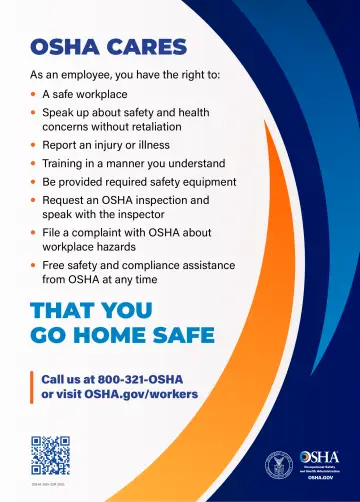
1 slidesJob Safety and Health: It's the Law Poster (OSHA 3165)
The required OSHA workplace poster; used as a handout in the Introduction to OSHA module.
U.S. Department of Labor, OSHAPublic domain