Introduction to OSHA
Short Introduction to OSHA deck (worker rights, employer duties, inspections) from the University of Tennessee construction fall-prevention grant.
Slide text
· 27 slides · by University of Tennessee
The words on each slide as the author wrote them, read from the file by software so they can be searched. Layout, pictures and tables are not shown here: the slides above and the download are the original.
- Slide 1
Introduction to OSHA
- DISCLAIMER: This material was produced under grant number SH-31204-SH7 from the Occupational Safety and Health Administration, U.S. Department of Labor. It does not necessarily reflect the views or policies of the U.S. Department of Labor, nor does mention of trade names, commercial products, or organizations imply endorsement by the U.S. Government.
- Training materials developed with grant funds will be posted at:
- http://www.osha.gov/dte/library
- Slide 2
Introduction to OSHA
- History
- Employer Responsibilities
- Worker Rights
- Slide 3
Purpose:
- To provide introductory knowledge of OSHA
- OSHA’s History
- What are your worker rights?
- What are the employer responsibilities? OSHA Standards and Violations
- Where to go for help
- Slide 4
Introduction to OSHA
- History
- OSHA stands for the Occupational Safety and Health Administration, a Federal agency of the U.S. Department of Labor
- OSHA’s responsibility is to improve worker safety and health protection
- On December 29, 1970, President Nixon signed the OSH Act
- This Act created OSHA, the agency, which formally came into being on April 28, 1971
- Slide 5
Introduction to OSHA
- Mission Statement
- The mission of OSHA is to assure safe and healthful working conditions for working men and women by setting and enforcing standards and by providing training, outreach, education and assistance.
- Developing job safety and health standards and enforcing them through worksite inspections
- Providing training programs to increase knowledge about occupational safety and health
- Slide 6
Introduction to OSHA
- Statistics
- Are we safer with OSHA?
- Worker deaths in America are down–on average, from about 38 worker deaths a day in 1970 to 14 a day in 2016.
- Worker injuries and illnesses are down–from 10.9 incidents per 100 workers in 1972 to 3.6 per 100 in 2016.
- Per OSHA & Bureau of Labor Statistics (BLS)
- Slide 7
The Situation Today…
- 5,190 Occupational Fatalities in 2016!
- or 14.2 fatalities per day
- 991 Construction Fatalities!
- or 2.7 construction fatalities per day
- Slide 8
Introduction to OSHA
- Worker Rights:
- Under OSHA Each Worker has the Right to…
- A safe and healthful workplace
- Know about hazardous chemicals
- Report injury to employer
- Complain of potential hazard
- Request hazard correction from employer
- Receive training by the employer
- Notification of hazard exposure and access to your medical records
- File a complaint with OSHA
- Participate in an OSHA inspection
- Be free from retaliation for exercising safety and health rights
- Slide 9
Introduction to OSHA
- Worker Rights: OSHA Posters
- Slide 10
It is your right to…
- Be provided a workplace free from serious recognized hazards and which complies with standards, rules and regulations issued under the OSH Act.
- Workplace conditions which conform to applicable OSHA Standards.
- Have and use safe and properly maintained tools and equipment.
- Slide 11
Introduction to OSHA
- Materials Safety Data Sheet
- As an example of your rights…
- Employers with hazardous chemicals in the workplace must develop and implement a written hazard communication program.
- Training of employees on the hazards they are potentially exposed to and the taking of proper precautions (and a copy of safety data sheets must be readily available).
- Slide 12
Introduction to OSHA
- OSHA 300 Logs
- It is your right to…
- Workers have the right to report an injury and to review current logs
- Workers also have the right to view the annually posted summary of the injuries and illnesses (OSHA 300A)
- Slide 13
Introduction to OSHA
- Whistle-Blowers
- It is your right to…
- Complain and Request Safety Changes
- Workers may bring up safety and health concerns in the workplace to their employers without fear of discharge or discrimination
- OSHA rules protect workers who raise concerns to their employer or OSHA about unsafe or unhealthful conditions in the workplace
- Slide 14
Introduction to OSHA
- Training
- It is your right to…
- Get training from employers on a variety of health and safety hazards and the standards that employers must follow.
- Be trained in a language and vocabulary you can understand
- Slide 15
Introduction to OSHA
- Medical Records
- It is your right to…
- Examine your exposure and medical records from the employer
- Possible exposures include:
- Dusts and Metals
- Biological
- Physical Stresses
- Slide 16
Introduction to OSHA
- Complaints
- It is your right to…
- File a Complaint with OSHA
- Workers may file a confidential complaint with OSHA if they believe a violation of a safety or health standard, or an imminent danger situation, exists in the workplace
- If a worker files a complaint, they have the right to find out OSHA’s action on the complaint and request a review if an inspection is not made
- Slide 17
Introduction to OSHA
- Inspection
- It is your right to…
- To be involved in an OSHA Inspection
- Workers can attend the OSHA walk-through
- Meet privately with the inspector
- Notify the inspector of hazards, injuries, near misses, or any other potential health/injury concerns
- Be informed of the inspection and (if needed) the abatement requirements
- Slide 18
Introduction to OSHA
- Retaliation
- It is your right to…
- To be free from retaliation
- Workers have a right to seek safety and health on the job without fear of punishment
- This right is spelled out in Section 11(c) of the OSH Act
- Workers have 30 days to contact OSHA if they feel they have been punished for exercising their safety and health rights
- Slide 19
Introduction to OSHA
- Responsibilities
- Employer Responsibilities
- Provide a workplace free from recognized hazards and to comply with OSHA standards
- Provide training required to meet OSHA standards
- Keep records of injuries and illnesses
- Provide medical exams when required by OSHA standards and provide workers access to their exposure and medical records
- Not discriminate against workers who exercise their rights under the Act (Section 11(c))
- Post OSHA citations and hazard correction notices
- Provide and pay for most personal protection equipment (PPE)
- Slide 20
Introduction to OSHA
- Injuries and Illnesses
- Employers are required to…
- Report fatalities to OSHA within 8 hours of the event
- Report all hospitalization, amputations, and eye-loss events to OSHA
- Maintain injury and Illness records
- Inform workers how to report an injury or illness to the employer
- Make records available to workers
- Allow OSHA access to records
- Post annual summary of injuries and illnesses (Feb to April)
- Slide 21
Introduction to OSHA
- Regulations
- OSHA Standards
- Rules that describe the methods employers must use to protect employees from hazards
- Designed to protect workers from a wide range of hazards
- Slide 22
Introduction to OSHA
- Permissible Exposure Limits
- OSHA Standards
- Limit the amount of hazardous chemicals, substances, or noise to which workers can be exposed
- Require the use of certain safe work practices and equipment
- Require employers to monitor certain hazards and keep records of workplace injuries and illnesses
- Slide 23
Introduction to OSHA
- OSHA Inspections
- The OSH Act authorizes OSHA Compliance Safety and Health Officers (CSHOs) to conduct workplace inspections at reasonable times
- OSHA conducts inspections without advance notice
- In fact, anyone who tells an employer about an OSHA inspection in advance can receive large fines and jail time
- Slide 24
Introduction to OSHA
- Fatal or Serious Injury Inspection Steps
- Steps of an OSHA Inspection
- 1. The event
- 2. Notify OSHA (8 hours/24 hours)
- 3. Opening conference with inspector
- 4. Walk around (inspection)
- 5. Closing conference
- 6. Informal settlement
- 7. Formal settlement
- 8. Abatement
- Slide 25
Introduction to OSHA
- Violations
- OSHA Citation Penalties
- OSHA Penalty Breakdown
- Type
- Other than Serious
- Serious
- Willful
- Repeat
- Failure to Abate
- Criminal
- Max Penalty Per
- Violations
- New Max Penalty Per Violation (2018)
- $7,000
- $12,934
- $7,000
- $12,934
- $70,000
- $129,336
- $70,000
- $129,336
- $7,000 per day
- $250,000 for Individual, 6 Months in Prison, $500,000 for Employer
- $12,934
- Slide 26
Introduction to OSHA
- Review
- 1. What are some of your OSHA given employee rights?
- 2. What happens to you if you are a whistleblower?
- 3. How long does an employer have to report a fatality and a hospitalization to OSHA?
- 4. Does my employer have to train me?
- Slide 27
Introduction to OSHA
- Where to go for additional information…
- OSHA website (www.osha.gov)
- National Institute for Occupational Safety and Health (NIOSH) – OSHA’s sister agency (www.cdc.gov/niosh)
- OSHA Training Institute Education Centers
- Compliance Assistance Specialists in the area offices (addresses and phone numbers can be found on OSHA’s website)
- Public libraries
More on Intro to OSHA
Introduction to OSHA Instructor Guide (2024)
OSHA's official instructor guide for the required 1-hour Introduction to OSHA module (worker rights, employer responsibilities, filing a complaint). Required content for every 10- and 30-hour Outreach class.
Introducción a OSHA: Guía del instructor (2024)
Spanish edition of OSHA's required Introduction to OSHA instructor guide for Outreach Training Program classes.
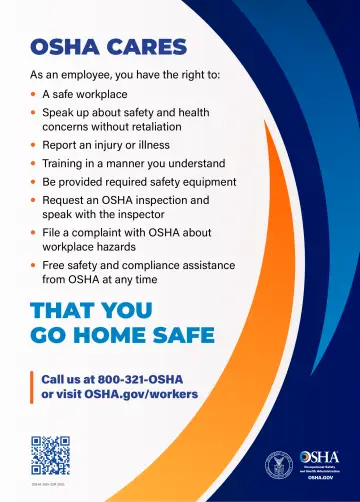
Job Safety and Health: It's the Law Poster (OSHA 3165)
The required OSHA workplace poster; used as a handout in the Introduction to OSHA module.