1 / 2Use ← → to flip
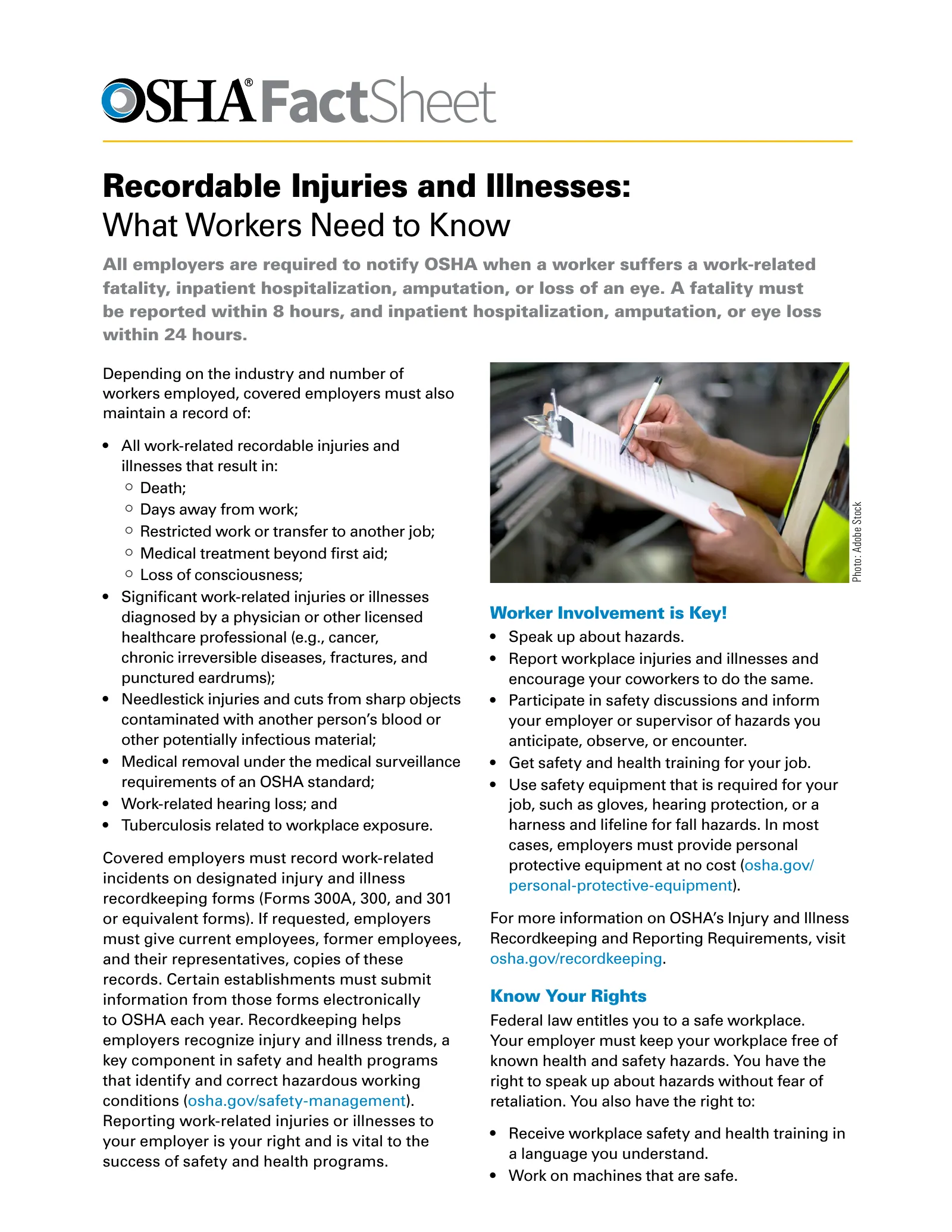
Recordkeeping: Recordable Injuries and Illnesses: What Workers Need to Know Fact Sheet (OSHA FS-4444)
OSHA fact sheet or bulletin, for General Industry classes.
Page text
· 2 pages · by U.S. Department of Labor, OSHA
The words on each page as the author wrote them, read from the file by software so they can be searched. Layout, pictures and tables are not shown here: the pages above and the download are the original.
- Page 1
FactSheet
- Recordable Injuries and Illnesses: What Workers Need to Know
- All employers are required to notify OSHA when a worker suffers a work-related fatality, inpatient hospitalization, amputation, or loss of an eye. A fatality must be reported within 8 hours, and inpatient hospitalization, amputation, or eye loss within 24 hours.
- All work-related recordable injuries and illnesses that result in:
- ¶ Death;
- ¶ Days away from work;
- ¶ Restricted work or transfer to another job; ¶ Medical treatment beyond first aid;
- ¶ Loss of consciousness;
- Significant work-related injuries or illnesses diagnosed by a physician or other licensed healthcare professional (e.g., cancer, chronic irreversible diseases, fractures, and punctured eardrums);
- Needlestick injuries and cuts from sharp objects contaminated with another person’s blood or other potentially infectious material;
- Medical removal under the medical surveillance requirements of an OSHA standard;
- Work-related hearing loss; and
- Tuberculosis related to workplace exposure.
- Covered employers must record work-related incidents on designated injury and illness recordkeeping forms (Forms 300A, 300, and 301 or equivalent forms). If requested, employers must give current employees, former employees, and their representatives, copies of these records. Certain establishments must submit information from those forms electronically to OSHA each year. Recordkeeping helps employers recognize injury and illness trends, a key component in safety and health programs that identify and correct hazardous working conditions (osha.gov/safety-management). Reporting work-related injuries or illnesses to your employer is your right and is vital to the success of safety and health programs.
- Photo: Adobe Stock
- Depending on the industry and number of workers employed, covered employers must also maintain a record of:
- Worker Involvement is Key!
- Speak up about hazards.
- Report workplace injuries and illnesses and encourage your coworkers to do the same.
- Participate in safety discussions and inform your employer or supervisor of hazards you anticipate, observe, or encounter.
- Get safety and health training for your job.
- Use safety equipment that is required for your job, such as gloves, hearing protection, or a harness and lifeline for fall hazards. In most cases, employers must provide personal protective equipment at no cost (osha.gov/ personal-protective-equipment).
- For more information on OSHA’s Injury and Illness Recordkeeping and Reporting Requirements, visit osha.gov/recordkeeping.
- Know Your Rights
- Federal law entitles you to a safe workplace. Your employer must keep your workplace free of known health and safety hazards. You have the right to speak up about hazards without fear of retaliation. You also have the right to:
- Receive workplace safety and health training in a language you understand.
- Work on machines that are safe.
- Page 2
- Refuse to work in a situation in which you would be exposed to a hazard.
- Receive required safety equipment, such as gloves or a harness and lifeline for falls.
- Be protected from toxic chemicals.
- Request an OSHA inspection, and speak to the inspector confidentially.
- Report an injury or illness, and get copies of your medical records.
- Review records of work-related injuries and illnesses.
- See results of tests taken to find workplace hazards.
- For additional information on Worker Rights and Protections, visit osha.gov/workers.
- How to contact OSHA
- OSHA’s mission is to assure America’s workers have safe and healthful working conditions free from unlawful retaliation. OSHA carries out its mission by setting and enforcing standards; enforcing anti-retaliation provisions of the
- OSH Act and other federal whistleblower laws; providing and supporting training, outreach, education, and assistance; and ensuring state OSHA programs are at least as effective as federal OSHA, furthering a national system of worker safety and health protections. For more information, visit osha.gov or call OSHA at 1-800-321-OSHA (6742), TTY 1-877-889-5627.
- This is one in a series of informational fact sheets highlighting OSHA programs, policies or standards. It does not impose any new compliance requirements. For a comprehensive list of compliance requirements of OSHA standards or regulations, refer to Title 29 of the Code of Federal Regulations. This information will be made available to sensory-impaired individuals upon request. The voice phone is (202) 693-1999; teletypewriter (TTY) number: (877) 889-5627.
- DSG FS-4444 09/2024
More on Intro to OSHA
pdf
36 slidesOSHA: All About OSHA (OSHA 3302)
OSHA booklet, for General Industry classes.
U.S. Department of Labor, OSHAPublic domain
pdfes
44 slidesOSHA: All About OSHA (OSHA 3173) (en español)
OSHA booklet, in Spanish, for General Industry classes.
U.S. Department of Labor, OSHAPublic domain
pdf
28 slidesWorkers' Rights Booklet (OSHA 3021)
OSHA booklet, for General Industry classes.
U.S. Department of Labor, OSHAPublic domain