1 / 36Use ← → to flip
OSHA: All About OSHA (OSHA 3302)
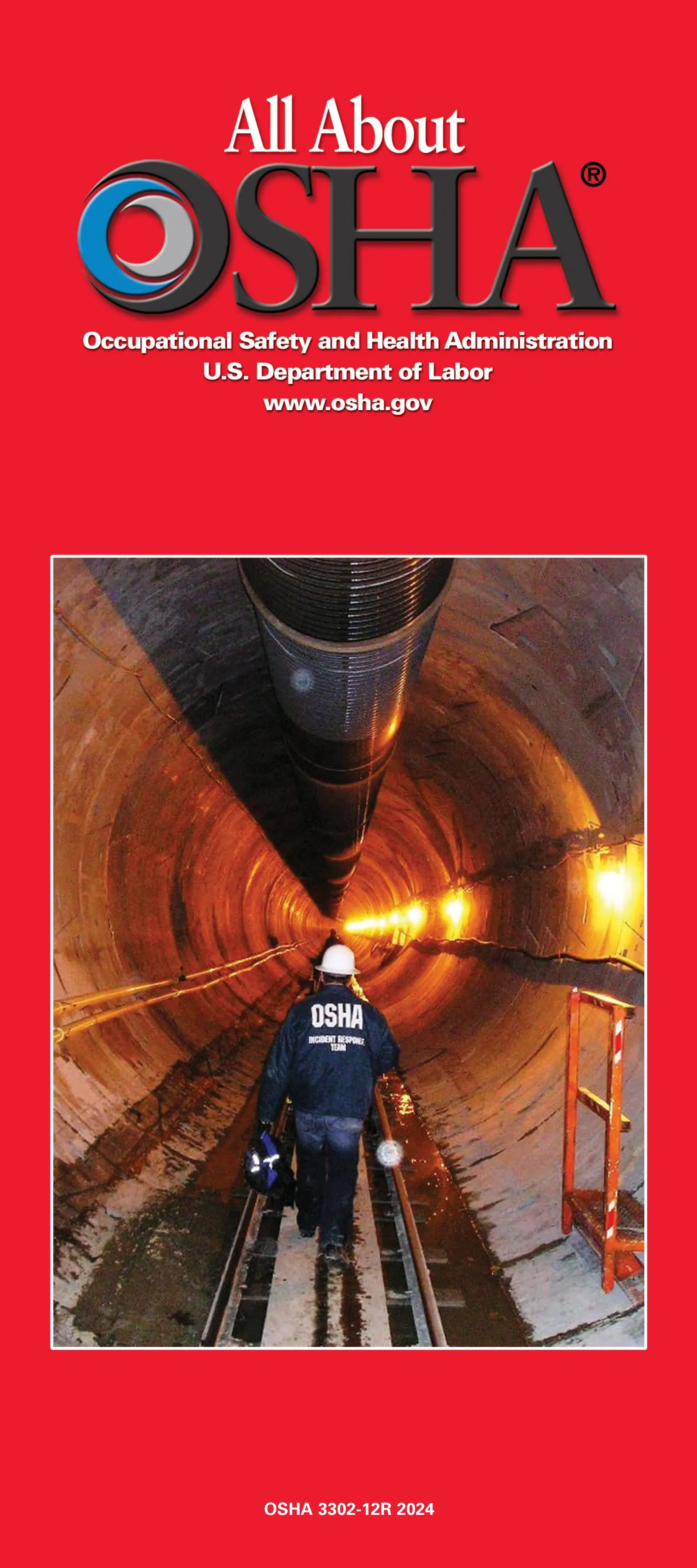
OSHA booklet, for General Industry classes.
Page text
· 36 pages · by U.S. Department of Labor, OSHA
The words on each page as the author wrote them, read from the file by software so they can be searched. Layout, pictures and tables are not shown here, and long pages are shortened: the pages above and the download are the original.
- Page 1
OSHA
- 3302-12R
- ALL
- A B OUT
- O SHA
- Page 2
- This booklet provides a general overview of basic topics related to OSHA and how it operates. Information provided does not determine compliance responsibilities under OSHA standards or the Occupational Safety and Health Act of 1970 (OSH Act).
- Because interpretations and enforcement policy may change over time, you should consult the agency for the most up-to-date information.
- Much of it is available at the OSHA website at www.osha.gov. The website also includes locations and phone numbers for OSHA offices around the country. If you do not have access to the website, call 1-800-321-OSHA (6742). This information is available to sensory-impaired individuals upon request. Voice phone: (202) 693- 1999; teletypewriter (TTY) number: (877) 889-5627.
- …
- Page 3
All About OSHA
- U.S. Department of Labor
- Occupational Safety and Health Administration OSHA 3302-12R 2024
- Page 4
Contents
- OSHA’s Mission . . . 4
- Introduction . . . 4
- OSHA Coverage . . . 5
- Rights and Responsibilities under OSHA Law . . . 9
- OSHA Standards . . . 11
- Enforcement . . . 14
- General Reporting and Recordkeeping Requirements . . . 17
- Filing a Complaint . . . 18
- OSHA’s Whistleblower Program: Protection from Retaliation . . . 19
- If There is a Dangerous Situation at Work . . . 20
- Additional Whistleblower Protections . . . 22
- OSHA Assistance, Services, and Programs . . . 27
- OSHA Advisory Committees . . . 30
- OSHA Regional Offices . . . 31
- How to Contact OSHA . . . 33
- Page 5
- In 1970, the United States Congress and President Richard Nixon created the Occupational Safety and Health Administration (OSHA), a national public health agency dedicated to the basic proposition that no worker should have to choose between their life and their job.
- Passed with bipartisan support, the creation of OSHA was a historic moment of cooperative national reform. The OSHA law makes it clear that the right to a safe workplace is a basic human right.
- Since OSHA’s first day on the job, the agency has delivered remarkable progress for our nation. Workplace injuries, illnesses and fatalities have fallen dramatically. Together with our state partners, OSHA has tackled fatal safety hazards and health risks. We have established common sense standards and enforced the law against those who put workers at risk. …
- …
- Page 6
OSHA’s Mission
- Congress created OSHA to assure safe and healthful conditions for workers by setting and enforcing standards and providing training, outreach, education and compliance assistance.
- Under the OSHA law, employers are responsible for providing a safe and healthful workplace for their workers. For more information, visit OSHA’s website at www.osha.gov.
- Introduction
- Photo: James Majors
- On December 29, 1970, President Nixon signed the Occupational Safety and Health Act of 1970 (OSH Act) into law, establishing OSHA. Coupled with the efforts of employers, workers, safety and health professionals, unions and advocates, OSHA and its state partners have dramatically improved workplace safety, reducing work-related fatalities by almost 63 percent.
- …
- Page 7
- 10 million worksites. The rate of reported serious workplace injuries and illnesses has also dropped markedly, from 10.9 per 100 workers in 1972 to 2.7 per 100 workers in 2021.
- OSHA’s safety and health standards, including those for asbestos, fall protection, cotton dust, trenching, machine guarding, benzene, lead and bloodborne pathogens have prevented countless work-related injuries, illnesses and fatalities. Nevertheless, far too many preventable injuries and fatalities continue to occur. Significant hazards and unsafe conditions still exist in U.S. workplaces; each year more than 3.2 million workers suffer a serious jobrelated injury or illness. Millions more are exposed to toxic chemicals that may cause illnesses years from now.
- In addition to the direct impact on individual workers, the negative consequences for…
- …
- Page 8
- Mariana Islands, Wake Island, Johnston Island, and the Outer Continental Shelf Lands as defined in the Outer Continental Shelf Lands Act.
- Private Sector Workers
- Federal OSHA covers most private sector employers and workers in 29 states, the District of Columbia, Virgin Islands, American Samoa, Guam, Northern Mariana Islands, Wake Island, Johnston Island, and the Outer Continental Shelf Lands. Private sector workers in the remaining 21 states and Puerto Rico are covered by OSHA-approved State Plans.
- State Plans are OSHA-approved workplace safety and health programs operated by individual states instead of Federal OSHA. The OSH Act encourages states to develop and operate their own workplace safety and health programs and precludes state enforcement of OSHA standards unless the state has an approved State Plan. …
- …
- Page 9
OSHA-approved
- OSHA-Approved State Plans
- SHA-approved State Plan covering private sector and state/local government workers
- State Plan covering state and local government
- workers only
- ederal OSHA covering private sector workers
- Exceptions to State Plan private sector coverage are listed on each State Plan’s webpage at www.osha.gov/stateplans.
- Complaints About State Program Administration Any interested person or group, including individual workers, with a complaint concerning the operation or administration of a State Plan may submit a complaint to the appropriate Federal OSHA Region (regional offices are listed at the end of this guide). This is called a Complaint About State Program Administration (CASPA).
- The complainant’s name will be kept confidential. OSHA will determine whether an investigation is warranted, and will…
- …
- Page 10
- State and Local Government Workers Workers at state and local government agencies are not covered by Federal OSHA, but are afforded OSH Act protections if they work in those states that have an OSHA-approved State Plan. Every State Plan must cover state and local government workers.
- OSHA regulations allow states and territories to develop State Plans that cover only state and local government workers. In states with state and local government only State Plans, private sector workers and employers remain under Federal OSHA jurisdiction. Six additional states and one U.S. territory have OSHA-approved State Plans that cover state and local government workers only:
- Connecticut
- New Jersey
- Illinois
- New York
- Maine
- Virgin Islands
- Massachusetts
- Federal Government Workers
- …
- Page 11
Rights and Responsibilities under OSHA Law
- Employers have the responsibility to provide a safe workplace. Employers MUST provide their workers with a workplace that does not have serious hazards and must follow all OSHA safety and health standards. Employers must find and correct safety and health problems. OSHA further requires that employers must first try to eliminate or reduce hazards by making feasible changes in working conditions rather than relying on personal protective equipment such as masks, gloves, or earplugs. Switching to safer chemicals, enclosing processes to trap harmful fumes, or using ventilation systems to clean the air are examples of effective ways to eliminate or reduce risks.
- Employers MUST also:
- Prominently display the official OSHA Job Safety and Health – It’s the Law poster that describes rights…
- …
- Page 12
- Notify OSHA within 8 hours of a workplace fatality or within 24 hours of any work-related inpatient hospitalization, amputation or loss of an eye (1-800-321-OSHA [6742]).
- Not retaliate against workers for using their rights under the law, including their right to report a work-related injury or illness.
- Employers must pay for most types of required personal protective equipment.
- Under OSHA law, workers are entitled to working conditions that do not pose a risk of serious harm.
- Workers have the right to:
- File a confidential complaint with OSHA to have their workplace inspected.
- Receive information and training about hazards, methods to prevent harm, and the OSHA standards that apply to their workplace. The training must be done in a language and vocabulary workers can understand.
- …
- Page 13
OSHA Standards
- Photo: iStock
- OSHA’s Construction, General Industry, Maritime and Agriculture standards protect workers from a wide range of serious hazards. Examples of OSHA standards include requirements for employers to:
- provide fall protection;
- prevent trenching cave-ins;
- prevent exposure to some infectious diseases;
- ensure the safety of workers who enter confined spaces;
- prevent exposure to harmful chemicals;
- put guards on dangerous machines;
- provide respirators or other safety equipment; and
- provide training for certain dangerous jobs in a language and vocabulary workers can understand.
- Employers must also comply with the General Duty Clause of the OSH Act. This clause requires employers to keep their workplaces free of serious recognized hazards and is generally cited when no specific OSHA standard applies to the…
- …
- Page 14
Photo: iStock
- The Standards-Setting Process
- OSHA has the authority to issue new or revised occupational safety and health standards. The OSHA standards-setting process involves many steps and provides many opportunities for public engagement. OSHA can begin standards-setting procedures on its own initiative or in response to recommendations or petitions from other parties, including:
- The National Institute for Occupational Safety and Health (NIOSH), the research agency for occupational safety and health. (For more information, call 1-800-CDC-INFO (1-800-232-4636) or visit the agency’s website at www.cdc.gov/niosh);
- State and local governments;
- Nationally recognized standards-producing organizations;
- Employer or labor representatives; and
- Any other interested parties.
- …
- Page 15
- (ANPRM) in the Federal Register to obtain information and views from interested members of the public. OSHA will also frequently hold stakeholder meetings with interested parties to solicit information and opinions on how the Agency should proceed with the regulation. When OSHA publishes an RFI or ANPRM, interested parties can submit written comments at www.regulations.gov, where all information and submissions are made public.
- If OSHA decides to proceed with issuing a new or revised regulation, it must first publish a Notice of Proposed Rulemaking (NPRM) in the Federal Register and solicit public comment. The NPRM contains a proposed standard along with OSHA’s explanation of the need for the various requirements in that proposed standard.
- Interested parties are invited to submit written comments through…
- …
- Page 16
Input from Small Business
- The Small Business Regulatory Enforcement Fairness Act of 1996 (SBREFA) gives small businesses help in understanding and complying with OSHA regulations and allows them a voice in developing new regulations. Under SBREFA, OSHA must:
- Produce Small Entity Compliance Guides for some agency rules;
- Be responsive to small business inquiries about complying with the Agency’s regulations;
- Submit final rules to Congress for review;
- Have a penalty reduction policy for small businesses; and
- Involve small businesses in developing proposed rules expected to significantly affect a large number of small entities through Small Business Advocacy Review Panels.
- More information about OSHA standards and the standards-setting process is available on OSHA’s website at www.osha.gov. …
- …
- Page 17
Photo: Aaron Sussell, Cincinnati, Ohio
- Targeted inspections – particular hazards, high injury rates; and
- Follow-up inspections.
- Current workers or their representatives may file a written complaint and ask OSHA to inspect their workplace if they believe there is a serious hazard or that their employer is not following OSHA standards. Workers and their representatives have the right to ask for an inspection without OSHA telling their employer who filed the complaint. It is a violation of the OSH Act for an employer to fire, demote, transfer or in any way retaliate against a worker for filing a complaint or using other OSHA rights.
- The on-site inspection begins with the presentation of the compliance officer’s credentials. The compliance officer will explain why OSHA selected the workplace for inspection and describe the…
- …
- Page 18
- officer will hold a closing conference with the employer and the employee representative to discuss the findings.
- When an inspector finds violations of OSHA standards or serious hazards, OSHA may issue citations and fines. A citation includes methods an employer may use to fix a problem and the date by which the corrective actions must be completed.
- Employers have the right to contest any part of the citation, including whether a violation actually exists. Workers only have the right to challenge the deadline by which a problem must be resolved. Appeals of citations are heard by the independent Occupational Safety and Health Review Commission (OSHRC). To contact the OSHRC, visit www.oshrc.gov or call (202) 606-5370.
- OSHA carries out its enforcement activities through its 10 regional offices and more than 85 area offices. …
- …
- Page 19
General Reporting and Recordkeeping Requirements
- OSHA’s Reporting Requirements All employers must report to OSHA:
- The death of any worker from a work-related incident within 8 hours of learning about it;
- Any work-related inpatient hospitalization, amputation, or loss of an eye within 24 hours.
- For more information, visit www.osha.gov/report.
- In addition, employers must report all fatal heart attacks that occur at work. Fatal injuries from motor vehicle accidents on public streets (except those in a construction work zone) and in accidents on commercial airplanes, trains, subways or buses do not need to be reported.
- These reports may be made by telephone or in person to the nearest OSHA area office listed at www.osha.gov or by calling OSHA’s toll-free number, 1-800-321-OSHA (6742).
- …
- Page 20
- of Work‑Related Injuries and Illnesses, in the workplace every year from February 1 to April 30. For more information, visit www.osha.gov/recordkeeping.
- Employers and workers need accurate, timely information to focus their prevention activities, and OSHA uses this information for many purposes, including inspection targeting, performance measurement, standards development and resource allocation. Injury and illness data also aid employers and workers in identifying possible safety and health hazards at the employer’s establishment. OSHA encourages employers to review and investigate patterns of injuries and illnesses, and to conduct investigations of injuries and near misses to prevent similar events in the future.
- OSHA is responsible for administering the recordkeeping system established by the
- …
- Page 21
- 1-800-321-OSHA (6742) or contact the nearest OSHA regional, area, State Plan, or consultation office listed at www.osha.gov. The teletypewriter (TTY) number is (877) 889-5627.
- Written, signed complaints submitted to OSHA area offices are more likely to result in an on-site OSHA inspection. Most online or unsigned complaints are resolved informally over the phone with the employer. Complaints from workers in states with an OSHA-approved State Plan will be forwarded to the appropriate State Plan for response.
- Workers can call 1-800-321-OSHA (6742) to request a complaint form from their local OSHA office or visit www.osha.gov/form/osha7 to submit the form online. Completed forms can also be faxed or mailed to the local OSHA office (provided at the end of this guide). …
- …
- Page 22
- Disciplining;
- Denying benefits;
- Failing to hire or rehire;
- Intimidation or harassment;
- Making threats;
- Reassignment to a less desirable position or actions affecting prospects for promotion (such as excluding an employee from training meetings);
- Reducing or changing pay or hours;
- More subtle actions, such as isolating, ostracizing, mocking, or falsely accusing the employee of poor performance;
- Blacklisting (intentionally interfering with an employee’s ability to obtain future employment); Constructive discharge (quitting when an employer makes working conditions intolerable due to the employee’s protected activity); or Reporting or threatening to report an employee to the police or immigration authorities.
- If a worker believes an employer has retaliated against them for exercising their safety and health rights, they…
- …
- Page 23
Photo: Frank Wenzel, Washington DOSH
- should not leave the worksite merely because they have filed a complaint. If the condition clearly presents a risk of death or serious physical harm, there is not sufficient time for OSHA to inspect, and, where possible, a worker has brought the condition to the attention of the employer, the worker may have a legal right to refuse to work in a situation in which he or she would be exposed to the hazard.
- If a worker, with no reasonable alternative, refuses in good faith to expose himself or herself to a dangerous condition, he or she would be protected from subsequent retaliation. The condition must be of such a nature that a reasonable person would conclude that there is a real danger of death or serious harm and that there is not enough time to contact OSHA and for OSHA to inspect. …
- …
- Page 24
Additional Whistleblower Protections
- Since passage of the OSH Act in 1970, Congress has expanded OSHA’s whistleblower protection authority to protect workers from retaliation under more than 20 federal laws. These laws protect workers who report violations of various workplace safety, airline, antitrust, anti-money laundering, commercial motor carrier, consumer product, environmental, financial reform, healthcare reform, nuclear, pipeline, public transportation agency, railroad, maritime, securities, and tax laws. Complaints must be reported to OSHA within set timeframes following the retaliatory action, as prescribed by each law. These laws, and the number of days workers have to file a complaint, are:
- Employee Safety and Environmental Protection Laws
- …
- Page 25
- employees of operators, contractors and subcontractors of nuclear power plants licensed by the Nuclear Regulatory Commission, and employees of contractors working with the Department of Energy under a contract pursuant to the Atomic Energy Act.
- Federal Water Pollution Control Act (FWPCA) (also known as the Clean Water Act)
- (30 days). Provides retaliation protection for employees who, among other things, report violations of the law controlling water pollution. Occupational Safety and Health Act (Section 11(c)) (30 days). Provides retaliation protection for employees who exercise a variety of rights guaranteed under this law, such as filing a safety and health complaint with OSHA and participating in an inspection.
- Safe Drinking Water Act (SDWA) (30 days). Provides retaliation protection for employees who, among other…
- …
- Page 26
- to railroad safety or security, or gross fraud, waste, or abuse of federal grants or other public funds intended to be used for railroad safety or security; report, in good faith, a hazardous safety or security condition; refuse to violate or assist in the violation of any federal law, rule, or regulation relating to railroad safety or security; refuse to work when confronted by a hazardous safety or security condition related to the performance of the employee’s duties (under imminent danger circumstances); request prompt medical or first-aid treatment for employmentrelated injuries; are disciplined for requesting medical or first-aid treatment or for following an order or treatment plan of a treating physician. International Safe Container Act (ISCA)
- …
- Page 27
- reporting to the Coast Guard or other federal agency a reasonably believed violation of a maritime safety law or regulation prescribed under that law or regulation. The law also protects work refusals where the employee reasonably believes an assigned task would result in serious injury or impairment of health to the seaman, other seamen, or the public and when the seaman sought, and was unable to obtain correction of the unsafe conditions. Surface Transportation Assistance Act (STAA) (180 days). Provides retaliation protection for truck drivers and other employees relating to the safety of commercial motor vehicles. Coverage includes all buses for hire and freight trucks with a gross vehicle weight greater than 10,001 pounds.
- Wendell H. Ford Aviation Investment and Reform Act for the 21st Century (AIR21)
- …
- Page 28
- perceived violations of any provision of the Dodd-Frank Act, which encompasses nearly every aspect of the financial services industry. The law also protects employees who report violations of any rule, order, standard or prohibition prescribed by the Bureau of Consumer Financial Protection.
- Criminal Antitrust Anti-Retaliation Act (CAARA) (180 days). Protects employees who report criminal antitrust violations to their employers or the federal government, or engage in related protected activities. Sarbanes-Oxley Act (SOX) (180 days). Protects employees of certain companies who report alleged mail, wire, bank or securities fraud; violations of the Securities and Exchange Commission (SEC) rules and regulations;
- or violations of federal laws related to fraud against shareholders. The law covers employees of publicly traded…
- …
- Page 29
- transporters for reporting a violation of the Food, Drug, and Cosmetic Act, or a regulation promulgated under this law. Employees are also protected from retaliation for refusing to participate in a practice that violates this law. Moving Ahead for Progress in the 21st Century Act (MAP-21) (180 days). Prohibits retaliation by motor vehicle manufacturers, part suppliers, and dealerships against employees for providing information to the employer or the U.S. Department of Transportation about motor vehicle defects, noncompliance, or violations of the notification or reporting requirements enforced by the National Highway Traffic Safety Administration or for engaging in related protected activities as set forth in the provision.
- If you believe that you have been retaliated against, call 1-800-321-OSHA (6742) to be connected…
- …
- Page 30
- about OSHA standards, short educational programs on specific hazards or OSHA rights and responsibilities, and information on additional compliance assistance resources.
- Visit www.osha.gov/complianceassistance/cas or call 1-800-321-OSHA (6742) to contact your local OSHA office.
- No-Cost On-Site Safety and Health Consultation Services for Small Business OSHA’s On-Site Consultation Program offers no‑cost and confidential advice to small and medium-sized businesses in all states, with priority given to high-hazard worksites. On-Site consultation services are separate from enforcement and do not result in penalties or citations.
- For more information or to find the local On-Site Consultation office in your state, visit www.osha.gov/consultation, or call 1-800-321- OSHA (6742).
- …
- Page 31
Photo: Thinkstock
- Voluntary Protection
- Programs (VPP)
- The VPP recognize
- employers and workers
- in the private sector and federal agencies who have implemented effective safety and health programs and maintain injury and illness rates below the national average for their respective industries.
- Through the Alliance Program, OSHA works with groups to develop compliance assistance tools and resources to share with workers and employers, and educate workers and employers about their rights and responsibilities.
- Occupational Safety and Health Training OSHA partners with more than 25 OSHA Training Institute Education Centers at multiple locations throughout the United States to deliver courses on OSHA standards and occupational safety and health topics to thousands of students a year.
- …
- Page 32
OSHA Advisory Committees
- OSHA sponsors advisory committees to advise the Secretary of Labor and the Assistant Secretary of Labor for Occupational Safety and Health on workplace safety and health issues.
- All OSHA advisory committees have membership balanced between representatives of workers and employers, and most also include other qualified individuals such as government officials, safety and health professionals and members of the public. All committees accept comments from interested individuals. Transcripts and minutes of the meetings are also available to the public on the committee webpages at www.osha.gov/advisorycommittees.
- The four current advisory committees are the:
- Advisory Committee on Construction Safety and Health (ACCSH), which advises the Secretary of Labor on construction safety and health standards and…
- …
- Page 33
OSHA Regional Offices
- Boston
- (CT*, ME*, MA*, NH, RI, VT*)
- JFK Federal Building
- 25 New Sudbury Street, Room E340 Boston, MA 02203
- (617) 565-9860 (617) 565-9827 Fax
- New York City
- (NJ*, NY*, PR*, VI*)
- Federal Building
- 201 Varick Street, Room 670
- New York, NY 10014
- (212) 337-2378 (212) 337-2371 Fax
- Philadelphia
- (DE, DC, MD*, PA, VA*, WV)
- 1835 Market Street
- Mailstop OSHA-RO/19 Philadelphia, PA 19103
- (215) 861-4900 (215) 861-4904 Fax
- Atlanta
- (FL, GA, NC*, SC*)
- Sam Nunn Atlanta Federal Center 61 Forsyth Street, SW, Room 6T50 Atlanta, GA 30303
- (678) 237-0400 (678) 237-0447 Fax
- Chicago
- (IL*, IN*, MI*, MN*, OH, WI)
- John C. Kluczynski Federal Building 230 South Dearborn Street, Room 3244 Chicago, IL 60604
- (312) 353-2220 (312) 353-7774 Fax
- Dallas
- (NM*, OK, TX)
- …
- Page 34
Kansas City
- (IA*, KS, MO, NE)
- Two Pershing Square Building 2300 Main Street, Suite 10030 Kansas City, MO 64108-2416
- (816) 283-8745 (816) 283-0547 Fax
- Denver
- (CO, MT, ND, SD, UT*, WY*) Cesar Chavez Memorial Building 1244 Speer Boulevard, Suite 551 Denver, CO 80204
- (720) 264-6550 (720) 264-6585 Fax
- San Francisco
- (AK*, AZ*, CA*, HI*, ID, NV*, OR*, WA*, and American Samoa, Guam and the Northern Mariana Islands)
- San Francisco Federal Building
- 90 7th Street, Suite 2650
- San Francisco, CA 94103
- (415) 625-2547 (415) 625-2534 Fax
- Birmingham
- (AL, AR, FL (west of the Apalachicola River), KY*, LA, MS, TN*)
- Medical Forum Building
- 950 22nd Street North, Room 1050
- Birmingham, AL 35203
- (205) 421-9390
- *These states and territories operate their own OSHA-approved job safety and health plans and cover state and local government employees as…
- …
- Page 35
Follow OSHA on @us-department-of-labor-osha
- Note: To get contact information for OSHA area offices, OSHA-approved State Plans and OSHA consultation projects, please visit us online at www.osha.gov or call us at 1-800-321-OSHA (6742).
- How to Contact OSHA
- OSHA’s mission is to assure America’s workers have safe and healthful working conditions free from unlawful retaliation. For more information, visit www.osha.gov or call OSHA at 1-800-321- OSHA (6742), TTY 1-877-889-5627.
- For assistance, contact us. We are OSHA. We can help.
- Page 36
U.S. Department of Labor
- For more information:
- Occupational Safety and Health Administration www.osha.gov
- (800) 321-OSHA (6742)
More on Intro to OSHA
pdfes
44 slidesOSHA: All About OSHA (OSHA 3173) (en español)
OSHA booklet, in Spanish, for General Industry classes.
U.S. Department of Labor, OSHAPublic domain
pdf
28 slidesWorkers' Rights Booklet (OSHA 3021)
OSHA booklet, for General Industry classes.
U.S. Department of Labor, OSHAPublic domain
pdfes
32 slidesWorkers' Rights Booklet (OSHA 3473) (en español)
OSHA booklet, in Spanish, for General Industry classes.
U.S. Department of Labor, OSHAPublic domain