1 / 108Use ← → to flip
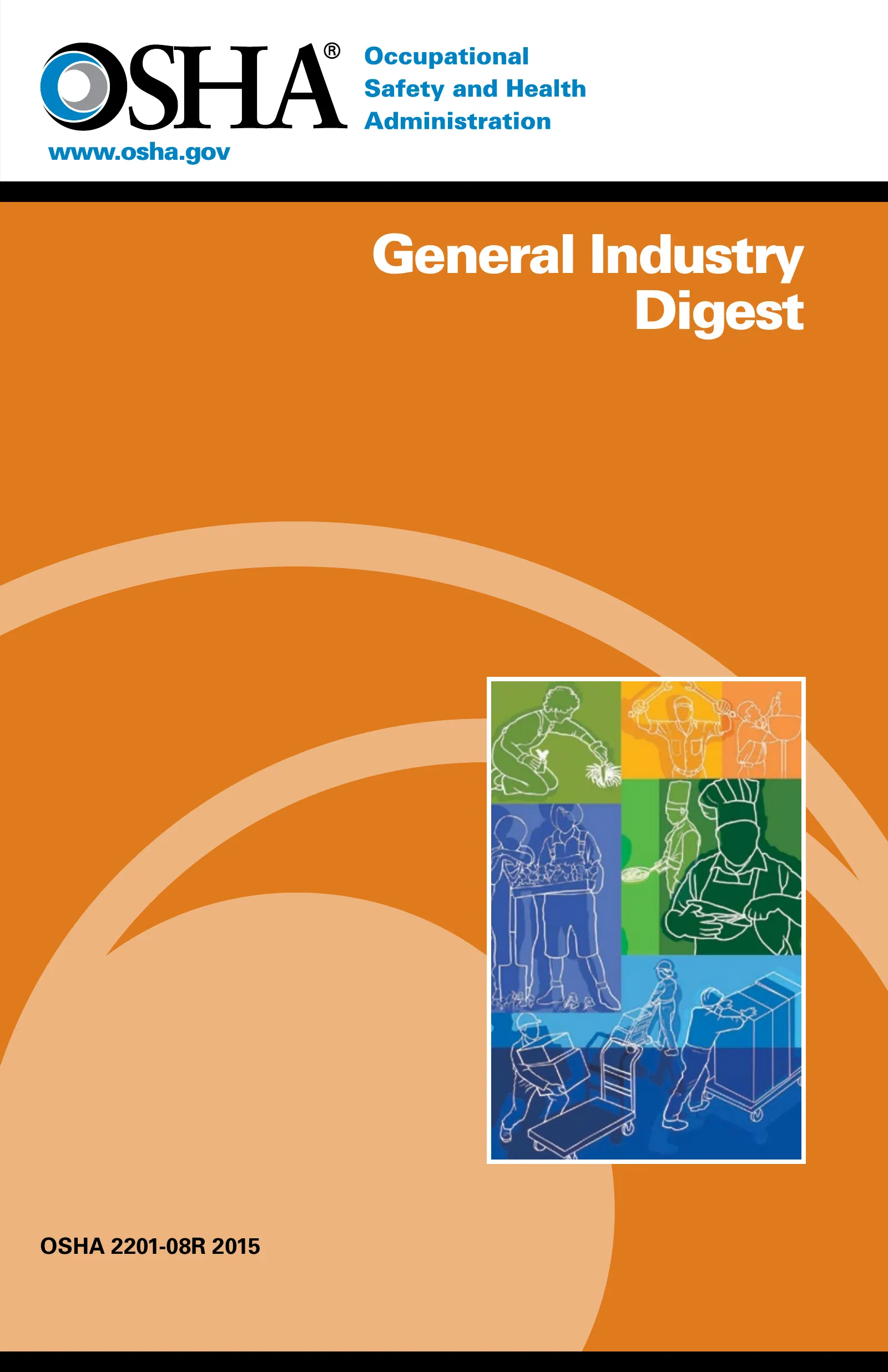
General Industry Digest (OSHA 2201)
OSHA booklet, for General Industry classes.
Page text
· 106 of 108 pages · by U.S. Department of Labor, OSHA
The words on each page as the author wrote them, read from the file by software so they can be searched. Layout, pictures and tables are not shown here, and long pages are shortened: the pages above and the download are the original.
- Page 1
General Industry
- Digest
- OSHA 2201-08R 2015
- Page 2
Occupational Safety and Health Act of 1970
- “To assure safe and healthful working conditions for working men and women; by authorizing enforcement of the standards developed under the Act; by assisting and encouraging the states in their efforts to assure safe and healthful working conditions; by…
- …
- Page 3
General Industry Digest
- U.S. Department of Labor
- Occupational Safety and Health Administration
- OSHA 2201-08R
- 2015
- Page 4
Foreword
- The summary of General Industry safety and health standards contained in this booklet are to aid employers, supervisors, workers, health and safety committee members, and safety and health personnel in their efforts toward achieving compliance with OSHA standards in the workplace.
- …
- Page 5
Contents
- Injury and Illness Prevention Programs
- Top 10 Most Frequently Cited Standards
- General Industry Standards
- General Duty Clause
- (Pub. Law 91-596 Section 5(a)(1))
- Fatality, Injury and Illness Information
- Recording and Reporting Occupational Fatalities, Injuries and Illnesses
- …
- Page 6
Eating and Drinking Areas
- Showers
- Toilets
- Confined Spaces
- Permit-Required Confined Spaces
- Control of Hazardous Energy (Lockout/Tagout)
- Hazardous Materials
- 27 27 27 28 28 29 31
- Compressed Gas Cylinders
- Oxygen-fueled Gas
- Acetylene
- Compressed Gases
- Hydrogen
- Nitrous Oxide
- Oxygen
- …
- Page 7
Methylene Chloride
- Methylenedianiline
- Hazard Communication
- Exposure to Hazardous Chemicals in Laboratories Ionizing Radiation
- DOT Markings, Placards and Labels
- Personal Protective Equipment
- 56 57 59 61 62 63 63
- Eye and Face Protection
- Eyewash/Drench Shower
- Foot Protection
- Head Protection
- …
- Page 8
Mechanical Power Presses
- Portable Power Tools (Pneumatic)
- Power Transmission Equipment Guarding
- Powered Platforms for Building Maintenance
- Portable Circular Saws
- Woodworking Machinery
- Restarts
- Circular Table Saws
- Rip Saws
- Inverted Swing or Sliding Cut-off Saws
- Radial Saws
- Self-feed Circular Saws
- …
- Page 9
Hazardous Workplace Complaints: Worker Rights
- OSHA Assistance, Services and Programs
- OSHA Advisory Committees
- NIOSH Health Hazard Evaluation Program
- OSHA Regional Offices
- How to Contact OSHA
- Page 10
Injury and Illness Prevention Programs
- An injury and illness prevention program, 1 is a proactive process to help employers find and fix workplace hazards before workers are hurt. We know these programs can be effective at reducing injuries, illnesses, and fatalities. …
- …
- Page 11
- Most successful injury and illness prevention programs include a similar set of commonsense elements that focus on finding hazards in the workplace and developing a plan for preventing and controlling those hazards. …
- …
- Page 12
- More recently, the American National Standards Institute (ANSI) issued ANSI Z10-2005, Occupational Health and Safety Management Systems. This voluntary consensus standard provides critical management system requirements and guidelines for improvement of occupational health and safety. …
- …
- Page 13
Top 10 Most Frequently Cited Standards
- Federal OSHA maintains a list of the top 10 most frequently cited standards following inspections of worksites to alert employers, so they can take steps to find and fix recognized hazards before preventable injuries and illnesses occur. …
- …
- Page 14
General Industry Standards
- General Duty Clause
- (Pub. Law 91-596 Section 5(a)(1))
- Hazardous conditions or practices not covered in an OSHA standard may be covered under Section 5(a)(1) of the Occupational Safety and Health Act (OSH Act), which states: “Each employer must furnish to each of his…
- …
- Page 15
Walking-Working Surfaces
- Employers who are required to keep Form 300, the Injury and Illness log, must post Form 300A, the Summary of Work-Related Injuries and Illnesses, in the workplace every year from February 1 to April 30 (§1904.32(b)(6)). …
- …
- Page 16
Floors, General Conditions
- All places of employment, passageways, storerooms, and service rooms must be kept clean and orderly and in a sanitary condition (§1910.22(a)(1)).
- The floor of every workroom must be maintained in a clean and, so far as possible, a dry condition. …
- …
- Page 17
- Every floor hole into which persons can accidentally walk must be guarded by either a standard railing with standard toeboard on all exposed sides, or a floor hole cover that should be hinged in place. …
- …
- Page 18
- Cages, wells, or ladder safety devices must be provided on all fixed ladders more than 20 feet (6 meters) long to a maximum unbroken length of 30 feet. A landing platform must be provided for each
- 30 feet (9 meters) of length. Where no cage is provided, landing platform intervals must be reduced to…
- …
- Page 19
- The top of a ladder used to gain access to a roof must extend at least 3 feet (0.9 meters) above the point of contact (support), at eave, gutter, or roofline (§1910.25(d)(2)(xv)).
- Portable ladders must have nonconductive siderails if they are used where the employee or the ladder could contact…
- …
- Page 20
- A standard toeboard must be at least 4 inches (10 centimeters) in height and may be of any substantial material, either solid or open, with openings not to exceed 1 inch (2.5 centimeters) in greatest dimension (§1910.23(e)(4)).
- Scaffolds
- …
- Page 21
Fixed Industrial Stairs
- Every flight of stairs having four or more risers must be provided with a standard railing on all open sides. Handrails must be provided on at least one side of closed stairways, preferably on the right side descending. …
- …
- Page 22
Exits
- Every building designed for human occupancy must be provided with exit routes sufficient to permit the prompt escape of occupants in case of emergency (§1910.36(b)). An exit door must be unlocked (§1910.36(d)).
- In hazardous areas, or where employees may be endangered by the blocking of any…
- …
- Page 23
Occupational Health and Environmental Controls
- Nonionizing Radiation (Electromagnetic Radiation)
- Nonionizing radiation (electromagnetic radiation) applies to all radiations originating from radio stations, radar equipment, and other possible sources of electromagnetic radiation such as those used for…
- …
- Page 24
- When workers are exposed to sound levels exceeding those shown in Table G-16 (below), employers must use feasible engineering and/or administrative controls to protect workers. When engineering or administrative controls fail to reduce the noise level to within the levels in Table G-16, personal…
- …
- Page 25
Local/Exhaust Ventilation
- Blast-cleaning enclosures must be exhaust ventilated in such a way that a continuous inward flow of air will be maintained at all openings in the enclosure during blasting operations. …
- …
- Page 26
- Spray booths or spray rooms are to be used to enclose or confine all spray finishing operations (§§1910.94(c)(2) and (c)(3)). The total air volume exhausted through a spray booth must be such as to dilute the solvent vapor to at least 25 percent of the lower explosive limit of the solvent being…
- …
- Page 27
- must be designed, constructed, and serviced to ensure sanitary conditions and must be capable of being closed, and have a tap (§1910.141(b)(1)(iii)). Open containers such as barrels, pails or tanks for drinking water from which the water must be dipped or poured, whether or not they are fitted with…
- …
- Page 28
- Wash basins (lavatories), with hot and cold, or tepid running water, hand soap or equivalent, and hand towels, blowers or equivalent, must be provided in every place of employment (§§1910.141(d)(2)(i) through (iv)).
- Confined Spaces
- Permit-Required Confined Spaces
- …
- Page 29
- and verifying that conditions in the permit space are acceptable for entry throughout the duration of an authorized entry (§§1910.146(d)
- (3) and (e)(1)).
- The employer must provide training so that all employees whose work is regulated by the permit entry system section acquire the understanding…
- …
- Page 30
- within a plant or facility, each employer must coordinate with the other employers to ensure that no employees are endangered (§1910.147(f)(2)(i)). When a group of employees are performing a servicing or maintenance activity, each employee must be afforded protection equivalent to the utilization of…
- …
- Page 31
Hazardous Materials
- Compressed Gas Cylinders
- Inside of buildings, oxygen-fuel gas welding cylinders must be stored in a well-protected, well-ventilated, dry location, at least
- 20 feet (6.1 meters) from highly combustible materials such as oil or excelsior. …
- …
- Page 32
- Hydrogen systems must be located (1) so that they are readily accessible to delivery equipment and to authorized personnel, (2) above ground, (3) so they are not beneath electric power lines, and
- (4) clear from flammable liquid piping or piping of other flammable gases. …
- …
- Page 33
- All dip tanks exceeding 150 gallons (570 liters) of flammable liquid capacity or having a liquid surface area exceeding four square feet (0.36 meters) must be protected with at least one of the following automatic extinguishing facilities: water spray system, foam system, carbon dioxide system, dry…
- …
- Page 34
- room or storage cabinet in a building or any one fire area of a building must not exceed (§1910.106(e)(2)(ii)(b)):
- 25 gallons (95 liters) of Class IA liquids in containers;
- 120 gallons (456 liters) of Class IB, IC, II, or III liquids in containers; or
- …
- Page 35
- a safe location for accumulated liquids. The storage areas must be protected against tampering or trespassing, where necessary, and must be kept free of weeds, debris, and other combustible material not necessary to the storage (§§1910.106(d)(6)(iii) and (iv)).
- …
- Page 36
Atmospheric tanks may be built in accord with the following consensus standards:
- Underwriters’ Laboratories, Inc., Subjects No. 142, Standard for Steel Aboveground Tanks for Flammable and Combustible Liquids, 1968; No. …
- …
- Page 37
- jobs safely including information on the proper personal protective equipment and procedures to safeguard employees against hazards and effects of exposure to toxic substances (§§1910.120(e), (p)(7), and (q)(6)). …
- …
- Page 38
- An emergency response plan must be developed and implemented to handle anticipated emergencies prior to the commencement of emergency response operations. The plan must be in writing and be available for inspection and copying by employees, their representatives, and OSHA personnel…
- …
- Page 39
- Each employee presently involved in operating a process, and each employee before being involved in operating a newly-assigned process, must be trained in an overview of the process and in the operating procedures as specified in the Operating Procedures section of the standard. …
- …
- Page 40
- Employers must also certify, at least every 3 years, that they have evaluated compliance with the provisions of the OSHA Process Safety Management of Highly Hazardous Chemicals standard (§§1910.119(n) and (o)(1)).
- Spray-Finishing Operations
- …
- Page 41
- The quantity of flammable or combustible liquids kept in the vicinity of spraying operations must be the minimum required for operations and should ordinarily not exceed a supply for one day or one shift. …
- …
- Page 42
- must be used to keep the exposure of employees to air contaminants within the limits prescribed in §1910.1000(e). In addition, whenever respirators are used, they must comply with §1910.134.
- Asbestos
- Employers must ensure that no employee is exposed to an airborne concentration of asbestos above the…
- …
- Page 43
- Respirators must be used: (1) while feasible engineering and work practice controls are being installed or implemented; (2) during maintenance and repair activities, or other activities where engineering and work practice controls are not feasible; (3) where feasible engineering and work-practice…
- …
- Page 44
- Employers required to establish an Exposure Control Plan must solicit input from non-managerial employees who are potentially exposed to injuries from contaminated sharps on the identification, evaluation, and selection of effective engineering and work practice controls, and must document such…
- …
- Page 45
Benzene
- Employee exposure to gaseous and liquid benzene must be limited to one (1) part per million (ppm) as an 8-hour time-weighted average (TWA), known as the permissible exposure limit (PEL), and five (5) ppm as averaged over a period of fifteen (15) minutes, known as the short-term exposure limit…
- …
- Page 46
- A medical exam following exposure in an emergency situation may require special elements or actions, including a urinary phenol test, blood tests, and physician’s referral to a hematologist/ internist for further evaluation or treatment (§§1910.1028(i)(4) and (5)). …
- …
- Page 47
- Additional monitoring is required when there has been a change in production, process, control equipment, personnel, or work practices and if a spill, leak, or rupture has occurred (§§1910.1051(d) (5)(i) and (ii)).
- Employers must institute engineering and work practice controls (excluding employee…
- …
- Page 48
Cadmium
- Employee exposure to cadmium must be limited to the permissible exposure limit (PEL) of 5 micrograms per cubic meter of air (µg/m 3 ) as an 8-hour time-weighted average (TWA) (§1910.1027(c)).
- Employee exposure to cadmium must be determined from breathing zone air samples that represent the…
- …
- Page 49
- to remove contaminated clothing in change rooms and place the clothing in sealable containers that are labeled with warnings (§§1910.1027(i)(2)(i) through (iv)).
- Employers must provide medical surveillance to employees who are exposed at or above the action level for 30 or more days per year, were…
- …
- Page 50
- additional monitoring when necessary (§§1910.1026(d)(2)(iii), (iv), and (vi)). Exposure may be determined through a performance approach, rather than monitoring (§1910.1026(d)(3)). Employees have the right to observe monitoring and must be notified of results (§§1910.1026(d)(4)(i) and (d)(6)(i)).
- …
- Page 51
- This standard also contains requirements for hazard communication and recordkeeping (§§1910.1026(l)(2) and (m)).
- Ethylene Oxide
- Employee exposure to ethylene oxide (EtO) must be limited to one (1) part per million (ppm) as an 8-hour time-weighted average (TWA) and five (5) ppm as averaged over a…
- …
- Page 52
- 30 days a year (§1910.1047(i)(1)(i)(A)). The employer must make available medical examinations and consultations to each covered employee at least annually and in other situations such as when employees develop signs or symptoms that might be related to exposure or when employees are exposed during…
- …
- Page 53
- Periodic monitoring must be conducted for employees exposed above the action level, 8-hour TWA, or 15-minute STEL (§1910.1048(d)(3)(i)). Exposure monitoring is required if the employer receives reports of signs or symptoms of respiratory or dermal (skin related) conditions associated with…
- …
- Page 54
- (1)(ii)). If a physician finds that significant irritation of the mucosa (mucous membranes) of the eyes or of the upper airways, respiratory sensitization, dermal irritation, or dermal sensitization and recommends restrictions or removal, the employer must transfer, if possible, the employee to work…
- …
- Page 55
- Employers must use engineering and work practice controls to reduce and maintain employee exposure at or below the TWA
- PEL (§§1910.1025(e)(1)(i) and (ii)). Employers must demonstrate effectiveness of ventilation systems and use a high efficiency filter, monitors, and automatic bypasses for return…
- …
- Page 56
- (§§1910.1025(k)(1)(i)(A) and (B), and (k)(2)(i)). Employees must also be removed if they have a medical condition which puts them at risk (§1920.1025(k)(1)(ii)(A)). During medical removal employers must maintain the employee’s benefits such as earnings and seniority (§1910.1025(k)(2)(ii)).
- …
- Page 57
- program (§§1910.1052(f)(1), (g)(1), and (g)(2)(i)). Half masks are not permitted (§1910.1052(g)(3)(i)). Employers must also provide appropriate protective clothing and equipment when employees could have MC-induced skin or eye irritation (§1910.1052(h)(1)).
- …
- Page 58
- (e)(2)). Employers must conduct periodic monitoring for employees exposed above the action level, 8-hour TWA, or 15-minute STEL and additional monitoring when necessary (§§1910.1050(e)
- (3)(i) and (ii), and (e)(5)). Employees have the right to observe monitoring and must be notified of results…
- …
- Page 59
- Employers must develop and implement a written plan for each workplace where there is a possibility of an emergency (§1910.1050(d)(1)(i)). The plan must cover respiratory protection for employees engaged in correcting emergency conditions, emergency action procedures, and fire prevention elements…
- …
- Page 60
- In order to classify chemical hazards, the importer or manufacturer is provided with specific criteria and detailed instructions for hazard evaluation and determinations. Additionally, mandatory Appendices A and B provide classification guidance for Health Hazards and Physical Hazards, respectively…
- …
- Page 61
- observations that may be used to detect the presence or release of a hazardous chemical in the work area (such as monitoring conducted by the employer, continuous monitoring devices, visual appearance or odor of hazardous chemicals when being released); the physical and health hazards of the…
- …
- Page 62
- If the initial monitoring discloses employee exposure over the action level (or in the absence of an action level, the PEL), the employer must immediately comply with the exposure monitoring requirements of the relevant standard (§1910.1450(d)(2)). …
- …
- Page 63
DOT Markings, Placards and Labels
- Each radiation area must be conspicuously posted with appropriate signs and/or barriers (§1910.1096(e)).
- Employers must maintain records of the radiation exposure to all employees for whom personnel monitoring is required (§§1910.1096(b)(2)(iii) and (n)(1)).
- …
- Page 64
- a sanitary and reliable condition whenever there is a hazard from processes or environment, chemical hazards, radiological hazards, or mechanical irritants that may cause injury or illness to employees through absorption, inhalation, or physical contact (§1910.132(a)).
- …
- Page 65
- The employer must provide training to each employee who is required to use PPE, so they know at least the following: when PPE is necessary; what PPE is necessary; how to properly don (put on), doff (take off), adjust, and wear PPE; the limitations of the PPE; and the proper care, maintenance, useful…
- …
- Page 66
Foot Protection
- Foot protective equipment must be worn when working in areas where there is a danger of foot injuries due to falling or rolling objects or objects piercing the sole, and where employees’ feet are exposed to electrical hazards (§1910.136(a)). …
- …
- Page 67
Head Protection
- Head protection equipment, such as helmets and hard hats must be worn when there is a possible danger of head injuries from impact, flying or falling objects, or electrical shock and burns (§§1910.135(a)
- (1) and (a)(2)).
- …
- Page 68
- flow of breathing air for atmosphere-supplying respirators; training of employees in the respiratory hazards to which they are potentially exposed during routine and emergency situations; training of employees in the proper use of respirators, including putting on and removing them, any limitations…
- …
- Page 69
- the protective effect of the respirator; what the limitations and capabilities of the respirator are; how to use the respirator effectively in emergency situations, including situations in which the respirator malfunctions; how to inspect, put on and remove, use, and check the seals of the…
- …
- Page 70
- Snap-hooks be sized to avoid unintentional disengagement due to depression, or be of locking type to prevent disengagement;
- Horizontal lifelines, where used, be designed, and installed as part of a complete personal fall arrest system, with a safety factor of at least two, under the supervision of a…
- …
- Page 71
Medical Services
- components subjected to impact loading must be immediately removed from service and never used again for employee fall protection, unless inspected and determined by a competent person to be undamaged and suitable for reuse (§1910.66, Appendix C, paragraph (e)(7)).
- …
- Page 72
Fire Protection
- Only approved portable fire extinguishers must be used (§1910.157(c)(2)). If portable fire extinguishers are provided for employee use, the employer must mount, locate, and identify them so they are readily accessible to employees without subjecting the employees to possible injury. …
- …
- Page 73
- In confined spaces or where the welding space contains partitions, balconies, or other structural barriers to the extent that they significantly obstruct cross ventilation (§1910.252(c)(2)(i)(C)).
- Proper shielding and eye protection to prevent exposure of personnel from welding hazards must be…
- …
- Page 74
Materials Handling and Storage
- Where welding operations are performed in confined spaces and where welders and helpers are provided with airline respirators or self-contained breathing equipment, a worker must be stationed on the outside of such confined spaces to ensure the safety of those working…
- …
- Page 75
Cranes (Overhead and Mobile), Hoists and Derricks
- All functional operating mechanisms, air and hydraulic systems, chains, ropes, slings, hooks, and other lifting equipment must be visually inspected daily (§1910.179(j)(2), §1910.180(d)(3), and §1910.184(d)).
- …
- Page 76
Hazardous Equipment and Machinery
- constitute hazards from tripping, fire, explosion or pest harborage. Vegetation control will be exercised when necessary (§1910.176(c)). Where mechanical handling equipment is used, sufficient safe clearance must be allowed for aisles, at loading docks, through…
- …
- Page 77
Use of Compressed Air
- Compressed air must not be used for cleaning purposes unless the pressure does not exceed 30 pounds (13.5 kilograms) per square inch (6.5 square centimeters) when the nozzle end is obstructed or dead-ended, and then only with effective chip guarding and personal protective…
- …
- Page 78
Hand Tools
- Portable electric equipment must be handled in a manner that will not cause damage. When the cord and plug connected tools are relocated they must be visually inspected before use on any shift for external defects (such as loose parts, deformed and missing pins, or damage to outer jacket…
- …
- Page 79
- flying chips, and sparks. The guard must be such that it does not pose an accident hazard in itself. Some examples of guarding methods include barrier guards, two-hand tripping devices, and electronic safety devices (§§1910.212(a)(1) and (2)).
- …
- Page 80
- Hand and foot operations must be provided with guards to prevent inadvertent activation of the press (§§1910.217(b)(4)(i) and (b)(5)(i) through (ii)).
- The employer must provide and enforce the use of safety blocks whenever dies are being adjusted or repaired in the press. …
- …
- Page 81
Portable Power Tools (Pneumatic)
- For portable tools, a tool retainer must be installed on each piece of utilization equipment which, without such a retainer, may eject the tool (§1910.243(b)(1)).
- Hose and hose connections used for conducting compressed air to utilization equipment must be designed…
- …
- Page 82
- Flywheels located so that any part is 7 feet (2.1 meters) or less above the floor or platform must be guarded with an enclosure of sheet, perforated, or expanded metal or woven wire (§§1910.219(b)
- (1) and (b)(1)(i)).
- Flywheels protruding through a working floor must be entirely enclosed or…
- …
- Page 83
- Repairs or major maintenance of those building portions that provide primary support for the suspended equipment must not affect the capability of the building to meet OSHA requirements (§1910.66(e)(10)).
- The equipment power circuit must be an independent electrical circuit that must remain separate…
- …
- Page 84
Woodworking Machinery
- All woodworking machinery – such as table saws, swing saws, radial saws, band saws, jointers, tenoning machines, boring and mortising machines, shapers, planers, lathes, sanders, veneer cutters, and other miscellaneous woodworking machinery – must be enclosed or guarded, except…
- …
- Page 85
- than self-feed saws with a roller or wheel at back of the saw) must be provided with a spreader fastened securely behind the saw. The spreader must be slightly thinner than the saw kerf and slightly thicker than the saw disk (§§1910.213(c)(2) and (e)(2)).
- …
- Page 86
- Swing or sliding cut-off saws must be provided with limit stops to prevent the saws from extending beyond the front or back edges of the table (§1910.213(g)(3)).
- Swing or sliding cut-off saws must be provided with an effective device to return the saw automatically to the back of the table when…
- …
- Page 87
- Where the nature of the work is such as to entirely cover the side of the wheel, the side covers of the guard may be omitted (§1910.215(a)(2)(i) and §1910.243(c)(1)(ii)(b)); and
- The spindle end, nut, and outer flange may be exposed on portable machines designed as portable saws, as well as on other…
- …
- Page 88
- De-energize and disconnect, lockout and tag, or block off all mechanical, electrical, hydraulic and pneumatic equipment that presents a danger (§1910.272(g)(1)(ii)).
- Prohibit workers from walking down grain and similar practices where walking on grain is intended to make it flow (§1910.272(g)…
- …
- Page 89
Control of Grain Dust Fires and Explosions
- The employer must develop and implement a written housekeeping program that establishes the frequency and method(s) determined best to reduce accumulations of fugitive grain dust on ledges, floors, equipment and other exposed surfaces (§1910.272(j)(1)).
- …
- Page 90
- Any dust collection systems determined to be malfunctioning or operating below designed efficiency, must be promptly corrected. Additionally, overheated bearings and slipping or misaligned belts associated with inside bucket elevators must be promptly corrected or removed from service until repaired…
- …
- Page 91
Emergency Action Plans
- Due to the potential for fires and explosions existing in grain handling operations, employers must develop and implement an emergency action plan that meets the requirements in §1910.38 (§1910.272(d)).
- The minimum elements of the plan must include:
- …
- Page 92
General Electrical Safety
- Electrical equipment must be free from recognized hazards that are likely to cause death or serious physical harm to employees. Safety of equipment must be determined using the following considerations: (1) suitability for installation and use in conformity;
- …
- Page 93
Flexible Cords and Cables (Extension Cords)
- Flexible cords and cables must be protected from accidental damage (§1910.305(a)(2)(x)). Unless specifically permitted, flexible cords and cables may not be used as a substitute for the fixed wiring of a structure, where attached to building surfaces, where…
- …
- Page 94
Guarding
- Except as elsewhere required or permitted by 29 CFR 1910, subpart S, live parts of electric equipment operating at 50 volts or more shall be guarded against accidental contact by use of approved cabinets or other forms of approved enclosures or by any of the approved means (§1910.303(g)(2)).
- …
- Page 95
- Live parts that an employee may be exposed to must be deenergized before the employee works on or near them, unless the employer can demonstrate that deenergizing introduces additional or increased hazards or it is infeasible due to equipment design or operational limitations (§1910.333(a)(1)).
- …
- Page 96
Hazardous Workplace Complaints: Worker Rights
- Workers have the right to a safe workplace. The Occupational Safety and Health Act of 1970 (OSH Act) was passed to prevent workers from being killed or seriously harmed at work. …
- …
- Page 97
OSHA Assistance, Services and Programs
- OSHA has a great deal of information to assist employers in complying with their responsibilities under OSHA law. Several OSHA programs and services can help employers identify and correct job hazards, as well as improve their injury and illness prevention…
- …
- Page 98
Free On-site Safety and Health Consultation Services for Small Business
- OSHA’s On-site Consultation Program offers free and confidential advice to small and medium-sized businesses in all states across the country, with priority given to high-hazard worksites. …
- …
- Page 99
Occupational Safety and Health Training Courses
- The OSHA Training Institute partners with 27 OSHA Training Institute Education Centers at 42 locations throughout the United States to deliver courses on OSHA standards and occupational safety and health topics to thousands of students a year. …
- …
- Page 100
OSHA Advisory Committees
- OSHA sponsors advisory committees to advise the Secretary of Labor and the Assistant Secretary of Labor for Occupational Safety and Health on workplace safety and health issues.
- All of OSHA’s advisory committees have membership balanced between representatives of workers and…
- …
- Page 101
NIOSH Health Hazard Evaluation Program
- Getting Help with Health Hazards
- The National Institute for Occupational Safety and Health (NIOSH) is a federal agency that conducts scientific and medical research on workers’ safety and health. …
- …
- Page 102
OSHA Regional Offices
- Region I
- Boston Regional Office
- (CT*, ME*, MA, NH, RI, VT*)
- JFK Federal Building, Room E340 Boston, MA 02203
- (617) 565-9860 (617) 565-9827 Fax
- Region II
- New York Regional Office
- (NJ*, NY*, PR*, VI*)
- 201 Varick Street, Room 670
- New York, NY 10014
- (212) 337-2378 (212) 337-2371 Fax
- …
- Page 103
Region VI
- Dallas Regional Office
- (AR, LA, NM*, OK, TX)
- 525 Griffin Street, Room 602
- Dallas, TX 75202
- (972) 850-4145 (972) 850-4149 Fax
- (972) 850-4150 FSO Fax
- Region VII
- Kansas City Regional Office
- (IA*, KS, MO, NE)
- Two Pershing Square Building
- 2300 Main Street, Suite 1010
- Kansas City, MO 64108-2416
- …
- Page 104
- Illinois, Maine, New Jersey, New York and Virgin Islands programs cover public employees only. (Private sector workers in these states are covered by Federal OSHA). States with approved programs must have standards that are identical to, or at least as effective as, the Federal OSHA standards.
- …
- Page 105
How to Contact OSHA
- For questions or to get information or advice, to report an emergency, fatality, hospitalization, amputation, or loss of an eye, or to file a confidential complaint, contact your nearest OSHA office, visit www.osha.gov or call OSHA at 1-800-321-OSHA (6742), TTY 1-877-889-5627.
- …
- Page 108
U.S. Department of Labor
- For more information
- Occupational
- Safety and Health Administration
- www.osha.gov (800) 321-OSHA (6742)
More on Intro to OSHA
pdf
36 slidesOSHA: All About OSHA (OSHA 3302)
OSHA booklet, for General Industry classes.
U.S. Department of Labor, OSHAPublic domain
pdfes
44 slidesOSHA: All About OSHA (OSHA 3173) (en español)
OSHA booklet, in Spanish, for General Industry classes.
U.S. Department of Labor, OSHAPublic domain
pdf
28 slidesWorkers' Rights Booklet (OSHA 3021)
OSHA booklet, for General Industry classes.
U.S. Department of Labor, OSHAPublic domain