1 / 17Use ← → to flip
Health Hazards in Construction: Lesson Plan (OSHA 10-Hour Construction Outreach)
Instructor lesson plan with objectives, timing and teaching procedures for the OSHA health hazards in construction outreach deck.
Page text
· 16 of 17 pages · by U.S. Department of Labor, OSHA (with the OTIEC Outreach Workgroup)
The words on each page as the author wrote them, read from the file by software so they can be searched. Layout, pictures and tables are not shown here: the pages above and the download are the original.
- Page 1
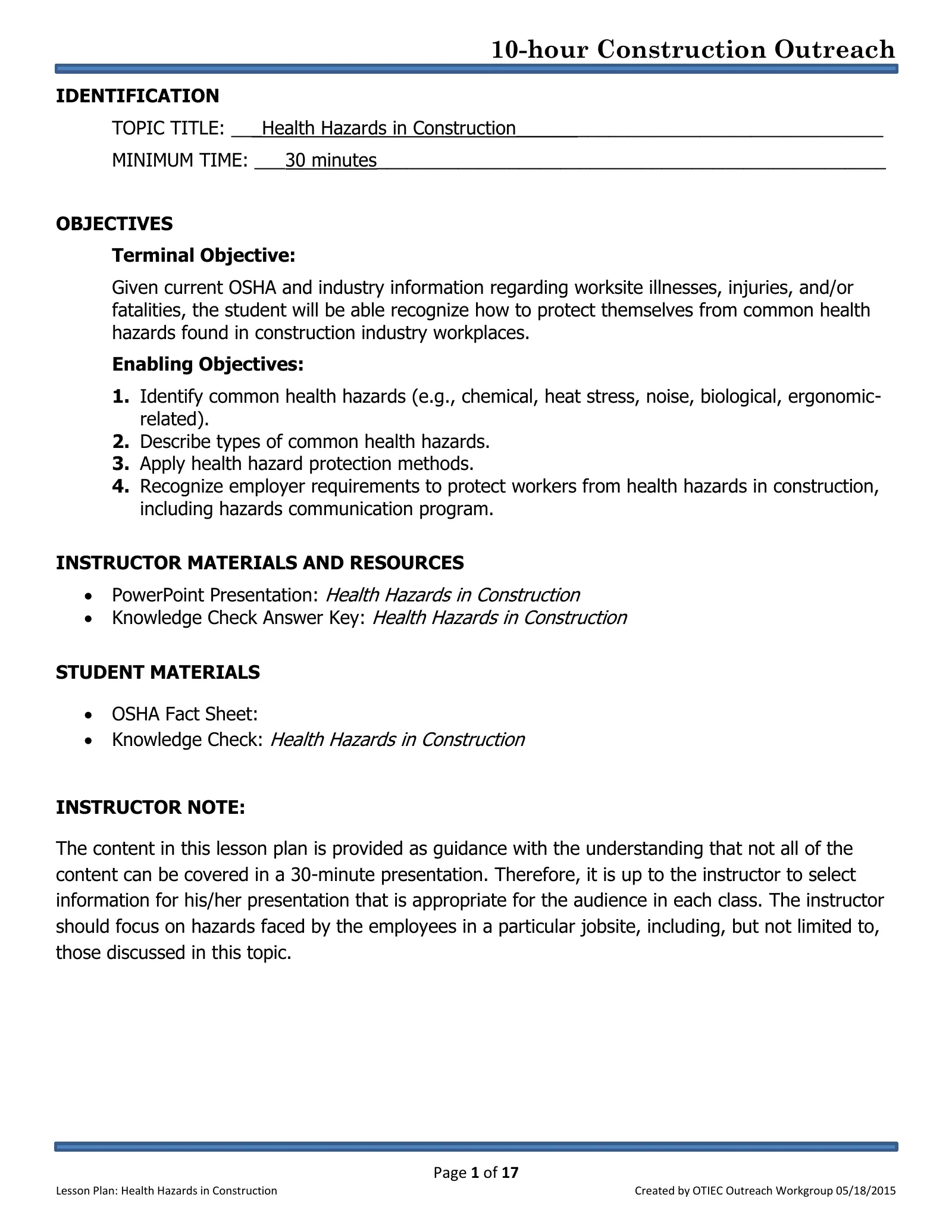
IDENTIFICATION
- TOPIC TITLE: ___Health Hazards in Construction___
- MINIMUM TIME: ___30 minutes___
- OBJECTIVES
- Terminal Objective:
- Given current OSHA and industry information regarding worksite illnesses, injuries, and/or fatalities, the student will be able recognize how to protect themselves from common health hazards found in construction industry workplaces.
- Enabling Objectives:
- 1. Identify common health hazards (e.g., chemical, heat stress, noise, biological, ergonomicrelated).
- 2. Describe types of common health hazards.
- 3. Apply health hazard protection methods.
- 4. Recognize employer requirements to protect workers from health hazards in construction, including hazards communication program.
- INSTRUCTOR MATERIALS AND RESOURCES
- PowerPoint Presentation: Health Hazards in Construction Knowledge Check Answer Key: Health Hazards in Construction
- STUDENT MATERIALS
- OSHA Fact Sheet:
- Knowledge Check: Health Hazards in Construction
- INSTRUCTOR NOTE:
- The content in this lesson plan is provided as guidance with the understanding that not all of the content can be covered in a 30-minute presentation. Therefore, it is up to the instructor to select information for his/her presentation that is appropriate for the audience in each class. The instructor should focus on hazards faced by the employees in a particular jobsite, including, but not limited to, those discussed in this topic.
- Page 2
TEACHING PROCEDURES ---Preparation, Presentation, Application, Evaluation
- Anticipatory Set (Focus Attention/Gain Interest)
- Estimated Time: ?? hours
- Key Points
- Methods
- Workers may potentially be exposed to chemical, physical, biological, and ergonomic hazards while on the job. These health hazards may cause sickness, illness, or even death. However, exposure to health hazards may not be limited to just the worker, but to his/her family as well. Unlike safety hazards, some health hazards can be brought home with a worker, thereby exposing the family to the potential for sickness, illness, or death.
- Presentation (Instruction)___
- Key Points
- I.
- Common Health Hazards
- A. Chemical
- B. Physical
- C. Biological
- D. Ergonomic
- II.
- Exposure Effects of Chemical Hazards and Methods of Control
- PPT slide #1 – #2
- Methods
- PPT slide #3
- PPT slides #4 – #10
- A. Chemical hazards exist in various forms – dusts, fumes, mists, aerosols, fibers, gases, vapors
- B. Common ways workers encounter chemical hazards on a construction worksite
- 1. Toxic atmospheres
- a. Confined spaces
- b. Storage tanks, process vessels, bins, boilers, ventilation or exhaust ducts, sewers, underground utility vaults, tunnels, pipelines, and open-top spaces more than 4 feet in depth
- (pits, tubs, vaults, vessels)
- Page 3
- 2. Lead exposure
- a. May occur during demolition, salvage, removal, encapsulation, renovation, and clean-up activities
- b. Used in lead-based paints, lead solder, electrical fittings and conduits, tanks linings, plumbing fixtures, and many metal alloys
- 3. Asbestos exposure
- a. Tends to occur in construction industry and ship repair, particularly during removal of asbestos materials during renovation, repairs, or demolition
- b. Used in products such as insulation for pipes, floor tiles, building materials, and in vehicle brakes and clutches
- 4. Crystalline silica
- a. Abundant in earth’s crust; most common form is quartz, which is found in many construction materials such as brick and mortar, concrete, slate, granite, sandstone, stone aggregate, tile, and sand
- b. Crystalline silica is also found in asphalt filler, roofing granules, plastic composites, soils, wallboard joint compounds, paint, plaster, caulking, and putty
- c. Exposure through inhalation of small particles in air which occurs with common operations such as cutting, sawing, and drilling
- 5. Welding fumes
- a. Contents of fumes depend on components of the base metal, coatings, and/or filler materials, as well as the temperatures used in the welding process
- b. Metal in fumes – aluminum, antimony, arsenic, beryllium, cadmium, chromium, cobalt, copper, iron, lead, manganese, molybdenum, nickel, silver, tin, titanium, vanadium, and zinc
- Page 4
- c. Gas by-products of welding
- i. Shielding – argon, helium, nitrogen, carbon dioxide
- ii. Process – nitric oxide, nitrogen dioxide, carbon monoxide, ozone, phosgene, hydrogen fluoride, carbon dioxide
- C. Effects of chemical exposures
- 1. May pose risk of fire and explosion hazards
- 2. May put workers at risk of developing health problems such as heart ailments, central nervous system damage, kidney damage, lung damage, sterility, cancer, burns, or rashes
- 3. Entry into the body
- a. Inhalation
- b. Ingestion
- c. Absorption
- d. Injection
- 4. Factors affecting exposures
- a. Physical form of chemical
- b. Means of entry into the body
- c. Amount (dose) that enters the body
- d. Toxicity level of chemical
- e. Age, sex, race, and weight of individual
- 5. Acute exposure versus chronic exposures
- 6. Immediate body reaction versus delayed body reaction
- 7. Damage to body
- a. Permanent versus reversible
- b. Localized versus systemic
- 8. Examples of chemical exposure symptoms
- a. Eye, nose, throat, upper respiratory tract, and skin irritation
- b. Flu-like symptoms
- c. Difficulty breathing
- d. Fatigue
- e. Loss of coordination
- f. Memory difficulties
- g. Sleeplessness
- Page 5
- h. Mental confusion
- i. Chronic effects – depend on extent and duration of exposure
- D. Methods of protecting workers against exposure to chemical hazards
- 1. Control methods hierarchy
- a. Engineering controls
- b. Work practice controls
- c. Administrative controls
- d. PPE
- 2. Substitute with safer chemicals
- 3. Practice good personal hygiene – wash hands and face; launder clothes daily, using proper cleaning methods
- 4. Monitor/measure exposure levels
- 5. Establish regulated work and break areas
- 6. Wear PPE
- 7. Training
- III.
- Exposure Effects of Physical Hazards and Methods of Control
- PPT slides #11 – #14
- A. Types of physical hazards on construction worksites
- 1. Extreme temperatures
- a. Exposure occurs in both indoor and outdoor environments due to climate or working conditions
- b. Temperatures affected by humidity level, wind speed, radiant heat, physical contact with hot or cold objects, and strenuous physical activity
- 2. Impact or vibrating tools
- a. Hand-held and stationary tools that transmit vibration through a workpiece
- b. Examples – chainsaws, mowers, drillers, air hammers, pile drivers, tractors, graders, excavators, earth-moving equipment, and other large machinery
- Page 6
- 3. Radiation exposure – invisible, undetectable energy that travels through space
- a. Extremely Low Frequency Radiation (ELF) – produced by power lines, electrical wiring, and electrical equipment; sources of intense exposure include ELF induction furnaces and high-voltage power lines
- b. Radiofrequency (RF) and Microwave Radiation
- (MW) – sources include radio emitters and cell phones
- c. Infrared Radiation (IR) – sources include furnaces, heat lamps, and IR lasers
- d. Visible Light Radiation – different visible frequencies of the electromagnetic spectrum;
- lighting
- e. Ultraviolet Radiation (UV) – sources include the sun, black lights, welding arcs, and UV lasers;
- most common form of exposure for construction workers
- f. Lasers – emit optical radiations (UV, visible light, IR)
- 4. Noise exposure
- a. Short-term exposure to loud noises; long-term exposure to noise
- b. Examples of noise sources on construction site
- tools, equipment, and heavy machinery
- c. Permissible Exposure Limit (PEL) is 90 dBA for 8-hour Time Weighted Average (TWA); this is the legal limit set by OSHA
- d. OSHA and NIOSH recommend that worker exposure to noise be controlled below a level of
- 85 dBA for 8-hour TWA
- B. Effects of exposure to physical hazards
- 1. Exposure to cold temperatures
- a. Hypothermia
- i. Body temperature drops to or below 95 О F
- ii. Impaired muscular and brain functions
- Page 7
- iii.
- Symptoms – uncontrolled shivering, fumbling hands/clumsy movements, slurred speech, memory loss, erratic behavior, cool bluish/purple-colored skin
- b. Frostbite
- i. Freezing body tissue – exposed skin susceptible when air temperature is below
- 0 О F or when cold temperatures are combined with high winds
- ii. Leads to tissue damage, scarring, and possible amputation
- iii. Symptoms – pale, waxy-white skin color that is cool to touch; tingling, stinging, or aching feeling in exposed area, followed by numbness; ears, fingers, toes, and cheeks are areas primarily affected; freezing of muscles and tendons, causing areas to become numb, painless, and hard to the touch
- c. Trench foot
- i. Result of prolonged exposure of lower extremities to cold (32 О F to 50 О F) and moisture
- ii. Usually develops slowly, over a period of hours to days
- iii. Symptoms – initially, reddened skin, which later becomes pale and swollen; numbness, followed by leg cramps; blister formation, followed by ulceration
- 2. Exposure to hot temperatures
- a. Heat rash – most common problem
- i. Caused by sweating
- ii. Looks like red cluster of pimples or small blisters; usually appears on neck, upper chest, in the groin, under the breasts, and in elbow creases
- Page 8
- b. Heat cramps
- i. Usually occurs after prolonged exposure to heat; heavy sweating depletes body of salt and moisture
- ii. Painful cramps in abdomen and other muscles as result of decreased salt
- iii. Signs/symptoms – muscle pains or spasms in abdomen, arms, or legs; sick feeling in the stomach
- c. Heat exhaustion – serious condition
- i. Caused by loss of large amounts of fluids and sometimes excessive loss of salts due to sweating during work/exercise in hot environment
- ii. Signs/symptoms – dizziness/lightheadedness; weakness; heavy sweating;
- pale skin color; feeling sick to stomach;
- vomiting; irritability; fainting; moist, clammy skin
- d. Heat stroke – most serious condition
- i. Serious medical condition that requires immediate attention; occurs when body is unable to control its temperature
- ii. Body’s temperature rises rapidly, sweating is diminished or absent, and body is unable to cool down; body temperature could rise to 104 О F or higher within 10-15 minutes
- iii. Warning signs – red, hot, dry skin; rapid, strong pulse; body temperature ˃104 О F;
- confusion; throbbing headache; dizziness;
- feeling sick to stomach; unconscious
- 3. Impact/vibrating hazards
- a. “White fingers” or Raynaud’s Syndrome
- i. Blood vessels in fingers collapse due to repeated exposure to vibration
- ii. Skin and muscle tissues do not get enough oxygen and will eventually die
- Page 9
- b. Hand-Arm Vibration Syndrome (HAVS)
- i. More advanced condition; entire hand or arm may be affected by exposure to vibration
- ii. Early signs – infrequent feelings of numbness and/or tingling in fingers, hands, or arms, or numbness and whiteness in the tip of the finger when exposed to cold
- iii. Disease progression – more frequent attacks of numbness, tingling, and pain;
- difficult to use hands; may disable worker for a long period of time
- c. Fatigue
- d. Strains
- 4. Radiation
- a. Danger from radiation increases with:
- i. Lengthening duration of exposure
- ii. Shortening distance from source
- b. Stochastic health effects – associated with long-term, low-level (chronic) exposures
- i. Cancer
- ii. DNA mutations
- c. Non-stochastic health effects – appear in cases involving exposure to radiation at high levels; short-term, high-level (acute) exposure
- i. Burns
- ii. Radiation sickness – nausea, weakness, hair loss, skin burns, or diminished organ function
- iii. Can cause premature aging or even death
- 5. Noise
- a. Hearing loss – temporary or permanent
- b. Tinnitus (ringing in the ears)
- c. Physical and psychological stress, reduced productivity, interference with communication and concentration
- d. Signs that workplace is too noisy – ringing in ears after leaving work; having to shout to be heard by co-worker an arm’s length away; experiencing temporary hearing loss when http://www.epa.gov/radiation/understand/health_effects.html
- Page 10
leaving work
- C. Methods of protecting workers against exposure to physical hazards
- 1. Extreme temperatures
- a. Use engineering controls, such as heaters and wind shields or air-conditioning and ventilation
- b. Adjust work schedules and practices to combat effects of exceedingly cold or hot weather
- c. Wear appropriate clothing for climatic conditions
- d. Use PPE such as cold weather hoods, cooling vests, and hard hat liners
- 2. Impact/vibrating tools or equipment
- a. Use tools designed to reduce vibrations
- b. Allow machine to do the work; do not grip too tightly
- c. Maintain machines in proper working order
- d. Alternate tasks using vibrating and non-vibrating tools
- e. Training
- f. PPE
- 3. Noise reduction
- a. Use equipment and systems that operate quietly
- b. Enclose or shield noisy equipment; erect sound barriers
- c. Keep equipment in good repair and properly maintained
- d. Use special mounts that reduce noise from vibrations
- e. Install silencers, mufflers, or baffles
- f. Weld parts rather than rivet
- g. Use acoustical material on floors, ceilings, and walls
- h. Use distance between source and receiver
- i. Provide hearing protection
- Page 11
- IV.
- Exposure Effects of Biological Hazards and Methods of Control
- PPT slides #15 – #17
- A. Types of biological hazards
- 1. Contact with contaminated or disease-carrying soil, water, feces, animals (including insects, rodents, etc.), or plants
- 2. Contact with human blood or bodily fluids on a construction site, which may contain bloodborne pathogens such as HIV, Hepatitis B, Hepatitis C
- 3. Contact with biting or puncturing organisms
- 4. Exposure can occur during demolition, renovation, sewer work, or other activities that put workers in contact with biohazards
- 5. Pathogens causes diseases and illnesses, including, but not limited to:
- a. Tetanus
- b. H1N1 or Swine flu
- c. Avian flu
- d. West Nile virus
- e. Lime disease
- f. Bloodborne pathogens – HIV, Hepatitis B,
- Hepatitis C
- 6. Exposure to poisonous or harmful plants
- a. Poison ivy, poison oak, poison sumac
- b. Thorn-bearing plants
- 7. Exposure to animals
- a. Mosquitoes and other biting insects, ticks, spiders, scorpions
- b. Snakes
- c. Stray or wild animals
- B. Effects of exposure to biological hazards
- 1. Relatively mild, allergic reactions
- 2. Serious medical conditions, even death
- 3. Most virulent and prevalent biological agents – anthrax, avian flu, bloodborne pathogens, botulism, floodborne disease, hantavirus,
- Legionnaires disease, mold, plague, ricin, SARS, smallpox, tularemia, viral hemorrhagic fevers
- Page 12
C. Methods of protecting workers against exposure to biological hazards
- 1. Practice universal precaution with blood or other bodily fluids
- 2. Personal hygiene
- 3. Proper first aid attention to cuts/scratches, especially on hands and forearms
- 4. Proper ventilation
- 5. Proper PPE
- 6. Keep current on vaccinations
- 7. Use insect repellent and wear clothing to ward off pathogen-carrying insects
- 8. Be alert for animals in hiding under materials or debris piles
- V.
- Exposure Effects of Ergonomic Hazards and Methods of Control
- PPT slides #18 – #20
- A. Types of ergonomic hazards
- 1. Associated with a range of tasks, including, but not limited to, lifting, holding, pushing, walking, and reaching
- 2. Examples of ergonomic hazards
- a. Heavy, frequent, or awkward lifting
- b. Awkward grips
- c. Poorly designed tools or workstations
- d. Repetitive and intensive work
- B. Effects of exposure to ergonomic hazards
- 1. Musculoskeletal Disorders (MSDs)
- a. Early indications – persistent pain, restriction of joint movement, soft tissue swelling
- b. MSD conditions – low back pain, sciatica, rotator cuff injuries, epicondylitis, carpal tunnel syndrome, tendinitis
- c. One of the leading causes of workday injury and illnesses
- Page 13
C. Methods of protecting workers against exposure to ergonomic hazards
- 1. Use correct work practices, such as lifting techniques
- 2. Ask for help when handling heavy, bulky materials
- 3. Use tools ergonomically designed for job
- 4. Worksite analysis and design of workstation
- 5. PPE
- VI.
- Employer Requirements
- PPT slide #21
- A. OSHA sets enforceable permissible exposure limits (PEL) to protect workers against the health effects of exposure to hazardous substances. PELs are regulatory limits on the amount or concentration of a substance in the air. They may also contain a skin designation. OSHA PELs are based on an 8-hour time weighted average (TWA) exposure.
- B. Employees potentially exposed to a substance with a specific standard (example lead, asbestos, etc.) must be monitored and protected in accordance with that specific standard.
- C. Hazard Communication Program
- 1. Worker right to know
- 2. Training related to hazardous chemicals to which workers are exposed
- 3. Written plan
- a. Chemical present at workplace
- b. Indication of who is responsible for various aspects of the program at the worksite
- c. Indication of where written materials will be available to employees
- d. Labeling and Safety Data Sheets (SDS)
- 4. Labeling requirements for chemicals include:
- a. Pictogram
- b. Signal word
- c. Hazard and precautionary statements
- Page 14
- d. Product identifier
- e. Supplier identification
- 5. Safety data sheets
- a. Employer must have SDS for each hazardous chemical they use
- b. Uniform format
- i. Section 1, Identification
- ii. Section 2, Hazard(s) Identification
- iii. Section 3, Composition/Information on Ingredients
- iv. Section 4, First-aid Measures
- v. Section 5, Fire-fighting Measures
- vi. Section 6, Accidental Release Measures
- vii. Section 7, Handling and Storage
- viii. Section 8, Exposure Controls/Personal
- Protection
- ix. Section 9, Physical and Chemical Properties
- x. Section 10, Stability and Reactivity
- xi. Section 11, Toxicological Information
- xii. Section 12, Ecological Information
- xiii. Section 13, Disposal Considerations
- xiv. Section 14, Transport Information
- xv. Section 15, Regulatory Information
- xvi. Section 16, Other Information
- Application (How students apply what they learn) __
- Estimated Time: ?? hours
- Key Points
- Methods
- Show picture of worker on construction site. Identify multiple health hazards to which the worker is exposed.
- PPT slide #22
- Evaluation/Summary
- Key Points
- Methods
- Knowledge Check: Health Hazards in Construction
- PPT slides #23 – #26
- Page 15
References
- OSHA Standard: https://www.osha.gov/pls/oshaweb/owasrch.search_form?p_doc_type=STANDARDS&p_toc_level=1 &p_keyvalue=Construction
- 29 CFR 1926 Subpart
- OSHA Publications
- Construction – Asbestos, https://www.osha.gov/pls/publications/publication.athruz?pType=Industry&pID=48
- Asbestos Fact Sheet
- (OSHA FS 3507 - 2014) (English: HTML PDF)
- Asbestos Standard for the Construction Industry
- (OSHA 3096 - 2002) (English: HTML PDF )
- Asbestos: Protecting Workers from Asbestos Hazards Fact Sheet
- (English: HTML PDF)
- Construction - Pocket Guide
- (OSHA 3252 - 2005) (English: HTML PDF)
- Hexavalent Chromium https://www.osha.gov/pls/publications/publication.arthruz?pType=Industry&pID=105
- Hexavalent Chromium (OSHA 3373 - 2009) (English: PDF)
- Hexavalent Chromium: Controlling Exposure to Hexavalent Chromium in Aerospace and Air Transport Painting (OSHA FS-3650 - 2013) (English: PDF)
- Hexavalent Chromium: Controlling Hazardous Fume and Gases during Welding Fact Sheet (OSHA FS-3647 - 2013) (English: HTML PDF)
- Hexavalent Chromium: Controlling Hexavalent Chromium Exposures during Electroplating (OSHA FS-3648 - 2013) (English: HTML PDF)
- Hexavalent Chromium: Hexavalent Chromium Hazards in Bridge Painting (OSHA FS- 3649 - 2013) (English: HTML PDF)
- Hexavalent Chromium: Small Entity Compliance Guide for the Hexavalent Chromium Standards (OSHA 3320 - 2006) (English: PDF)
- Page 16
Lead
- Silica
- Noise and Hearing Conservation
- Cold
- Heat
- OSHA References/Resources
- Noise and Hearing Conservation (2005), OSHA eTool, https://www.osha.gov/dts/osta/otm/noise/index.html
- Lead in Construction (n.d.), OSHA Advisor, http://www.dol.gov/elaws/oshalead.htm
More on Health Hazards
pptx
83 slidesCarbon Monoxide & Inhalation Hazards
Carbon monoxide and inhalation hazards on construction sites (gas-powered tools, enclosed spaces) from Western Iowa Tech Community College.
Western Iowa Technical Community CollegeOSHA Harwood grant
pptx
18 slidesRespiratory Protection
Respiratory protection instructor deck from the University of Puerto Rico Medical Sciences Campus.
University of Puerto Rico Medical Sciences CampusOSHA Harwood grant
pptxes
18 slidesProtección respiratoria
Spanish respiratory protection instructor deck.
University of Puerto Rico Medical Sciences CampusOSHA Harwood grant