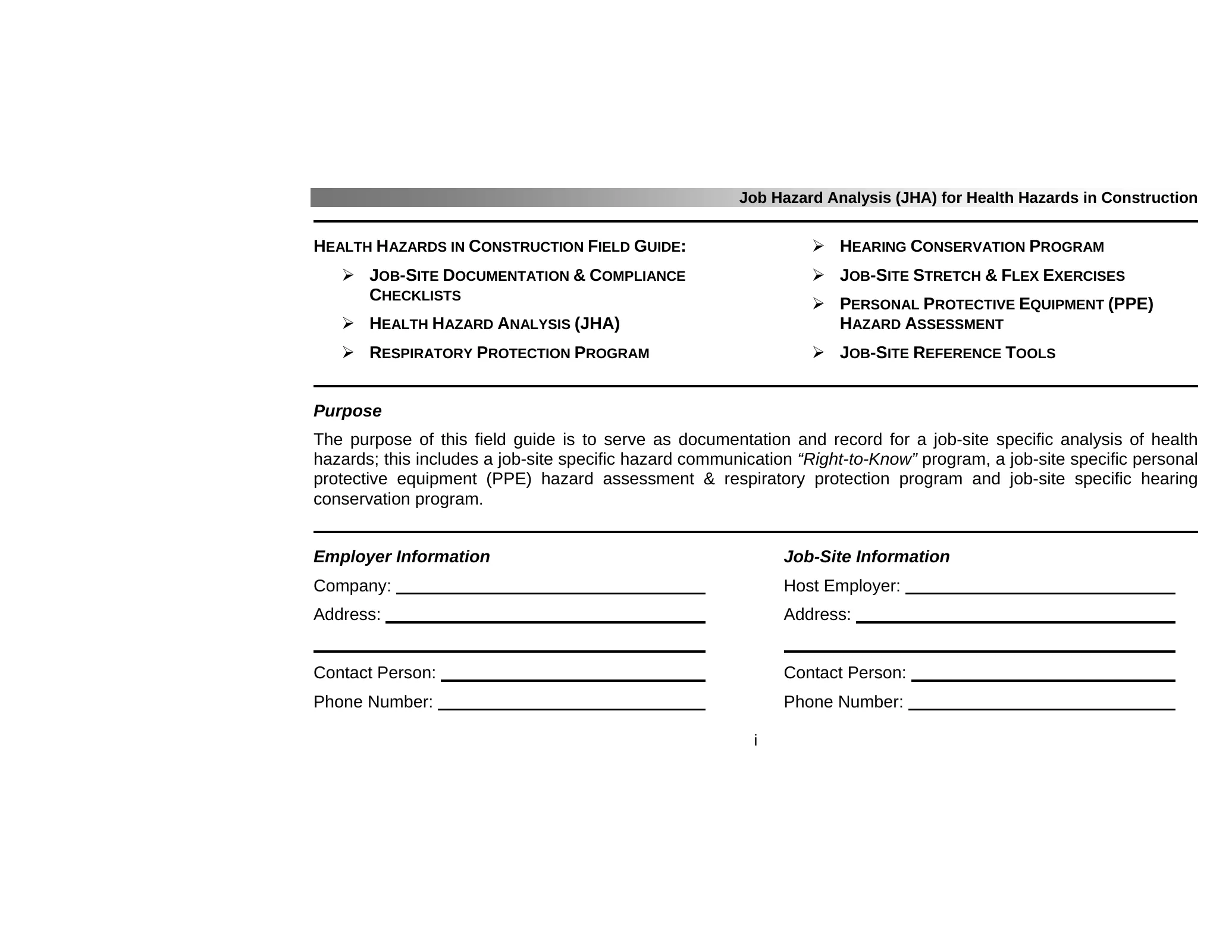
1 / 97Use ← → to flip
Health Hazards in Construction Field Guide
Construction Safety Council pocket field guide (97 pages) on construction health hazards.
Page text
· 97 pages · by Construction Safety Council
The words on each page as the author wrote them, read from the file by software so they can be searched. Layout, pictures and tables are not shown here, and long pages are shortened: the pages above and the download are the original.
- Page 1
HEARING CONSERVATION PROGRAM
- Job Hazard Analysis (JHA) for Health Hazards in Construction
- HEALTH HAZARDS IN CONSTRUCTION FIELD GUIDE :
- JOB -SITE DOCUMENTATION & COMPLIANCE
- C HECKLISTS
- JOB -SITE STRETCH & FLEX EXERCISES
- HEALTH HAZARD ANALYSIS (JHA)
- PERSONAL PROTECTIVE EQUIPMENT (PPE)
- H AZARD A SSESSMENT
- …
- Page 2
Credits & Disclaimer
- This publication was produced by:
- Construction Safety Council
- 4100 Madison Street
- Hillside, IL 60162
- (800) 552-7744
- www.buildsafe.org
- Copyright © 2012
- GENERAL DISCLAIMER
- This material is not a substitute for any provision of the Occupational Safety and Health Administration (OSHA) or any…
- …
- Page 3
Table of Contents
- Page #
- Page #
- Job-Site Responsibility & Authority
- Units of Concentration & Measurement
- Workers’ Rights under OSHA Law
- Occupational Health & Environmental Controls
- Job-Site Complaint Documentation
- Hazard Communication Program
- Filling an OSHA Complaint
- JHA Worksheet (Hazard Anticipation)
- …
- Page 4
Table of Contents
- Page #
- Page #
- Respiratory Protection Program – Selection Guide 48
- Hazard Communication Symbols
- Medical Evaluation
- Hazard Symbols & Classes
- Fit Testing
- Physical Hazards Classification
- User Seal Check
- Health Hazards Classification
- Employee Training & Limitations of Use
- …
- Page 5
Job-Site Responsibility & Authority
- Qualified & Competent Person
- An employer has the responsibility to anticipate, recognize, evaluate, and control workplace conditions that may cause workers' injury or illness. To ensure a safe and healthful job-site, a qualified and competent person must be identified by…
- …
- Page 6
Job-Site Responsibility & Authority
- A qualified person is one who, by possession of a recognized degree, certificate, or professional standing, or who by extensive knowledge, training, and experience, has successfully demonstrated his ability to solve or resolve problems relating to the subject matter, the…
- …
- Page 7
Workers’ Rights under OSHA Law
- All employees must be informed of their rights under OSHA (Occupational Safety & Health Administration) laws.
- EMPLOYEES:
- You have the right to notify your employer or OSHA about workplace hazards. You may ask OSHA to keep your name confidential.
- …
- Page 8
Workers’ Rights under OSHA Law
- EMPLOYERS:
- Employers have the responsibility to provide a safe workplace. Employers MUST provide their employees with a workplace that does not have serious hazards and follow all OSHA safety and health standards.
- …
- Page 9
Workers’ Rights under OSHA Law
- Right to Know about Chemical Hazards
- The Hazard Communication standard, known as the “right-to-know” law, requires employers to inform and train workers about hazardous chemicals and substances in the workplace. Employers must:
- …
- Page 10
Workers’ Rights under OSHA Law
- Right to Exposure Data
- Many OSHA standards require employers to run tests of the workplace environment to find out if their workers are being exposed to hazards such as toxic chemicals, hazardous substances such as lead or asbestos or high levels of noise or radiation. …
- …
- Page 11
The employee has asked the employer to eliminate the danger, and the employer failed to do so; and
- Job-Site Complaint Documentation
- Workers have the right to refuse to do a job if they believe in good faith that they are exposed to an imminent danger. …
- …
- Page 12
Filing an OSHA Complaint
- A complaint can be filed in a number of ways:
- 1. Mail or submit the OSHA Complaint Form - Download the OSHA complaint form from our website (or request a copy from your local OSHA Regional or Area Office), complete it and then fax or mail it back to your nearest OSHA Regional or Area…
- …
- Page 13
Ask your employer/host employer (controlling contractor) to correct the hazard;
- Filing an OSHA Complaint
- When all of these conditions are met, you take the following steps:
- Ask your employer/host employer (controlling contractor) for other work;
- …
- Page 14
Job Hazard Analysis (JHA) Overview
- A job hazard analysis (JHA) is a technique that focuses on the relationship between the worker, the task, the tools, and the work environment; it’s an essential first step that helps an employer determine the sources of potential problems.
- …
- Page 15
Job Hazard Analysis (JHA) Overview
- What do you see?
- Visible material in the air – Visible clouds of vapor or particles may mean a serious exposure problem. Remember, however, that most gases and vapors are invisible, and that often the most dangerous particles are too small to see.
- …
- Page 16
Job Hazard Analysis (JHA) Overview
- Do you hear anything?
- Loud noise can severely damage your hearing!
- Sources of loud noise in construction:
- Hand tools (e.g., metal hammers)
- Power tools (e.g., jackhammers, grinders, saws, powder actuated
- tools)
- Equipment (e.g., generators, excavators, cranes, trucks)
- Blasting
- …
- Page 17
Immediately Dangerous to Life & Health Environments (IDLH)
- A work environment that poses an immediate or delayed threat to an employee’s life and health or that would cause irreversible adverse health effects or that would interfere with an individual's ability to escape unaided from a space is considered to…
- …
- Page 18
Apprise the contractor of the hazards identified and the host employer’s experience with the space.
- Confined & Enclosed Spaces
- "Confined or enclosed space" means any space having a limited means of egress, which is subject to the accumulation of toxic or flammable contaminants or has an oxygen deficient…
- …
- Page 19
Flammable gas, vapor, or mist in excess of 10 percent of its lower flammable limit (LFL).
- Hazardous Atmospheres
- Employees must not be permitted to work in hazardous and/or toxic atmospheres! A hazardous atmosphere means an atmosphere that may expose employees to the risk of death, incapacitation, impairment…
- …
- Page 20
Lower Flammable Limit (LFL)
- Flammable & Explosive Environments
- Flammable limits are defined as the concentration range in which a flammable substance can produce a fire or explosion when an ignition source (such as a spark or open flame) is present. …
- …
- Page 21
Permissible Exposure Limits (PEL) – OSHA
- Occupational Safety & Health Administration (OSHA)
- OSHAs health standards relating to exposure to gases, vapors, fumes, dusts/fibers and mists; noise and radiation, are based on established exposure limits. …
- …
- Page 22
Threshold Limit Values (TLV®) – ACGIH
- The American Conference of Governmental Industrial Hygienists (ACGIH)
- Since the early 1900’s, the ACGIH has been investigating, recommending, and annually reviewing exposure limits for chemical substances. …
- …
- Page 23
CHEMICAL HAZARDS
- Recommended Exposure Limits (REL) – NIOSH
- National Institute for Occupational Safety and Health (NIOSH)
- NIOSH is a Federal agency established to help assure safe and healthful working conditions for working men and women by providing research, information, education, and training in the field…
- …
- Page 24
Additional Exposure Limits – TWA, AL, C & STEL
- Time Weighted Average (TWA)
- The 8-Hour Time Weighted Average (TWA) is the average employee exposure over an 8-hour period, based on chemical measurements close to the worker. …
- …
- Page 25
Concentration
- Exposure Limit Comparison Chart
- STEL
- C – (Ceiling) Never to be exceeded.
- PEL – Enforceable by OSHA
- TLV – Not enforceable by OSHA REL – Not enforceable by OSHA
- Time
- ZERO
- “0”
- TLV® & REL
- PEL
- IDLH
- Increasing Concentrations
- LFL
- Page 26
Chemical Hazards Routes of Entry
- Inhalation is the primary route of entry for hazardous chemicals in the work environment. Nearly all materials that are airborne can be inhaled. The smallest, respirable size particles can be inhaled deep into the alveoli; the final branch of the respiratory system that acts…
- …
- Page 27
Environmental & Personal Air Monitoring Devices
- Indicates that user is being exposed to high levels of noise. Real time instant reading;
- used
- as a personal alarm.
- Used to determine an average exposure over a period of time (time weighted average).
- Samples taken in the “breathing zone” of the employee.
- …
- Page 28
1 x 10 -6 or .000001
- Units of Concentration & Measurement
- (ppm)
- (mg/m³)
- (µg/m³)
- (f/cc)
- (dB)
- Parts per Million
- Milligrams per Cubic
- Meter of Air
- Micrograms per Cubic
- Fibers per Cubic Centimeter of Air
- Decibel
- Used to express the amount of a gas or vapor; one part of a gas or vapor per million parts of air.
- …
- Page 29
Occupational Health & Environmental Controls Checklist
- Medical Services & First Aid (29 CFR 1926.50)
- Medical personnel available for advice and consultation on matters of occupational health.
- Provisions made for prompt medical attention in case of serious injury.
- …
- Page 30
First Aid Kits (Appendix A to § 1926.50)
- Occupational Health & Environmental Controls Checklist
- Minimal contents of a generic first aid kit as described in American National Standard (ANSI) Z308.1
- Minimum Size or Volume
- Quantity per
- Package
- Unit
- Package
- Size
- Item
- Package
- Unit
- Package
- Size
- Absorbent compress
- …
- Page 31
Occupational Health & Environmental Controls Checklist
- Sanitation of Job-Sites (29 CFR 1926.51)
- An adequate supply of potable water (drinking water) must be provided in all
- places of employment.
- Portable containers used to dispense drinking water must be capable of being
- …
- Page 32
WARNING
- Occupational Health & Environmental Controls Checklist
- Washing Facilities [29 CFR 1926.51(f)]
- Adequate washing facilities provided for employees engaged in the application of paints, coatings, herbicides, or insecticides or in other operations where contaminants may be harmful to the employees.
- …
- Page 33
Hazard Communication Program & Compliance Checklist
- Hazard Communication [29 CFR 1926.59 (see 29 CFR 1910.1200)]
- A job-site hazard communication program is to ensure that the hazards of all chemicals handled are communicated to employees and others that may be exposed either through routine handling or as a…
- …
- Page 34
Safety Data Sheets (SDSs):
- Hazard Communication Program & Compliance Checklist
- In order to ensure that a current SDS for each chemical is on the job-site as required, and that employees have access to these SDSs, the following information must be in your written program:
- …
- Page 35
Hazard Communication Program & Compliance Checklist
- Employee Training (Hazard Communication):
- All employees know the location and requirements of the Federal Hazard Communication Standard,
- 29 CFR 1926.59 (see 29 CFR 1910.1200).
- All employees know the location and availability of the company's written hazard…
- …
- Page 36
Hazard Communication Program & Compliance Checklist
- Information:
- I have been informed of the new Hazard Communication Standard (29 CFR 1910.1200) requirements.
- I have been informed of the operations in my work area where hazardous chemicals are present.
- …
- Page 37
JHA Worksheet (Hazard Anticipation)
- Chemical Health Hazards Found on Job-Site (Check all that Apply):
- Gases
- Vapors
- Fumes
- Dusts
- Fibers
- Mists
- Physical Health Hazards Found on Job-Site (Check all that Apply):
- Temperature
- Noise
- Repetitive Motion & Awkward Postures
- Radiation
- …
- Page 38
Is there a safe alternative? Yes/No (If yes, describe:
- JHA Worksheet (Hazard Identification)
- Description of Health Hazard:
- Gas
- Vapor
- Fume
- Noise
- Radiation
- Other ___
- C.A.S #
- PEL:
- Flash Point (FP)
- TLV:
- REL:
- Dust/Fiber
- Mist
- Fungi (Mold)
- Vapor/Gas Density
- Lower Flammable Limit (LFL)
- AL:
- STEL:
- C:
- …
- Page 39
JHA Worksheet (Hazard Evaluation)
- Health Hazard Route of Entry(s)
- Inhalation Ingestion
- Absorption Injection
- Ears (Noise)
- Other
- Environmental & Personal Air Monitoring:
- Air monitoring does not measure you or what you are doing, but rather what you are exposed to on the job.
- …
- Page 40
Dust suppression (wet methods):
- JHA Worksheet (Engineering Control Options)
- Engineering Controls (Select engineering controls to be implemented):
- Dust collection systems (vacuum):
- General (dilution) ventilation; works best when air contaminants are widely disbursed through the area.
- …
- Page 41
JHA Worksheet (Administrative Control Options)
- Administrative Controls (used with personal protective equipment):
- Gather all specialty equipment, including, ventilators, warning signs, personal protective equipment, etc. (list all specialty equipment needed for job):
- …
- Page 42
workplace to identify and control physical and Attend training sessions on PPE.
- JHA Worksheet (Personal Protective Equipment)
- Employer Obligations
- Worker Responsibility:
- Perform a “hazard assessment” of the Properly wear PPE.
- health hazards.
- Care for, clean and maintain PPE.
- …
- Page 43
JHA Worksheet (Personal Protective Equipment)
- Controlling a hazard at its source is the best way to protect workers. However, when engineering, work practices and administrative controls are not feasible* or do not provide sufficient protection, employers must provide personal protective equipment (PPE) to…
- …
- Page 44
7A.CHIPPING GOGGLES, Eyecup Type, Clear Safety Lenses (Not Illustrated) **11. WELDING HELMETS
- Eye & Face Protector Selection Guide
- Table E-1. Eye and Face Protector Selection Guide
- 1. GOGGLES, Flexible Fitting, Regular Ventilation
- 2. GOGGLES, Flexible Fitting, Hooded Ventilation
- …
- Page 45
Eye & Face Protector Selection Guide
- Applications
- Operation
- Recommended Protectors: Numbers
- Signify Preferred Protection
- Hazards
- Acetylene – Burning, Acetylene – Cutting, Acetylene – Welding
- Sparks, harmful rays, molten metal, flying particles
- 7, 8, 9
- Chemical Handling
- Splash, acid burns, fumes
- …
- Page 46
Filter Lens Shade Number for Protection Against Radiant Energy
- Table E-2: Filter Lens Shade Number for Protection against Radiant Energy
- Welding Operation
- Shade Number
- Shielded metal-arc welding 1/16-, 3/32-, 1/8-, 5/32-inch diameter electrodes
- …
- Page 47
Chemical Resistant Gloves Types & Definitions
- Chemical-resistant gloves are made with different kinds of rubber: natural, butyl, neoprene, nitrile and fluorocarbon (viton); or various kinds of plastic: polyvinyl chloride (PVC), polyvinyl alcohol and polyethylene. …
- …
- Page 48
Respiratory Protection Types & Definitions
- Use only NIOSH (National Institute for Occupational Safety & Health) approved respirators.
- Filtering Facepiece
- Air-Purifying Respirator
- Powered Air-Purifying
- Respirator
- Self-Contained Breathing
- Apparatus (SCBA)
- …
- Page 49
Respiratory Protection Program – Compliance Checklist
- The allowable use of a respirator depends on certain circumstances; two scenarios in which an employee may wear a respirator are:
- 1. Employee must wear a respirator due to job-site conditions; if concentrations of airborne contaminants cannot be…
- …
- Page 50
Respiratory Protection Program – Decision Flow Chart
- Start
- Is respirator use necessary to protect the health of an employee or required by the employer?
- No
- Is respirator use voluntary?
- Yes
- Yes
- Is the respirator an approved elastomeric type (NIOSH Certified)?
- Yes
- No
- Respirator program must include (See 29 CFR
- …
- Page 51
Determine whether respirators are required due to hazards in the work environment.
- Respiratory Protection Program – Needs Assessment
- An effective respiratory protection program needs to be able to perform the following key functions:
- Identify which respirator will be needed to provide the best protection.
- …
- Page 52
Respiratory Protection Program – Selection Guide
- The appropriate respirator will depend on the contaminant(s) to which you are exposed and the protection factor (PF) required. Required respirators must be NIOSH-approved and medical evaluation, fit testing and training must be provided before use.
- …
- Page 53
Respiratory Protection Program – Selection Guide
- The appropriate respirator will depend on the contaminant(s) to which you are exposed and the protection factor (PF) required. Required respirators must be NIOSH-approved and medical evaluation, fit testing and training must be provided before use.
- …
- Page 54
Demand mode
- Respiratory Protection Program – Selection Guide
- Table 1. (29 CFR 1910.134) -- Assigned Protection Factors 5
- Type of respirator 1 , 2
- Air-Purifying Respirator
- Powered Air-Purifying Respirator
- (PAPR)
- Supplied-Air Respirator (SAR) or Airline Respirator
- Continuous flow mode
- Pressure-demand or other
- …
- Page 55
Notes for Table 1. (29 CFR 1910.134) -- Assigned Protection Factors 5
- Respiratory Protection Program – Selection Guide
- Employers may select respirators assigned for use in higher workplace concentrations of a hazardous substance for use at lower concentrations of that substance, or when required respirator…
- …
- Page 56
Particulate Air Filter Use Description
- Respiratory Protection Program – Selection Guide
- Respirator cartridges and filters are made to protect against a variety of vapors, gases, fumes, dusts, fibers and mists. The type of cartridge/filter used is based on a particular hazard. …
- …
- Page 57
Respiratory Protection Program – Selection Guide
- Dust & Fiber Respirator Selection Guide
- Hazard
- Efficiency
- Comments
- Silica
- 100 (HEPA)
- Atmosphere supplying respirators may be required.
- Asbestos
- 100 (HEPA)
- Requires specific respirators to be used based on task and exposure level. …
- …
- Page 58
Respiratory Protection Program – Medical Evaluation
- The medical evaluation is performed in one of two manners. First, a confidential questionnaire (Appendix C of the Respirator Standard, 29 CFR 1910.134) can be given during work hours or at a time and location convenient for the workers. …
- …
- Page 59
The qualitative fit test is done using a taste test (saccharin or Bitrex ® ), an
- Respiratory Protection Program – Fit Testing
- There are four methods of fit testing qualitatively (pass/fail) and three methods quantitatively (measures actual fit). …
- …
- Page 60
May use qualitative fit test or quantitative fit test.
- Respiratory Protection Program – Fit Testing
- Any half mask air purifying respirator (disposable or elastomeric):
- Maximum Assigned Protection Factor (APF) = 10
- Full face elastomeric air purifying respirator:
- Must use quantitative fit test.
- …
- Page 61
Respiratory Protection Program – User Seal Check
- Prior to wearing a respirator, a seal check is performed to make sure a good seal is obtained. Seal checks are done both negatively and positively.
- To perform a negative pressure seal check; cover the inlets to the filters or cartridges, and inhale to cause the…
- …
- Page 62
Respiratory Protection Program – Employee Training & Limitations of Use
- Employee Training
- A program administrator must be appointed by the employer to ensure the proper administration of an effective respiratory protection program. This person will ensure the following:
- …
- Page 63
Respiratory Protection Program – Respirators Used when Not Required
- Appendix D to Sec. 1910.134 (Mandatory) – Information for Employees Using Respirators When Not Required Under the Standard
- Respirators are an effective method of protection against designated hazards when properly selected and worn. …
- …
- Page 64
Respiratory Protection Program – Cleaning & Disinfecting Guide
- The manufacturer’s guidance for cleaning and sanitizing a respirator should always be followed and is included with the packaging of all products. If you do not have access to that copy, check the manufacturer’s web site. …
- …
- Page 65
Hearing Conservation Program
- The Occupational Safety and Health Administration (OSHA) has determined that an effective hearing conservation program consists of the following elements:
- 1. Monitoring of employee noise exposures; (e.g., frequent and regular inspecton of the job-site is required by competent…
- …
- Page 66
OSHA Permissible Noise Exposures
- Employers have the responsibility to protect against the effects of noise exposure when the sound levels exceed those shown in Table D-2 of 29 CFR 1926.52 when measured on the A-weighted scale of a standard sound level meter at slow response.
- …
- Page 67
Engineering & Administrative Controls for Noise
- Contractors can analysis jobs, tasks and equipment; once loud operations are identified, employers can then seek out alternative tools and equipment that are less noisy (eliminate the hazard).
- Enclose equipment operators inside cabs.
- …
- Page 68
A hearing protector's ability to reduce noise is its Noise
- Noise Reduction Rating (NRR)
- The Noise Reduction Rating (NRR) is the measurement, in decibels (dB), of how well a hearing protector reduces noise. The higher the NRR number the greater the noise reduction. …
- …
- Page 69
Noise Reduction Rating (NRR)
- NIOSH NRR Adjustment
- NIOSH recommends the following NRR adjustment:
- Subtract 25% from the manufacturer’s adjusted NRR.
- Earmuffs
- (Listed NRR – 7) x .75 = NIOSH Recommended Adjustment
- Subtract 50% from the manufacturer’s adjusted NRR.
- Formable Ear Plugs
- …
- Page 70
Noise Reduction Rating (NRR)
- Dual Hearing Protection
- Workers whose 8-hour time weighted average exposures exceed 100 decibels should wear double hearing protection (wearing earplugs and earmuffs simultaneously).
- NOTE: The term "double hearing protection" is misleading. The attenuation provided from any…
- …
- Page 71
Relative Humidity (%)
- NOAA’s National Weather Service Heat Index NOAA (National Oceanic and Atmospheric Administration)
- Heat Index
- Temperature (ºF)
- Likelihood of Heat Disorders with Prolonged Exposure or Strenuous Activity
- Caution
- Extreme Caution
- Danger
- Extreme Danger
- Page 72
LOW TEMPERATURE + WIND SPEED + WETNESS
- OSHA Cold Stress Equation
- THE COLD STRESS
- 30°F / -1.1°C
- 0 10 20 30 40
- 20°F / -6.7°C
- 10°F / -12.2°C –
- 0°F / -17.8°C
- Adapted from: ACGIH® Threshold Limit Values, and Physical Agents Biohazard Indices,
- 1998 – 1999.
- Freezing to Exposed
- Flesh within 30
- Extreme Danger
- …
- Page 73
Pre-Work Stretch & Flex Exercises
- WARNING: Before beginning any stretching program, check with your healthcare provider. If you question any of the following stretches, or feel any discomfort while doing any of these stretches, stop immediately and check with your healthcare provider before continuing.
- …
- Page 74
Pre-Work Stretch & Flex Exercises
- WARNING: Before beginning any stretching program, check with your healthcare provider. If you question any of the following stretches, or feel any discomfort while doing any of these stretches, stop immediately and check with your healthcare provider before continuing.
- Legs
- …
- Page 75
Pre-Work Stretch & Flex Exercises
- WARNING: Before beginning any stretching program, check with your healthcare provider. If you question any of the following stretches, or feel any discomfort while doing any of these stretches, stop immediately and check with your healthcare provider before continuing.
- …
- Page 76
Personal Protective Equipment (PPE) Hazard Assessment
- Name of job-site:
- Assessment conducted by:
- Work place address:
- Date of Assessment:
- Work area(s):
- Job/Task(s):
- Work Activity:
- Hazardous Exposure:
- Controls:
- Sawing
- Gas
- Fungi (Mold)
- Grinding
- Vapor
- Noise
- Can hazard be eliminated without the use of PPE? Yes No
- …
- Page 77
Globally Harmonized System Pictograms
- Hazard Communication Symbols
- Gas
- This is the symbol that will appear on chemicals that are; gases under pressure, compressed gases, liquefied gases, refrigerated liquefied gases, dissolved gases.
- Aquatic Hazard
- …
- Page 78
Globally Harmonized System Pictograms
- Hazard Communication Symbols
- Oxidizer
- This is the symbol that will appear on chemical that will release oxygen or behave like oxygen in a chemical reaction; causing a greater fire and explosion.
- Irritant & Sensitizer
- …
- Page 79
Flame Flame Over Circle
- Hazard Symbols & Classes
- Hazard Class is the nature of the physical or health hazard, e.g., flammable solid, carcinogen, oral acute toxicity.
- Exclamation
- Mark
- Exploding
- Bomb
- Flammables
- Oxidizers
- Irritant
- Explosives
- Self Reactives
- Dermal Sensitizer
- Pyrophorics
- Acute Toxicity
- (Harmful)
- …
- Page 80
Corrosion Gas Cylinder Health Hazard Skull & Crossbones
- Hazard Symbols & Classes
- Hazard Class is the nature of the physical or health hazard, e.g., flammable solid, carcinogen, oral acute toxicity.
- Corrosives
- Gases Under
- Pressure
- Carcinogen
- Acute Toxicity
- (Severe)
- Respiratory Sensitizer
- Reproductive Toxicity
- …
- Page 81
Physical Hazards Classification
- Hazard Category is the division of criteria within each hazard class.
- Hazard Class
- Hazard Category
- Unstable Explosive
- Div 1.1
- Flammable Gases
- Flammable Aerosols
- Oxidizing Gases
- Explosive
- Div 1.2
- Div 1.3
- Div 1.4
- Div 1.5
- Div 1.6
- Type E
- Type F
- Type G
- Gases under Pressure
- …
- Page 82
Physical Hazards Classification
- Hazard Category is the division of criteria within each hazard class.
- Hazard Class
- Hazard Category
- Pyrophoric Liquids
- Pyrophoric Solid
- Pyrophoric Gases
- Single
- Category
- Self-Heating Chemicals
- Chemicals, which in contact with water, emit flammable gases
- Oxidizing Liquids
- …
- Page 83
Health Hazards Classification
- Hazard Category is the division of criteria within each hazard class.
- Hazard Class
- Hazard Category
- Acute Toxicity
- Skin Corrosion/Irritation
- 1A
- 2A
- 1C
- Serious Eye Damage/Eye
- Irritation
- 2A
- 2B
- Respiratory or Skin
- Sensitization
- Germ Cell Mutagenicity
- 1A
- 1B
- Carcinogenicity
- 1A
- 1B
- …
- Page 84
Health Hazards Classification
- Hazard Category is the division of criteria within each hazard class.
- Hazard Class
- Hazard Category
- STOT* – Single Exposure
- STOT* – Repeated
- Aspiration
- Simple Asphyxiants
- Single Category
- STOT - Specific Target Organ Toxicity
- Environmental Hazards Classification
- …
- Page 85
Container Labeling Requirements
- Page 86
Symbols for Sources of Radiant Energy
- Ionizing Radiation
- Ionizing radiation is energy in the form of waves or particles that has enough force to remove electrons from atoms. This process is known as radioactive decay. …
- …
- Page 87
Hazardous Materials Identification System
- HMIS
- (Hazardous
- Materials
- Identification System), developed by the National Paint and Coatings
- Association (NPCA), is a numerical hazard rating that incorporates the use of labels with color-coded bars.
- A special
- code
- identifying
- …
- Page 88
Red Blue
- NFPA 704M
- HEALTH HAZARD
- FIRE HAZARD – Flash Point
- 4 – Deadly
- 3 – Extreme Danger
- 2 – Hazardous
- 1 – Slightly Hazardous
- 0 – Normal Material
- 4 – Below 73°F
- 3 – Below 100°F 2 – Below 200°F 1 – Above 200°F 0 – Will Not Burn
- REACTIVITY
- SPECIFIC HAZARD
- 4 – May Detonate
- 3 – Shock and Heat May
- Detonate
- …
- Page 89
ACGIH ®
- List of Acronyms
- American Conference of Governmental Industrial Hygienists
- AIHA
- American Industrial Hygiene Association, Fairfax, Virginia. The broad professional association for Industrial Hygienists in the U.S. and Canada, with local sections also in parts of Europe. …
- …
- Page 90
List of Acronyms
- CFC
- Chlorofluorocarbons, being phased out worldwide because of their detrimental effect on the ozone layer.
- CFM
- Cubic feet per minute, a unit of measure of air flow which is used in evaluating ventilation systems.
- CFR
- …
- Page 91
recognized group of agents is present in excess of a PEL or TLV ® .
- List of Acronyms
- HAZMAT
- Hazardous Material
- HAZWOPER
- Hazardous Waste Operations and Emergency Response, a term derived from U.S. EPA regulations.
- HEPA filter
- High-Efficiency Particulate Air filter. At least 99.97% efficient in the filtration…
- …
- Page 92
List of Acronyms
- MSDS
- Material Safety Data Sheet. See SDS (Safety Data Sheet).
- MSHA
- Mine Safety and Health Administration. An agency of the US Department of Labor.
- NFPA
- National Fire Protection Association. Publishes useful hazard ratings on many chemicals.
- NIH
- …
- Page 93
List of Acronyms
- REL
- Recommended Exposure Limit. This abbreviation usually refers to a recommendation formally made by NIOSH and published in a Criteria Document for a particular agent or category of agents.
- RTK
- Right to Know. May refer to an individual employee's right to know about the nature and hazards of…
- …
- Page 94
Job-Site Employee Log
- Job-site Employee Log (Add Names as Necessary)
- Employee Name:
- Notification of Rights
- HazCom
- Trained
- Respirator Use
- Authorized
- Fitted for Hearing
- Protection
- Fit for Duty
- Date___
- Date___
- Date___
- Date___
- Date___
- Date___
- Date___
- Date___
- Date___
- Date___
- Date___
- Date___
- Date___
- Date___
- Date___
- …
- Page 95
Job-Site Employee Log
- Job-site Employee Log (Add Names as Necessary)
- Employee Name:
- Notification of Rights
- HazCom
- Trained
- Respirator Use
- Authorized
- Fitted for Hearing
- Protection
- Fit for Duty
- Date___
- Date___
- Date___
- Date___
- Date___
- Date___
- Date___
- Date___
- Date___
- Date___
- Date___
- Date___
- Date___
- Date___
- Date___
- …
- Page 96
Health Hazards Resources
- Publications
- Bertinuson, J., & Weinstein, S. (1978). Occupational Health Hazards of Construction – A manual for Building Trades Apprentices. U.S. Labor Occupational Health Program.
- Plog, B. A., Niland, J., & Quinlan. P. J. (1996). Fundamentals of Industrial Hygiene (Fourth Edition). …
- …
- Page 97
Construction Safety Council Training & Services
- Our Mission... The Construction Safety Council is dedicated to the elimination of the tragic and costly accidents, injuries and illnesses that take the lives of construction men and women in the United States every day.
- Training & Education
- …
More on Health Hazards
pptx
83 slidesCarbon Monoxide & Inhalation Hazards
Carbon monoxide and inhalation hazards on construction sites (gas-powered tools, enclosed spaces) from Western Iowa Tech Community College.
Western Iowa Technical Community CollegeOSHA Harwood grant
pptx
18 slidesRespiratory Protection
Respiratory protection instructor deck from the University of Puerto Rico Medical Sciences Campus.
University of Puerto Rico Medical Sciences CampusOSHA Harwood grant
pptxes
18 slidesProtección respiratoria
Spanish respiratory protection instructor deck.
University of Puerto Rico Medical Sciences CampusOSHA Harwood grant