1 / 63Use ← → to flip
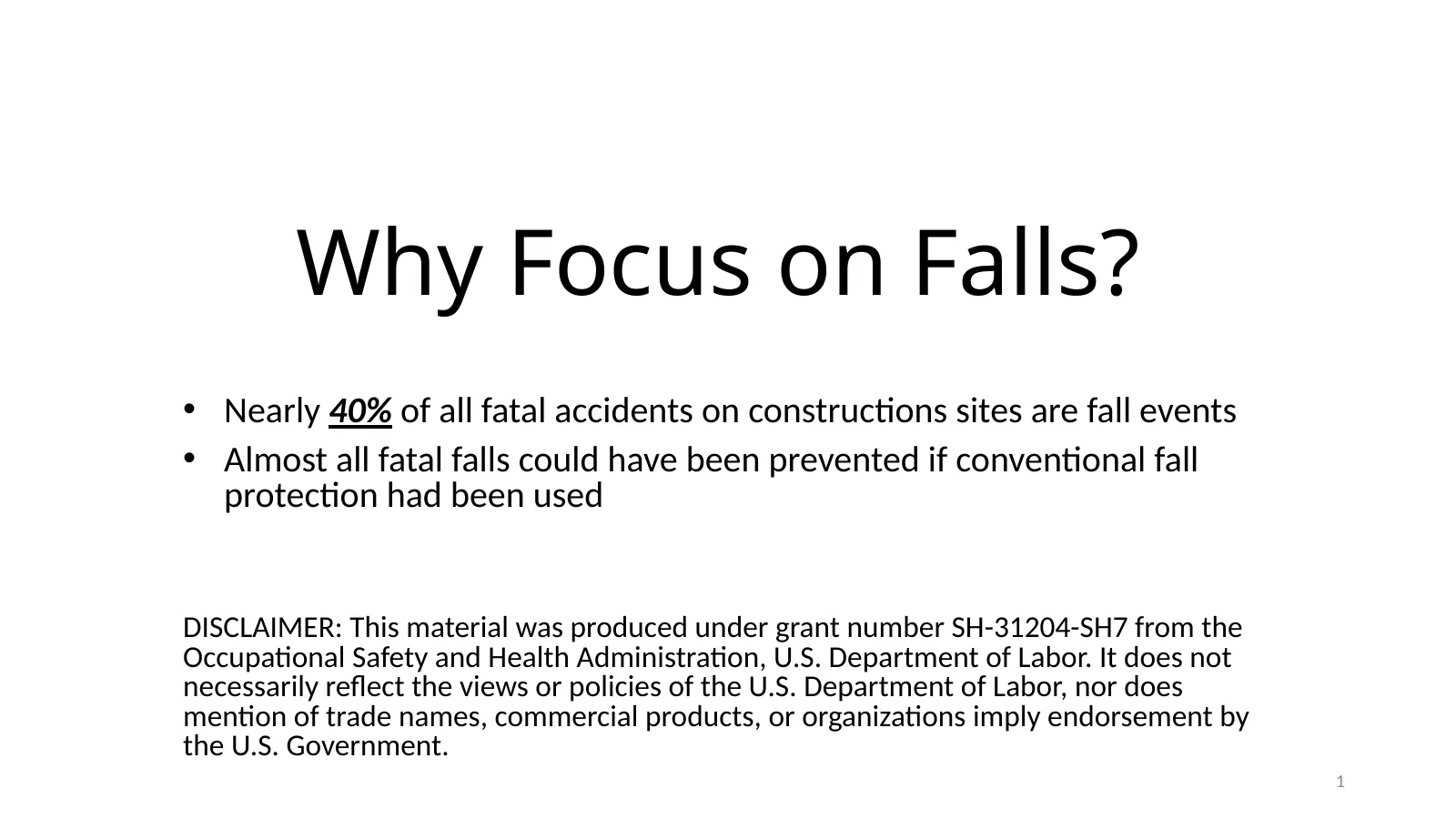
Why Focus on Falls?
Construction fall prevention deck covering roof, ladder, scaffold, aerial lift and floor-opening falls. Well sized for the 90-minute falls block.
Slide text
· 63 slides · by University of Tennessee
The words on each slide as the author wrote them, read from the file by software so they can be searched. Layout, pictures and tables are not shown here: the slides above and the download are the original.
- Slide 1
Why Focus on Falls?
- Nearly 40% of all fatal accidents on constructions sites are fall events
- Almost all fatal falls could have been prevented if conventional fall protection had been used
- DISCLAIMER: This material was produced under grant number SH-31204-SH7 from the Occupational Safety and Health Administration, U.S. Department of Labor. It does not necessarily reflect the views or policies of the U.S. Department of Labor, nor does mention of trade names, commercial products, or organizations imply endorsement by the U.S. Government.
- Slide 2
What is Conventional Fall Protection?
- Guardrail systems
- Safety net systems
- Personal fall arrest systems (PFAS)
- Slide 3
The Components of a Personal Fall Arrest System
- Slide 4
When to Use Conventional Fall Protection
- The 6 Foot Rule…
- Any location when a 6 foot fall could occur Use Fall Protection
- Roofs
- Structures
- Towers
- Power Poles
- Any leading edge, walking, or working surface of a 6 foot height
- Exceptions:
- Scaffolding (10 feet)
- Steel Work (15 feet)
- When the employer can demonstrate that it is infeasible or creates a greater hazard to use these systems, THEN the employer must develop and implement a fall protection plan which meets the requirements of 29 CFR 1926.502(k).
- Slide 5
Competent vs. Qualified Person
- 29 CFR 1926.32(f) states: "Competent person" means one who is capable of identifying existing and predictable hazards in the surroundings or working conditions, which are unsanitary, hazardous, or dangerous to employees, and who has authorization to take prompt corrective measures to eliminate them.
- 29 CFR 1926.32(l) states: "Qualified" means one who, by possession of a recognized degree, certificate, or professional standing, or who by extensive knowledge, training and experience, has successfully demonstrated his ability to solve or resolve problems relating to the subject matter, the work, or the project.
- Slide 6
Categories of Falls
- 1. Roofing/Structure Falls
- 2. Ladder Falls
- 3. Scaffolds/Platform Falls
- 4. Bucket/Aerial Lift Falls
- 5. Fall though Opening
- Slide 7
I. Roofing/Structures
- Photos of slipping and sliding off a roof without fall protection
- Slide 8
I. Roofing/Structures
- Low Sloped Roof
- Low Sloped Roof (Not greater than 4 in 12)
- Guardrail system
- Safety net system
- Personal fall arrest system
- A combination of conventional fall protection systems and warning line systems, or
- A warning line system and a safety monitoring system.
- Slide 9
I. Roofing/Structures
- High Sloped Roofs
- High Sloped Roofs (Greater than 4 in 12)
- Guardrail systems with toe boards,
- Safety net systems, or
- Personal fall arrest systems.
- Slide 10
I. Roofing/Structures
- Walking and Working Surfaces
- Guard all hazards – any potential places for a fall – holes, edges, trips.
- Area should be clean and dry.
- Inspect the area regularly.
- Use the appropriate fall protection.
- Train and re-train as needed.
- Slide 11
I. Roofing/Structure
- Case Study Background
- Roofing/Structure Fall Case Study
- Jones Roofing
- Company is in South
- 27 years in the roofing business
- 4 Employees and Owner/Supervisor
- Specializing in Roof Replacements (Commercial or Residential)
- Note: All names (employee and company) have been changed
- Slide 12
I. Roofing/Structure
- Narrative
- Roofing/Structure Fall Case Study
- Narrative of the event:
- On a Friday morning (10:30 am) in the month of October three employees were working on a 4:12 re-roofing operation of a two-story apartment building. The three employees (Johnny, Tommy, and Billy) were on the roof putting down chalk lines as guides prior to installing shingles. They had already marked the spacing and had “popped” the initial chalk lines at 11 inches from the bottom edge and then another 20 inches up from there. Johnny and Tommy were at each end of the chalk line and Billy was in the middle to “pop” the line on the tar paper covered roof.
- Before marking the third line the chalk line needed to be re-chalked. The line was reeled back and chalked. Then Tommy held the chalk box and Johnny walked backwards with the line in his hand. Tommy and Billy watched Johnny walk backwards towards the edge and then, while still backwards, walk off the roof and fall 19 feet to the ground below.
- Johnny passed away in the ambulance ride to the hospital.
- Slide 13
I. Roofing/Structure
- Site Pictures
- Roofing/Structure Fall Case Study
- Slide 14
I. Roofing/Structure
- What contributed to the event?
- Roofing/Structure Fall Case Study
- Contributing Factors…
- Slide 15
I. Roofing/Structure
- Contributing Factors
- Roofing/Structure Fall Case Study Contributing Factors
- No fall protection used
- No written safety and health plan (only verbal)
- Lack of attention to surroundings
- Lack of hazard training (no records)
- Slide 16
I. Roofing/Structure
- Citations
- Roofing/Structure Fall Case Study Penalties OSHA Violations
- No Safety and Health Program - 1926.20(b)(1)
- No Fall Protection – 1926.501(b)(11)
- Ladder not secured – 1926.1053(b)(8)
- No First-Aid/CPR Responder – 1926.50(c) Total
- 2018 Total (Inflation Adjusted)
- $225 $5,600 $375 $0 $6,200
- $11,456
- Slide 17
I. Roofing/Structure
- Quick Review
- What is wrong with this picture?
- Slide 18
I. Roofing/Structure
- Quick Review (Continued)
- What is wrong with this picture?
- Slide 19
II. Ladders
- Photos of a fall from a misstep on a ladder
- Slide 20
II. Ladders
- Requirements:
- When using ladders…
- Always have three points of contact when on ladder
- Extend 3 feet above landing
- Free from damage, wear, bending, etc.
- Watch for energy sources (power lines)
- Maintain the correct angle
- Use per the manufacturer requirements (No user modifications)
- Complete ladder training
- Slide 21
II. Ladders
- Case Study Background
- Ladder Fall Case Study
- USA Construction Company, Inc.
- Company is in South
- 20 years in the construction business
- 1000 Employees
- General Contractor – Commercial work
- Note: All names (employee and company) have been changed
- Slide 22
II. Ladders
- Narrative
- Ladder Case Study
- Narrative of the event:
- A USA Construction crew had been caulking and painting at an existing apartment complex. Charlie, a temporary labor service worker, had been assigned to paint guard rails located on the second level breezeway. Charlie had painted the inside section of the guard rail on the second level, but could not reach over the rail and paint the outside section. Charlie decided to use a ladder. He set it up in the breezeway ground floor landing area, which was about 10 feet below the guard rails. He climbed up the ladder and started painting the outside section. As Charlie was painting, the ladder feet slipped on the ground surface causing Charlie and the ladder to fall 10 feet. Charlie received several lacerations to his extremities and chest as well as multiple blunt force trauma. After a week in the hospital, Charlie passed away from complications caused by the trauma.
- The ladder Charlie had chosen was the top half of a 24 foot extension ladder. The bottom half was missing. The section he used did not have slip resistant feet on it.
- Slide 23
II. Ladders
- Site Pictures:
- Ladder Fall Case Study
- Slide 24
II. Ladders
- What contributed to the event?
- Ladder Case Study
- Contributing Factors…
- Slide 25
II. Ladders
- Contributing Factors
- Ladder Case Study
- Contributing Factors:
- Ladder did not have slip resistant feet
- Ladder not used per manufacturer’s design (separate parts)
- Victim was from a temporary labor service and had not been trained in hazard recognition.
- No ladder training
- Slide 26
II. Ladders
- Citations
- Ladder Case Study Penalties
- OSHA Violations
- Ladders were used for purposes other than designed for – 1926.1053(b)
- $6,300
- OSHA 300 Log/301 Logs (Not recording Injury) –
- 1904.29(b)
- $900
- Report death of employee within 8 hours –
- 1904.39(a)
- $4,500
- Total
- $11,700
- 2018 Total (Inflation Adjusted)
- $21,618 26
- Slide 27
II. Ladders
- Quick Review
- What is wrong with this picture?
- Slide 28
II. Ladders
- Quick Review (Continued)
- What is wrong with this picture?
- Slide 29
- III.
- Scaffolds/Platforms
- Photos of a collapsing mobile scaffold with two workers on top.
- Slide 30
III. Scaffolds/Platforms
- Requirements:
- Supported & Suspended Scaffolds:
- Use scaffolds according to the manufacturer’s instructions.
- Never overload a scaffold beyond its maximum rated capacity.
- Do not use makeshift methods to increase the working height of the scaffold platform (ladders, buckets or blocks).
- Employees must not work on platforms covered with snow, ice, or other slippery material.
- The employer must provide suitable access to and between scaffolds.
- Slide 31
III. Scaffolds/Platforms
- Requirements (Continued):
- Fall protection arrest system required (at 10 feet)
- Guardrail system is required
- Competent person for daily inspections
- Train, train, train!!
- Slide 32
III. Scaffolds/Platforms
- Case Study Background
- Scaffold/Platform Case Study
- Patch You Up Drywall
- Company is in Mid-West
- 10 years in the construction business
- 3 Employees
- Sub Contractor – Drywall residential work
- Note: All names (employee and company) have been changed
- Slide 33
III. Scaffolds/Platforms
- Narrative
- Scaffold/Platform Case Study
- Narrative of the event:
- Luke was taping drywall for a new large residential house. Luke could not reach the next section, so he used an extension ladder that he had placed on a 12 foot high scaffold. The scaffold was planked with one 19 inch metal sheet. Luke climbed approximately 4 feet up on the ladder, when the metal sheet slipped. This caused the ladder and scaffold to overturn. Luke fell from the ladder-scaffold combination and struck his head against several objects, as he fell to the concrete floor below. Luke was rushed to the nearest hospital, where he later died from severe head injuries.
- Slide 34
III. Scaffolds/Platforms
- Site Pictures
- Scaffold/Platform Case Study
- Slide 35
III. Scaffolds/Platforms
- What contributed to the event?
- Scaffold/Platform Study Contributing Factors…
- Slide 36
III. Scaffolds/Platforms
- Contributing Factors
- Scaffold/Platform Study Contributing Factors
- Use of a ladder on a scaffold
- Improperly planked scaffold
- Lack of guardrails on scaffold
- Lack of fall protection on scaffold (10 feet)
- Lack of training – Scaffold/Fall Protection/Ladder
- Communication Issue? (Luke was Hispanic)
- Slide 37
III. Scaffolds/Platforms
- Citations
- Scaffold/Platform Case Study Penalties
- OSHA Violations
- Violations were not issued – Company is out of business
- Could have been cited for
- Improper use of scaffold
- Not properly planked
- No guard rails
- No fall protection
- No scaffold/ladder/fall protection training
- Slide 38
III. Scaffolds/Platforms
- Quick Review
- What is wrong with this picture?
- Slide 39
III. Scaffolds/Platforms
- Quick Review (Continued)
- What is wrong with this picture?
- Slide 40
IV. Buckets/Aerial Lifts
- Photos of an aerial lift “catapulting” a worker without fall protection
- Slide 41
IV. Buckets/Aerial Lifts
- Examples
- Extendable boom platforms,
- Aerial ladders,
- Articulating (jointed) boom platforms,
- Vertical towers, and
- Any combination of the above.
- Slide 42
IV. Bucket/Aerial Lifts
- Examples of different lifts:
- Slide 43
IV. Bucket/Aerial Lifts
- Requirements
- Essential Precautions:
- Training
- Pre-job inspection of equipment
- Use outriggers!
- Use fall protection (PFAS)
- Work zone inspection (electrical lines, ground stability, weather, etc.)
- Slide 44
IV. Bucket/Aerial Lifts
- Case Study Background
- Bucket/Aerial Lift Case Study
- Speedy Construction Inc.
- Company is in West
- 5 years in the construction business 3 Employees
- Sub-Contractor - Laborers
- Note: All names (employee and company) have been changed
- Slide 45
IV. Bucket/Aerial Lifts
- Narrative
- Bucket/Aerial Lift Case Study
- Narrative of the event:
- Speedy Construction had been tasked with site clean up of a new multi-family dwelling being built. Jake and two co-workers were asked to remove a number of icicles from the inside corner of the building at the roof level. Jake and his co-workers decided to use the all terrain forklift and a job-made plywood box to lift him up to the roof level and use a hammer to knock the icicles off the edge.
- Jake was lifted to the roof level and walked out to the right edge of the box. This caused the box to become unstable and tipped off the forklift. Jake and the box fell 50 feet the surface below.
- Jake suffered severe head trauma and multiple internal injuries and passed away before medical personnel arrived.
- Slide 46
IV. Bucket/Aerial Lifts
- Site Pictures
- Bucket/Aerial Lifts Case Study
- Slide 47
IV. Bucket/Aerial Lifts
- What contributed to the event?
- Bucket/Aerial Lift Study Contributing Factors…
- Slide 48
IV. Bucket/Aerial Lifts
- Contributing Factors
- Bucket/Aerial Lift Study
- No Fall Protection
- Improperly designed “bucket”
- Lack of training (hazard recognition, fall, and forklift)
- Slide 49
IV. Bucket/Aerial Lifts
- Citations
- Bucket/Aerial Lift Study Penalties
- OSHA Violations
- No safety program (no training, inspections, etc.)
- 1926.20(b)(2) $1,050
- Total
- 2018 Total (Inflation Adjusted)
- $1,050 $1,940
- Slide 50
IV. Bucket/Aerial Lifts
- Quick Review
- What is wrong with this picture?
- Slide 51
IV. Bucket/Aerial Lifts
- Quick Review (Continued)
- What is wrong with this picture?
- Slide 52
V. Fall Through Opening
- Photos of employee falling in a floor hole
- Slide 53
V. Fall Through Opening
- Requirements
- Cover or guard floor holes as soon as they are created.
- Mark cover with “Hole.”
- Construct all floor hole covers so they will effectively support two times the weight of employees, equipment, and materials that may be imposed on the cover at any one time.
- Slide 54
V. Fall Through Opening
- Examples of guards and covers
- Slide 55
V. Fall Through Opening
- Case Study Background
- Fall Through Opening Case Study
- HazMat Clean Up Inc.
- Company is in Mid-West
- 21 years in the construction business
- 5 Employees
- Hazardous Material Clean up - Asbestos
- Note: All names (employee and company) have been changed
- Slide 56
V. Fall Through Opening
- Narrative
- Fall Through Opening Case Study
- Narrative of the event:
- Three employees of HazMat were to perform asbestos testing at an existing industrial plant. The employees took a 30 minute contractor safety program from the plant before they were allowed into the facility.
- The employees were taking samples at the 4 th floor of a boiler room where a small section of the roof had collapsed inward and debris was on the floor. The room had a 3 ½ foot yellow barricade splitting the room in half. One of the employees, Larry, offered to get a sample on the other side of the barricade. He jumped over the barricade and stepped on a sheet of Styrofoam that covered an equipment hole. The Styrofoam had dust and debris on it and looked identical to the surrounding floor. The Styrofoam broke and Larry fell 32 feet to the surface below.
- Larry passed away from complications of the injuries from the fall.
- Slide 57
V. Fall Through Opening
- Site Pictures
- Fall Through Opening Case Study
- Slide 58
V. Fall Through Opening
- What contributed to the event?
- Fall Through Opening Study
- Contributing Factors…
- Slide 59
V. Fall Through Opening
- Contributing Factors
- Fall Through Opening Study Contributing Factors
- No signage of fall hazard/hole
- Improper hole cover
- No fall protection
- Hazard recognition training
- LACK OF COMMUNICATION!
- Slide 60
V. Fall Through Opening
- Citations
- Fall Through Opening Case Study Penalties
- OSHA Violations
- Recognition Training – 1926.21(b)(2)
- Hazard
- $1,500
- Protection Training – 1926.503(a)(1)
- Fall
- $0
- Fall Protection Used – 1904.501(b)(4)(i)
- No
- $1,500
- from Falling Objects – 1926.501(c)(3)
- Protection
- $750
- Exposure Assessment – 1926.1101(f)(2)(iii)(B)
- No
- $750
- EPA Required Training – 1926.1101(k)(9)(v)
- No
- $750
- Total
- $9,702
- $5,250
- 2018 Total (Inflation Adjusted)
- Slide 61
V. Fall Through Opening
- Quick Review
- What is wrong with this picture?
- Slide 62
V. Fall Through Opening
- Quick Review (Continued)
- What is wrong with this picture?
- Slide 63
General Note:
- In addition to the penalties OSHA issues for a fatal event, a company could face…
- 1. Productivity loss/costs
- 2. Insurance costs
- 3. Criminal/Civil lawsuits
- 4. Adverse Public Opinion
More on Falls
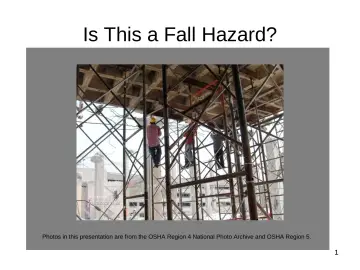
ppt
24 slidesFocus Four: Fall Hazard Recognition
OSHA's official Construction Focus Four slide deck on recognizing and preventing fall hazards; pairs with the Fall Hazards instructor guide.
U.S. Department of Labor, OSHAPublic domain
pdf
50 slidesFocus Four: Fall Hazards Instructor Guide
OSHA instructor guide/lesson plan for the Focus Four fall hazards module (minimum 1.5 hours in the 10-hour course).
U.S. Department of Labor, OSHAPublic domain
pdf
10 slidesFocus Four: Fall Hazards Student Handouts
Student handouts: guardrail and safety net summary, personal fall arrest summary, preventing ladder falls, scaffold hazards.
U.S. Department of Labor, OSHAPublic domain