1 / 50Use ← → to flip
Focus Four: Fall Hazards Instructor Guide
OSHA instructor guide/lesson plan for the Focus Four fall hazards module (minimum 1.5 hours in the 10-hour course).
Page text
· 45 of 50 pages · by U.S. Department of Labor, OSHA
The words on each page as the author wrote them, read from the file by software so they can be searched. Layout, pictures and tables are not shown here, and long pages are shortened: the pages above and the download are the original.
- Page 1
Construction Focus Four: Fall Hazards
- OSHA Training Institute
- I NSTRUCTOR G UIDE
- OSHA Directorate of Training and Education April 2011
- (Updated pages ii and 12 - September 2011)
- Page 3
Table of Contents
- TRAINER PREPARATION GUIDANCE … i Online Resources … ii
- Overview … 1
- Topic 1: What is a fall hazard? … 2
- A. Definition … 3
- B. Examples … 3
- C. Statistics … 4
- Topic 2. What are the major types of fall hazards in construction? … 5
- A. Unprotected roof edges, roof/floor openings, structural steel & leading edges … 5
- B. Improper scaffold construction … 7
- C. Unsafe portable ladders … 8
- Topic 3. How can I protect myself from fall hazards? … 9
- A. Use fall protection equipment … 9
- B. Safe ladder use … 10
- C. Training … 10
- Topic 4. What is my employer required to do to protect workers from falls? … 12
- A. Provide fall protection … 12
- …
- Page 5
TRAINER PREPARATION GUIDANCE
- The “Construction Focus Four: Fall Hazards” lesson is part of the 4-hour block consisting of segments on each of the Focus Four Hazards: Falls, Caught-In or -Between, Struck-By and Electrocution. Because most construction fatalities are caused by fall hazards, falls must be covered for at least one hour and 15 minutes. The other focus four hazards lessons must be covered for a minimum of one-half hour each. This training is developed to be used in both the 10- and 30-hour
- OSHA Outreach Training programs and if applicable, for other safety and health training purposes.
- …
- Page 6
Online Resources
- Aerial Lifts OSHA Quick Card (also available in Spanish) http://www.osha.gov/OshDoc/data_Hurricane_Facts/aerial_lifts_safety.pdf
- Construction eTool: Falls http://www.osha.gov/SLTC/etools/construction/falls/mainpage.html
- Electronic Library of Construction Occupational Safety & Health materials, developed by CPWR – Center for Construction Research and Training, with funding from NIOSH http://www.elcosh.org/
- NOTE: Materials may be copyrighted.
- Fall Protection for the Construction Industry, Oregon OSHA http://www.orosha.org/pdf/pubs/2824.pdf
- Preventing Fatal Falls in Construction OSHA Page http://www.osha.gov/doc/falls/preventingfalls.html
- …
- Page 7
Overview
- The purpose of this lesson is to provide workers with information that will enable them to recognize major fall hazards at construction worksites. This Instructor Guide is intended to be used when presenting the OSHA Training Institute Construction Outreach 10- and 30-hour courses. The lesson is comprised of the following four topics:
- 1. What is a fall hazard?
- 2. What are the major types of fall hazards in construction?
- 3. How can I protect myself from fall hazards?
- 4. What is my employer required to do to protect workers from falls?
- Materials Needed:
- Training
- Preparation:
- Flip chart and markers
- Review Online
- Presentation slides
- …
- Page 8
Instruction for this session:
- 1. Ask the class if they can give an example of a hazard on a construction site that could cause a worker to fall. Discuss the examples with the class. Be sure that examples of the most common fall hazards (from unprotected edges, openings, scaffolds and ladders) are covered.
- 2. Discuss “Content” section.
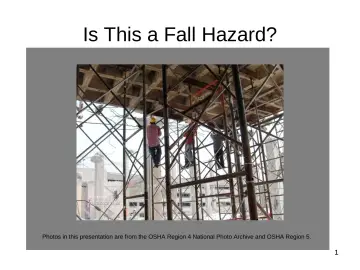
- 3. Show PowerPoint ® presentation with photos of fall hazards and have the class identify the hazards shown. Note: Slides with answers follow each hazard slide.
- 4. If time permits, conduct one of the following small group activities:
- Personal Fall Arrest Demonstration – If the equipment is available, demonstrate the proper use…
- …
- Page 9
Content for Topic 1:
- A. Definition
- Fall hazards are present at most worksites and many workers are exposed to these hazards on a daily basis. A fall hazard is anything at your worksite that could cause you to lose your balance or lose bodily support and result in a fall. Any walking or working surface can be a potential fall hazard.
- NOTES:
- Any time you are working at a height of four feet or more, you are at risk. OSHA generally requires that fall protection be provided at four feet in general industry, five feet in maritime and six feet in construction. …
- …
- Page 10
C. Statistics
- BLS found the leading causes of worker deaths in the construction industry were: falls, struck-by object, caught-in or -between, and electrocution. These "Fatal [Focus] Four" were responsible for nearly three out of five (59%) construction worker deaths in 2009, BLS reports. In 2009, falls accounted for more than one-third of fatal occupational injuries in construction (34%). Nearly half (48%) of all fatal falls in private industry involved construction workers.
- NOTES:
- According to BLS, average hours worked at the national level fell by one percent in 2008, and some industries that have historically accounted for a significant share of worker…
- …
- Page 11
Topic 2. What are the major types of fall hazards in construction?
- A. Unprotected roof edges, roof and floor openings, structural steel and leading edges, etc.
- Major hazards related to unprotected roof edges, roof and floor openings, structural steel and leading edges
- Examples of accidents related to unprotected roof edges, roof and floor openings, structural steel and leading edges
- B. Improper scaffold construction
- Major hazards related to scaffolds
- Examples of accidents related to scaffolds
- C. Unsafe portable ladders
- Major hazards related to ladders
- Examples of accidents related to ladders
- Content for Topic 2
- …
- Page 12
- Roofing falls are the leading cause of roofing injuries and fatalities. Roofing, siding and sheet metal work have the highest rate of occupational injuries and illnesses for a non-manufacturing industry. One of the most frequently cited serious OSHA violations involving roofing and fall protection is unprotected sides and edges.
- NOTES:
- Workers involved in steel erection are exposed to fall hazards. According to The Construction Chart Book (CPWR, December, 2007), more ironworkers are killed from falls than workers in any other construction occupation. The rate of work-related deaths among ironworkers is 10 times higher than the construction average. …
- …
- Page 13
B. Improper scaffold construction
- Major hazards:
- Working with heavy equipment and building materials on the limited space of a scaffold is difficult. Without fall protection or safe access, it becomes hazardous. Falls from improperly constructed scaffolds can result in injuries ranging from sprains to death. Guardrails or personal fall arrest systems for fall prevention/protection are required for workers on platforms 10 feet or higher.
- NOTES:
- For additional information on scaffolds, see:
- Supported Scaffold Safety Tips
- OSHA Quick Card http://www.osha.gov/
- OshDoc/data_Hurricane_ acts/supported_scaffold_ tips.pdf
- …
- Page 14
C. Unsafe portable ladders
- Major hazards:
- You risk falling if a portable ladder is not safely positioned each time you use one. While you are on a ladder, it may move and slip from its supports. You can also lose your balance while getting on or off an unsteady ladder. Falls from ladders can cause injuries ranging from sprains to death.
- NOTES:
- For additional information on ladders, see:
- Portable Ladder Safety Tips OSHA Quick Card http://www.osha.gov/
- OshDoc/data_
- Hurricane_Facts/ portable_ladder_qc.pdf
- BLS data show that falls from ladders account for over 100 fatalities each year. Factors that contribute to falls from ladders are ladder slip (top or bottom)…
- …
- Page 15
Topic 3. How can I protect myself from fall hazards?
- A. Use fall protection equipment
- Guardrail systems
- Safety Net systems
- Personal Fall Arrest systems
- B. Safe ladder use
- C. Training
- NOTES:
- CONTENT for Topic 3:
- The three generally acceptable methods of protection for workers on a construction site who are exposed to vertical drops of 6 feet or more are guardrails, safety net systems and personal fall arrest systems.
- Guardrails are considered prevention systems, as they stop you from having a fall in the first place.
- Safety net systems are designed to catch you and break your fall. They must be placed as close as practicable under your working surface, but…
- …
- Page 16
Discuss the information on the Guardrail and Safety
- Net Systems and Personal Fall Arrest Systems
- Summaries.
- B. Safe ladder use
- Discuss the information in the Preventing Ladder Falls handout.
- NOTES:
- Refer to: Handout #1 - Guardrail & Safety Net Systems Summary and Handout #2 - Personal Fall Arrest Systems Summary
- Refer to: Handout #3 - Preventing Ladder Falls
- C. Training
- Your employer must provide you with training if you are exposed to fall hazards. The training program must train you to recognize the hazards of falling and explain the procedures to be followed in order to minimize fall hazards. …
- …
- Page 17
- 8. Keep your feet firmly on the platform on a boom lift and tie-off at all times.
- NOTES:
- 9. Choose the correct ladder for the task, read the instructions and be sure that the ladder is in good condition. Check for surrounding hazards, stable footing and the proper angle.
- 10. Identify skylights and make sure they are properly protected.
- 11. Contact your supervisor if you see fall hazards or have any questions about fall prevention. Do not work until unsafe conditions have been corrected.
- Page 18
Topic 4. What is my employer required to do to protect workers from falls?
- A. Provide fall protection
- B. Ensure proper scaffold construction
- C. Ensure safe ladder use and condition
- D. Conduct worksite maintenance
- E. Provide training
- CONTENT for Topic 4:
- OSHA’s fall protection standards require employers to provide fall protection for you when you are exposed to a fall hazard. The standards set the criteria and practices for fall protection systems and require training. The standards cover hazard assessment, fall protection and safety monitoring systems. …
- …
- Page 19
- If personal fall protection systems are used, employers must pay particular attention to identifying attachment points and to ensuring that workers know how to properly don and inspect the equipment.
- NOTES:
- The following are some things your employer should do to prevent fall hazards at your worksite:
- These guidelines are from the Laborers’ Health & Safety Fund of North America
- 1. Develop a written fall protection plan.
- 2. Identify potential fall hazards prior to each project and during daily walk-arounds. Pay attention to hazards associated with routine and non-routine tasks.
- 3. Eliminate the need for fall protection where possible by rescheduling the task…
- …
- Page 20
Discuss the information in the following: Supported Scaffold Safety Tips OSHA Quick Card
- B. Proper scaffold construction
- Employers must construct all scaffolds according to the manufacturer’s instructions. A “competent person” must supervise as scaffolds are erected, moved, taken apart or changed, and must inspect the scaffolding. A guardrail system or a personal fall arrest system is required for scaffolds more than 10 feet above a lower level. In addition, employers must provide safe access to scaffold platforms.
- NOTES:
- OSHA defines a “competent person’ as “one who is capable of identifying existing and predictable hazards in the surroundings or working…
- …
- Page 21
E. Training
- As discussed, your employer must provide you with training on fall hazards and the required personal protective equipment. OSHA also has specific standards that require your employer to train you when you work with scaffolds and ladders. If you see fall hazards or have any questions about fall prevention, contact your supervisor. Do not work until unsafe conditions have been corrected. If hazards are not corrected, you may contact OSHA and file a complaint.
- NOTES:
- See 1926.503, Fall Protection Training Requirements; 1926.454, Scaffolds Training Requirements; 1926.1060, Ladders Training Requirements. …
- …
- Page 22
References/Sources
- OSHA Website
- BLS Website
- CDC/NIOSH Website
- The Construction Chart Book (CPWR, 2007)
- Central New York COSH, 2007, Construction Safety & Health Fall Hazards Grantee module, Grant Number SH-16586-07-06-F-36 from OSHA
- CDC/NIOSH in partnership with CPWR-The Center for Construction Research and Training, Hollywood, Health and Society, and the Spanish-language network Telemundo, http://www.cdc.gov/Features/ConstructionFalls/
- Laborers’ Health & Safety Fund of North America, Preventing Falls in Construction, an OSHA Alliance product
- Page 23
APPENDIX A
- Appendix A: Fall Hazards Lesson Test
- Instructor Copy - answers provided separately
- See file: Falls_TestwAns_April2011.pdf
- Student copy to distribute follows
- Page A1
- Page 24
APPENDIX A
- Page A2
- Page 25
Construction Focus Four: Fall Hazards Lesson Test
- Name: ___
- Student Copy
- Date: ___
- 1. In general, fall protection must be provided to construction workers who are working on surfaces with unprotected sides and edges which are ___ above the lower level:
- a. 3 feet
- b. 4 feet
- c. 6 feet
- 2. What are the ways an employer can protect workers from falls?
- a. Guardrails, safety net systems and safety belts
- b. Guardrails and safety nets
- c. Guardrails, safety net systems and personal fall arrest systems
- 3. For workers on scaffolds, fall protection must be provided if they are working
- ___ above a lower level.
- a. 4 feet
- b. 6 feet
- c. 10 feet
- …
- Page 27
APPENDIX B
- Appendix B: Personal Fall Arrest System Checklist
- Personal Fall Arrest Systems are one way to protect workers on construction sites where there are vertical drops of 6 or more feet. Systems must be set up so that a worker cannot fall more than 6 feet, nor come into contact with any lower level.
- You should be able to answer Yes to each of the following.
- 1. Is your Personal Fall Arrest System made up of an anchorage, connecting device, and a full-body harness?
- 2. Are the components from the same manufacturer to ensure that the system works as it should? If not, has any substitution or change to a personal fall arrest system been fully evaluated or…
- …
- Page 28
APPENDIX B
- Page B2
- Page 29
LADDER SAFETY: What’s Wrong with this Picture?
- APPENDIX C
- Appendix C: Ladder Safety Exercise Instructor copy (Student copy follows)
- Instructor Notes are in Italics
- Read the following scenario; ask participants to take on the roles of Mike, Joe and the foreman. After reading the story, participants should identify all the wrong things that the workers did when working with ladders; discuss the RIGHT way to work safely on a ladder. Roles: Mike and Joe, the workers and Mr. Smith, the foreman
- INTRODUCTION:
- Joe and Mike are excited; they just got the call to work on the new residential construction project in the area. …
- …
- Page 30
APPENDIX C
- SCENE TWO: Mike and Joe are outside setting up.
- Mike: So Joe, you work out here, and I’ll do the inside work, okay?
- Joe: Sure, but can you help me to set up here? Is this extension ladder okay, and how do I set it up?
- Mike: Well, first you should inspect it. Of course the ladder needs to be long enough to reach the top, and it has to be able to hold you. So check the information on the ladder. It says it’s a Type I – I’m not sure what that means, but I think it has something to do with your weight. How heavy are you?
- Joe: About 260 pounds – I’ve been eating like a horse lately. I have to get back to the gym. …
- …
- Page 31
APPENDIX C
- Joe: This bolt seems a bit loose, and the pulley rope is a bit frayed. I wonder how that happened…and the steps feel like they have some kind of slippery stuff on them…
- (There should be no loose bolts, no frayed pulley ropes. If a ladder is defective in any way, it needs to be marked “Do Not Use” and taken out of service.)
- Mike: So just wipe them off. Listen, we need to get started here…
- Joe: Okay, okay, let’s just set up then. Where should I start?
- Mike: Start over by the doorway; it’s early in the day, so not many people should be walking in and out. If you see anyone, just yell. …
- …
- Page 32
APPENDIX C
- SCENE THREE: Mike is inside, using the step ladder.
- Mr. Smith: Hey Mike, how’s it going?
- Mike: Great, Mr. Smith, this is a great job.
- Mr. Smith: Be careful, you should not be sitting on the ladder, and before I saw you standing on the top step.
- (Never sit on a ladder, or step on the top step – it’s dangerous!)
- Mike: Oh, don’t worry, Mr. Smith, I can handle myself on a ladder – I’ve been working with my father for years doing this kind of work.
- Mr. Smith: Okay, but try not to lean so far; just get down and walk the ladder closer, okay? (Never lean on the ladder; stay centered. And never “walk” a ladder while you are standing on it – very dangerous!)
- …
- Page 33
APPENDIX C
- Have students complete this worksheet in their copy of this exercise.
- 1. Are there any problems with Joe’s and Mike’s ladder work?
- Yes. They have not been trained in safe ladder use. As a result, there are problems with the ladder itself (type not sufficient for weight, too short, in disrepair, steps slippery), the set-up of the ladder (near doorway, ground uneven, close to power lines, incorrect angle, not tied off, debris near work area, etc.), and using the ladder (Joe carried paint cans up the ladder with him).
- 2. What could have been the reason for Joe’s fall?
- There are several possibilities. The ladder could have moved or slipped for some or…
- …
- Page 34
APPENDIX C
- Page C6
- Page 35
LADDER SAFETY: What’s Wrong with this Picture?
- Student Copy
- Read the following scenario; ask participants to take on the roles of Mike, Joe and the foreman. After reading the story, participants should identify all the wrong things that the workers did when working with ladders; discuss the RIGHT way to work safely on a ladder.
- Roles: Mike and Joe, the workers and Mr. Smith, the foreman
- INTRODUCTION:
- Joe and Mike are excited; they just got the call to work on the new residential construction project in the area. They don’t have much experience, but the pay is good, and they want to use this job as a stepping stone to bigger and better jobs.
- …
- Page 36
- SCENE TWO: Mike and Joe are outside setting up.
- Mike: So Joe, you work out here, and I’ll do the inside work, okay?
- Joe: Sure, but can you help me to set up here? Is this extension ladder okay, and how do I set it up?
- Mike: Well, first you should inspect it. Of course the ladder needs to be long enough to reach the top, and it has to be able to hold you. So check the information on the ladder. It says it’s a Type I – I’m not sure what that means, but I think it has something to do with your weight. How heavy are you?
- Joe: About 260 pounds – I’ve been eating like a horse lately. I have to get back to the gym.
- …
- Page 37
Scene Two continued
- Mike: So just wipe them off. Listen, we need to get started here…
- Joe: Okay, okay, let’s just set up then. Where should I start?
- Mike: Start over by the doorway; it’s early in the day, so not many people should be walking in and out. If you see anyone, just yell. And it’s windy already, and it’s supposed to get worse later on, so be careful.
- Joe: Okay. The ground is pretty uneven here with all these rocks. And do I need to worry about those electrical wires? They seem like they are pretty close to the ladder.
- Mike: Man, you ask a lot of questions, dude! Let’s get this set up. Okay, you need to set this up at the right angle to make sure…
- …
- Page 38
- SCENE THREE: Mike is inside, using the step ladder.
- Mr. Smith: Hey Mike, how’s it going?
- Mike: Great, Mr. Smith, this is a great job.
- Mr. Smith: Be careful, you should not be sitting on the ladder, and before I saw you standing on the top step.
- Mike: Oh, don’t worry, Mr. Smith, I can handle myself on a ladder – I’ve been working with my father for years doing this kind of work.
- Mr. Smith: Okay, but try not to lean so far; just get down and walk the ladder closer, okay?
- Mike: No problem, Mr. Smith, I’m a good worker, and I work fast. Suddenly, they hear Joe yelling from outside, and then they hear a “thud.” They run outside to see what happened.
- Unsafe Work:
- …
- Page 39
- Consider the Ladder Safety scenario to complete this worksheet.
- 1. Are there any problems with Joe’s and Mike’s ladder work?
- 2. What could have been the reason for Joe’s fall?
- 3. Do you think Mike is working safely? Why or why not?
- SOURCE: Construction Safety & Health Fall Hazards, Central New York COSH, 2007, OSHA grant product
- Page 41
APPENDIX D
- Appendix D: Student Handouts
- Guardrail and Safety Net Systems Summary
- Personal Fall Arrest Systems Summary
- Preventing Ladder Falls
- Scaffold Work Can Be Dangerous
- Page D1
- Page 42
APPENDIX D
- Page D2
- Page 43
Guardrail and Safety Net Systems Summary
- Guardrail and safety net systems are two ways to protect workers from falls on the job. If you are more than 6 feet above the lower surface, some type of fall protection must be used by your employer.
- If your employer uses guardrails:
- Toprails must be at least ¼ inch thick to prevent cuts and lacerations; and they must be between 39 and 45 inches from the working surface;
- If wire rope is used, it must be flagged at least every six feet with highly visible materials;
- Midrails, screens or mesh must be installed when there are no walls at least 21 inches high.
- …
- Page 45
Personal Fall Arrest Systems Summary
- Personal fall arrest systems are one way to protect workers from falls. In general, workers must have fall protection when they could fall 6 feet or more while they are working.
- OSHA requires workers to wear a full-body harness, (one part of a Personal Fall Arrest System) when they are working on a suspended scaffold more than 10 feet above the working surface, or when they are working in bucket truck or aerial lift. Employers may also choose to use a Personal Fall Arrest System, instead of a guardrail, when workers are working on a supported scaffold more than 10 feet above the working surface.
- …
- Page 46
- 4. The attachment location of the body harness must be in the center of your back, near the shoulder level or above your head.
- 5. Vertical lifelines or lanyards must have a minimum breaking strength of 5,000 lbs., and be protected against being cut or abraded.
- 6. Each worker must be attached to a separate vertical lifeline. [There is a special exception when constructing elevator shafts.]
- 7. The webbing, which is the materials used for ropes and straps of lifelines, lanyard and harnesses, must be made of synthetic fibers.
- 8. An anchorage for workers’ personal fall arrest equipment must be independent of any anchorage used to support or suspend platforms, and…
- …
- Page 47
Preventing Ladder Falls - Construction Safety
- Why construction falls?
- Here area few basic facts about falls in construction:
- Every day, four construction workers die on the job.
- Falls are the most common cause of fatal injuries to construction workers.
- The consequences of a fall affect not only the worker, but also his or her family and community.
- Construction falls can be prevented. Contractors and foreman can do many things to organize the worksite to be safer for their employees. But workers themselves can also make some inexpensive, simple changes to the way they work that can save their lives.
- …
- Page 48
- on the ladder to descend. Setting the ladder at the right angle helps you keep your balance on the ladder. It also helps keep the ladder from falling backwards.
- Make sure the ladder extends 3 feet (3 rungs; 0.9 meters) above the surface you will be working on.
- Make sure the ladder is placed at a stable angle. For every four feet (1.2
- m) high the ladder is, the base should be 1 foot (.3 m) out from the wall
- For example, if you will be working on a 10 foot-high roof (3 m), you need a ladder that is at least 14 feet (4.25 m) long. The base should be 2 ½ feet
- (.75 m) from the wall.
- Is the ladder in good working condition? It shouldn’t be missing pieces or be…
- …
- Page 49
Scaffold Work Can Be Dangerous: Know the Basics of Scaffold Safety
- There are thousands of scaffold-related injuries – and about 40 scaffold-related deaths – every year in the U.S. If you are doing work on scaffolds, know how to work on them safely – it could save your life!
- Here are some rules about scaffolds that must be followed if you want to work safely:
- 1. A competent person must be available to direct workers who are constructing or moving scaffolds. The competent person must also train workers, and inspect the scaffold and its components before every work shift, and after any event that could affect the structural integrity of the scaffold. …
- …
- Page 50
- The use of a guardrail OR a personal fall arrest system when working on a supported scaffold.
- BOTH a guardrail AND a personal fall arrest system when working on a single-point or two-point suspended scaffold.
- A personal fall arrest system when working on an aerial lift.
- 8. Your lifeline must be tied back to a structural anchorage capable of withstanding 5,000 lbs of dead weight per person tied off to it. Attaching your lifeline to a guardrail, a standpipe or other piping systems will not meet the 5,000 lbs requirement and is not a safe move.
- 9. Wear hard hats, and make sure there are toeboards, screens and debris nets in place to protect other people from…
- …
More on Falls
ppt
24 slidesFocus Four: Fall Hazard Recognition
OSHA's official Construction Focus Four slide deck on recognizing and preventing fall hazards; pairs with the Fall Hazards instructor guide.
U.S. Department of Labor, OSHAPublic domain

pdf
10 slidesFocus Four: Fall Hazards Student Handouts
Student handouts: guardrail and safety net summary, personal fall arrest summary, preventing ladder falls, scaffold hazards.
U.S. Department of Labor, OSHAPublic domain
pdf
1 slidesFocus Four: Personal Fall Arrest System Checklist
Small-group activity checklist for inspecting a personal fall arrest system.
U.S. Department of Labor, OSHAPublic domain