1 / 43Use ← → to flip
Fall Protection in Construction
Concise construction fall protection deck from the Structural Building Components Association (truss/framing focus).
Slide text
· 43 slides · by Structural Building Components Association
The words on each slide as the author wrote them, read from the file by software so they can be searched. Layout, pictures and tables are not shown here: the slides above and the download are the original.
- Slide 1
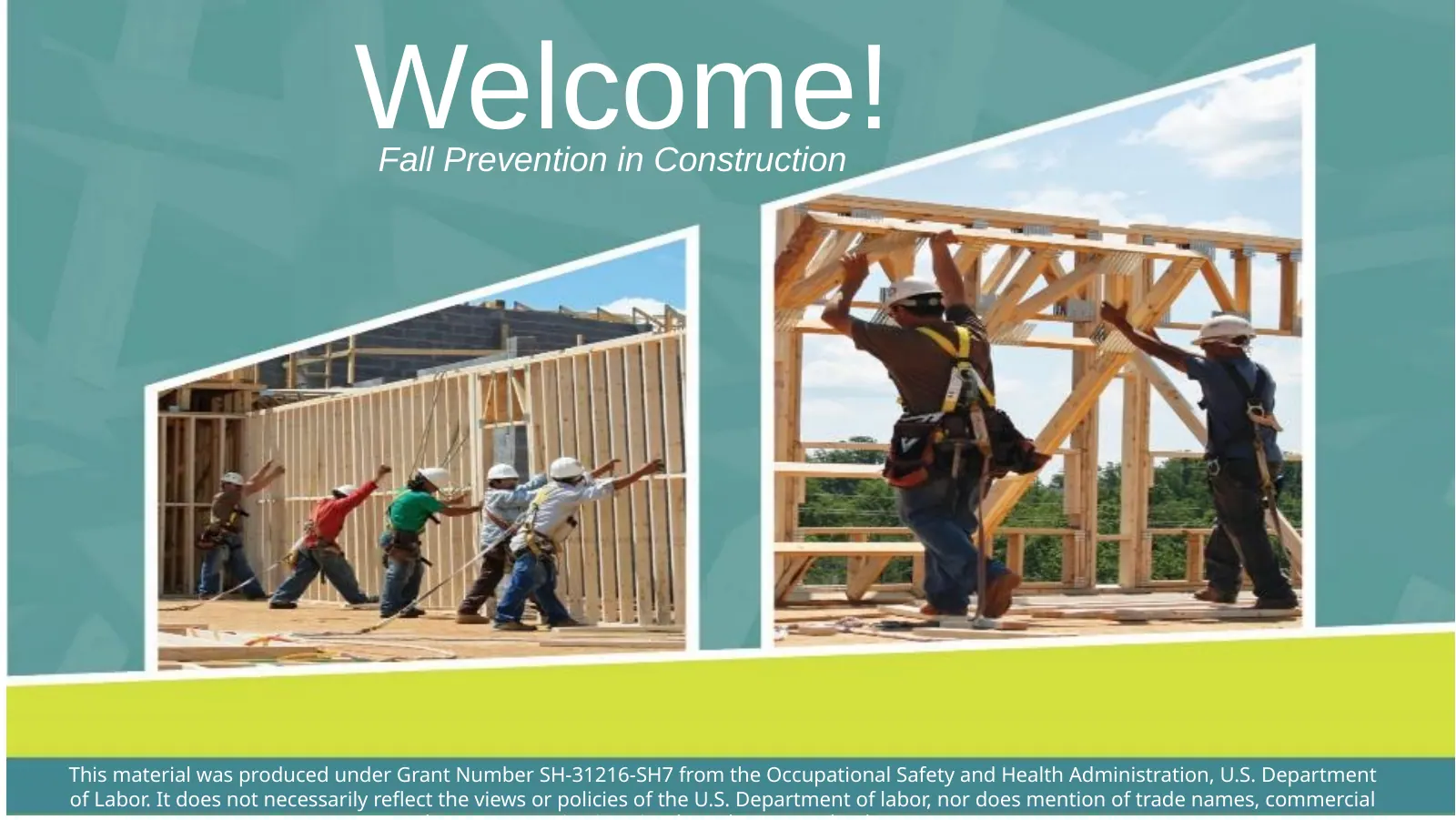
Welcome!
- Fall Prevention in Construction
- This material was produced under Grant Number SH-31216-SH7 from the Occupational Safety and Health Administration, U.S. Department of Labor. It does not necessarily reflect the views or policies of the U.S. Department of labor, nor does mention of trade names, commercial
- Slide 2
Content
- The content provided in this training was developed by the National Framers Council and is in compliance with OSHA 29 CFR 1926 Subpart M.
- Likewise, the content within the site-specific fall protection plan was developed by framers on the NFC Safety Committee, and have been developed to be compliant with OSHA 29 CFR 1926 Subpart M Appendix E.
- This material was produced under Grant Number SH-31216-SH7 from the Occupational Safety and Health Administration, U.S. Department of Labor. It does not necessarily reflect the views or policies of the U.S. Department of labor, nor does mention of trade names, commercial products, or organizations imply endorsement by the U.S. Government.
- Slide 3
Introduction
- Everyone shares the responsibility of practicing jobsite safety.
- Employers
- Develop and enforce jobsite safety manual and regular training schedule in compliance with Occupational Safety and Health Administration (OSHA) standards
- Create and maintain a safe jobsite that includes regular inspection
- Oversee the proper use of all tools and safety equipment on each site
- Employees
- Take training seriously
- Practice safety and encourage fellow employees to be safe
- Learn the responsibilities of everyone on the jobsite and recognize who the qualified persons are
- Slide 4
Overview
- Today’s training focuses on general fall protection guidelines and requirements:
- Ladders
- Protection from falling objects
- Guardrails
- Scaffolding
- Personal Fall Arrest Systems (PFAS)
- Positioning Device Systems
- Horizontal Lifeline System (HLL)
- Rescue Planning
- As well as:
- Site-specific fall protection plans
- Slide 5
Overview
- Training is intended to include a hands-on roof truss model where trainees can apply the safety techniques of this course when setting roof trusses.
- Why?
- Accidental falls are the leading cause of death for framers
- Setting roof trusses is one of the most dangerous activities
- Truss installation exposes workers to greatest heights
- Trusses are unstable until they are braced
- This material was produced under Grant Number SH-31216-SH7 from the Occupational Safety and Health Administration, U.S. Department of Labor. It does not necessarily reflect the views or policies of the U.S. Department of labor, nor does mention of trade names, commercial
- Slide 6
Definitions
- Authorized person - a person approved or assigned by the employer to perform a specific type of duty or duties or to be at a specific location or locations at the jobsite.
- Competent Person - one who is capable of identifying existing and predictable hazards in the surroundings or working conditions which are unsanitary, hazardous, or dangerous to employees, and who has authorization to take prompt corrective measures to eliminate them.
- Designated person - means "authorized person“.
- Slide 7
Definitions
- Employee - every laborer or mechanic under the Act regardless of the contractual relationship which may be alleged to exist between the laborer and mechanic and the contractor or subcontractor who engaged him…"Laborer" generally means one who performs manual labor or who labors at an occupation requiring physical strength; "mechanic" generally means a worker skilled with tools.
- Employer - contractor or subcontractor within the meaning of the Act.
- Qualified - one who, by possession of a recognized degree, certificate, or professional standing, or who by extensive knowledge, training, and experience, has successfully demonstrated his ability to solve or resolve problems relating to the subject matter, the work, or the project.
- Slide 8
Discussion
- Do you use fall protection on your jobsites?
- What kind?
- Are there certain tasks you perform without the use of fall protection?
- Do you receive regular training on fall protection?
- Employer based? External companies?
- Has OSHA visited a jobsite you were working at?
- How did the visit turn out?
- Slide 9
OSHA Basics
- Purpose:
- To assure safe and healthful working conditions for working men and women; by authorizing enforcement of the standards developed under the Act; by assisting and encouraging the States in their efforts to assure safe and healthful working conditions; by providing for research, information, education, and training in the field of occupational safety and health; and for other purposes
- Slide 10
OSHA Basics
- General Duty Clause:
- Section 5(a)(1) of the OSH Act is known as “The General Duty Clause”.
- Requires that each employer provides a workplace that is free from recognized hazards that are causing or likely to cause death or serious physical harm.
- Can be used by OSHA only where there is no standard that applies to the particular hazard and the employer has its own employees exposed to the alleged hazard. Required elements include:
- Employer fails to keep the workplace free of a hazard to which employees were exposed.
- The hazard was recognized.
- The hazard was causing, or was likely to cause, death or serious physical harm.
- There was a feasible and useful method to correct the hazard.
- Slide 11
OSHA Basics
- Accident Reporting:
- OSHA Standard, 29 CFR Subpart 1904.39, Reporting Fatality, Injury and Illness Information to the Government
- Requires employers report all work related fatalities within eight (8) hours and all work-related inpatient hospitalizations, all amputations and all losses of an eye within 24 hours. Employers must orally report the fatality/hospitalization by telephone or in person to the OSHA Area Office or to the State Plan Office that is nearest to the site of the incident.
- Slide 12
OSHA Basics
- Employee Rights:
- Right to refuse to work if you believe, in good faith, you are exposed to imminent danger.
- Protection from workplace retaliation if you refuse to work OR if you report your employer.
- Slide 13
OSHA Basics
- Employee Rights:
- Other basic rights include the right to:
- Be trained in a language you understand
- Work on machines that are safe
- Be provided required safety gear, such as gloves or a harness and lifeline for falls
- Be protected from toxic chemicals
- Request an OSHA inspection, and speak to the inspector
- Report an injury or illness, and get copies of your medical records
- See copies of the workplace injury and illness log
- Review records of work-related injuries and illnesses
- Get copies of test results done to find hazards in the workplace
- Slide 14
Ladders
- General guidelines:
- Don’t exceed maximum intended load
- Never tie ladders together unless they are made to do so
- Make sure ladder extends at least 3 ft. past the platform onto which you’re climbing
- Maintain 3 points of contact with ladders when ascending or descending.
- Slide 15
Ladders
- Extension:
- 4-to-1 rule
- For ever 4 ft. of height, the base should be placed 1 ft. from whatever the ladder is leaning against
- At least 3 rungs overlapped
- Never stand on the top three rungs Step:
- Don’t use as a single ladder (leaning)
- Lock the spreader hinges
- Do not sit/stand on the top platform
- Slide 16
Ladders
- Job-made wooden:
- Secure top and base so it does not move
- Maintain OSHA compliant rail system at the top to protect from falls
- Inspections:
- Loose components
- Cracks, dents, splits
- Tag ladders that don’t meet inspections, remove from jobsite and report to supervisor
- Slide 17
Protection from Falling Objects
- General guidelines:
- Wear hardhat and safety glasses to protect from falling objects
- Holes and opening must be covered and/or protected by a guardrail system
- Hole covers must support 2-times the weight of employee with equipment and materials
- Holes must be labeled
- Materials must be kept 6 ft. from any leading edge unless a guardrail is in place Canopy
- Must be strong enough to prevent collapse by objects that fall onto it Barricade
- Must prevent employees from accessing area with falling objects
- Slide 18
Guardrails
- General Guidelines:
- Should be erected only under the guidance of a competent person.
- Use when working surface is greater than 6 ft. above a lower level
- Use across holes/opening greater than 18 in.
- Slide 19
Guardrails
- Guardrail dimensions:
- Top Rail: 42 in. +/- 3 in. above working surface
- Mid Rail: At least 21 in. above working surface (halfway) when there is no wall or parapet wall at least 21 in. high
- Toe Board: 3.5 in. tall
- Verticals: Minimum of every 8 ft.
- Additional Members: Installed so no opening is more than 19 in. apart
- Weight requirements:
- Force of at least 200 lbs. applied within 2 in. of the top edge
- Slide 20
Scaffolding
- General guidelines:
- Erected only under supervision of competent person
- Do not erect within 10 ft. of power lines
- Settling or displacement should not occur
- Pumpjack poles must be secured to building
- Employees on scaffolds over 10 ft. in height must have fall protection
- If guardrails are installed per manufacturer specifications and OSHA requirements, personal fall protection is not needed
- If personal fall protection is required, the anchor point must be attached to a structural member; DO NOT attach to scaffolding guardrail
- Slide 21
Scaffolding
- Fall protection:
- Do not use scaffolds where drop-off is 6 ft. or greater unless guardrail systems,
- including toe boards, are installed at open sides and ends.
- Each walkway located within a scaffold shall be protected by a guardrail system
- installed within 9.5 in. of and along at least one side of the walkway
- DO NOT attach personal fall protection devices to guardrail systems Inspection
- Must be done by competent person before each work day and/or after events that
- could affect scaffold’s integrity
- Remove slippery substances from floor
- Remove debris
- Damaged components must be removed and replaced or repaired, and tagged
- appropriately
- Slide 22
Personal Fall Arrest System (PFAS)
- General Guidelines
- Consists of body harness, lanyard with shock-absorbing pack, and rope grab and locking snap hook for connection to anchor.
- DO NOT use body belt as a PFAS; full body harness is required
- PFAS must:
- Limit max. arresting force to 1,800 lbs. when used with a body harness
- Prevent employee from falling more than 6 ft., nor contact any lower level
- Bring employee to complete stop and limit max. deceleration distance of travel to 3.5 ft.
- Be strong enough to withstand twice the potential impact energy of a free-falling employee a distance of 6 ft. or the free-fall distance permitted by the system, whichever is less
- Rescue person or ladder is required during use of PFAS
- Slide 23
Personal Fall Arrest System (PFAS)
- Slide 24
Personal Fall Arrest System (PFAS)
- Inspection:
- All equipment must be tested by the manufacturer
- Perform inspection before every use and remove defective systems from use
- PFAS subject to any impact loading shall be removed from service, never to be used again. Until inspection and clearance from a competent person.
- Slide 25
Personal Fall Arrest System (PFAS)
- Components:
- Body harness
- Distributes fall arrest forces over thighs, pelvis, waist, chest and shoulders. D-rings should be between shoulder blades
- Anchor point
- Must be independent of any anchorage being used to support or suspend platforms
- Must support at least 5,000 lbs. per employee attached or shall be designed, installed and used:
- As part of a complete PFAS that maintains a factor of safety of at least 2
- Under the supervision of a qualified person
- Self-retracing lanyard
- Deceleration device containing drum-wound line that can be extracted from or retracted onto, the drum under tension during normal employee movement and that, after onset of a fall, automatically locks the drum and arrests the fall
- Slide 26
Personal Fall Arrest System (PFAS)
- Components:
- Lanyard
- Flexible line of rope, wire rope or strap that has a connector at each end for connecting body harness to deceleration device, lifeline, or anchor.
- Must have a shock absorbing pack and rope grab
- Snap hook
- A connector comprised of a hook-shaped member with a normally closed keeper, or similar arrangement, that can be opened to permit the hook to receive an object, and, when released, automatically closes to retain the object
- NEVER connect 2 snap hooks together. Accidental disengagement could result in failure of PFAS.
- Slide 27
Positioning Device Systems
- General guidelines:
- Consists of a body harness system rigged to allow employee to be supported on elevated vertical surface while working with both hands free while leaning
- DO NOT attach to guardrail systems
- System should prevent employee from falling more than 2 ft. Components:
- Body belt
- Waist strap that attaches to lanyard, lifeline or deceleration device.
- Cannot be used as a PFAS, only a positioning device system
- Body harness
- Distributes fall arrest forces over thighs, pelvis, waist, chest and shoulders. D-rings should be between shoulder blades
- Slide 28
Positioning Device Systems
- Components:
- Anchor point
- Must be independent of any anchorage being used to support or suspend platforms
- Must support at least 5,000 lbs. per employee attached or shall be designed, installed and used:
- As part of a complete PFAS that maintains a factor of safety of at least 2
- Under the supervision of a qualified person
- Self-retracing lanyard
- Deceleration device containing drum-wound line that can be extracted from or retracted onto, the drum under tension during normal employee movement and that, after onset of a fall, automatically locks the drum and arrests the fall
- Slide 29
Positioning Device Systems
- Components:
- Lanyard
- Flexible line of rope, wire rope or strap that has a connector at each end for connecting body harness to deceleration device, lifeline, or anchor.
- Must have a shock absorbing pack and rope grab
- Snap hook
- A connector comprised of a hook-shaped member with a normally closed keeper, or similar arrangement, that can be opened to permit the hook to receive an object, and, when released, automatically closes to retain the object
- NEVER connect 2 snap hooks together. Accidental disengagement could result in failure of PFAS.
- Slide 30
Positioning Device Systems
- Slide 31
Positioning Device Systems
- Inspection:
- All equipment must be tested by the manufacturer
- Perform inspection before every use and remove defective systems from use
- Slide 32
Horizontal Lifeline (HLL) System
- General guidelines:
- HLL System shall be installed according to the manufacturer’s instructions.
- Lifelines must:
- Limit max. arresting force to 1,800 lbs. when used with a body harness
- Prevent employee from falling more than 6 ft., nor contact any lower level
- Bring employee to complete stop and limit max. deceleration distance of travel to 3.5 ft.
- Be strong enough to withstand twice the potential impact energy of a free-falling employee a distance of 6 ft. or the free-fall distance permitted by the system, whichever is less
- Rescue person or ladder is required during use of PFAS
- Slide 33
Horizontal Lifeline (HLL) System
- Inspection:
- All equipment must be tested by the manufacturer
- Perform inspection before every use and remove defective systems from use
- HLL Systems subject to any impact loading shall be removed from service, never to be used again until inspection and clearance from a competent person.
- Slide 34
Horizontal Lifeline (HLL) System
- Components:
- HLL
- Must be independent of any anchorage being used to support or suspend platforms
- Must support at least 5,000 lbs. per employee attached or shall be designed, installed and used:
- As part of a complete PFAS that maintains a factor of safety of at least 2
- Under the supervision of a qualified person
- Body harness
- Distributes fall arrest forces over thighs, pelvis, waist, chest and shoulders. D-rings should be between shoulder blades
- Slide 35
Horizontal Lifeline (HLL) System
- Components:
- Self-retracing lifeline
- Deceleration device containing drum-wound line that can be extracted from or retracted onto, the drum under tension during normal employee movement and that, after onset of a fall, automatically locks the drum and arrests the fall
- This differs from self-retracting lanyards; HLLs are not designed to accommodate lanyards
- Snap hook
- A connector comprised of a hook-shaped member with a normally closed keeper, or similar arrangement, that can be opened to permit the hook to receive an object, and, when released, automatically closes to retain the object
- NEVER connect 2 snap hooks together. Accidental disengagement could result in failure of PFAS.
- Slide 36
Rescue Planning
- Time is the most important factor when a fall occurs on a jobsite. Being informed and having a plan in place before a fall happens will help reduce or limit injury to a fellow employee after a fall.
- Discussion
- Has a fall ever happened on a jobsite you were on? What happened? How did the events unfold?
- Slide 37
Discussion
- In your opinion, is there a practical way to perform roof truss installation that meets the safety requirements of OSHA?
- This material was produced under Grant Number SH-31216-SH7 from the Occupational Safety and Health Administration, U.S. Department of Labor. It does not necessarily reflect the views or policies of the U.S. Department of labor, nor does mention of trade names, commercial products, or organizations imply endorsement by the U.S. Government.
- Slide 38
Setting Roof Trusses
- Why do roof trusses present a greater hazard for falls?
- Exposes framers to the greatest heights
- Unbraced/unrestrained trusses are not structurally stable
- The number of structural members available to be used for anchoring fall protection devices is limited
- Solution:
- Site-Specific Fall Protection Plan
- Slide 39
Setting Roof Trusses
- General guidelines:
- Do not walk on unbraced trusses (top or bottom chords)
- Do not walk on trusses or gable end frames lying flat
- Do not stand on truss overhangs until sheathing has been applied
- Minimum size lumber for lateral restraint and diagonal bracing is 2x4, unless specified by Building Designer.
- Drive at least 2 nails into each truss member, ensuring they are flush
- Slide 40
Setting Roof Trusses
- Site-Specific
- 29 CFR 1926 Subpart M App E
- Employers engaged in leading edge work, precast concrete construction work and residential construction work who can demonstrate that it is infeasible or creates a greater hazard to use conventional fall protection systems must develop and follow a fall protection plan.
- Sample plan can be modified to be used for other work involving leading edge work.
- Sample plan outlines the elements that must be addressed in any fall protection plan.
- Slide 41
Setting Roof Trusses
- Site-Specific
- Components:
- Statement of company policy
- Fall protection systems to be used on project
- Enforcement
- Accident investigations
- Changes to plan
- Plan
- Step-by-step procedure for each different task where conventional fall protection is either unfeasible or exposes workers to greater risk of fall
- Slide 42
Questions?
- Slide 43
Thank you!
- “Work Safely. Go home Safely”
- This material was produced under Grant Number SH-31216-SH7 from the Occupational Safety and Health Administration, U.S. Department of Labor. It does not necessarily reflect the views or policies of the U.S. Department of labor, nor does mention of trade names, commercial products, or organizations imply endorsement by the U.S. Government.
More on Falls
ppt
24 slidesFocus Four: Fall Hazard Recognition
OSHA's official Construction Focus Four slide deck on recognizing and preventing fall hazards; pairs with the Fall Hazards instructor guide.
U.S. Department of Labor, OSHAPublic domain
pdf
50 slidesFocus Four: Fall Hazards Instructor Guide
OSHA instructor guide/lesson plan for the Focus Four fall hazards module (minimum 1.5 hours in the 10-hour course).
U.S. Department of Labor, OSHAPublic domain

pdf
10 slidesFocus Four: Fall Hazards Student Handouts
Student handouts: guardrail and safety net summary, personal fall arrest summary, preventing ladder falls, scaffold hazards.
U.S. Department of Labor, OSHAPublic domain