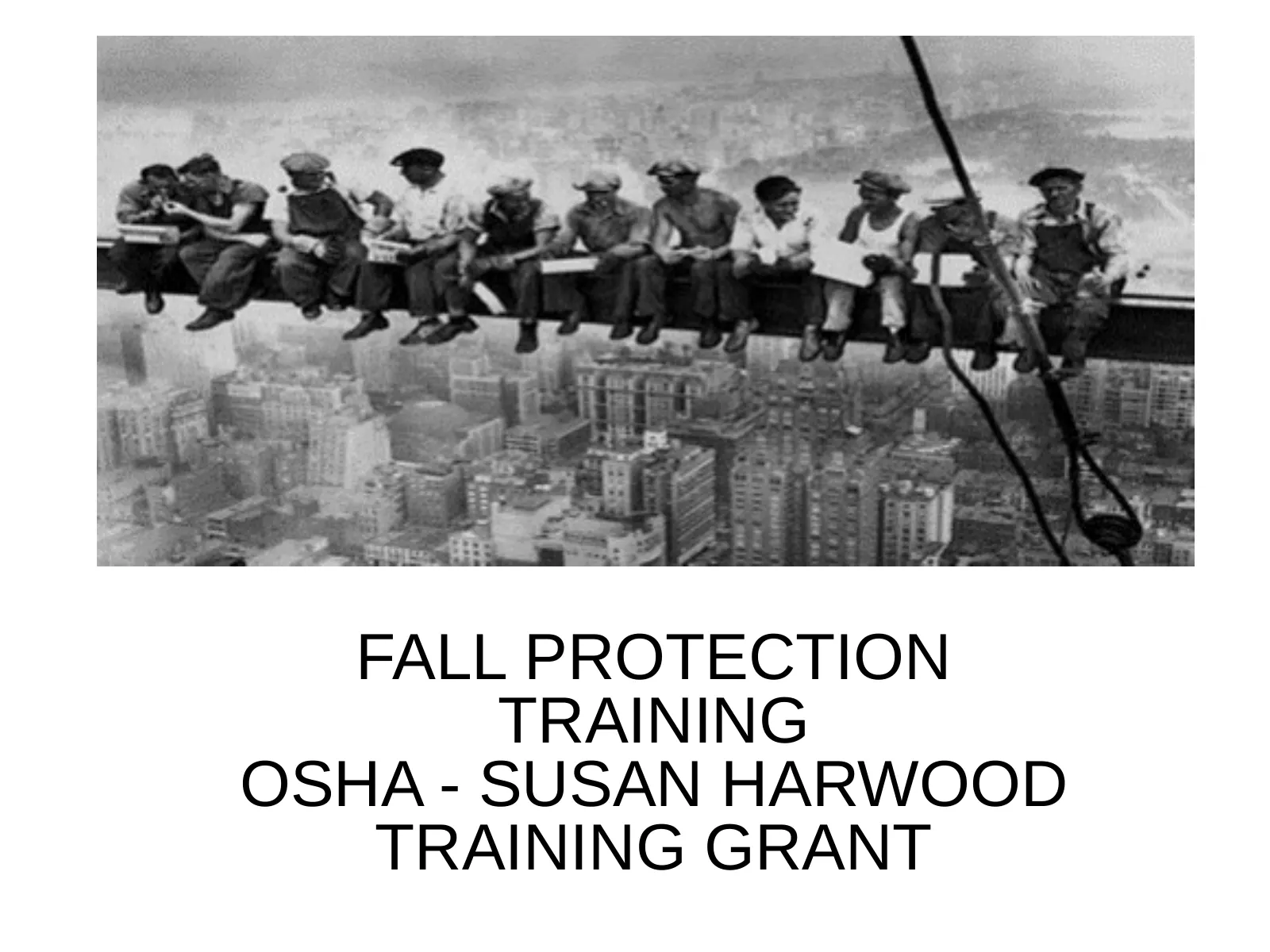
1 / 146Use ← → to flip
Fall Protection Training
Florida International University construction fall protection training (long deck; select slides for a 10-hour class).
Slide text
· 146 slides · by Florida International University
The words on each slide as the author wrote them, read from the file by software so they can be searched. Layout, pictures and tables are not shown here: the slides above and the download are the original.
- Slide 1
FALL PROTECTION
- TRAINING
- OSHA - SUSAN HARWOOD
- TRAINING GRANT
- Slide 2
WELCOME
- Please sign the attendance sheet
- Take one handout
- Answer the pre-test
- Slide 3
LOCATION
- Emergency Exits
- Emergency Stairs
- Location of restrooms
- Location of water fountains
- Slide 4
DISCLAIMER
- This material was produced under grant num ber SH-31201-SH7 from the Occupational Safety and Health Adm inistration, U.S. Department of Labor. It does not necessarily reflect the views or policies of the U. S. Department of Labor, nor does m ention of trade nam es, com mercial products, or organizations im ply endorsem ent by the U. S. Government.
- Slide 5
AGENDA
- Welcome
- Introduction to OSHA
- Worker’s rights
- Introduction to Fall Protection
- Recognition of Fall Hazards
- Basic Fall Prevention Principles
- Basic Fall Protection Principles
- Brief Review of Applicable Standards
- Break
- Slide 6
AGENDA
- Controlling the Hazard
- Hierarchy of Controls
- Restrain
- Components
- Fall Clearance
- Inspections
- Rescue
- Certificates
- Slide 7
INTRODUCTION TO OSHA
- Overview of anti-retaliation provisions, employee rights, employer responsibilities, whistleblower laws, and OSHA’s complaint investigation procedures
- Slide 8
WHY IS OSHA IMPORTANT TO YOU?
- OSHA began because, until 1970, there were no national laws for safety and health hazards.
- On average, 12 workers die every day from job injuries
- Worker deaths in America are down–on average, from about 38 worker deaths a day in 1970 to 12 a day in 2013.
- WORKER FATALITIES
- 4,836 workers were killed on the job in 2015
- Falls — 364 out of 937 total deaths in construction in CY 2015 (38.8%)
- Slide 9
DISCUSSION QUESTIONS
- When, during your work experience, did you first hear about OSHA?
- What did you think about OSHA then?
- What do you think OSHA’s job is?
- Slide 10
HISTORY OF OSHA
- OSHA stands for the Occupational Safety and Health Administration, an agency of the U.S. Department of Labor
- OSHA’s responsibility is worker safety and health protection
- On December 29, 1970, President Nixon signed the OSH Act
- This Act created OSHA, the agency, which formally came into being on April 28, 1971
- Slide 11
OSHA’S M I SSI ON
- To save lives
- To prevent injuries
- To protect America’s workers
- Slide 12
STRATEGIES TO REDUCE INJURIES AND DEATHS
- Strong, fair, and effective enforcement.
- Outreach, education, and compliance assistance.
- Partnerships and other cooperative programs.
- Slide 13
LABELS
- FOR
- HAZARDOUS
- SUBSTANCES
- Labels for hazardous
- substances in your workplace
- Slide 14
OSHA INSPECTIONS
- The OSH Act authorizes OSHA compliance safety and health officers (CSHOs) to conduct workplace inspections at reasonable times.
- OSHA conducts inspections without advance notice, except in rare circumstances (e.g. Imminent Danger)
- In fact, anyone who tells an employer about an OSHA inspection in advance can receive fines and a jail term.
- Slide 15
I NSPECTI ONS PROCESS
- A typical OSHA on-site inspection includes four stages:
- 1. Presentation of inspector credentials.
- 2. An opening conference.
- 3. An inspection walk-around.
- 4. A closing conference.
- Slide 16
OSHA’S INSPECTION PRIORITIES
- Slide 17
OSHA’S COMPLAINT INVESTIGATIONS
- OSHA evaluates each complaint to determine how it can be handled best--an off-site investigation or an on-site inspection
- Before beginning an inspection, OSHA staff must be able to determine from the complaint that there are reasonable grounds to believe that a violation of an OSHA standard or a safety or health hazard exists.
- If OSHA has information indicating the employer is aware of the hazard and is correcting it, the agency may not conduct an inspection after obtaining the necessary documentation from the employer.
- Slide 18
RIGHTS AS A WHISTLEBLOWER
- Employee may file a complain with OSHA under Section 11(c) if your employer retaliates against you by taking unfavorable personnel action because you engaged in protected activity relating to workplace safety and health.
- OSHA requires that complaints must be filed within 30 days after the alleged retaliation.
- Slide 19
RIGHTS AS A WHISTLEBLOWER
- Your employer may be found to have retaliated against you if your protected activity was a contributing or motivating factor in its decision to take unfavorable personnel action against you. Such actions may include:
- Firing or laying off
- Blacklisting
- Denying overtim e or prom otion
- Disciplining
- Denying benefits
- Failing to hire or rehire
- Intim idation
- Reassignm ent aff ecting prom otion prospects
- Reducing pay or hour
- Slide 20
QUESTIONS ABOUT
- OSHA?
- Slide 21
INTRODUCTION TO FALL PROTECTION
- Slide 22
OBJECTIVES
- Recognize, avoid and prevent fall hazards in construction
- Identify m ajor fall hazards
- Describe types of fall hazards
- Protect him /herself from fall hazards
- Recognize em ployer requirem ents to protect workers from fall hazards
- Slide 23
FALLS IN CONSTRUCTION
- Did you know?
- Falls from elevation account for one third of all deaths in construction.
- Slide 24
FALLS IN CONSTRUCTION
- FALLS ARE THE LEADING CAUSE OF DEATH IN CONSTRUCTION.
- In 2015, there were 350 fatal falls to a lower level out of 937 construction fatalities (BLS data). These deaths are preventable.
- Slide 25
FALLS IN CONSTRUCTION
- It is important that safety and health programs contain provisions to protect workers from falls on the job.
- The following hazards cause the most fall-related injuries:
- Unprotected Sides, Wall Openings, and Floor Holes
- Unguarded Protruding Steel Rebars
- Im proper Scaff old Construction
- Misuse of Portable Ladders
- Slide 26
OSHA REGULATIONS ON FALL PROTECTION
- General Industry:
- Fall protection required when working at 4 feet above lower level
- Construction Industry:
- Fall protection required when working at 6 feet above lower level
- Employer’s operations will completely or mostly fall under one of the sectors listed and will follow their regulations.
- Slide 27
OSHA'S FALL PREVENTION CAMPAIGN
- Slide 28
OSHA'S FALL PREVENTION CAMPAIGN
- PLAN ahead to get the job done safely When working from heights, such as ladders, scaff olds, and roofs, employers must plan projects to ensure that the job is done safely. PROVI DE the right equipment
- Workers who are six feet or more above lower levels are at risk for serious injury or death if they should fall.
- TRAI N everyone to use the equipment safely
- Falls can be prevented when workers understand proper set-up and safe use of equipment.
- Slide 29
ROOF SAFETY
- Employees must be trained to avoid fall hazards on a roof and properly use fall protection equipment-this includes safety measures like:
- Make sure your harness fits and is not defective when using PFAS
- Always stay connected/tie off
- Ensure that all anchor points are safe
- Protect all holes, openings and skylights
- Don't sit or walk on skylights or other openings
- Slide 30
WARNING LINES – 1926 ROOFING
- 4-sided set of lines in-place to warn workers of edge hazard
- NOT a guardrail
- Distances from edge:
- 6’ - General
- 10’ – “Mechanical Equipment ”
- Perm it work inside w/ no PFAS
- Points of access, m aterials handling areas, storage areas, and hoisting areas connected by access path form ed by two warning lines
- Rope / Wire / Chain Gate or “Other Barricade”
- Off set Access
- Slide 31
LADDER REGULATIONS
- Where are tem porary ladder regulations found?
- 1910 – Subpart D
- 1926 – Subpart X
- Fall protection required?
- Since both of these are regulations of their own, separate from those for fall protection, OSHA does not require a PFAS.
- That said, the recom m endation would be to use one whenever possible.
- Slide 32
FIXED LADDERS
- OSHA requires F.P. on fi xed ladders at the following heights:
- 20’ – Current Subpart D / 24’ Proposed Subpart D
- 24’ – Construction
- Options for protection include:
- Poor: Cage / Well
- Bet t er: SRL
- Best : Vertical Lifeline (VLL)
- VLL Com ponents:
- Flexible Cable / Rigid Rail
- Rope / Cable / Bargrab
- Slide 33
MISUSE OF PORTABLE LADDERS
- This one seem s properly inclined and secured
- Slide 34
PLAN-PROVIDE-TRAIN
- Slide 35
PLAN-PROVIDE-TRAIN
- Slide 36
PLAN-PROVIDE-TRAIN
- Slide 37
AERIAL LIFT FALL PROTECTION
- Is fall protection required?
- Where is the correct place to attach?
- What about outside the basket?
- Basket guardrails?
- Connector Options Hierarchy:
- 1) Restraint Lanyard
- 2) PFL
- 3) Energy-Absorbing Lanyard
- General Prohibitions:
- Moving large distances w/ the basket elevated
- Standing on the basket guardrails
- Slide 38
SCAFFOLD TYPES
- Supported Scaff old
- Slide 39
SCAFFOLD TYPES
- Suspended Scaff old
- Slide 40
Avoiding risks
- SCAFFOLDS IN CONSTRUCTION
- Follow manufacturer 's instructions.
- Install guardrail systems along all open sides and ends of platforms.
- Personal fall arrest system should be used on scaff olds higher than 10 feet.
- Slide 41
SCAFFOLDS IN CONSTRUCTION
- Falling objects
- Wear hardhats
- Barricade area below scaff old
- Use panels or screens if m aterial is stacked higher than the toe board .
- Slide 42
REBAR CAPS
- The OSHA Standard requires that rebar "be guarded to elim inate the hazard of im palem ent." Not all guards provide that level of protection. In som e circum stances, the force of a fall can cause rebar to push clear through a plastic cap and still im pale a worker, or the worker can be im paled by the rebar and the cap together.
- Slide 43
REBAR CAPS
- Only rebar caps designed to provide im palem ent protection, such as those containing steel reinforcement, should be used.
- This type of cap positions a 2 x 4 over the exposed rebar, and has been approved by California OSHA.
- Slide 44
WHAT DOES FALL PREVENTION DO?
- Catch The Fall
- Stop/ Prevent The Fall
- Fall Arrest
- Restraint/ Positioning
- Safet y Nets
- Guardrails
- Catch Platforms
- Warning Lines
- Controlled Access Zones
- Controlled Decking Zones
- Safet y M onitors
- Slide 45
FALL PROTECTION DEFINITION
- Fall protection is a broad term that used to describe various types of equipment, [systems], and policies that help to minimize the potential for workers to be injured when managing tasks that are high above ground level. Companies often use a combination of safety equipment along with training personnel on how to use it.
- Slide 46
RESULTS OF A FALL
- The average fatal fall is only 6 feet
- A 6’ foot fall generates over 3,200 lb of force – that is the approximate weight of an average midsize car
- A fall from 10 feet has an 4 out of 5 probability of causing death or permanent injury
- A fall from 11 feet has an 8.5 out of 10 chance of causing death
- Slide 47
FALL PREVENTI ON PLANNI NG
- A fall prevention plan identifies places where regular fall prevention m ethods, such as guardrails, cannot be used.
- These are called Controlled Access Zones.
- Safety m onitoring system should be installed in Controlled Access Zones
- Slide 48
OSHA REGULATIONS ON FALL PROTECTION
- General Industry:
- Fall protection required when working at 4 feet above lower level
- Construction Industry:
- Fall protection required when working at 6 feet above lower level
- Employer’s operations will completely or mostly fall under one of the sectors listed and will follow their regulations.
- Slide 49
FALL PREVENTI ON PLANNI NG
- Fall prevention system s and work practices m ust be in place before you start work.
- These m ust be prepared by a qualified person.
- Plan shall be m aintained at the job site
- Qualified person should supervise the plan
- Falls in Const ruct ion/ Bridge Decking falls in construction bridge decking video
- Slide 50
AUTHORIZED PERSON
- Authorized Person:
- A person approved or assigned by the employer to perform a specific type of duty or duties or to be at a specific location or locations at the jobsite.
- This is the “user” of the equipment.
- They know what they need to know in order to be able to perform their particular jobs
- Slide 51
COMPETENT PERSON
- Competent Person:
- One who
- (1)is capable of identifying
- [a] existing &
- [b] predictable hazards in surroundings or work conditions which are unsanitary, hazardous, or dangerous to employees, and
- (2) who has authorization to take prompt corrective measures to eliminate them.
- Slide 52
QUALIFIED PERSON
- Qualifi ed Person:
- One who
- (1) by possession of a
- [i] recognized degree,
- [ii] certifi cate or
- [iii] professional standing, or
- (2) who by extensive knowledge, training, and experience has successfully dem onstrated his ability to resolve problems relating to the subject m atter, the work, or the project.
- Slide 53
FALL HAZARD ANALYSIS
- Before finding a solution – the hazard m ust be evaluated.
- Use Hazard or Risk Prediction -- What are the conditions and behaviors to consider?
- How will we get to the work area?
- What are the hazards below the work area?
- How high is the work area?
- Are there holes or openings below or around the work area?
- Are there slip or trip hazards around the work area?
- How difficult is it to rescue som eone if they fall?
- Slide 54
FALL PROTECTION REQUIREMENT
- "Unprotected sides and edges." Each employee on a walking/working surface (horizontal and vertical surface) with an unprotected side or edge which is 6 feet (1.8 m) or more above a lower level shall be protected from falling by the use of guardrail system s, safety net system s, or personal fall arrest systems.
- On scaff olds, fall protection is required at 10 feet.
- Slide 55
AVOIDING FALL HAZARDS
- Construct all floor hole covers so they will eff ectively support two times the weight of employees, equipment, and materials that may be imposed on the cover at any one time.
- I n general, it is better to use fall prevention systems, such as guardrails, than fall protection systems, such as safety nets or fall arrest devices, because they provide more positive safety means.
- Slide 56
GUARDRAILS
- 3 Components:
- Top Rail
- 42” or 42” +/ - 3”
- Strength?
- Mid Rail
- Midway between top rail and ground (screens / m esh an option)
- Toe Board
- Purpose? / Height?
- Note:
- Rails shall not overhang (due to being a projection hazard).
- No steel or plastic banding
- Slide 57
GUARDRAILS
- Top Rail M id- Rail Toeboard
- Top rails 42 +/- 3 in: between 39 and 45 inches tall
- Toe boards at least 3 1/2 inches high
- Slide 58
USE OF SAFETY NETS
- Assum es the fall will occur
- Slide 59
SAFETY NET SYSTEMS
- Safety nets must be inspected for wear, damage, and other deterioration at least once a week, and after any occurrence which could affect the integrity of the system.
- Defective nets shall not be used, and defective components must be removed from service.
- Objects which have fallen into the safety net, such as scrap pieces, equipment, and tools, must be removed as soon as possible from the net and at least before the next work shift.
- Slide 60
SAFETY NETS
- Not a debris net
- This is meant to catch falling people.
- Form of collective and passive F.P.
- Sometimes used during work on bridge projects or pre-fab building construction
- Safety Net in Residential
- Construction
- SafetyRespect® Safety Net
- System
- Slide 61
SKYLIGHTS & HOLES
- Skylights & Roof Floor Openings
- Back / Trip into;
- Step on weak area of roof;
- Hole hidden by non-load-supporting covering
- NIOSH FACE Skylight Fatality
- Hole Covers:
- Be able to support at least twice the load im posed upon them
- Be secured to prevent accidental displacem ent
- Slide 62
PERSONAL FALL ARREST SYSTEMS
- Includes an anchor point, a lifeline, and a safety harness
- Slide 63
PERSONAL FALL ARREST SYSTEMS
- Once a Personal Fall Arrest System has been used in a fall, it m ust be rem oved from service right away.
- Slide 64
ANCHORAGE POINT
- Secure location of attachm ent for the worker ’s F.P. gear:
- Typical “anchorage / anchor points” include:
- Large Colum ns
- Large Beam s
- Concrete
- Roof Panel /
- Understructure
- OSHA Anchorage Requirem ents:
- Opt ion A: 5,000 lbs.
- Opt ion B: Safety Factor of 2 per a Q.P .
- Slide 65
TEMPORARY ANCHORAGE CONNECTORS
- Slide 66
PERMANENT ANCHORAGE CONNECTORS
- Slide 67
CONNECTORS
- Connectors
- D- Rings
- Snaphooks
- Slide 68
CONNECTING DEVICES
- Self-Ret ract ing Lifelines
- Drum-wound line is slowly extracted from or retracted back into the housing in normal use
- Like a car seatbelt, locking off in a fall
- PFL
- Web SRL
- Slide 69
LANYARDS
- Inspections should be recorded in log
- If past prescribed inspection interval, m ark as “unusable.”
- Many inspection points are sim ilar to those on a harness.
- Lanyard Inspection Points:
- Hardware
- Energy-Absorber
- Webbing
- Tags
- St it ching
- Slide 70
SELF RETRACTABLE LI NES
- Snaphook or Carabiner (2)
- No cracks, breaks, bends, corrosion
- Check functionality.
- Load I ndicat or
- A broken indicator indicates fall force exposure.
- Housing
- No breaks or deform ation that aff ects operation
- Labeling
- Must be present and legible
- Lifeline (Web or Cable)
- Check entire length of line with gloves and cloth. Check retraction of lifeline.
- Check lock-off of device.
- Slide 71
PERMANENT HORIZONTAL LIFELINES (HLLS)
- Designed by a Qualified Person
- No. of workers per system ?
- Lim its on # per span
- System s
- Specially Engineered
- Slide 72
VERTICAL LIFELINE/LANYARD
- Slide 73
ANCHORAGE POINT
- Other considerations include:
- Locat ion:
- Above
- Vertically inline with the worker
- Note: Although the picture demonstrates a lanyard, this is a com mon issue when utilizing self-retracting lifelines (SRLs).
- Rescue:
- What does OSHA say about how quickly rescue must take place?
- “Prom pt ”
- Slide 74
BODY HARNESS
- Slide 75
PFAS INSPECTION
- Slide 76
WEBBING
- Webbing are the ropes and straps used in lifelines, lanyards, and strength com ponents of body harnesses. The webbing m ust be made from synthetic fibers.
- Slide 77
CONNECTING DEVICES
- Slide 78
PERSONAL FALL PROTECTION SYSTEM
- Restraint
- Positioning
- Slide 79
FALL CLEARANCE - LANYARD
- Safety Margin: 3’
- Slide 80
FALL CLEARANCE - SRL
- A Typical Example
- MAD = 4 ½ Feet (1.37 m)
- + 39” (1 m) Safety Margin
- Max Arrest Distance
- D = 7’9” Feet (2.4 m)
- Fall Clearance
- Safety Factor of 39”(1 m)
- Slide 81
FALL PROTECTION - RESCUE PLAN
- Each tim e PPE is used, there m ust be a rescue plan!
- You m ust be able to rescue
- som eone in a minimum am ount of tim e.
- Identify the norm al conditions and allowances.
- Define the plan during the Hazard and Risk Prediction.
- Slide 82
RESCUE EQUIPMENT
- Rescue Cradle
- Person is rescued in a physically neutral position.
- Full Body Harness
- May be different
- Allows longer suspension
- Anthron
- Self-Rescue
- Great in a panic
- Rescue Equipm ent Kits
- Rescue Utility Set
- Rescue Hoist
- Confined Space Application
- Able to reset
- Slide 83
FALL RESCUE PROCEDURES
- Manage the people needed to operate the rescue equipment
- Protect rescue personnel during rescue operations
- Em ergency medical technicians should give first aid if needed.
- The fall prevention plan m ust include provisions for quick rescue.
- Slide 84
QUESTI ONS?
- Slide 85
DISCLAIMER AND COPYRIGHT INFORMATION
- material was produced under grant # SH-31201–SH7 from the Occupational Safety
- This
- and Health Administration, U.S. Department of Labor. It does not necessarily reflect the views or policies of the U. S. Department of Labor, nor does mention of trade names, commercial products, or organizations imply endorsement by the U. S. Government. The U.S. Government does not warrant or assume any legal liability or responsibility for the accuracy, completeness, or usefulness of any information, apparatus, product, or process disclosed.
- material is the copyrighted property of Florida International University. By federal
- This
- regulation, OSHA reserves a license to use and disseminate such material for the purpose of promoting safety and health in the workplace. Florida International University hereby authorizes employers and workplace safety and health professionals to use this material, distributed by or through OSHA, in their workplaces or practices in accordance with the guidance contained in the material.
- this end, permission is granted to use such copyrighted material solely for non-
- To
- commercial, instructional, personal, or scholarly purposes. The material may be used and incorporated into other workplace safety and health programs on the condition that no fee may be charged for the subsequent use of the material. Use of the material for any other purpose, particularly commercial use, without the prior, express written permission of the copyright owner/s is prohibited. Furthermore, any modification to the material is prohibited without the prior, express written permission of the copyright owners.
- Slide 86
SUPPORTING
- MATERIAL
- Slide 87
WHAT IS A FALL HAZARD?
- Types of Fall Hazards:
- Falls to a lower level
- Falls to the same level
- Slips & trips
- Falls from ladders
- Falls from scaffolds
- Falls from roofs
- Falls from equipment
- Slide 88
UNPROTECTED SIDES, WALL OPENINGS, AND FLOOR HOLES
- Alm ost all sites have unprotected sides and edges, wall openings, or floor holes at som e point during construction. If these sides and openings are not protected at your site, injuries from falls or falling objects m ay result, ranging from sprains and concussions to death.
- Slide 89
A FALL WITH A 1.8 M (6 FT) LANYARD
- Time
- Physical Response
- Free-Fall Distance
- Velocity
- 0.1 sec
- Unaware
- 5.1 cm (2 in)
- 1.0 m/s (3.3 ft/s)
- 0.2 sec
- Aware
- 20.3 cm (8 in)
- 2.13 m/s (7 ft/s)
- 0.5 sec
- Start to Move
- 1.22 m (4 ft)
- 4.88 m/s (16 ft/s)
- 0.61 sec
- Slight Movement
- 1.83 m (6 ft)
- 5.97 m/s (19.6 ft/s)
- 0.7 sec
- Impact
- 2.41 m (7.9 ft)
- 7.01 m/s (23 ft/s)
- 0.9 sec
- Rebound
- 3.96 m (13 ft)
- 8.84 m/s (29 ft/s)
- 1.0 sec
- Suspend
- 4.9 m (16 ft)
- 9.75 m/s (32 ft/s)
- Slide 90
DISABLING INJURIES
- Top 4 Disabling Injuries 2016
- Liberty Mutual Workplace Safety Index
- 15%
- 15%
- 42%
- 28%
- Slide 91
WORKPLACE FATALITIES
- Slide 92
HIERARCHY OF CONTROLS
- Slide 93
CONVENTIONAL METHODS OF CONTROL
- Slide 94
FALL HAZARD ANALYSIS
- Before finding a solution – the hazard m ust be evaluated.
- Use Hazard or Risk Prediction -- What are the conditions and behaviors to consider?
- How will we get to the work area?
- What are the hazards below the work area?
- How high is the work area?
- Are there holes or openings below or around the work area?
- Are there slip or trip hazards around the work area?
- How difficult is it to rescue som eone if they fall?
- Slide 95
SAFETY NETS
- Slide 96
FALL PREVENTION OPTIONS
- Platforms and Railings Lifts
- Scaffolding
- Ladders
- Fall Restraint System s Mobile Stairs
- Slide 97
COMMONLY USED TERMS
- FALL RESTRAI N
- Prevents people from reaching a fall hazard through a tie off system .
- FALL ARREST
- Stops a fall that is in progress through a tie off system .
- Slide 98
Ensure that personal fall arrest systems will, when stopping a fall:
- PERSONAL FALL ARREST SYSTEMS
- Lim it m axim um arresting force to 1,800 pounds.
- Be rigged such that an em ployee can neither free fall m ore than 6 feet nor contact any lower level.
- Bring an em ployee to a com plete stop and lim it m axim um deceleration distance to 3½ feet.
- Have sufficient strength to withstand twice the potential im pact energy of a worker free falling a distance of 6 feet, or the free fall distance perm itted by the system , whichever is less
- Slide 99
PERSONAL FALL ARREST SYSTEMS
- Remove systems and com ponents from service immediately if they have been subjected to fall impact, until inspected by a competent person and deem ed undamaged and suitable for use.
- Promptly rescue employees in the event of a fall, or assure that they are able to rescue themselves.
- Inspect systems before each use for wear, damage, and other deterioration, and remove defective components from service.
- Slide 100
PERSONAL FALL ARREST SYSTEM
- Do not attach fall arrest systems to guardrail system s or hoists.
- Rig fall arrest system s to allow movement of the worker only as far as the edge of the walking/working surface, when used at hoist areas.
- Slide 101
PERSONAL FALL ARREST SYSTEM
- A nchorage
- Point
- B odywear
- & connector
- C onnecting Device
- Rescue
- Slide 102
ATTACHMENT LOCATION
- The attachm ent of the body harness must be located in the center of the wearer 's back, near the shoulder level, or above the head.
- Slide 103
BODY HARNESS
- Body harnesses are designed to minimize stress forces on an employee's body in the event of a fall, while providing sufficient freedom of movement to allow work to be performed.
- Do not use body harnesses to hoist materials.
- Slide 104
CONNECTING DEVICES
- Self-Ret ract ing Lifelines
- Drum-wound line is slowly extracted from or retracted back into the housing in normal use
- Like a car seatbelt, locking off in a fall
- PFL
- Web SRL
- Slide 105
ANSI Z359.14 – 2014
- Class A SRL
- “Maxim um Arrest Distance” = 24”
- Average Arrest Force = 1,350 lb. (1,800 lb. peak)
- Class B SRL
- “Maxim um Arrest Distance” = 54”
- Average Arrest Force = 900 lb. (1,800 lb. peak)
- “Leading Edge” (LE-SRL)
- Inline energy absorber at attachm ent end to user ’s back
- Specifically tested for going over sharp edges
- Fact ory Recert ifi cat ion
- Based on frequency of use from date of
- Slide 106
HORIZONTAL LIFELINE
- Horizontal lifelines are to be designed, installed, and used under the supervision of a qualified person, and as part of a complete personal fall arrest system which maintains a safety factor of at least two.
- On suspended scaff olds or similar working platforms with horizontal lifelines that may become vertical lifelines, the devices used to connect to a horizontal lifeline must be capable of locking in both directions on the lifeline.
- Slide 107
LADDER SAFETY
- Employees must be trained to properly use a ladder- this includes safety measures like:
- Maintain three points of contact
- Place the ladder on level footing
- Always face the ladder
- Secure the ladder by locking the metal braces at the center of the ladder
- Don't overreach
- Don't walk the ladder
- Slide 108
MISUSE OF PORTABLE LADDERS
- You risk falling if portable ladders are not safely positioned each tim e they are used. While you are on a ladder, it m ay m ove and slip from its supports. You can also lose your balance while getting on or off an unsteady ladder. Falls from ladders can cause injuries ranging from sprains to death.
- Slide 109
MISUSE OF PORTABLE LADDERS
- Position port able ladders so the side rails extend at least 3 feet above the landing.
- Secure side rails at the top to a rigid support and use a grab device when 3 foot extension is not possible.
- Make sure that the weight on the ladder will not cause it to slip off its support.
- Before each use inspect ladders for cracked or broken parts such as rungs, steps, side rails, feet and locking components.
- Do not apply more weight on the ladder than it is designed to support [For additional information, see Ladder Safety].
- Use only ladders that comply with OSHA design standards [29 CFR 1926.1053(a)(1)].
- link to OSHA Publicationabout portable ladder
- Slide 110
WARNING LINES – 1926 NON- ROOFING
- Originally just for roofers doing roofing work
- May 12 th , 2000 LOI perm itted use for other activities, with restrictions
- “Fall Prot ect ion M yt hs and M isconcept ions: Working Wit hin the OSHA Syst em”
- Slide 111
DESIGNATED AREA - 1910
- 4-sided set of lines in-place to warn workers of edge hazard
- Perm itted, in 2003, by P. Subpart D
- “De Minim is Violation”
- Work m ust be of “temp. nature”
- Perm it work inside w/ no PFAS
- Most rules m irror 1926 requirem ents
- Distances?
- G.I. “Maintenance Work”
- Slide 112
CONNECTORS
- Connectors, including D-rings and snaphooks, m ust be m ade from drop-forged, pressed or form ed steel, or equivalent m aterials. They m ust have a corrosion-resistant finish, with smooth surfaces and edges to prevent damage to connecting parts of the system .
- D-Rings m ust have a m inim um tensile strength of 5,000 pounds, and be proof-tested to a m inim um tensile load of 3,600 pounds without cracking, breaking, or becom ing perm anently deform ed.
- Slide 113
CONNECTORS
- Snaphooks m ust have a m inim um tensile strength of 5,000 pounds, and be proof-tested to a m inim um tensile load of 3,600 pounds without cracking, breaking, or becom ing perm anently deform ed. They m ust also be locking-type, double-locking, designed and used to prevent the disengagem ent of the snaphook by the contact of the snaphook keeper with the connected m em ber.
- Unless it is designed for the following connections, snaphooks must not be engaged:
- Directly to webbing, rope, or wire.
- To each other.
- To a D-ring to which another snaphook or other connector is attached.
- To a horizontal lifeline.
- To any object which is incom patibly shaped in relation to the snaphook such that the connected object could depress the snaphook keeper and release itself.
- Slide 114
EXAMPLES OF PPE FAILURES
- Heat damage
- Slide 115
EXAMPLES OF PPE FAILURES
- Separation of layers – stitching was broken
- Slide 116
EXAMPLES OF PPE FAILURES
- Top view --
- Cut
- Side view -- Cut
- Slide 117
EXAMPLES OF PPE FAILURES
- Damage due to heat – inside fiber exposed
- Hardened surface due to exposure to paint
- Slide 118
EXAMPLES OF PPE FAILURES
- Outside plastic cover is damaged – inside exposed
- Stretching due to force or heat – incorrect shape
- Slide 119
EXAMPLES OF PPE FAILURES
- Damage due to spark or heat – surface damaged
- Buckling damage
- Slide 120
EXAMPLES OF PPE FAILURES
- Damage due to chemicals and paint – surface is hardened
- Slide 121
EXAMPLES OF PPE FAILURES
- Slide 122
EXAMPLES OF PPE FAILURES
- Slide 123
EXAMPLES OF PPE FAILURES
- Suspension trauma, also known as orthostatic intolerance, is an eff ect which occurs when the human body is held upright without any movement for a period of time.
- If the person is strapped into a harness or tied to an upright object they will eventually suff er the central ischemic response.
- If one faints but remains vertical, one risks death due to one's brain not receiving the oxygen it requires
- Slide 124
REVIEW
- Fall Hazard scenarios have options
- Fall Prevention
- Fall Protection
- Must choose which solution works
- best for your situation
- Inspection
- Training
- Rescue
- Slide 125
SCAFFOLD SAFETY
- Em ployees m ust be trained to safely set up and use scaff olds- this includes safety m easures like:
- During setup: fully plank scaff olds, com plete all guardrails, ensure stable footing and plum b and level
- Ensure proper access to scaff olds
- A com petent person m ust inspect the scaff old before use
- Don't clim b over cross braces
- Don't stand on guardrails
- Don't use a ladder on a scaff old
- Slide 126
SCAFFOLDS IN CONSTRUCTION
- Suspended Scaff old
- Slide 127
SCAFFOLDS IN CONSTRUCTION
- Suspended Scaff old
- Slide 128
SCAFFOLDS IN CONSTRUCTION
- Aerial Lift Scaff old
- Slide 129
SCAFFOLD I N CONSTRUCTI ON
- How many things are wrong here?
- Slide 130
YES
- IS THIS A FALL HAZARD?
- Workers could fall while
- clim bing on the shoring structure to set it up and rem ove it.
- Ladders and lift s must be provided.
- Photos in this presentation are from the OSHA Region 4 National Photo Archive and OSHA Region 5.
- Slide 131
IS THIS A FALL HAZARD?
- YES
- Workers are exposed to a fall hazard greater than 6 feet, while working near stairwell opening.
- Workers must be prot ect ed from falls over 6 feet .
- Slide 132
YES
- IS THIS A FALL HAZARD?
- Unprotected open-sided floors 6 feet or m ore above ground level.
- Guardrail
- syst ems, safet y net syst ems or personal fall arrest syst ems are required.
- Slide 133
IS THIS A FALL HAZARD?
- YES
- Workers are installing a new m etal roof without fall protection.
- NOTE: Remember that ladders must extend 3 feet above the landing area.
- Slide 134
YES
- IS THIS A FALL HAZARD?
- Lack of fall protection for workers on fabricated fram e scaff olds.
- Planks appear to be overloaded and there is no safe access for workers.
- The workers are exposed t o a 35-foot fall hazard from a scaff old while st acking blocks prior t o overhand bricklaying operat ions.
- Slide 135
CAN YOU IDENTIFY THE FALL HAZARD?
- YES
- Ladder to work platform is not of sufficient length.
- I t must ext end 3 feet above t he working surface.
- Slide 136
IS THIS A FALL HAZARD?
- YES
- Worker is working off of the top of a step ladder.
- The t op of a st epladder shall not be used as a st ep.
- Slide 137
CAN YOU IDENTIFY THE FALL HAZARDS? YES
- A worker is working from a carpenters' scaff old that has no guardrail, extends too far beyond either end, and is not wide enough.
- The worker also does not have proper access to the scaff old.
- The worker inside of the window is not provided with fall protection as there is no standard guardrail for the window.
- The worker working below is exposed to the struck-by hazards of tools and equipm ent falling from the em ployees working above.
- NOTE: A competent person must supervise as scaff olds are erected, moved and taken apart.
- Slide 138
I S THI S A FALL HAZARD?
- Falls in Construction Re-Roofi ng Link to webcast about reroofing
- Slide 139
YES
- Worker working on an 8:12 pitch roof with only the lifeline tied to his waist as fall protection.
- Employer must provide full body harnesses.
- Slide 140
I S THI S A FALL HAZARD?
- Slide 141
YES
- Scaff old was not erected with guardrails in areas where workers were working at heights greater than 10 feet.
- Slide 142
- Prevent PLANNING
- ion Planning
- FALL Fall
- PREVENTION
- Lanyards and Personal Fall Arrest System in use
- Fall prevention system s and work practices must be in place before you start work.
- Slide 143
FALL RESCUE PROCEDURES
- If the worker may be hurt, call 9–1–1.
- Figure out the best way to rescue the fallen worker.
- Locate the nearest rescue anchor
- Look for the nearest safe working level for the fallen worker
- Identify equipment needed to get the fallen worker to a safe working level
- Slide 144
IS THIS A GOOD GUARDRAIL?
- Slide 145
PERSONAL FALL ARREST SYSTEMS
- Body belts are not acceptable as part of a personal fall arrest system
- Slide 146
BODYWEAR
- The Body Harness
- Holds the person in it during the fall
- Will only work if worn correctly
- Distributes fall forces to specific locations
- Prior to 1998 another type of “bodywear” was permissible. What was it?
- Is NOT “one size fits all.”
More on Falls
ppt
24 slidesFocus Four: Fall Hazard Recognition
OSHA's official Construction Focus Four slide deck on recognizing and preventing fall hazards; pairs with the Fall Hazards instructor guide.
U.S. Department of Labor, OSHAPublic domain
pdf
50 slidesFocus Four: Fall Hazards Instructor Guide
OSHA instructor guide/lesson plan for the Focus Four fall hazards module (minimum 1.5 hours in the 10-hour course).
U.S. Department of Labor, OSHAPublic domain

pdf
10 slidesFocus Four: Fall Hazards Student Handouts
Student handouts: guardrail and safety net summary, personal fall arrest summary, preventing ladder falls, scaffold hazards.
U.S. Department of Labor, OSHAPublic domain