1 / 93Use ← → to flip
Fall Hazards in Construction
Fall hazards in construction training from Compacion Foundation, built for Hispanic/immigrant construction workers.
Slide text
· 93 slides · by Compacion Foundation
The words on each slide as the author wrote them, read from the file by software so they can be searched. Layout, pictures and tables are not shown here: the slides above and the download are the original.
- Slide 1
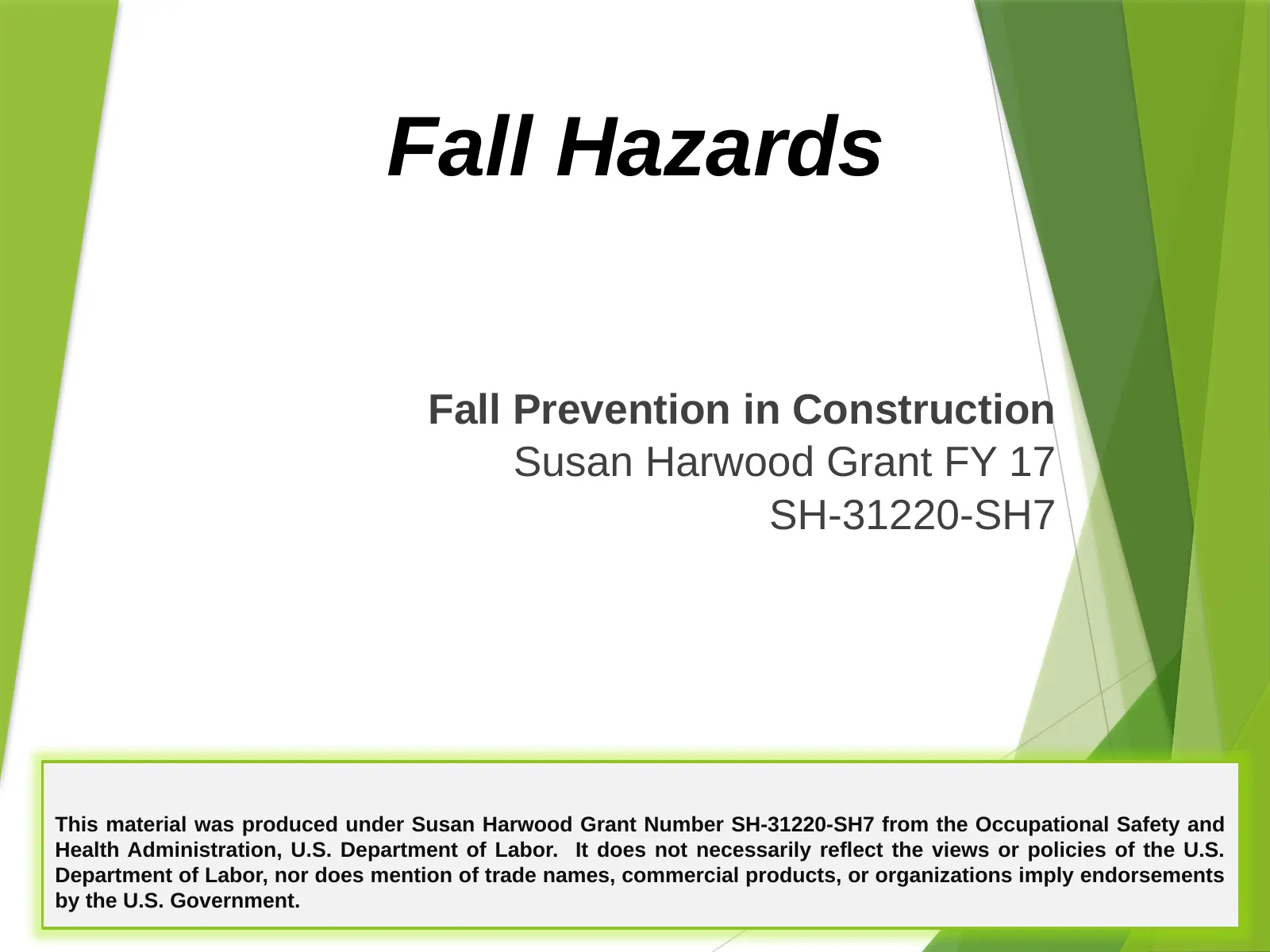
Fall Hazards
- Fall Prevention in Construction
- Susan Harwood Grant FY 17
- SH-31220-SH7
- This material was produced under Susan Harwood Grant Number SH-31220-SH7 from the Occupational Safety and Health Administration, U.S. Department of Labor. It does not necessarily reflect the views or policies of the U.S. Department of Labor, nor does mention of trade names, commercial products, or organizations imply endorsements by the U.S. Government.
- Slide 2
Introduction
- The following presentations have been developed in both Spanish and English for the construction industry. These presentations focus in fall Hazards in construction.
- This training materials will cover the fall hazards seen regularly on construction sites and will focus on the methods for the recognition and the prevention of these common hazards .
- Slide 3
Fall Hazards - Overview
- Fall Hazards
- Accident Prevention
- Building Structures
- Guardrails
- Exterior Construction Areas
- Warning Lines
- Scaffolds
- Stairs
- Ladders
- Personal Fall Arrest Systems
- Floor Covers
- Slide 4
Fall Hazards
- Falls are one of the greatest hazards on construction sites.
- This program will help you recognize common fall hazards.
- The symbols will tell you if the situation in the picture is either safe or not safe.
- Slide 5
Fall Hazards Statistics
- Each year workers die from falls. During the year 2015:
- Total deaths from falls: 648
- Deaths in construction: 298
- A total of 46% of deaths in Construction are from falls
- Approximately 13% of all occupational deaths are falls
- Slide 6
Fall Hazards
- Fall hazards can be found on every construction site:
- Building structures
- Exterior construction areas
- Scaffolds
- Stairs
- Ladders
- Slide 7
Building Structures
- Work conditions 6’ or more above lower level require the use of fall protection:
- Unprotected sides, edges
- Leading edges
- Excavations
- Walking/working surfaces
- Slide 8
Building Structures
- This worker is working 6’ above the lower level without using fall protection.
- Slide 9
Building Structures
- When working at a height of 6’ above the lower level you must use fall protection:
- Personal fall arrest systems
- Guardrails
- Slide 10
Building Structures
- When working at a height of 6’ above the lower level you must use fall protection.
- These workers are not utilizing a personal fall arrest system.
- Slide 11
Building Structures
- Guardrails must be maintained when working 6’ above lower level.
- Slide 12
Building Structures
- Damaged or missing guardrails must be fixed immediately.
- Slide 13
Exterior Construction Areas
- Falls from a short distance can result in serious injury.
- All workers must be protected from falling onto sharp materials.
- Slide 14
Exterior Construction Areas
- All open excavations and pier holes must be guarded or protected.
- Slide 15
Scaffolds
- Scaffolds are elevated,temporary work platforms:
- Supported scaffold
- Guardrails
- Access ladders
- Powered work
- platforms
- Slide 16
Scaffolds
- Scaffold bases must
- rest on a base plate and a mud sill.
- The base plate is
- designed to level and support the scaffold.
- Slide 17
Scaffolds
- Only work from scaffolds that are properly constructed and supported.
- Slide 18
Scaffolds
- Scaffolds used in stair wells must be properly constructed.
- Slide 19
Scaffolds
- When working on scaffolds 6’ above lower level, guardrails must be installed.
- Slide 20
Scaffolds
- Never use scaffolds that do not have proper guardrails installed.
- Slide 21
Scaffolds
- Scaffold platforms must be fully and properly planked
- Slide 22
Scaffolds
- Never stack blocks, bricks, or use ladders on top of scaffolds for extra height.
- Slide 23
Scaffolds
- Workers must have a safe way to access the scaffold.
- Slide 24
Scaffolds
- Never use blocks, bricks, walk boards, and other unsafe methods to access a scaffold.
- Slide 25
Scaffolds
- Use only ladders designed for use with scaffolds.
- The ladder must be firmly secured to the scaffold.
- Slide 26
Powered Work Platforms
- Powered platforms include:
- man-baskets placed on a forklift, aerial lifts, and scissor lifts.
- Slide 27
Powered Work Platforms
- Always make sure you have proper fall protection and training before using a powered platform.
- Slide 28
Powered Work Platforms
- Only use equipment that is designed for lifting personnel.
- Slide 29
Stairs
- Stairways must have a stair rail along each unprotected side or edge.
- Slide 30
Stairs
- Stairs that have walls on both sides must have at least one hand rail on the right-hand side when climbing down.
- Slide 31
Ladders
- Never use stairs that are not complete or unsafe.
- Slide 32
Ladders
- Ladders must be inspected prior to use.
- Ladders must be kept in a good condition and safe location.
- Slide 33
Ladders
- Do not stand on the top of a ladder.
- Slide 34
Ladders
- Read labels on ladders for instructions to ensure proper use
- Slide 35
Ladders
- Always maintain
- good footing on a step ladder.
- Use the correct
- size ladder for the work that is to be done.
- Slide 36
Ladders
- Always use the right equipment for the job:
- Ladders
- Lifts
- Scaffolds
- Slide 37
Ladders
- Never straddle or sit on top of a step ladder.
- Slide 38
Ladders
- An A-Frame ladder
- must be fully opened and locked into position.
- Use ladders only for
- their designed purpose.
- Slide 39
Ladders
- Only use ladders on stable and level surfaces to prevent accidental movement.
- Slide 40
Ladders
- Ladders must be positioned at a safe angle to avoid potential fall hazards when climbing.
- Extension ladders must extend 3’ over the landing for safe access.
- Slide 41
Ladders
- When using a portable ladder for access to an upper landing surface, the side rails must extend at least 3’ above the upper landing surface.
- Slide 42
Ladders
- Proper use
- vs.
- Improper application
- Slide 43
Ladders
- Maintain contact with the ladder using both hands to keep a safe grip.
- Face ladder when going up or down.
- Never climb a ladder while carrying any materials.
- Slide 44
Job Made Ladders
- Job made ladders must be properly constructed:
- Steps equally spaced
- No missing steps or rungs
- No sharp edges or nails sticking out
- Slide 45
Job Made Ladders
- Never use a job made
- ladder that is damaged or missing steps.
- Only use a job made
- ladder that has been properly built.
- Slide 46
Job Made Ladders
- must also be constructed so that no nails protrude or sharp edges exist.
- Nails and sharp
- edges can catch on
- clothing and cause
- falls.
- Slide 47
QUIZ
- You will be presented with a specific hazard recognition question to test your understanding of this material.
- Slide 48
Question 1
- Before using a ladder, inspect it for which of the following?
- A.
- Cracks in the frame
- B.
- Broken or missing rungs
- C.
- Oil, grease or other substances on the rungs
- D.
- All of the above
- Slide 49
Question 1
- Before using a ladder, inspect it for which of the following?
- The correct answer is:
- D – All of the above
- Slide 50
Question 2
- Job made ladders may be used if the steps are equally spaced with no steps missing and no sharp edges or nails sticking out.
- True
- B. False
- A.
- Slide 51
Question 2
- Job made ladders may be used if the steps are equally spaced with no steps missing and no sharp edges or nails sticking out.
- The correct answer is:
- A - True
- Slide 52
Question 3
- When erecting scaffolding, the base plate must be placed on what?
- A.
- B.
- C.
- D.
- A Firm Foundation
- Cement Blocks
- Soft Dirt
- Wood Blocks
- Slide 53
Question 3
- When erecting scaffolding, the base plate must be placed on what?
- The correct answer is:
- A – A Firm Foundation
- Slide 54
Question 4
- When working on scaffolding and you need a little more height, you must do the following:
- Stand on a saw-horse Jump
- Erect another section of scaffolding
- D. Use a ladder
- A. B. C.
- Slide 55
Question 4
- When working on scaffolding and you need a little more height, you must do the following:
- The correct answer is:
- C – Erect another section of scaffolding
- Slide 56
Question 5
- Stairs that are incomplete and missing handrails are acceptable to use during the construction phase of the project.
- True
- B. False
- A.
- Slide 57
Question 5
- Stairs that are incomplete and missing handrails are acceptable to use during the construction phase of the project.
- The correct answer is:
- B – False
- Slide 58
Accident Prevention
- A willing, positive attitude towards safety will help make a safer work environment.
- Slide 59
Preventing Fall Accidents
- Construction work performed at 6’ or higher above a lower level requires fall protection.
- Some fall protection methods include:
- Guardrails
- Warning lines
- Fall arrest systems and
- Floor covers
- Slide 60
Guardrails
- Guardrails must have a top rail, a mid rail and a toe board.
- The top rail must be at least 42” from the working surface.
- Slide 61
Guardrails
- All guardrails must be constructed with a top rail and a mid rail.
- The top rail must support 200 lbs. of force downward and outward.
- Slide 62
Guardrails
- Cable guardrails must meet the same rules as wood guardrails.
- The top rail must be at least 42” high and resist up to 200 lbs.
- Slide 63
Cable Guardrails
- Steel cable guardrails must have the top rail flagged every 6 feet.
- Slide 64
Cable Guardrails
- The clamps used for a steel cable system must be placed correctly.
- Slide 65
Warning Lines
- Warning lines are used to keep workers away from an unsafe edge.
- The warning line must be at least 6’ away from the edge.
- Slide 66
Warning Lines
- Warning lines must withstand 16 lbs. of tipping force.
- The warning line must be at least 34” from the ground.
- Slide 67
Warning Lines
- Warning lines must be maintained.
- Report any unsafe condition to your supervisor.
- Slide 68
Warning Lines
- Never work in an area if the warning line has been knocked down or damaged.
- Slide 69
Personal Fall Arrest Systems
- The fall arrest system components are:
- body harness,
- lanyard, and
- anchorage point
- Slide 70
Personal Fall Arrest Systems
- Body harness must be worn properly.
- D-ring must rest between the shoulders and the chest strap must be secured.
- Slide 71
Body harness must be:
- Personal Fall Arrest Systems
- inspected before use,
- adjusted to fit the worker, and
- free from other visible damage.
- Slide 72
Personal Fall Arrest Systems
- Lanyards must be in good condition and free from visible damage.
- Slide 73
Personal Fall Arrest Systems
- Lanyard must attach to the D-ring on the body harness.
- Slide 74
Personal Fall Arrest Systems
- Never anchor or tie
- off to pipes, wood structures, electrical wires, or other areas not designed for anchorage points.
- Slide 75
Personal Fall Arrest Systems
- The anchorage point is
- the place where you tie off to or hook to.
- The anchorage point
- must support the force of a person falling.
- Slide 76
Personal Fall Arrest Systems
- A life line is used to allow a worker to stay tied off while he moves through the work area.
- Slide 77
Personal Fall Arrest Systems
- Workers must always be tied off when working with a personal fall arrest system .
- Slide 78
Floor Covers
- The cover must be marked to make sure everyone knows it is a safety device.
- Slide 79
Floor Covers
- All floor holes where an employee could fall through must be covered or guarded.
- Slide 80
Floor Covers
- Sky-lights are another form of floor holes.
- Never sit, stand, or place any materials on sky-lights.
- Slide 81
Floor Covers
- Pier holes must be guarded or protected.
- Either a guard rail system or floor hole cover can be used.
- Slide 82
QUIZ
- You will be presented with a specific accident prevention question to test your understanding of this material.
- Slide 83
Question 1
- While working in the construction industry, at what height is fall protection required?
- 4 feet
- B. 10 feet
- C. 6 feet
- D. 8 feet
- A.
- Slide 84
Question 1
- While working in the construction industry, at what height is fall protection required?
- The correct answer is:
- C – 6 feet
- Slide 85
Question 2
- Guardrails are designed to protect you from falling. The top rail must be inches high and be able to withstand pounds of force.
- A. 42 / 300
- B. 36 / 300
- C. 42 / 200
- D. 36 / 200
- Slide 86
Question 2
- Guardrails are designed to protect you from falling. The top rail must be inches high and be able to withstand
- pounds of force.
- The correct answer is:
- C – 42 / 200
- Slide 87
Question 3
- Guardrails can be made of wood or steel cables. When using steel cables the cable clamps must be placed:
- In alternating directions
- With the U-bolt on the dead end of the cable With the saddle on the dead end of the cable
- D. None of the above, clamps are not required
- A. B. C.
- Slide 88
Question 3
- Guardrails can be made of wood or steal cables. When using steal cables the cable clamps must be placed:
- The correct answer is:
- B – With the U-bolt on the dead end of the cable
- Slide 89
Question 4
- When inspecting a harness before using it, you should look for the following:
- Cuts/Abrasions
- B. Burns
- C. Other visible damage
- D. All the above
- A.
- Slide 90
Question 4
- When inspecting a harness before using it, you should look for the following:
- The correct answer is:
- D – All the above
- Slide 91
Question 5
- Floor holes can include which of the following:
- Pier holes, skylights and stair openings
- B. Pier holes, skylights and window openings
- C. Skylights, stair openings and doorways
- D. Skylights, stair openings and open sided floors
- A.
- Slide 92
Question 5
- Floor holes can include which of the following:
- The correct answer is:
- A – Pier holes, skylights and stair openings
- Slide 93
Thank You For Attending!
- Questions
More on Falls
ppt
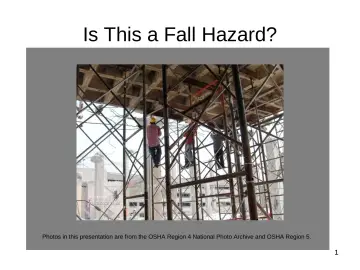
24 slidesFocus Four: Fall Hazard Recognition
OSHA's official Construction Focus Four slide deck on recognizing and preventing fall hazards; pairs with the Fall Hazards instructor guide.
U.S. Department of Labor, OSHAPublic domain
pdf
50 slidesFocus Four: Fall Hazards Instructor Guide
OSHA instructor guide/lesson plan for the Focus Four fall hazards module (minimum 1.5 hours in the 10-hour course).
U.S. Department of Labor, OSHAPublic domain
pdf
10 slidesFocus Four: Fall Hazards Student Handouts
Student handouts: guardrail and safety net summary, personal fall arrest summary, preventing ladder falls, scaffold hazards.
U.S. Department of Labor, OSHAPublic domain