1 / 28Use ← → to flip
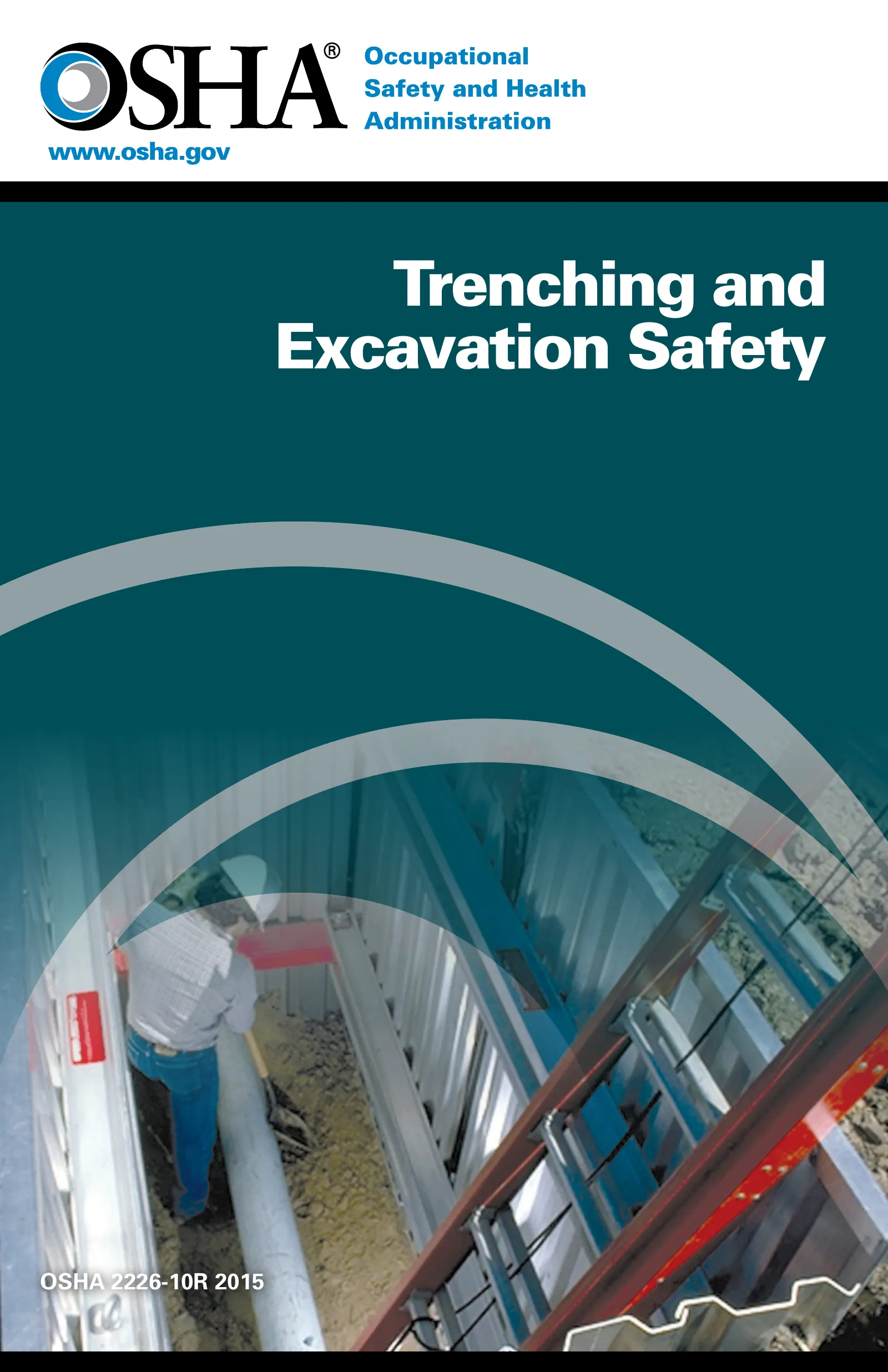
Trenching and Excavation Safety (OSHA 2226)
OSHA booklet on the excavation standard (Subpart P), soil types and protective systems.
Page text
· 27 of 28 pages · by U.S. Department of Labor, OSHA
The words on each page as the author wrote them, read from the file by software so they can be searched. Layout, pictures and tables are not shown here, and long pages are shortened: the pages above and the download are the original.
- Page 1
Trenching and Excavation Safety
- OSHA 2226-10R 2015
- Page 2
Occupational Safety and Health Act of 1970
- “To assure safe and healthful working conditions for working men and women; by authorizing enforcement of the standards developed under the Act; by assisting and encouraging the States in their efforts to assure safe and healthful working conditions; by providing for research, information, education, and training in the field of occupational safety and health.”
- Material contained in this publication is in the public domain and may be reproduced, fully or partially, without permission. Source credit is requested but not required.
- This information will be made available to sensory-impaired individuals upon request. Voice phone: (202) 693-1999; teletypewriter (TTY) number: 1-877-889-5627.
- This publication is intended to provide information about OSHA’s Excavations standards at 29 CFR Part 1926, Subpart P. The Occupational Safety and Health Act requires employers to comply with safety and health standards promulgated by OSHA or by a state with an OSHA-approved state plan. …
- …
- Page 3
Trenching and Excavation Safety
- U.S. Department of Labor
- Occupational Safety and Health Administration
- OSHA 2226-10R 2015
- Page 5
Table of Contents
- Introduction … 1
- What is the difference between an excavation and a trench? … 1
- What are the dangers of trenching and excavation operations? … 1
- What do the OSHA Excavation standards cover, and how do they protect workers? … 1
- What are the soil classification categories? … 2
- What is a competent person? … 3
- Preplanning … 3
- Why is preplanning important to excavation work? … 3
- What safety factors should be considered when bidding on a job? … 4
- How can employers avoid hitting underground utility lines and pipes during excavation work? … 4
- Protective Systems … 5
- How can employers prevent cave-ins? … 5
- What types of protective systems can employers use to protect workers from cave-ins? … 5
- What other precautions do employers need to take to protect workers from cave-ins? … 7
- What are the requirements for safely installing and removing protective systems? … 8
- What do employers need to do to maintain materials and equipment used for protective systems? … 9
- Additional Hazards and Protections … 9
- What other excavation hazards do employers need to address? … 9
- …
- Page 6
What means of access and egress must employers provide? … 12
- What protective equipment are employers required to provide to workers in pier holes and confined footing excavations? … 12
- When must employers conduct site inspections? … 12
- Conclusion … 13
- Workers’ Rights … 14
- OSHA Assistance, Services and Programs … 14
- Establishing an Injury and Illness Prevention Program … 15
- Compliance Assistance Specialists … 15
- Free On-site Safety and Health Consultation Services for Small Business … 15
- Cooperative Programs … 16
- Occupational Safety and Health Training … 17
- OSHA Educational Materials … 17
- NIOSH Health Hazard Evaluation Program … 18
- OSHA Regional Offices … 19
- How to Contact OSHA … 21
- Page 7
Introduction
- Excavation and trenching are among the most hazardous construction operations. The Occupational Safety and Health Administration’s (OSHA) Excavation standards, 29 Code of Federal Regulations (CFR) Part 1926, Subpart P, contain requirements for excavation and trenching operations. This booklet highlights key elements of the standards and describes safe work practices that can protect workers from cave-ins and other hazards.
- What is the difference between an excavation and a trench?
- OSHA defines an excavation as any man-made cut, cavity, trench, or depression in the Earth’s surface formed by earth removal.
- A trench is defined as a narrow excavation (in relation to its length) made below the surface of the ground. In general, the depth of a trench is greater than its width, but the width of a trench (measured at the bottom) is not greater than 15 feet (4.6 m).
- What are the dangers of trenching and excavation operations?
- Trenching and excavation work presents serious hazards to all workers involved. Cave-ins pose the greatest risk and are more likely than some other excavation-related…
- …
- Page 8
What are the soil classification categories?
- Some of the compliance methods permitted under the Excavation standards require a competent person to classify soil and rock deposits as:
- Stable rock;
- Type B soil; or
- Type A soil;
- Type C soil.
- See Appendix A to Subpart P of Part 1926 – Soil Classification.
- Stable Rock – Natural solid mineral matter that can be excavated with vertical sides and remain intact while exposed.
- Type A – Cohesive soils with an unconfined compressive strength of 1.5 tons per square foot (tsf) (144 kPa) or greater. Examples include: clay, silty clay, sandy clay, and clay loam. Certain conditions preclude soil from being classified as Type
- A. For example, no soil is Type A if it is fissured or has been previously disturbed. See Appendix A to Subpart P of Part 1926, paragraph (b) – Definitions (Type A), for a detailed definition of Type A soil.
- Type B – Includes cohesive soil with an unconfined compressive strength greater than 0.5 tsf (48 kPa) but less than 1.5 tsf (144 kPa) and granular cohesionless soils (such as angular gravel, similar to crushed rock, silt, silt loam, sandy…
- …
- Page 9
What is a competent person?
- Note: Unconfined compressive strength means the load per unit area at which a soil will fail in compression. It can be determined by laboratory testing or estimated in the field using a pocket penetrometer, thumb penetration tests, or other methods.
- See the video link below
- for additional guidance on classifying soil: www.osha.gov/dts/vtools/construction/soil_testing_fnl_eng_web.html.
- A competent person is an individual, designated by the employer, who is capable of identifying existing and predictable hazards in the surroundings or working conditions which are unsanitary, hazardous or dangerous to workers, and who is authorized to take prompt corrective measures to eliminate them.
- Under the Excavation standards, tasks performed by the competent person include:
- Classifying soil;
- Inspecting protective systems;
- Monitoring water removal equipment; and
- Conducting site inspections.
- Designing structural ramps;
- Preplanning
- Why is preplanning important to excavation work?
- No matter how many trenching, shoring, and backfilling jobs an employer has done in the past, it is…
- …
- Page 10
What safety factors should be considered when bidding on a job?
- work starts to correct mistakes in shoring or sloping slows down the operation, adds to the cost of the project, and makes a cave-in or other excavation failure more likely.
- Before preparing a bid, employers should know as much as possible about the jobsite and the materials they will need to have on hand to perform the work safely and in compliance with OSHA standards. A safety checklist may prove helpful when employers are considering new projects. Factors to consider may include:
- Traffic
- Weather
- Proximity and physical condition of nearby structures
- Quantity of shoring or protective systems that may be required
- Soil classification
- Fall protection needs
- Surface and ground water
- Location of the water table
- Number of ladders that may be needed
- Overhead and underground utilities
- Other equipment needs.
- Employers can gather the information they need through jobsite studies, observations, test borings for soil type or conditions, and consultations with local officials and utility companies. …
- …
- Page 11
Protective Systems
- Contact and notify the utility companies or owners involved to inform them of the proposed work within established or customary local response times.
- Ask the utility companies or owners to establish the location of underground installations prior to the start of excavation work. If they cannot respond within 24 hours (unless the period required by state or local law is longer) or cannot establish the exact location of the utility installations, employers may proceed with caution, which includes using detection equipment or other acceptable means to locate utility installations.
- Determine the exact location of underground installations by safe and acceptable means when excavation operations approach the approximate location of the installations.
- Ensure that while the excavation is open, underground installations are protected, supported or removed as necessary to safeguard workers.
- How can employers prevent cave-ins?
- OSHA generally requires that employers protect workers from cave-ins by:
- Sloping and benching the sides of the excavation;
- …
- Page 12
- in the vicinity. Employers are free to choose the most practical design that will provide the necessary protections. Any system used must meet the required performance criteria.
- The Excavation standards describe various methods and approaches that can be used to design protective systems. Examples of protective systems that can be used to comply with the Excavation standards include:
- Sloping the sides of the excavation to an angle not steeper than 1½:1 (for every foot of depth, the trench must be excavated back 1½ feet). A slope of this gradation is safe for any type of soil.
- Figure 1. Slope of 1½:1
- Designing a sloping and benching system in accord with tabulated data, such as tables and charts, approved by a registered professional engineer. This data must be in writing and must include enough explanatory information (including the criteria for selecting a system and the limits on the use of the data) for the user to be able to select an appropriate protective system. …
- …
- Page 13
Figure 2. Trench Shields
- The Excavation standards do not require a protective system when an excavation is made entirely in stable rock or when an excavation is less than 5 feet (1.52 meters) deep and a competent person has examined the ground and found no indication of a potential cave-in.
- What other precautions do employers need to take to protect workers from cave-ins?
- The Excavation standards require employers to provide support systems, such as shoring, bracing, or underpinning, when necessary to ensure that adjacent structures (including adjoining buildings, walls, sidewalks and pavements) remain stable for the protection of workers. The standards also prohibit excavation below the base or footing of any foundation or retaining wall that could be reasonably expected to pose a hazard to workers unless:
- The employer provides a support system, such as underpinning;
- The excavation is in stable rock; or
- Page 14
What are the requirements for safely installing and removing protective systems?
- A registered professional engineer determines that the structure is far enough away from the excavation that it would not be affected by the excavation activity or that the excavation work will not pose a hazard to workers.
- Excavations that would undermine sidewalks, pavement, and appurtenant structures are prohibited unless the employer provides an appropriately designed support system or another effective method of protecting workers from the possible collapse of those structures.
- The Excavation standards require employers to take certain steps to protect workers when installing and removing support systems. For example:
- Members of support systems must be securely connected to prevent sliding, falling, kickouts or predictable failure.
- Support systems must be installed and removed in a manner that protects workers from cave-ins and structural collapses and from being struck by members of the support system.
- Members of support systems must not be overloaded.
- …
- Page 15
What do employers need to do to maintain materials and equipment used for protective systems?
- Employers are responsible for maintaining materials and equipment used for protective systems. Defective and damaged materials and equipment can cause protective systems to fail and lead to other excavation hazards.
- Employers must ensure that:
- Materials and equipment are free from damage or defects that might impair their proper function;
- Manufactured materials and equipment are used and maintained consistent with the manufacturer’s recommendations and are used so as to prevent worker exposure to hazards;
- A competent person examines any damaged materials or equipment to evaluate its suitability for continued use; and
- If a competent person cannot assure that damaged material or equipment can support the intended loads or is otherwise suitable for use, the materials and equipment are removed from service until evaluated and approved by a registered professional engineer.
- Additional Hazards and Protections
- What other excavation hazards do employers need to address?
- …
- Page 16
- inside the excavation by placing and keeping such materials or equipment at least 2 feet (0.61 meters) from the edge and/or by using a retaining device to keep the materials or equipment from falling or rolling into the excavation.
- Provide a warning system (such as barricades, hand or mechanical signals, or stop logs) when mobile equipment is operated adjacent to an excavation, or when such equipment must approach the edge of an excavation, and the operator does not have a clear and direct view of the edge.
- Protect workers from loose rock or soil that could fall or roll from an excavation face by scaling to remove loose material, installing protective barricades at appropriate intervals, or using other equivalent forms of protection.
- Institute and enforce work rules prohibiting workers from working on faces of sloped or benched excavations at levels above other workers unless the workers at the lower levels are adequately protected from the hazards of falling, rolling, or sliding material or equipment.
- Institute and enforce work rules prohibiting workers from standing or working under loads…
- …
- Page 17
How can employers protect workers from hazardous atmospheres inside excavations?
- support or shield systems to prevent cave-ins, water removal to control the water level, or the use of a safety harness and lifeline. If an employer uses water removal equipment to control or prevent water accumulation, the equipment and operations must be monitored by a competent person to ensure proper use. If excavation work interrupts the natural drainage of surface water, the OSHA standards also require the use of diversion ditches, dikes, or other suitable means to prevent surface water from entering the excavation and to provide adequate drainage of the adjacent area. In addition, a competent person must inspect excavations subject to runoffs from heavy rains, and excavations subject to such runoffs are subject to the requirements described previously in this paragraph.
- Atmospheric testing is required before workers enter an excavation greater than 4 feet (1.22 meters) in depth where an oxygen deficiency or a hazardous atmosphere is present or could reasonably be expected, such as in excavations in landfill…
- …
- Page 18
What means of access and egress must employers provide?
- excavation. These standards are intended to complement each other and address two distinct hazards: hazardous atmospheres in excavations and the additional hazards associated with confined spaces located within excavations. For example, the Confined Spaces in Construction standard covers entry into a prefabricated storm drain, other pipe, or manhole even if located at the bottom of an open excavation.
- OSHA requires employers to provide ladders, steps, ramps, or other safe means of egress for workers working in trench excavations 4 feet (1.22 meters) or deeper. The means of egress must be located so as not to require workers to travel more than 25 feet (7.62 meters) laterally within the trench.
- Any structural ramps used solely for worker access or egress must be designed by a competent person. Structural ramps used for access or egress of equipment must be designed by a competent person qualified in structural design. …
- …
- Page 19
Conclusion
- conditions. Inspections must be done prior to the start of work and as needed throughout the shift. Inspections are also required after natural events, such as rainstorms, or other hazard-increasing occurrences, such as blasting work. If an inspector finds any unsafe conditions during an inspection, the employer must clear workers from the hazardous area until the necessary safety precautions have been taken.
- When employers share the details of their safety and health programs with workers, they should emphasize the critical role workers play in keeping the jobsite safe. Employers also need to emphasize specific practices that will help reduce the risk of on-the-job injuries at excavation sites. Such practices can include the following:
- Know where underground utilities are located before digging.
- Keep excavated soil (spoils) and other materials at least 2 feet (0.61 meters) from trench edges.
- Keep heavy equipment away from trench edges.
- Identify any equipment or activities that could affect trench stability.
- …
- Page 20
Workers’ Rights
- policies, procedures, and practices for protecting workers from job-related safety and health hazards. See www.osha.gov/Publications/safety-health-management-systems.pdf.
- Workers have the right to:
- Working conditions that do not pose a risk of serious harm.
- Receive information and training (in a language and vocabulary the worker understands) about workplace hazards, methods to prevent them, and the OSHA standards that apply to their workplace.
- Review records of work-related injuries and illnesses.
- File a complaint asking OSHA to inspect their workplace if they believe there is a serious hazard or that their employer is not following OSHA’s rules. OSHA will keep all identities confidential.
- Exercise their rights under the law without retaliation, including reporting an injury or raising health and safety concerns with their employer or OSHA. If a worker has been retaliated against for using their rights, they must file a complaint with OSHA as soon as possible, but no later than 30 days.
- For more information, see OSHA’s Workers page.
- OSHA Assistance, Services and Programs
- …
- Page 21
Establishing an Injury and Illness Prevention Program
- The key to a safe and healthful work environment is a comprehensive injury and illness prevention program.
- Injury and illness prevention programs are systems that can substantially reduce the number and severity of workplace injuries and illnesses, while reducing costs to employers. Thousands of employers across the United States already manage safety using injury and illness prevention programs, and OSHA believes that all employers can and should do the same. Thirty-four states have requirements or voluntary guidelines for workplace injury and illness prevention programs. Most successful injury and illness prevention programs are based on a common set of key elements. These include management leadership, worker participation, hazard identification, hazard prevention and control, education and training, and program evaluation and improvement. Visit OSHA’s Injury and Illness Prevention Programs web page at www.osha.gov/dsg/topics/safetyhealth for more information.
- Compliance Assistance Specialists
- …
- Page 22
- management programs, OSHA’s On-site Consultation Program conducts over 29,000 visits to small business worksites covering over 1.5 million workers across the nation.
- On-site consultation services are separate from enforcement and do not result in penalties or citations. Consultants from state agencies or universities work with employers to identify workplace hazards, provide advice on compliance with OSHA standards, and assist in establishing safety and health management programs.
- For more information, to find the local On-site Consultation office in your state, or to request a brochure on Consultation Services, visit www.osha.gov/consultation, or call 1-800-321-OSHA (6742).
- Under the consultation program, certain exemplary employers may request participation in OSHA’s Safety and Health Achievement Recognition Program (SHARP). Eligibility for participation includes, but is not limited to, receiving a full-service, comprehensive consultation visit, correcting all identified hazards and developing an effective safety and health management program. …
- …
- Page 23
Occupational Safety and Health Training
- and health to prevent workplace fatalities, injuries and illnesses by developing compliance assistance tools and resources to share with workers and employers, and educate workers and employers about their rights and responsibilities.
- Voluntary Protection Programs (VPP)
- The VPP recognize employers and workers in private industry and federal agencies who have implemented effective safety and health management programs and maintain injury and illness rates below the national average for their respective industries. In VPP, management, labor, and OSHA work cooperatively and proactively to prevent fatalities, injuries, and illnesses through a system focused on: hazard prevention and control, worksite analysis, training, and management commitment and worker involvement.
- The OSHA Training Institute partners with 27 OSHA Training Institute Education Centers at 42 locations throughout the United States to deliver courses on OSHA standards and occupational safety and health topics to thousands of students a year. …
- …
- Page 24
NIOSH Health Hazard Evaluation Program
- QuickTakes, OSHA’s free, twice-monthly online newsletter with the latest news about OSHA initiatives and products to assist employers and workers in finding and preventing workplace hazards. To sign up for QuickTakes visit www.osha.gov/quicktakes.
- To view materials available online or for a listing of free publications, visit www.osha.gov/publications. You can also call 1-800-321-OSHA (6742) to order publications.
- Select OSHA publications are available in e-Book format. OSHA e-Books are designed to increase readability on smartphones, tablets and other mobile devices. For access, go to www.osha.gov/ebooks.
- OSHA’s web site also has information on job hazards and injury and illness prevention for employers and workers. To learn more about OSHA’s safety and health resources online, visit www.osha.gov or www.osha.gov/html/a‑z‑index.html.
- Getting Help with Health Hazards
- The National Institute for Occupational Safety and Health (NIOSH) is a federal agency that conducts scientific and medical research on workers’ safety and health. …
- …
- Page 25
OSHA Regional Offices
- Region I
- Boston Regional Office
- (CT*, ME*, MA, NH, RI, VT*)
- JFK Federal Building, Room E340 Boston, MA 02203
- (617) 565-9860 (617) 565-9827 Fax
- Region II
- New York Regional Office
- (NJ*, NY*, PR*, VI*)
- 201 Varick Street, Room 670
- New York, NY 10014
- (212) 337-2378 (212) 337-2371 Fax
- Region III
- Philadelphia Regional Office
- (DE, DC, MD*, PA, VA*, WV)
- The Curtis Center
- 170 S. Independence Mall West
- Suite 740 West
- Philadelphia, PA 19106-3309
- (215) 861-4900 (215) 861-4904 Fax
- Region IV
- Atlanta Regional Office
- (AL, FL, GA, KY*, MS, NC*, SC*, TN*) 61 Forsyth Street, SW, Room 6T50
- Atlanta, GA 30303
- (678) 237-0400 (678) 237-0447 Fax
- Region V
- Chicago Regional Office
- (IL*, IN*, MI*, MN*, OH, WI)
- 230 South Dearborn Street
- Room 3244
- Chicago, IL 60604
- (312) 353-2220 (312) 353-7774 Fax
- Page 26
Region VI
- Dallas Regional Office
- (AR, LA, NM*, OK, TX)
- 525 Griffin Street, Room 602
- Dallas, TX 75202
- (972) 850-4145 (972) 850-4149 Fax
- (972) 850-4150 FSO Fax
- Region VII
- Kansas City Regional Office
- (IA*, KS, MO, NE)
- Two Pershing Square Building
- 2300 Main Street, Suite 1010
- Kansas City, MO 64108-2416
- (816) 283-8745 (816) 283-0547 Fax
- Region VIII
- Denver Regional Office
- (CO, MT, ND, SD, UT*, WY*) Cesar Chavez Memorial Building 1244 Speer Boulevard, Suite 551 Denver, CO 80204
- (720) 264-6550 (720) 264-6585 Fax
- Region IX
- San Francisco Regional Office
- (AZ*, CA*, HI*, NV*, and American Samoa, Guam and the Northern Mariana Islands) 90 7th Street, Suite 18100
- San Francisco, CA 94103
- (415) 625-2547 (415) 625-2534 Fax
- Region X
- Seattle Regional Office
- (AK*, ID, OR*, WA*)
- 300 Fifth Avenue, Suite 1280
- Seattle, WA 98104
- (206) 757-6700 (206) 757-6705 Fax
- Page 27
How to Contact OSHA
- These states and territories operate their own OSHA-approved job safety and health plans and cover state and local government employees as well as private sector employees. The Connecticut, Illinois, Maine, New Jersey, New York and Virgin Islands programs cover public employees only. (Private sector workers in these states are covered by Federal OSHA). States with approved programs must have standards that are identical to, or at least as effective as, the Federal OSHA standards.
- Note: To get contact information for OSHA area offices, OSHAapproved state plans and OSHA consultation projects, please visit us online at www.osha.gov or call us at 1-800-321-OSHA (6742).
- For questions or to get information or advice, to report an emergency, fatality, inpatient hospitalization, amputation, or loss of an eye, or to file a confidential complaint, contact your nearest
- OSHA office, visit www.osha.gov or call OSHA at 1-800-321-OSHA (6742), TTY 1-877-889-5627.
- For assistance, contact us. We are OSHA. We can help.
- Page 28
U.S. Department of Labor
- For more information:
- Occupational Safety and Health Administration www.osha.gov
- (800) 321-OSHA (6742)
More on Excavations
pptx
42 slidesExcavations (OSHA 10-Hour Construction Outreach)
OSHA's own 10-hour Construction Outreach deck on trenching and excavation hazards and protective systems (2015 edition).
U.S. Department of Labor, OSHA (with the OTIEC Outreach Workgroup)ArchivedPublic domain
pdf
7 slidesExcavations: Lesson Plan (OSHA 10-Hour Construction Outreach)
Instructor lesson plan with objectives, timing and teaching procedures for the OSHA excavations outreach deck.
U.S. Department of Labor, OSHA (with the OTIEC Outreach Workgroup)ArchivedPublic domain
pdf
1 slidesExcavations: Knowledge Check (OSHA 10-Hour Construction Outreach)
Student knowledge-check quiz that accompanies the OSHA excavations outreach deck.
U.S. Department of Labor, OSHA (with the OTIEC Outreach Workgroup)ArchivedPublic domain