1 / 103Use ← → to flip
Excavation and Trenching Hazards in Construction
Southern Illinois University excavation and trenching hazards in construction (version without embedded videos).
Slide text
· 103 slides · by Southern Illinois University Carbondale Board of Trustees
The words on each slide as the author wrote them, read from the file by software so they can be searched. Layout, pictures and tables are not shown here: the slides above and the download are the original.
- Slide 1
Excavation and Trenching Hazards in Construction
- A Language and Literacy Appropriate
- Safety Training
- This material was produced under a grant (SH-05149-SH9) from the Occupational Safety and Health Administration, U.S. Department of Labor. It does not necessarily reflect the views or policies of the U.S. Department of Labor, nor does mention of trade names, commercial products, or organizations imply endorsement by the U.S. Government.
- Slide 2
Disclaimer
- No legal advice is offered or implied, and no attorney-client relationship is intended or established. If legal advice or other expert assistance is required, the services of a competent professional should be sought.
- It is the responsibility of the employer and its employees to comply with all pertinent OSHA rules and regulations in the jurisdiction in which they work.
- Slide 3
Objectives
- Understand basic terms and knowledge
- Recognize competent persons and employer responsibilities to protect workers
- Raise awareness about the hazards of working in trenches
- Identify major types of excavation hazards at construction workplaces
- Learn how to prevent excavation accidents at construction sites
- Slide 4
Step-by-Step Training Agenda
- Sign Up
- Pre-Test
- Training Modules
- Case Study
- Basic Terms
- Case Study
- Excavation Hazards
- Excavation
- Hazards Prevention
- Post-Test
- Feedback Survey
- Slide 5
Sign-In
- It is time to fill out the sign-in sheet
- Slide 6
Pre-Test
- Please Begin Pre-Test (15 Minutes)
- Slide 7
Section I: Training Modules
- Section I: Basic Terms and Case Study
- Worker Rights under OSH Act
- Basic Terms Associated with Excavation
- Excavation and Trenching Hazards Statistics
- A Case Study Discussion
- Slide 8
Section II: Training Modules
- Section II: Excavation Hazards in Construction
- Cave-In (Trench Collapse)
- Water Accumulation
- Oxygen Deficiency and Toxic Fumes
- Ingress or Egress
- Exposure to Falling Loads
- Mobile Equipment
- Electrocution or Explosion
- Slide 9
Section III: Training Modules
- Section III: Excavation Hazards Prevention
- Cave-In Protection Measures
- Look for Standing Water in Trenches
- Test for Atmospheric Hazards
- Ensure a Safe Way of Entering and Exit
- Don’t Work under Suspended or Raised Loads
- Keep Materials Away from Trench Edges
- Never Dig Trench Unless Being Properly Inspected
- Slide 10
Training Modules Agenda for Section I
- Section I: Basic Terms and Case Study
- Worker Rights under OSHA Act
- Basic Terms Associated with Excavation
- Excavation and Trenching Hazards Statistics
- A Case Study Discussion
- Section II: Excavation Hazards in Construction
- Section III: Excavation Hazards Prevention
- Slide 11
Worker Rights Under the OSH Act
- Workers have rights to
- Working condition without a risk of serious harm
- Review employer’s records of work-related injuries and illnesses
- Get a copy of their medical records
- Receive information and training about hazards and prevention methods, and the OSHA standards
- Slide 12
More Worker Rights Under the OSH Act
- Workers have rights to
- File a complaint asking OSHA to inspect workplace
- OSHA will keep all identities confidential
- Exercise rights under the law without retaliation
- If a worker is retaliated against for using their rights, the worker must file a complaint with OSHA as soon as possible (no later than 30 days)
- Slide 13
Worker Rights: OSHA Standard
- OSHA safety training and education standard for construction industry, in Title 29, Code of Federal Regulations (29 CFR 1926), mandates that “The employer shall instruct each employee in the recognition and avoidance of unsafe conditions and the regulations applicable to his work environment to control or eliminate any hazards or other exposure to illness or injury”.
- Slide 14
Basic Terms (Part 1)
- Excavation: a man-made cut, cavity, trench, or depression formed by earth removal
- Trench: an underground narrow excavation
- Width ≤ 15 feet
- Depth > Width
- OSHA Regulation: 1926.650
- Trench Depth
- Trench Width
- All excavations are inherently unstable and hazardous 14
- Slide 15
Basic Terms (Part 2)
- Soil Stability: When stress (e.g., water or force) is applied to soil, soil will decompose due to the loss of its compressive strength and stiffness
- Four Types of Soils: Based on soil stability
- Type C Type B Type A Stable Rock
- Low
- Stability
- High
- Stability
- Slide 16
Basic Terms (Part 3)
- Stable Rock: natural solid mineral matter that can be excavated with vertical sides and remain intact while exposed
- Is this stable rock?
- It is hard to determine stable rock unless know
- Whether cracks exist and
- Whether cracks run into/ away from excavation
- Slide 17
Basic Terms (Part 4)
- Type A Soils
- Type B Soils
- Type C Soils
- often cracked; No stick together;
- cohesive;
- Features high
- low strength
- strength medium strength
- Weight
- ≥1.5 tons/ square foot
- 0.5~1 tons/ square foot
- ≤0.5 tons/ square foot
- A video is embedded here for soil classification, found at
- (https://www.youtube.com/watch? v=nks5rdeFF5Q)
- OSHA Regulation: 192 6 Subpart P App A
- Slide 18
Basic Terms (Part 5)
- Type A Soils
- Type B Soils
- Type C Soils
- Angular Gravel Granular Soils
- Clay
- Previously
- Submerged Rock
- Example Silty Clay Distributed Soils Soil From which
- Sandy Clay
- Dry Unstable
- Water is Freely
- Rock
- Seeping
- No Soil is Type A if it
- Is fissured
- Is subject to vibration
- Has been previously disturbed Has seeping water
- OSHA Regulation: 1926 Subpart P App A
- Slide 19
Basic Terms (Part 6)
- Thumb Penetration Test: a method of quickly and visually estimate the type of soil
- Press the end of a thumb into a fresh clump of soil
- Type A Soils
- Thumb makes an indentation in soil with great effort
- Type B Soils
- Type C Soils
- Thumb sinks into soil up to the end of thumbnail
- Thumb sinks all the way into soil
- Slide 20
Basic Terms (Part 7)
- A Competent Person
- Be capable of identifying existing and predictable
- excavation hazards
- Be authorized to take prompt corrective measures
- to eliminate the hazards
- OSHA Regulation: 1926.650
- Slide 21
Basic Terms (Part 8)
- Under the OSHA excavation standards, tasks performed by a Competent Person include:
- Classifying soil
- Inspecting protective systems
- Designing structural ramps
- Monitoring water removal equipment
- Conducting site inspections
- OSHA Publication: 2226
- Slide 22
Basic Terms (Part 9)
- A Competent Person inspects excavations, the adjacent areas and protective systems
- Daily
- Prior to the start of work
- As needed throughout shift
- After every rainstorm
- After other hazard increasing occurrence
- OSHA Regulation: 1926.651
- Slide 23
Basic Terms (Part 10)
- Employer Responsibilities
- Under the Occupational Safety and Health
- Act of 1970, employers are responsible for providing safe and healthful workplaces for their employees.
- OSHA’s role is to ensure the safety and health of workers by setting and enforcing standards, and providing training, education, and assistance.
- OSHA: Trenching and Excavation Safety Factsheet
- Slide 24
Excavation Hazard Statistics
- According to the U.S. Department of Labor
- 97 excavation fatalities from 2013-2017 in construction industry (36 death in 2016)
- Excavation fatality rate is 112% higher than
- the rate for general construction
- Most death are
- men in age of 25-34
- due to asphyxiation or internal injuries
- companies of less than 50 workers
- occurred in May, August, November in the South and Midwest
- Slide 25
Excavation Hazard Status
- In recent years, trenching and excavation fatalities reach an alarming number
- Current status and trend
- Skilled construction labor is in short supply
- Some young construction workers are lack of experience, especially in trenching and excavation
- A video is embedded here for trenching and excavation safety, found at
- (https://www.youtube.com/watch?v=6dTu34WqCC0)
- Slide 26
OSHA Educational Efforts
- From 2018, OSHA started National Emphasis Program (NEP) on trenching and excavation to increase education and enforcement efforts
- Require each area office and region develop and implement outreach program
- Increases compliance assistant for trenching
- Issue trenching safety QuickCard, updated posters and web pages
- Slide 27
Excavation Hazard Symbols
- These symbols tell you if the situation in the picture is safe or not safe during this training.
- Safe
- Not safe
- Slide 28
A Case Study Discussion
- Excavation is very hazardous (injury or death)
- A video is embedded here for trench cave-in case study, found at (https://www.youtube.com/watch? v=mjBBmzlKjKg)
- Slide 29
A Case Study Discussion (Part 1)
- Q1: Who is responsible for providing necessary excavation safety training for employees?
- OSHA? Employers? Employees? Competent Person?
- Answer: Employers
- Employers must provide safety training in a language and vocabulary that workers can understand. Employers make sure employees have and use safe tools and equipment
- Slide 30
A Case Study Discussion (Part 2)
- Q2: During excavation, should workers keep tools and materials close to trench edge for easy access?
- Answer: No
- Equipment and materials can easily fall or roll into a trench and hurt workers inside in the trench
- Slide 31
A Case Study Discussion (Part 3)
- Q3: Is wet weather a potential reason for cave-ins?
- Answer: Yes
- Water seeps into the ground and makes it unstable. Small cracks in the ground cause trench collapse
- A video is embedded here for trench cave-in accident partly due to wet weather, found at (https://www.wnep.com/embeds/video/523-8f5e2fd4-bc82-45e5-9d85-ca6c8ace15ab/iframe)
- Slide 32
A Case Study Discussion (Part 4)
- Q4: Can vibrations from nearby construction equipment (e.g., excavator) cause trench collapse?
- Answer: Yes
- Machinery near excavation causes excessive vibration of the ground and forces soil to shift
- A video is embedded here for a trench cave-in, found at (https://www.youtube.com/ watch?v=0wmcD3aM8X4)
- Slide 33
A Case Study Discussion (Part 5)
- Q5: When working in a trench, you notice a condition indicating a possible cave-in. What should you do first?
- Answer: Exit the trench immediately
- Trench collapse may quickly bury workers with a large amount of soil, and cause serious injury
- Slide 34
A Case Study Discussion (Part 6)
- Q6: If a pack of cigarettes falls from your pocket into an unprotected trench, is it safe to jump into this trench to pick up it?
- Answer: No.
- Never enter unprotected trench. Trench collapse is sudden without warning, so never assume that a worker would have time to exit of the trench when cave-in happens.
- Slide 35
A Case Study Discussion (Part 7)
- Q7: If you observe a trench collapse, do you immediately enter the trench to rescue buried coworkers?
- Answer: No. Since a second collapse may occur, untrained rescuers could be trapped and become victims
- Slide 36
A Case Study Discussion (Part 8)
- Date
- Place
- What happen?
- Trench
- sidewall
- burying
- July 2019 Alabama collapsed, workers under 2 feet of soil.
- July 2019
- April 2019
- In an unsecured trench,
- Virginia sidewall
- collapsed, trapping two workers
- Utah
- Injury
- Died due to asphyxiation
- Buried and killed by asphyxiation
- A worker
- entered Asphyxiation due
- excavation with hand
- tools, the spoils pile to the weight of collapsed and trapped him
- soil and died
- in the trench.
- Slide 37
A Case Study Discussion (Part 9)
- Date
- Place
- April 2019
- A worker was standing on the street at the edge of an excavation and guiding his coworker to operate a
- Buried under
- Georgia backhoe. The street surface
- soil (died)
- collapsed, he
- dropped
- into
- excavation. The opposite side of excavation then collapsed.
- May 2017
- A worker was directing a crane Fell in hole operator while standing inside an and engulfed excavation. The ground gave away
- (died) and collapsed.
- New York
- What happen?
- Injury
- Slide 38
Other Reported Accidents
- Source: https://www.osha.gov/pls/imis/accidentsearch.search
- Event Description
- Employee is killed when trench wall collapses
- Employee’s ankle is crushed in trench collapses
- Employee in trench cave-in has ankle broken
- Employee is buried in trench cave-in and legs are fractured
- Employee is caught in trench cave-in and hip is dislocated
- Employee is caught in trench collapse and incurs multiple fractured ribs
- Slide 39
Excavation Hazards
- Slide 40
Training Modules Agenda for Section II
- Section I: Basic Terms and Case Study
- Section II: Excavation Hazards
- Construction
- Cave-In (Trench Collapse)
- Water Accumulation
- Oxygen Deficiency or Toxic Fumes
- Ingress or Egress
- Falls or Exposure to Falling Loads
- Mobile Equipment
- Electrocution or Explosion
- in
- Section III: Excavation Hazards Prevention
- Slide 41
Hazard 1: Cave-In (Part 1)
- It is natural for a trench to try to fill itself.
- 2-3 cubic feet of soil makes person out of breathing and causes permanent brain damage
- Hazardous for employees to work in an unprotected excavation with debris piled atop the excavation
- OSHA Regulation: 1926.650(b)
- Slide 42
Hazard 1: Cave-In (Part 2)
- Slide 43
Hazard 1: Cave-In (Part 3)
- Q8: Why cave-in hazards are so dangerous?
- A cubic yard of soil weights up to 3000 pounds
- Falling off a trench 6 feet overhead
- Falling time = 0.6 seconds
- Hitting speed = 13.3 miles per hour
- Broken bones, internal bleeding, punctured organs, no blood circulation, asphyxiation
- Slide 44
Hazard 1: Cave-In (Part 4)
- While working in a trench, imagine that a car of 3000 pounds may strike you at 13 MPH anytime when cave-in happens.
- A video is embedded here for a car crash accident, found at (https://www.youtube.com/watch?v=YMnvC0oae10)
- Slide 45
Hazard 2: Water Accumulation (Part 1)
- When water is present, the ground is saturated, so it is extremely hazardous to enter
- Slide 46
Hazard 2: Water Accumulation (Part 2)
- Standing Water Increases the Risk of Cave-in
- Slide 47
Hazard 2: Water Accumulation (Part 3)
- A video is embedded here for a trench collapse accident, found at
- (https://denver.cbslocal.com/2019/10/04/backhoe-excavating-company-fine-trench-collapse-two-workers-killed-windsor-firestone-construction-accident-christopher-ramirez-jorge-valadez/)
- In this video, fatal trench collapse occured when
- Water was accumulating in the trench
- Workers in the trench without protective systems
- Slide 48
Hazard 3: Oxygen Deficiency or Toxic Fumes (Part 1)
- Test for atmospheric hazards if trench depth >4 feet
- Especially when
- Gasoline engine-driven equipment is running
- Welding in trenches containing flammable, combustible substances
- OSHA Publication: 2226
- Slide 49
Hazard 3: Oxygen Deficiency or Toxic Fumes (Part 2)
- Testing and Control
- Hazardous fumes
- Toxic gases (e.g., sulfide) Flammable gases or vapors Oxygen deficiency (<19.5% oxygen)
- A video is embedded here for oxygen deficiency, found at (https://www.youtube.com/watch?v=Z8226Umtgx4)
- Slide 50
Hazard 4: Ingress or Egress (Part 1)
- Q9: Does this site have an ingress or egress for this worker to safely get in or get out of this trench?
- Answer: No
- Ingress = Entry
- Egress = Exit
- Slide 51
Hazard 4: Ingress or Egress (Part 2)
- Slide 52
Hazard 5: Falls or Exposure to Falling
- Loads (Part 1)
- Workers may unintendedly lose balance and fall
- Slide 53
Hazard 5: Falls or Exposure to Falling
- Loads (Part 2)
- It is hazardous for employees under loads handled by lifting or digging equipment
- Slide 54
Hazard 6: Mobile Equipment (Part 1)
- It is hazardous when the operator of mobile equipment does not have a clear direct view of excavation edge
- Slide 55
Hazard 6: Mobile Equipment (Part 2)
- It is hazardous when heavy equipment is not kept away from excavation edges
- Slide 56
Hazard 7: Electrocution or Explosion
- (Part 1)
- It is hazardous when workers dig around underground utilities
- Confirm the exact underground locations of
- Sewer line
- Telephone line
- Fuel line
- Electric line
- Water line
- A video is embedded here for trenching and excavation hazards, found at (https://www.youtube.com/watch?v=29lCiaj3OIk)
- Slide 57
Hazard 7: Electrocution or Explosion
- (Part 2)
- Q10: should you contact utility companies before underground digging?
- Answer: Yes
- Contact local officials or utility companies before digging
- Slide 58
Quiz 1
- What excavation hazards can you find below?
- Slide 59
Quiz 2
- What excavation hazards can you find below?
- debris falling into trench
- vibrations from equipment
- fumes from equipment
- cave-in hazards
- exposure to falling loads
- Slide 60
Quiz 3
- How to prevent cars from falling into excavation?
- install barricades
- keep spoil at least 2 feet away from the excavation
- require a designated trained flagperson
- Slide 61
Training Modules Agenda for Section III
- Section I: Basic Terms and Case Study
- Section II: Excavation Hazards in Construction
- Section III: Excavation Hazards Prevention
- Cave-in Protection Measures
- Look for Standing Water in Trenches
- Test for Atmospheric Hazards
- Ensure a Safe Way of Entering and Exit
- Don’t Work under Suspended or Raised Loads
- Keep Materials Away from Trench Edges
- Never Dig Trench Unless Being Properly Inspected
- Slide 62
Cave-In Protection Measures (Part 1)
- OSHA excavation standards protective system in place
- requires
- when an excavation is 5 feet deep or greater unless the excavation is made entirely in stable rock
- If less than 5 feet deep, a competent person may determine that a protective system is required.
- OSHA Publication: 2226
- Slide 63
Cave-In Protection Measures (Part 2)
- Do not enter unprotected trenches
- When excavations are ≥ 5 feet deep, protective systems are required unless the excavation is made entirely in stable rock
- OSHA: Trenching and Excavation Safety Factsheet
- Slide 64
Cave-In Protection Measures (Part 3)
- When excavations are ≥ 20 feet deep
- Protective systems are required to be designed by a registered professional engineer
- Protective systems are based on tabulated data prepared and/or approved by a registered professional engineer
- OSHA: Trenching and Excavation Safety Factsheet
- Slide 65
Cave-In Protection Measures (Part 4)
- Factors involved in protective system design
- Soil analysis and characteristics
- Depth of cut
- Water content of soil
- Changes caused by weather and climate
- Surcharge loads (i.e., excessive vertical load or weight caused by spoil, vehicle, or equipment)
- Other operations in the trench vicinity
- OSHA: Trenching and Excavation Safety Factsheet
- Slide 66
Slope Trench Walls (Part 1)
- Sloping means cutting back the trench wall at an angle inclined away from the excavation
- OSHA Regulation:
- 1926.650
- Slide 67
Slope Trench Walls (Part 2)
- Soil Type Maximum Depth Height/Depth Slope Angle
- Stable Rock
- 20 feet
- Vertical
- ≤ 90 degree
- Type A
- 20 feet
- 0.75 to 1
- ≤ 53 degree
- Type B
- 20 feet
- 1 to 1
- ≤ 45 degree
- Type C
- 20 feet
- 1.5 to 1
- ≤ 34 degree
- Maximum depth (20 feet)
- Slope angle
- Trench
- OSHA Regulation: 1926 Subpart P App B
- Slide 68
Slope Trench Walls
- Q11: If a type of soil is unknown, what type of soil should we assume in designing a protective systems for excavation and trench safety?
- Answer: Type C soil. Type C soil is the most unstable and is prone to cave-in. It is proper to conservatively estimate.
- Slide 69
Bench Trench Walls
- Benching makes the side of an excavation to form one or series of horizontal levels or steps
- OSHA Regulation:
- 1926.650
- Note Benching is not allowed in Type C soil
- Slide 70
Shore Trench Walls with Supports (Part
- Shoring means a structure such as a metal hydraulic, mechanical or timber shoring system that supports the sides of an excavation to prevent cave-ins
- OSHA Regulation: 1926.650
- Slide 71
Shore Trench Walls with Supports (Part
- Hydraulic Trench Support
- Use hydraulic jacks the operator can easily drop the system into the hole
- Once in place, hydraulic pressure is increased to keep the forms in place
- Trench pins are installed in case of hydraulic failure
- OSHA Regulation: 1926 Subpart P App D
- Slide 72
Shore Trench Walls with Supports
- (Part 3)
- Make inadequate shoring does little other than provide a false sense of security!
- Slide 73
Shield with Trench Boxes (Part 1)
- Using prefabricated, protective structures (e.g., trench boxes) supports to prevent soil cave-ins
- The top edge of a shielding must extend a minimum of 18 inches above the vertical part of the wall
- Slide 74
Shield with Trench Boxes (Part 2)
- Shield System
- Slide 75
Quiz 4
- Q12: Name Three Common Types of Protective Systems in Excavation Job
- Answer: Sloping
- Shoring
- Shielding
- Slide 76
Cave-In Protection Measures (Part 5)
- Shoring, shielding and sloping are acceptable to OSHA
- It is up to the competent person to determine which method is the most effective for the job
- Keep excavations open the minimum amount of time needed to complete operations
- Slide 77
Cave-In Protection Measures (Part 6)
- Equipment for protective systems must not have damager or defects that impair function
- If equipment is damaged, competent person must examine to see if suitable for continued use
- If not suitable, remove it from service until a professional engineer approves it for use
- Slide 78
Look for Standing Water in Trenches
- (Part 1)
- Do not enter excavations where water is accumulating or has accumulated unless adequate precautions are taken
- Water in trench is hazardous
- Slide 79
Look for Standing Water in Trenches (Part 2)
- Methods for controlling standing water in trenches
- Use of special support or shield systems
- Water removal equipment
- Use of safety harness and lifeline
- Surface water diverted away from the trench
- Employees removed from the trench during rains
- Trenches inspected by a competent person after each rain and before employees re-enter the trench
- OSHA: Technical Manual
- Slide 80
Test for Atmospheric Hazards (Part 1)
- Test for atmospheric hazards for > 4 feet deep trenches
- low oxygen
- hazardous fumes
- toxic gases
- high combustible gas
- Test should be conducted before employees enter the trench
- Test should be done regularly to ensure that the trench remains safe
- Slide 81
Test for Atmospheric Hazards (Part 2)
- Ensure acceptable atmospheric conditions through
- Atmospheric testing
- Removal of the substance
- Proper ventilation
- Respiratory protection
- Employees required to wear respiratory protection must be trained
- Slide 82
Ensure a Safe Way of Entering and Exiting (Part 1)
- Safe means to enter/exit trenches >= 4 feet deep
- Stairway, ladder, ramp, or other safe means
- Ensure workers do not need to travel more than 25 feet to the closest means of egress
- OSHA Regulation: 1926.651(c)(2)
- Slide 83
Ensure a Safe Way of Entering and Exiting (Part 2)
- Ladders must be secured and extend at least 3 feet above the landing
- Metal ladders should be used with caution, especially when electric utilities are present
- Slide 84
Ensure a Safe Way of Entering and Exiting (Part 3)
- Structural Ramps
- A ramp built of steel or wood designed by a competent person
- Used solely as a means of ingress or egress from excavations
- OSHA Regulation: 1926.650(b), 1926.651(b)
- Slide 85
Ensure a Safe Way of Entering and Exiting (Part 4)
- Egress must be uniform in thickness and joined in a manner to prevent tripping or displacement
- o sa fe a ccess or egr ess
- OSHA Publication: 2226
- Slide 86
- Ensure a Safe Way of Entering and Exiting (Part 5)
- exca va tion
- Slide 87
Don’t Work under Suspended or Raised Loads
- Workers are not permitted to work under raised loads. Workers should stand away from equipment being loaded or unloaded.
- OSHA: Technical Manual
- Slide 88
Keep Materials Away from Trenches (Part 1)
- Keep excavated soil (spoils) and other materials at least 2 feet from trench edges
- OSHA Regulation:
- 1926.651(j)(2)
- 2 feet
- Trench
- spoils
- Pressure from spoils
- Slide 89
Keep Materials Away from Trenches
- (Part 2)
- sp oils
- Slide 90
Keep Materials Away from Trenches
- (Part 3)
- Identify sources that affect trench stability and use warning systems (e.g., barricades, stop logs)
- OSHA Regulation: 1926.501(b)(7)
- Slide 91
Keep Materials Away from Trenches
- (Part 4)
- Personnel wear high visibility or other suitable clothing when walking around trenches
- OSHA: Trenching and Excavation Safety Factsheet
- Slide 92
Quiz 5
- Q13: what excavation hazards do you find?
- Slide 93
Never Dig Trench Unless Being Properly Inspected (Part 1)
- Before beginning excavation
- Determine the proper locations of utility installations
- One common practice is to call 811 – the “call before you dig” number
- Contact and notify utility companies or owners to inform them of the proposed work within established or customary local response times
- OSHA Publication: 2226
- Slide 94
Never Dig Trench Unless Being
- Properly Inspected (Part 2)
- If utility companies cannot establish exact location of utility installations, workers may proceed with caution to use detection equipment or other acceptable means to locate
- While the excavation is open, underground installations are protected, supported or removed as necessary to safeguard workers
- OSHA Publication: 2226
- Slide 95
A Kentucky Trench Accident
- A video is embedded here for construction laborer crushed in trench collapse, found at (https://www.wave3.com/story/29298688/trench-rescue-underway-on-dixie-highway/)
- Discussion: what factors contributes to this accident? What measures do you suggest to avoid this accident?
- Slide 96
Training Modules Summary (Part 1)
- The greatest risk in an excavation is cave-ins
- Protected through sloping, shielding, shoring
- Other excavation hazards include
- Water accumulation
- Oxygen deficiency or toxic fumes Ingress or egress
- Falls or exposure to falling loads Mobile equipment
- Electrocution or explosion
- Slide 97
Training Modules Summary (Part 2)
- For a Competent Person
- Ensures safety measures in place
- Design and install protective systems
- Test for soil type
- Test for low oxygen, hazardous fumes and toxic gases
- Inspect all trenches at the start of each shift
- Inspect all trenches after a rainstorm
- Ensure availability of emergency rescue equipment
- Remove workers from hazardous area
- Slide 98
Training Modules Summary (Part 3)
- For a Construction Worker
- Don’t enter unprotected trenches even for a short task
- Recognize potential hazards before entering trenches
- Know location of a safe way to enter and exit trenches
- Keep loads and piles at least 2 feet from trench edges
- Exit the trench and call the competent person if you see any problem of protective systems
- A video is embedded here for excavations in construction/trenching, found at (https://www.youtube.com/watch? v=cFYkeT0Yk6k&ab_channel=USDepartmentofLabor)
- Slide 99
Any Questions?
- Slide 100
Post-Test
- Please Begin Post-Test (15 Minutes)
- Slide 101
Feedback Survey
- Please fill in the feedback survey
- Slide 102
Post-Test Solution
- Interactive Post-Test Q/A Session
- Slide 103
The End
- Thank you!
More on Excavations
pptx
42 slidesExcavations (OSHA 10-Hour Construction Outreach)
OSHA's own 10-hour Construction Outreach deck on trenching and excavation hazards and protective systems (2015 edition).
U.S. Department of Labor, OSHA (with the OTIEC Outreach Workgroup)ArchivedPublic domain
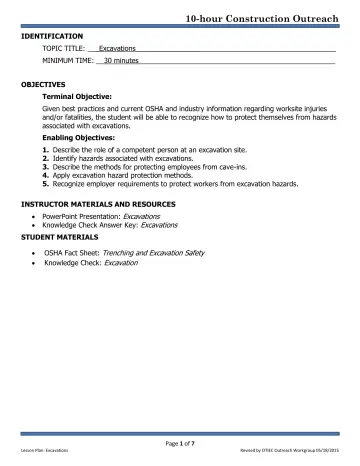
pdf
7 slidesExcavations: Lesson Plan (OSHA 10-Hour Construction Outreach)
Instructor lesson plan with objectives, timing and teaching procedures for the OSHA excavations outreach deck.
U.S. Department of Labor, OSHA (with the OTIEC Outreach Workgroup)ArchivedPublic domain
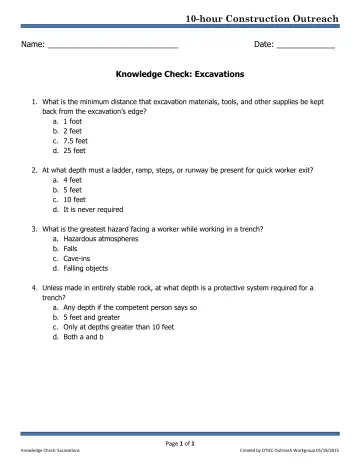
pdf
1 slidesExcavations: Knowledge Check (OSHA 10-Hour Construction Outreach)
Student knowledge-check quiz that accompanies the OSHA excavations outreach deck.
U.S. Department of Labor, OSHA (with the OTIEC Outreach Workgroup)ArchivedPublic domain