1 / 68Use ← → to flip
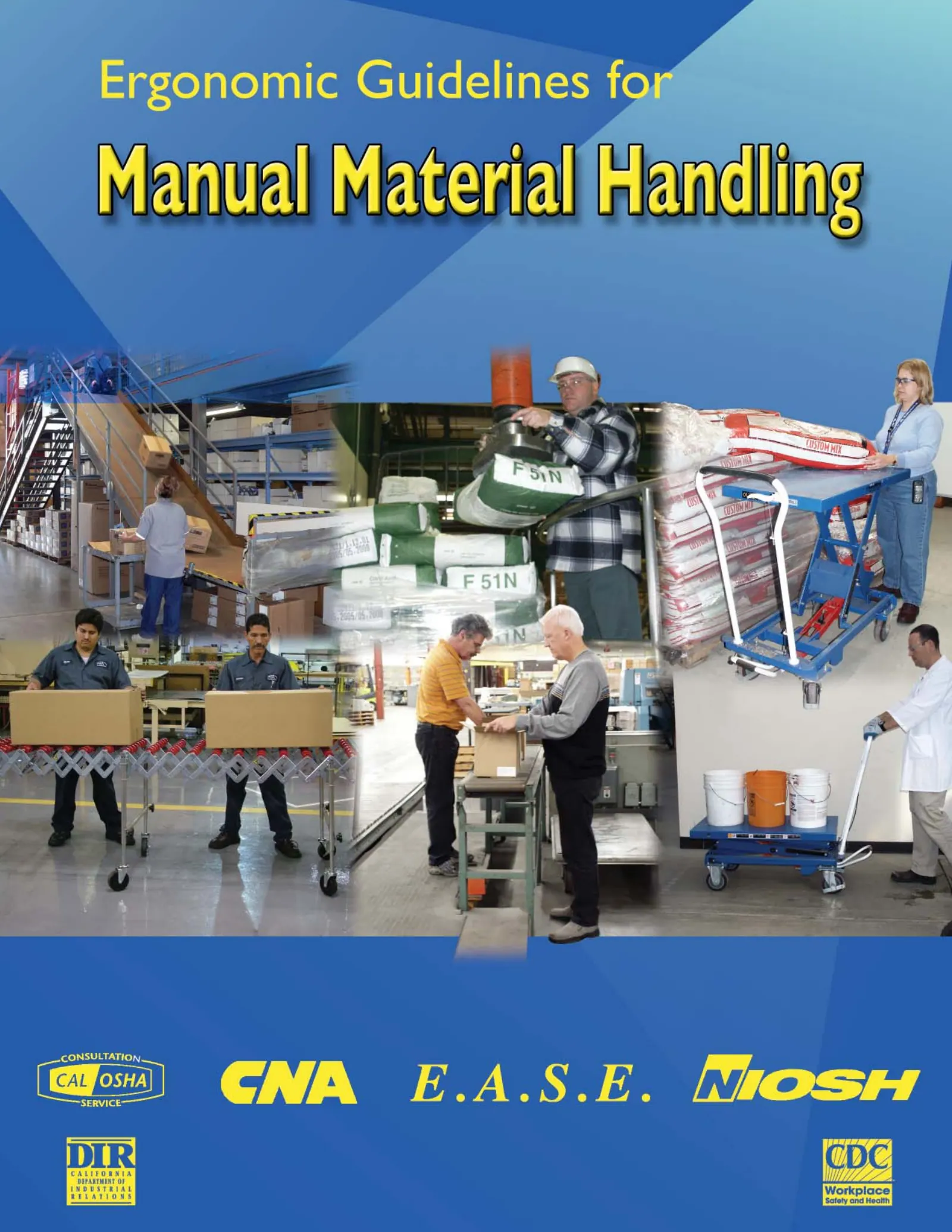
Ergonomic Guidelines for Manual Material Handling (NIOSH 2007-131)
Illustrated guide to improving lifting, carrying and pushing tasks, with checklists and equipment options.
Page text
· 67 of 68 pages · by National Institute for Occupational Safety and Health (NIOSH)
The words on each page as the author wrote them, read from the file by software so they can be searched. Layout, pictures and tables are not shown here, and long pages are shortened: the pages above and the download are the original.
- Page 2
Disclaimers
- Cal/OSHA Consultation Service, Research and Education Unit,
- Division of Occupational Safety and Health, California Department of Industrial Relations.
- Ergonomic Guidelines for Manual Material Handling was prepared for publication by the Cal/OSHA Consultation Service, Research and Education Unit, Division of Occupational Safety and Health, California Department of Industrial Relations.
- …
- Page 3
Foreword
- Manual material handling (MMH) work contributes to a large percentage of the over half a million cases of musculoskeletal disorders reported annually in the United States. Musculoskeletal disorders often involve strains and sprains to the lower back, shoulders, and upper limbs. …
- …
- Page 4
Partners
- The following organizations are responsible for the development and co-publishing of this booklet. To obtain copies of this booklet, contact any of the partners listed below.
- Cal/OSHA Consultation Service
- Research and Education Unit
- 2211 Park Towne Circle, #4
- Sacramento, CA 95825
- Tel: (916) 574-2528 http://www.dir.ca.gov/dosh/reu http://www.dir.ca.gov/dosh/puborder.asp
- CNA Insurance Companies
- 333 S. Wabash Ave.
- Chicago, IL 60604
- …
- Page 5
Contents
- About This Booklet
- Improving Manual Material Handling in Your Workplace
- What Manual Material Handling Is Why Improve Your Workplace What to Look for
- Types of Ergonomic Improvements Training
- A Proactive Action Plan
- Improvement Options
- 1. Easier Ways to Manually Lift, Lower, Fill, or Empty Containers
- 2. Easier Ways to Manually Carry Containers
- 3. Alternatives to Manual Handling of Individual Containers
- Resources
- …
- Page 6
About This Booklet
- This booklet is written for managers and supervisors in industries that involve the manual handling of containers. It offers suggestions to improve the handling of rectangular, square, and cylindrical containers, sacks, and bags.
- “Improving Manual Material Handling in Your Workplace” lists the benefits of improving your work tasks. It also contains information on risk factors, types of ergonomic improvements, and effective…
- …
- Page 7
Improving Manual Material Handling in Your Workplace
- Page 8
What Manual Material Handling Is
- Improving Manual Material Handling in Your Workplace
- According to the U.S. Department of Labor, handling is defi ned as:
- Seizing, holding, grasping, turning, or otherwise working with the hand or hands. Fingers are involved only to the extent that they are an extension of the hand, such as to turn a switch or to shift automobile gears.
- …
- Page 9
What to Look for
- Manual material handling tasks may expose workers to physical risk factors.
- If these tasks are performed repeatedly or over long periods of time, they can lead to fatigue and injury. The main risk factors, or conditions, associated with the development of injuries in manual material handling tasks include:
- Awkward postures (e.g., bending, twisting)
- Repetitive motions (e.g., frequent reaching, lifting, carrying)
- …
- Page 10
Improving Manual Material Handling in Your Workplace
- 2. Administrative Improvements
- Observe how different workers perform the same tasks to get ideas for improving work practices or organizing the work. Then consider the following improvements:
- Your power zone
- Alternate heavy tasks with light tasks.
- Provide variety in jobs to eliminate or reduce repetition (i.e., overuse of the same muscle groups).
- …
- Page 11
A Proactive Action Plan
- Manual material handling jobs require movement and physical activity. But how do you fi nd out:
- Why workplace problems are occurring?
- Which work tasks may be causing injuries or production bottlenecks or decreasing product and service quality?
- What to do about problems once you fi nd them?
- How to reduce your workers’ compensation costs?
- One way to answer these questions is to be proactive in your problem solving. …
- …
- Page 12
- Improving Manual Material Handling in Your Workplace
- b. Observe work activities. Talk to workers, supervisors, and managers about where problems exist. Look for warning signs, such as:
- Risk factors in work tasks (e.g., awkward postures, repetitive motions, forceful exertions, pressure points, staying in the same position for a long time)
- Worker fatigue, discomfort, or reports of related problems
- …
- Page 13
A Proactive Action Plan
- Step 2: Prioritize Jobs for Improvements
- After detecting the problems, decide which tasks to improve and then set priorities. Consider:
- The frequency and severity of the risk factors you have identified that may lead to injuries
- The frequency and severity of complaints, symptoms, and/or injuries
- Technical and financial resources at your disposal
- Ideas of workers for making improvements
- …
- Page 14
Improving Manual Material Handling in Your Workplace
- Step 4: Follow Up
- It is important to follow up in order to evaluate if your improvements have worked. After a reasonable adjustment period, set a date to follow up on the changes made. Make sure to evaluate each improvement separately for effectiveness. The following questions may be helpful:
- Has each improvement:
- Reduced or eliminated fatigue, discomfort, symptoms, and/or injuries?
- …
- Page 15
Improvement Options
- Page 16
Section 1
- Easier Ways to Manually Lift, Lower, Fill, or Empty Containers
- Pages 17–28
- Consider the following options that will:
- Section 2
- Reduce reaching and bending.
- Reduce the stress on your back and shoulders.
- Reduce the effort and force needed to perform work tasks.
- Easier Ways to Manually
- Carry Containers
- Pages 29–34
- Section 3
- Improve your grip.
- Reduce stress on your back and shoulders.
- Reduce contact pressure on your shoulders and hands.
- …
- Page 17
Section 1
- Easier Ways to Manually Lift, Lower, Fill, or Empty Containers
- Consider the following options that will:
- Reduce reaching and bending.
- Reduce the stress on your back and shoulders. Reduce the effort and force needed to perform work tasks.
- Page 18
NIOSH Lifting Equation
- The Revised National Institute of Occupational Safety and Health (NIOSH) Lifting Equation (1994) provides guidelines for evaluating two-handed manual lifting tasks. It defi nes a Recommended Weight Limit (RWL) as the weight of the load that nearly all healthy workers can lift over a substantial period of time (e.g., eight hours) without an increased risk of developing lower back pain. …
- …
- Page 19
Employee Guidelines for Safer Lifting
- The use of stretching is appropriate as part of a comprehensive ergonomic program. Stretching must not be used in place of engineering and/or administrative improvements.
- Check for tags on loads.
- Before lifting, always test the load for stability and weight.
- For loads that are unstable and/or heavy, follow management guidelines for:
- Equipment use
- Reducing the weight of the load
- …
- Page 20
Improvement Options
- Avoid lifting from the floor whenever possible. If you must lift from the floor, do not bend at the waist. The techniques shown below help the worker to keep the spine in a safer position while lifting from the fl oor.
- Caution:
- This technique may be effective only if loads are small, light weight, and can easily fit between the knees.
- Keep the load close to your body and lift by pushing up with your legs.
- …
- Page 21
Section 1. Easier Ways to Manually Lift, Lower, Fill, or Empty Containers
- Use team lifting as a temporary measure until a more permanent improvement can be found. If possible, try to find a co-worker of similar height to help with the lift.
- Caution: Team lifting can increase the risk of a slip, trip, or fall accident.
- Team lifting can reduce the load in half.
- Discuss your lifting plan so you don’t make surprise movements.
- …
- Page 22
Improvement Options
- Use a turntable. Rotate the turntable to bring the container closer. Always work from the side closest to the load.
- Turntable on a load leveler
- A fixed-height turntable for pallets with short low stacks.
- Table with a turntable inset
- Turntable on a cart
- Caution: To promote stability when loading and unloading, rotate the turntable occasionally to avoid the buildup of the load on one side.
- Use a tool.
- …
- Page 23
Section 1. Easier Ways to Manually Lift, Lower, Fill, or Empty Containers
- Raise the worker so that the container is grasped 30’’– 40’’ from the surface the worker is standing on.
- Use a step stool.
- Use portable steps.
- Use catwalks or platforms.
- Use a portable work platform and adjust it to the height of the worker.
- Caution: When using portable steps, stools, catwalks, or other work platforms, follow all manufacturers’ recommendations for proper…
- …
- Page 24
Improvement Options
- Work within your power zone. Raise or lower the work surface.
- Stack pallets to create a higher work surface.
- Provide variable-height work surfaces.
- Use electric or pneumatic scissors lift
- (accordion skirting).
- Use mobile scissors lifts.
- Use powered stackers.
- Use stationary scissors lift.
- Store heavier or bulkier containers so that they can be handled within your power zone where you have the greatest strength and most…
- …
- Page 25
Section 1. Easier Ways to Manually Lift, Lower, Fill, or Empty Containers
- Work within your power zone.Tilt the container to improve handling of materials.
- Use fixed or adjustable tilt stands for smaller containers.
- Powered tilters provide better access to large containers.
- Use angled shelving to improve access to containers.
- Page 26
Improvement Options
- Hold the container close to the body when lifting and lowering.
- For easier access, remove or lower the sides of the receptacle.
- Add extra handles for better grip and control.
- Page 27
Section 1. Easier Ways to Manually Lift, Lower, Fill, or Empty Containers
- Support the container on or against a fixed object, rack, or stand while pouring the contents.
- Use a removable plate or a work surface to support the container while pouring the contents into the receptacle.
- Use a screen over the opening to support the sack. Pour the contents through the screen.
- Page 28
Improvement Options
- Use a cutout work surface so that you can get closer to the container.
- Use a pail tipper.
- Manual pail tippers are available for 1-, 2-, and 5-gallon containers.
- Page 29
Section 2
- Easier Ways to Manually Carry Containers
- Consider the follo wing options that will:
- Improve your grip.
- Reduce stress on your back and shoulders.
- Reduce contact pressure on your shoulders and hands. Reduce the effort and force needed to perform work tasks.
- Page 30
Management Guidelines for Safer Carrying
- Plan the workfl ow to eliminate unnecessary carrying.
- Slide, push, or roll instead of carrying, when appropriate.
- Organize the work so that the physical demands and work pace increase gradually.
- Reduce the distances that loads are moved to a minimum. If long trips are required, use equipment.
- For loads that are unstable and/or heavy:
- Tag the load to alert workers.
- …
- Page 31
Employee Guidelines for Safer Carrying
- The use of stretching is appropriate as part of a comprehensive ergonomic program. Stretching must not be used in place of engineering and/or administrative improvements.
- Check for tags on loads.
- Before carrying, always test the load for stability and weight.
- For long trips or loads that are unstable and/or heavy, follow management guidelines for:
- Equipment use.
- Reducing the weight of the load.
- …
- Page 32
Improvement Options
- Redesign the container so it has handles, grips, or handholds.
- Hold the container close to the body.
- Don’t carry more than you can handle.To reduce the weight of the load, use a smaller container.
- Page 33
Section 2. Easier Ways to Manually Carry Containers
- Wear proper size gloves that fit. Gloves with rubber dots on the surface can increase grip stability on slippery surfaces.
- Caution:
- Be aware that gloves can reduce your grip strength up to 60 percent depending on the material they are made of and how many pairs you wear at once.
- Increase the size of the bucket or pail handle with padding or a clamp-on handle.
- …
- Page 34
Improvement Options
- Pad the shoulder. Support the container on one shoulder and alternate between shoulders.
- Use equipment
- to carry materials whenever possible.
- If you must manually carry materials on your shoulder, reduce the weight of the load and use a pad to provide a cushion.
- Use a tool.
- Pinch grips involve grasping items with the thumb and the tips of the other fi ngers. Power grips involve grasping items by wrapping all the fi ngers…
- …
- Page 35
Section 3
- Alternatives to Manual Handling of Individual Containers
- Change the container .
- Use a tool.
- Use non-powered equipment.
- Use powered equipment.
- Page 36
Guidelines for Equipment Use
- Equipment
- Know your load and buy equipment of appropriate capacity. Remember, lighter-weight equipment is easier to move.
- Choose equipment appropriate for the material(s) being handled, the layout and design of your workplace, and the work tasks being performed (see Appendix B).
- Consider using powered equipment —rather than non-powered— when pushing and pulling forces are excessive (see Appendix C, Snook’s…
- …
- Page 37
Section 3. Alternatives to Manual Handling of Individual Containers
- Change the container
- Instead of lifting and pouring from the drum, insert a siphon or a pump.
- Caution: To prevent cross-contamination, chemical incompatibility, and flammability hazards, do not interchange pumps or siphons among different containers.
- Increase the size of the container or the weight of the load so that it is too large to handle manually.
- Page 38
Improvement Options
- Use a tool
- Use a hook for light-weight containers to reduce your reach.
- Use non-powered equipment
- Use a drum dolly.
- The drum must be set down into this dolly.
- This drum dolly lifts and transports drums.
- Page 39
Section 3. Alternatives to Manual Handling of Individual Containers
- Use a cart or platform truck.
- This three-wheel cart transports but does not lift drums.
- This six-wheel platform truck is easy to maneuver and will turn in its own length.
- Use non-powered equipment
- A hand cart can have multiple shelves for moving a variety of containers at one time.
- Two-wheel carts work well for loads up to about 300 pounds.
- Use a portable scissors lift.
- …
- Page 40
Improvement Options
- Use a hand truck.
- This specialty hand truck with brakes will allow more control when heavy loads are on inclines.
- Another type of hand truck converts to four wheels for moving unstable loads.
- Use non-powered equipment
- Hand trucks can be fitted with trays to carry bottles.
- Two-wheel hand trucks work well for transporting bottles or cylinders over short distances.
- …
- Page 41
Section 3. Alternatives to Manual Handling of Individual Containers
- Use a conveyor, slide, or chute.
- Small containers and lightweight loads can be handled by gravity conveyors.
- Skate-wheel conveyors can be easily set up wherever needed and work well for light loads.
- Gravity-activated conveyors work well for short, downhill runs.
- Use non-powered equipment
- Design a conveyor system that Use slides or chutes to do the work Use spiral conveyors…
- …
- Page 42
Improvement Options
- Use a hand pallet truck.
- Non-powered hand pallet trucks are useful for moving loads over short distances when low forces are required. For moving heavy loads requiring high forces over long distances it is advantageous to use powered pallet trucks.
- When using hand pallet trucks, be sure the floor is smooth and free of debris.
- For unstable pallet loads, wrap straps around the load.
- Use non-powered equipment
- …
- Page 43
Section 3. Alternatives to Manual Handling of Individual Containers
- Use powered equipment
- Use a stacker.
- This stacker is well suited for
- This stacker is fitted with a special moving loads up to 3,000 pounds drum-handling attachment.
- for short distances.
- Stackers can be fitted with specially shaped forks to handle round or cylindrical containers.
- Use a powered hand truck.
- This is a powered two-wheel hand truck designed for climbing stairs.
- Page 44
Improvement Options
- Use an airball table.
- An airball table makes it easier to slide containers, thereby reducing workers’ efforts.
- Use powered equipment
- Use a forklift.
- A forklift moves pallets long distances.
- Special attachments are available for removing cartons layer by layer.
- Page 45
Section 3. Alternatives to Manual Handling of Individual Containers
- Use a crane.
- A portable gantry crane fitted with an electric hoist
- A workstation crane fitted with a balancer and a vacuum lifter for handling large or heavy containers
- A jib crane fitted with an electric hoist and a lifting tong
- Use powered equipment
- Use a pallet truck.
- Page 46
Improvement Options
- Use a lifter.
- A manually propelled load A drum lifter/rotator can lay the drum on its side.
- lifter carries containers.
- The power lift raises and Add a spigot to the drum to empty its contents.
- lowers containers to the appropriate work height.
- Some vacuum lifters have two handles and work best for lifts performed below mid-chest height within the power zone.
- …
- Page 47
Section 3. Alternatives to Manual Handling of Individual Containers
- Use a carousel.
- Vertical carousels rotate and present items on shelves or roll out drawers within the worker’s power zone.
- Use powered equipment
- Horizontal carousels rotate and bring items to the worker, eliminating walking and carrying loads.
- Page 48
Improvement Options
- Use a tilter.
- Industrial tilters can improve access to large containers and make handling of materials easier. They can tilt up to 110 0 , but angles to 45 0 are most common.
- Some industrial tilters can also elevate so that containers or materials being handled are within the worker’s power zone.
- Page 49
Resources
- Page 50
Appendix A Administrative Improvements
- Resources
- Administrative improvements include changing work practices or the way work is organized. Administrative improvements require continual monitoring by management and employee feedback to make sure the improvements are effective.
- Provide variety in jobs
- There are a couple of ways to increase variety in jobs. Job rotation means rotating employees through different jobs. …
- …
- Page 51
Appendix A. Administrative Improvements
- Modify work practices
- Pay close attention to how the work is being performed. Employees should be encouraged to be comfortable, change positions, and stretch during work periods. The human body is stronger, more efficient, and less prone to injury when work is performed in midrange postures and within the power zone.
- Midrange postures mean postures in which the joints of the neck, back, legs, arms, and…
- …
- Page 52
Appendix B Assessment Tools
- Resources
- NIOSH Manual Material Handling (MMH) Checklist http://www.cdc.gov/niosh/docs/97-117/eptbtr5f.html
- This checklist is not designed to be a comprehensive risk assessment technique but rather as a tool to quickly identify potential problem jobs. Additional risk factors may exist that are not accounted for in this checklist. …
- …
- Page 53
Appendix B. Assessment Tools
- Hazard Evaluation Checklist for Lifting, Carrying, Pushing, or Pulling
- This checklist is not designed to be a comprehensive risk assessment technique but rather as a tool to quickly identify potential problem jobs. Additional risk factors may exist that are not accounted for in this checklist. It is common practice to follow up checklist observations with more precise techniques to confirm problem risk factors.
- …
- Page 54
Resources
- Ergonomics Awareness Worksheet
- The purpose of the worksheet is to increase basic awareness of potential problems associated with jobs and tasks. This awareness can help provide clues on how to make effective improvements.
- Job Title:
- Name of Employee: Name of Observer:
- Risk Factors
- Task 1:
- Task 2:
- Job Location:
- Date:
- Other Clues
- Reasons for Problems
- Page 55
Appendix B. Assessment Tools
- Risk Factors
- Other Clues
- Reasons for Problems
- Task 3:
- Task 4:
- Task 5:
- Adapted from Easy Ergonomics: A Practical Approach for Improving the Workplace. Sacramento: California Department of Industrial Relations, Cal/OSHA Consultation Service, Research and Education Unit, 1999.
- Page 56
Resources
- Ergonomics Checklist — Material Handling
- The checklist presented below is from the book Kodak’s Ergonomic Design for People at Work (adapted from material developed by the Chemical Manufacturers Association). It helps users to identify any job risk factors that may be present in the job. This checklist is applicable to jobs requiring the routine handling of objects of 10 pounds or more.
- Job/Task:
- Dept:
- Before
- Date:
- Analyst:
- …
- Page 57
Appendix B. Assessment Tools
- Condition
- X if a Concern
- Comments
- LIFTING AND LOWERING
- Heavy objects need to be handled
- Handling bulky or diffi cult-to-grasp objects
- Handling above the shoulders or below the knees
- Lifting to the side or unbalanced lifting
- Placing objects accurately/precisely
- Sudden, jerky movements during handling
- One-handed lifting
- Long-duration exertions (static work)
- PUSHING/PULLING/CARRYING
- …
- Page 58
Appendix C Analysis Methods
- Resources
- The following methods are comprehensive tools designed to provide a detailed analysis of various types of manual material handling tasks. They can be used to evaluate lifting, lowering, pushing, pulling, carrying, and other activities.
- NIOSH Lifting Equation
- The NIOSH Lifting Equation is a tool used to evaluate manual lifting tasks. This equation allows the user to insert the exact conditions of the lift…
- …
- Page 59
Appendix C. Analysis Methods
- Ohio State Lumbar Motion Monitor
- Traditionally, most workplace ergonomic assessments have focused on joint loading in static postures. However, epidemiologic studies have shown that three-dimensional dynamic motion is associated with an increased risk of occupational injury and illness. …
- …
- Page 60
Appendix D Improvement Evaluation “Tool”
- Resources
- As you evaluate possible improvement options, keep in mind the requirements that are most important in your particular workplace. Then, ask the following general questions for each improvement option under consideration:
- Will this improvement:
- Reduce or eliminate most or all of the identified risk factors?
- Add any new risk factors that have not been previously identified?
- …
- Page 61
Appendix E Organizations
- Appendix E. Organizations
- The following organizations may provide additional information on material handling equipment and work practices.
- American National Standards Institute (ANSI)
- ANSI coordinates the U.S. voluntary consensus standards system, approves American National Standards, and is the sole U.S. representative and dues-paying member of the International Organization for Standardization and the IEC.
- …
- Page 62
Resources
- Council of Supply Chain Management Professionals (CSCMP)
- Council of Supply Chain Management Professionals seeks to enhance the development of the logistics profession by providing information and educational opportunities. www.cscmp.org
- Darcor and Ergoweb ® Ergonomic White Paper
- The Ergonomics of Manual Material Handling - Pushing and Pulling Tasks www.darcor.com/library_wp.htm
- Fédération Européenne de la Manutention (FEM)
- …
- Page 63
Appendix E. Organizations
- The Material Handling Institute is the educational wing of the MHIA. www.mhia.org
- The following are product sections or councils within the MHIA: Automated Storage/Retrieval Systems (AS/RS) www.mhia.org/ASRS
- Automatic Guided Vehicle Systems (AGVS) www.mhia.org/AGVS
- Conveyor Product Section (CPS) www.mhia.org/CPS
- Crane Manufacturers Association of America, Inc. (CMAA) www.mhia.org/CMAA
- …
- Page 64
Resources
- National Wooden Pallet & Container Association (NWPCA)
- The NWPCA is dedicated to the success of its members by helping them create costeffective, environmentally responsible solutions to meet their customers’ changing unit load handling needs.
- www.nwpca.com
- Packaging Machinery Manufacturing Institute (PMMI)
- The PMMI is a resource for packaging. PMMI’s mission states that it is committed to improving, leading, and unifying all segments…
- …
- Page 65
Acknowledgments
- Page 66
Writers and Editors
- Acknowledgments
- Zin Cheung, MS, CIE - Cal/OSHA Consultation Service - Sacramento, CA Mario Feletto, MS, MPH - Cal/OSHA Consultation Service - Sacramento, CA Jim Galante - EASE Council - Charlotte, NC
- Tom Waters, PhD, CPE - NIOSH - Cincinnati, OH
- Page Layout and Design
- Jitan Patel - Cal/OSHA Consultation Service - Sacramento, CA
- Photographers and Image Editors
- …
- Page 67
Contributors
- We thank the following people and organizations for their support and assistance in the development of this publication:
- Denny Albrecht - BMH Equipment, Inc. - Sacramento, CA
- Jim Borman - Signode Western Operations - Pittsburg, CA
- Delia Deas - Tropicana - City of Industry, CA
- Linda Donavon - Eagle Group - Clayton, DE
- Ken Fletcher - Blue Diamond Growers - Sacramento, CA
- …
- Page 68
Cal/OSHA Consultation Programs
- Toll-free number: 1-800-963-9424
- Internet: www.dir.ca.gov
- On-site Assistance Program
- Area Offices
- Northern California 2424 Arden Way, Suite 410 Sacramento, CA 95825 (916) 263-0704
- San Francisco Bay Area
- 1515 Clay St., Suite 1103
- Oakland, CA 94612
- (510) 622-2891
- San Fernando Valley
- 6150 Van Nuys Blvd., Suite 307
- Van Nuys, CA 91401
- (818) 901-5754
- Los Angeles
- 10350 Heritage Park Dr., Suite 201
- …
More on Ergonomics
pptx
57 slidesIntroduction to Ergonomics (OSHA 10-Hour General Industry Outreach)
OSHA's general industry outreach ergonomics deck (2017): risk factors, MSDs and controls.
U.S. Department of Labor, OSHAPublic domain
pdf
10 slidesIntroduction to Ergonomics: Lesson Plan (OSHA 10-Hour General Industry Outreach)
Instructor lesson plan (objectives, timing, teaching steps) for the OSHA General Industry introduction to ergonomics outreach deck.
U.S. Department of Labor, OSHA (with the OTIEC Outreach Workgroup)Public domain
pdf
1 slidesIntroduction to Ergonomics: Knowledge Check (OSHA 10-Hour General Industry Outreach)
Student knowledge-check quiz for the OSHA General Industry introduction to ergonomics outreach deck.
U.S. Department of Labor, OSHA (with the OTIEC Outreach Workgroup)Public domain