1 / 57Use ← → to flip
Introduction to Ergonomics (OSHA 10-Hour General Industry Outreach)
OSHA's general industry outreach ergonomics deck (2017): risk factors, MSDs and controls.
Slide text
· 57 slides · by U.S. Department of Labor, OSHA
The words on each slide as the author wrote them, read from the file by software so they can be searched. Layout, pictures and tables are not shown here: the slides above and the download are the original.
- Slide 1
Introduction to Ergonomics
- 10-hour General Industry
- Outreach Training
- Slide 2
Introduction
- Lesson objectives:
- 1. Identify common work-related musculoskeletal disorders (MSDs).
- 2. Recognize risk factors associated with work-related MSDs.
- 3. Identify ergonomic control methods for eliminating/reducing work-related MSDs.
- Slide 3
Introduction
- This chart shows how MSDs compare to other hazards based on percentage of injuries and illnesses using statistics from the Bureau of Labor Statistics, FY2014.
- Slide 4
Introduction
- This chart shows the incident rates of musculoskeletal disorders for selected private sector industries. Source: Bureau of Labor Statistics
- Slide 5
Introduction
- Ergonomics
- “The scientific discipline concerned with understanding of interactions among humans and other elements of a system, and the profession that applies theory, principles, methods and data to design in order to optimize human well-being and overall system performance”
- Slide 6
Introduction
- Ergonomics means
- “fitting the job to the worker,” including:
- Work stations
- Tools
- Equipment
- Ergo = Work
- Nomos = Law
- Slide 7
Introduction
- Why is ergonomics important?
- Overexertion leading cause of injuries
- Most costly
- Recurring/Persistent pain may develop in future
- Bodily reaction is another leading cause of injuries in workplace
- Repetitive motion also within top 10 most common workplace injuries
- Slide 8
Common Work-Related MSDs
- Musculoskeletal Disorders (MSDs)
- Affect the muscles, nerves, blood vessels, ligaments, and tendons
- Symptoms
- Discomfort
- Pain
- Numbness
- Loss of motion/flexibility
- Spasticity
- Stiff joints
- Burning
- Swelling
- Tingling
- Inflammation
- Throbbing
- Paralysis
- Slide 9
Common Work-Related MSDs
- Common MSD disorders:
- Carpal Tunnel Syndrome
- Tennis Elbow
- Bursitis
- Ischemia
- De Quervain’s
- Sciatica
- Herniated Discs
- Neck strain/disability
- Tendinitis
- Rotator Cuff
- Neuritis
- Reynaud’s Syndrome
- Trigger Finger
- Thoracic Outlet Syndrome
- Epicondylitis
- Back strain/disability
- Slide 10
Common Work-Related MSDs
- Most commonly affected areas:
- Back
- Arms, Elbows, and Shoulders
- Neck
- Hands, Wrists, and Fingers
- Knees, Ankles, and Feet
- This chart shows a distribution of injuries and illnesses to body parts due to MSDs using statistics from the Bureau of Labor Statistics, FY2014.
- Slide 11
Common Work-Related MSDs
- Highest rate of missed days
- Highest incident rate
- Source: Bureau of Labor Statistics
- Slide 12
Risk Factors Associated with MSDs
- Risk factors of MSD injuries:
- Dependent upon:
- Work positions and postures
- How often task is performed
- Level of required effort and duration of task
- Slide 13
Risk Factors Associated with MSDs
- Examples of risk factors include:
- Exerting excessive force
- Lifting heavy objects/people
- Pushing or pulling heavy loads
- Manual pouring materials
- Maintaining control of equipment or tools
- Performing same/similar tasks repetitively
- Source: OSHA
- Slide 14
Risk Factors Associated with MSDs
- Working in awkward postures or same postures for long periods
- Prolonged/repetitive reaching above shoulder height
- Kneeling
- Squatting
- Leaning over a counter/bending
- Using a knife with wrists bent
- Twisting the torso while lifting
- Localized pressure into the body part
- Source: OSHA
- Pressing the body/part of the body against hard or sharp edges
- Using the hand as a hammer
- Slide 15
Risk Factors Associated with MSDs
- Cold temperatures
- (in combination with other risk factors)
- Vibration
- Whole body
- Hand-arm
- Combined exposure to several risk factors
- Slide 16
Ergonomic Control Methods
- Methods of protecting against MSDs:
- Establish ergonomics program
- Training
- Feedback from all levels
- Conduct job hazard analysis (JHAs)
- Early recognition and reporting of potential MSDs
- Slide 17
Ergonomic Control Methods
- Job Hazard Analysis
- Tasks
- Hazards
- Controls
- This table provides an example of a tool that can be used when conducting a job hazard analysis. The first column provides a list of tasks performed by a job; the middle column is provided for listing identified hazards; and, the third column provides a list of controls that can be used to mitigate the hazards.
- Slide 18
Ergonomic Control Methods
- Examples of engineering controls
- Work station design and setup
- Ergonomically designed tools
- Ergonomically designed equipment
- Load weight reduction
- Source: OSHA (International Labor Organization)
- Slide 19
Ergonomic Control Methods
- Examples of proper work practices:
- Proper lifting techniques (NIOSH)
- Team lift heavy/bulky/awkward loads
- Stretch
- Work rotation
- Task variety
- Increase rest breaks
- Slide 20
Ergonomic Control Methods
- Examples of PPE:
- Gripping gloves
- Knee pads
- Vibration gloves
- Thermal gloves
- Lifting straps
- Shoulder harness
- Lifting braces
- Source of graphics: OSHA
- Slide 21
Ergonomic Control Methods
- Physical ergonomic hazards and solutions:
- Reaching above the head/shoulders - hazards
- Working with the hands above head for more than 2 hours per day
- Slide 22
Ergonomic Control Methods
- Working with the elbows above shoulders for more than 2 hours per day
- Slide 23
Ergonomic Control Methods
- Reaching above the head/shoulders - solutions
- Keep items within close reach
- Elevate work areas
- Source: NIOSH
- Source: OSHA
- Slide 24
Ergonomic Control Methods
- Reaching above the head/shoulders - solutions
- Remove obstacles
- Utilize equipment to raise and lower items or move items closer to worker
- Source: OSHA
- Source: NIOSH
- Slide 25
Ergonomic Control Methods
- Awkward body postures - hazards
- Working with the neck or back bent forward more than 30° for more than 2 hours per day
- Slide 26
Ergonomic Control Methods
- Squatting for more than 2 hours per day
- Slide 27
Ergonomic Control Methods
- Kneeling for more than 2 hours per day
- Source: OSHA
- Slide 28
Ergonomic Control Methods
- Awkward body postures - solutions
- Raise and/or tilt the work for better access
- Use a stool for ground-level work
- Source: OSHA
- Source: NIOSH
- Slide 29
Ergonomic Control Methods
- Awkward body postures - solutions
- Use tools with longer handles
- Alternate between bending, kneeling, sitting, and squatting
- Source: OSHA
- Source: NIOSH
- Slide 30
Ergonomic Control Methods
- Awkward grips - hazards
- Gripping 10 or more pounds or force for 2 or more hours per day
- Slide 31
Ergonomic Control Methods
- Awkward grips - hazards
- Pinching 2 or more pounds of weight or 4 or more pounds of force for 2 or more hours per day
- Slide 32
Ergonomic Control Methods
- Awkward grips - solutions
- Design work layout to reduce hand-carrying
- Reduce amount of items carried at one time
- Use non-pinch grip postures
- Use ergonomically designed tools/aids
- Use job/task rotation
- “C” shaped posture
- Slide 33
Ergonomic Control Methods
- Repetitive motions - hazards
- Repeating same motion for more than two hours per day with hands, wrists, elbows, shoulders, or neck
- Source: OSHA
- Slide 34
Ergonomic Control Methods
- Repetitive motions - hazards
- Intense keying for more than 4 hours per day
- Source: OSHA
- Slide 35
Ergonomic Control Methods
- Repetitive motions - solutions
- Arrange work to avoid unnecessary motions
- Let power tools and machinery do the work
- Spread repetitive work out during the day
- Take stretch pauses
- Rotate task with co-workers if possible
- Change hands or motions frequently
- Slide 36
Ergonomic Control Methods
- Localized pressure on body part - hazards
- Pressing the body/part of the body against hard or sharp edges
- Standing/kneeling for prolonged periods on hard surfaces
- Using tools with hard handle surfaces or short handles
- Slide 37
Ergonomic Control Methods
- Localized pressure on body part - hazards
- Using hands/knees as a hammer more than 10 times in 1 hour or more than 2 times per day (long-term)
- Slide 38
Ergonomic Control Methods
- Localized pressure on body part - solutions
- Use tools with longer handles
- Use tools with padded grips
- Alternate between bending, kneeling, sitting, and squatting; use sit/stand stools or tables
- Slide 39
Ergonomic Control Methods
- Localized pressure on body part - solutions
- Pad table edges or use tables/desktops with rounded edges
- Use wrist rests, anti-fatigue mats, knee pads, shoe inserts or other items that reduce stress on body parts
- Source of graphics: OSHA
- Slide 40
Ergonomic Control Methods
- Lifting objects - hazards
- Lifting more than
- 75 lbs. once/day
- 55 lbs. ten times/day
- 10 lbs. more than twice/minute or for more than 2 hours/day
- 25 lbs. above shoulders, below knees, or at arms length more than
- 25 times/day
- Source of graphics: OSHA
- Slide 41
Ergonomic Control Methods
- Lifting objects - hazards
- Heavy, frequent, and awkward lifting
- Slide 42
Ergonomic Control Methods
- Lifting - solutions
- Managing for safer lifting
- Plan lifts
- Minimize lifting distances
- Position materials to power zone levels
- Avoid manually lifting/lowering loads to/from floor
- Identify/reduce unstable or heavy loads
- Reduce frequency of lifting and duration of lifting tasks
- Provide clear access
- Source of graphics: NIOSH
- Slide 43
Ergonomic Control Methods
- Lifting - solutions
- Employee guidelines for safer lifting
- Stretch before lifting
- Check for tags on loads
- Test load for stability and weight
- Plan the lift
- Use proper lifting techniques – grip; two hands; smooth, even motions; load close to body; legs to push up and lift load; avoid twisting; alternate with less physically demanding tasks;
- rest breaks
- Get assistance when necessary
- Slide 44
Ergonomic Control Methods
- Lifting - solutions
- Use proper lifting techniques
- Caution: This technique may be effective only if loads are small, light-weight, and can easily fit between the knees.
- Keep the load close to your body and lift by pushing up with your legs.
- Source: NIOSH
- Slide 45
Ergonomic Control Methods
- Lifting - solutions
- Use proper lifting techniques
- Lean the sack onto your kneeling leg.
- Slide the sack up onto your kneeling leg.
- Slide the sack onto the other leg while keeping the sack close to your body.
- As you stand up, keep the sack close to your body.
- Source: NIOSH
- Slide 46
Ergonomic Control Methods
- Vibration – hazards
- Moderate – more than 2 hours per day
- High – more than 30 minutes per day
- Prolonged
- Slide 47
Ergonomic Control Methods
- Vibration – solutions
- Use low-vibration tools and devices that may reduce vibration (tool balancers, extension handles, vibration isolators, damping techniques)
- Adequate rest periods
- Rotate jobs
- Maintenance
- PPE
- Source of graphics: OSHA
- Slide 48
Ergonomic Control Methods
- Environmental ergonomic hazards:
- Amplify/increase risk of MSDs
- Examples
- Hot weather
- Cold weather – affects worker coordination and dexterity
- High-temperature indoor (steam rooms, attics)
- Cold-temperature indoor (walk-in freezers, cold process rooms)
- Low visibility
- Slide 49
Employer/Employee Requirements
- General Duty Clause
- Each Employer:
- 1. Shall furnish to each of his employees employment and a place of employment which are free from recognized hazards that are causing or are likely to cause death or serious physical harm to his employees;
- 2. Shall comply with occupational safety and health standards promulgated under this Act.
- Each Employee:
- 1. Shall comply with occupational safety and health standards and all rules, regulations, and orders issued pursuant to this Act which are applicable to his own actions and conduct.
- Slide 50
Employee/Employer Requirements
- Report signs or symptoms if:
- Pain is persistent, severe or worsening
- Pain radiates
- Symptoms include numbness or tingling
- Symptoms keep you from sleeping at night
- Fingers blanch or turning white
- Slide 51
Employee/Employer Requirements
- Getting involved:
- Look at jobs
- Come up with solutions
- Work with solutions
- Take part in training
- Take responsibility for changing the way you do your job
- Help to make sure efforts are successful
- Slide 52
Five Key Points to Remember
- Ergonomics can help you on your job
- WMSDs can happen in jobs with risk factors
- Risk factors can be reduced and WMSDs prevented
- Reporting signs and symptoms early is important
- You can help your company put ergonomics changes into place
- Slide 53
Knowledge Check
- 1. Ergonomics is the science of ___.
- a. designing the job to fit the worker
- b. fitting the worker to the job
- c. lifting injuries
- d. safety and health
- Answer: a. designing the job to fit the worker
- Slide 54
Knowledge Check
- 2. MSDs account for approximately
- ___ of all injuries and illnesses.
- a. 1%
- b. 10%
- c. 33%
- d. 54%
- Answer: c. 33%
- Slide 55
Knowledge Check
- 3. Which of the following is an example of an ergonomic risk factor?
- a. Neutral postures
- b. Rest
- c. Repetition
- d. Personal protective equipment
- Answer: c. Repetition
- Slide 56
Knowledge Check
- 4. Ergonomic hazards can be prevented or reduced by which of the following control methods?
- a. Engineering controls
- b. Proper work practices/administrative controls
- c. Personal protective equipment
- d. All of the above
- Answer: d. All of the above
- Slide 57
What questions do you have?
- Thank You
More on Ergonomics
pdf
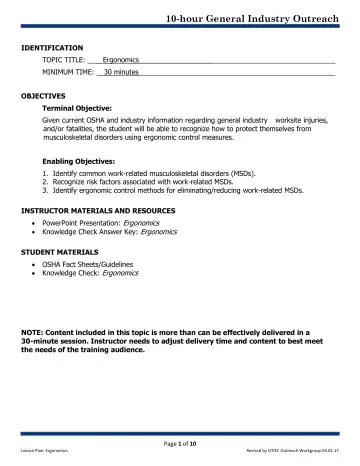
10 slidesIntroduction to Ergonomics: Lesson Plan (OSHA 10-Hour General Industry Outreach)
Instructor lesson plan (objectives, timing, teaching steps) for the OSHA General Industry introduction to ergonomics outreach deck.
U.S. Department of Labor, OSHA (with the OTIEC Outreach Workgroup)Public domain
pdf
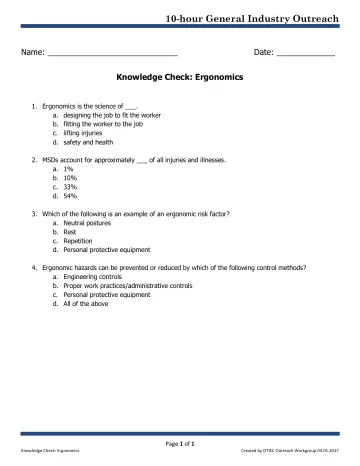
1 slidesIntroduction to Ergonomics: Knowledge Check (OSHA 10-Hour General Industry Outreach)
Student knowledge-check quiz for the OSHA General Industry introduction to ergonomics outreach deck.
U.S. Department of Labor, OSHA (with the OTIEC Outreach Workgroup)Public domain
pdfes
57 slidesIntroducción a la ergonomía (Capacitación de Extensión de 10 horas de OSHA, Industria General)
Spanish edition of OSHA's 10-hour General Industry Outreach deck on introduction to ergonomics (PDF slides; OSHA does not publish an editable Spanish PowerPoint).
U.S. Department of Labor, OSHA (with the OTIEC Outreach Workgroup)Public domain