1 / 10Use ← → to flip
Introduction to Ergonomics: Lesson Plan (OSHA 10-Hour General Industry Outreach)
Instructor lesson plan (objectives, timing, teaching steps) for the OSHA General Industry introduction to ergonomics outreach deck.
Page text
· 10 pages · by U.S. Department of Labor, OSHA (with the OTIEC Outreach Workgroup)
The words on each page as the author wrote them, read from the file by software so they can be searched. Layout, pictures and tables are not shown here: the pages above and the download are the original.
- Page 1
IDENTIFICATION
- TOPIC TITLE: ___Ergonomics___
- MINIMUM TIME: __30 mi nutes___
- OBJECTIVES
- Terminal Objective:
- Given current OSHA and industry information regarding general industry worksite injuries, and/or fatalities, the student will be able to recognize how to protect themselves from musculoskeletal disorders using ergonomic control measures.
- Enabling Objectives:
- 1. Identify common work-related musculoskeletal disorders (MSDs).
- 2. Recognize risk factors associated with work-related MSDs.
- 3. Identify ergonomic control methods for eliminating/reducing work-related MSDs.
- INSTRUCTOR MATERIALS AND RESOURCES
- PowerPoint Presentation: Ergonomics
- Knowledge Check Answer Key: Ergonomics
- STUDENT MATERIALS
- OSHA Fact Sheets/Guidelines Knowledge Check: Ergonomics
- NOTE: Content included in this topic is more than can be effectively delivered in a 30-minute session. Instructor needs to adjust delivery time and content to best meet the needs of the training audience.
- Page 2
TEACHING PROCEDURES ---Preparation, Presentation, Application, Evaluation
- Anticipatory Set (Focus Attention/Gain Interest)
- Estimated Time: 0.5 hour s
- Key Points
- Methods
- Work-related MSDs are a mong the most frequently reported causes of lost or restricted work time. “Musculoskeletal disorders (MSDs) accounted for 32 p ercent of all injury and illness ca ses in 2014 for all ownerships. …Nursing assistants a nd laborers and freight, stock, and material movers incurred the highest number of MSD cases in 2014…. MSD cases a ccounted for 54 p ercent of total cases t hat occurred to nursing assistants in 2014.”
- PPT slides #1 – #4
- “… In 2014 for all workers, there we re 3 65,580 ca ses of musculoskeletal disorders (M SDs), s uch as s prains or strains resulting from overexertion in lifting. The MSD incidence ra te wa s 3 3.8 cases per 10,000 fu ll-time wo rkers in 2014, down from 35.8 in 2013. Workers who sustained an MSD required a median of 13 d ays to recuperate b efore returning to work in 2014, compared to 9 d ays for all types of cases a nd up from 11 d ays in 2013.”
- Source of graphic: 2014 Nonfatal Occupational Injuries and Illnesses: Cases with days away from work (November 2015), U.S.
- Bureau of Labor Statistics, http://www.bls.gov/iif/oshwc/osh/case/osch0055.pdf
- Source: Nonfatal Occupational
- Injuries an d Illnesses Requiring Days Away From Work (2014),
- Bureau of Labor Statistics (2015), http://www.bls.gov/news.release/pdf/osh2.pdf
- Work-related MSDs can be prevented. Ergonomics --- fitting a job to a person --- helps lessen muscle fatigue, increases productivity and reduces the number and severity of work-related MSDs.
- In the workplace, the number and severity of MSDs resulting from physical overexertion, and their associated costs, can be substantially reduced by applying ergonomic principals.
- Presentation (Instruction)___
- Estimated Time: 0.5 hours
- Key Points
- Methods
- I.
- Introduction
- PPT slides #5 – #7
- A. Ergonomics is the science of designing the job to fit the worker, rather than the worker to fit the job, through adaptation of:
- 1. Work stations
- 2. Tools
- 3. Equipment
- B. Why is Ergonomics important?
- 1. Overexertion is the leading cause of injuries throughout all industries.
- a. It is also the most costly, regularly accounting for a quarter to a third of all workers compensation expenses (32% in 2014, BLS)
- Page 3
b. For the worker, recurring pain or persistent pain may develop in the future
- 2. Bodily reaction (Bending, Climbing, Reaching, Standing, Sitting, and Slipping and Tripping without falling) is another leading cause of injuries in the workplace
- 3. Repetitive motion also falls within the top 10 most common workplace injuries.
- a. Lifting, pushing, and/or moving objects over and over
- b. Cumulative office deskwork (Carpal Tunnel, Tendonitis, Bursitis)
- II.
- Common Work-Related MSDs
- A. May cause musculoskeletal disorders (MSDs)
- 1. Disorders of soft tissues (muscles, tendons, ligaments, joints, cartilage, blood vessels)
- 2. Disorders of nervous system (nerves, tendon sheaths)
- B. Common MSD Conditions / Signs of Exposure
- 1. Discomfort
- 2. Pain
- 3. Numbness
- 4. Loss of motion/flexibility
- 5. Spasticity
- 6. Stiff Joints
- 7. Burning
- 8. Swelling
- 9. Tingling
- 10. Inflammation
- 11. Throbbing
- 12. Paralysis
- C. Common MSD Disorders
- 1. Carpal Tunnel Syndrome
- 2. Rotator Cuff
- 3. Tennis Elbow
- 4. Neuritis
- 5. Bursitis
- 6. Reynaud’s Syndrome (White Finger)
- 7. Ischemia
- 8. Trigger Finger
- 9. De Quervain’s (Pain at base of thumbs)
- 10. Thoracic Outlet Syndrome
- 11. Sciatica
- 12. Herniated Discs
- PPT slides #8 - #11
- Page 4
13. Epicondylitis
- 14. Neck and Back Strain/Disability
- 15. Tendinitis
- D. Body parts most commonly affected
- 1. Back
- 2. Arms, Elbows, and Shoulders
- 3. Neck
- 4. Hands, Wrists, and Fingers
- 5. Knees, Ankles, and Feet
- E. Highest rate of missed days was due to repetitive motion involving microtasks (23 median days away from work)
- F. Highest incident rate was due to overexertion and bodily reaction (36 per 10,000 full-time workers)
- III.
- Risk Factors Associated with MSDs
- A. Risk factors dependent upon:
- 1. Work positions and postures
- 2. How often task is performed
- 3. Level of required effort and duration of task
- B. Examples of risk factors
- 1. Exerting excessive force
- a. Lifting heavy objects/people
- b. Pushing or pulling heavy loads
- c. Manually pouring materials
- d. Maintaining control of equipment or tools
- 2. Performing same/similar tasks repetitively
- 3. Working in awkward postures or same postures for long periods
- a. Prolonged/repetitive reaching above shoulder height
- b. Kneeling
- c. Squatting
- d. Leaning over a counter/bending
- e. Using a knife with wrists bent
- f. Twisting the torso while lifting
- 4. Localized pressure into the body part
- a. Pressing the body/part of body against hard or sharp edges
- b. Using the hand as a hammer
- 5. Cold temperatures (with other risk factors)
- 6. Vibration
- a. Whole body
- b. Hand-arm
- 7. Combined exposure to several risk factors
- PPT slides #12 - #15
- Page 5
- IV.
- Ergonomic Control Methods for Eliminating/Reducing
- PPT slides #16 - #48
- Work-Related MSDs
- A. Establish ergonomics program that emphasizes involvement and feedback from all levels
- 1. Training
- 2. Feedback from all levels
- B. Conducting Job Hazard Analysis (JHAs)
- C. Early recognition and reporting of potential MSDs
- D. Use appropriate engineering controls
- 1. Work station design and setup
- 2. Ergonomically designed tools
- 3. Ergonomically designed equipment
- 4. Load weight reduction
- E. Use correct work practices (Administrative Controls)
- 1. Proper lifting techniques (NIOSH Lifting)
- 2. Teamwork when lifting heavy loads and bulky/awkward materials
- 3. Worker rotation
- 4. Task variety
- 5. Increase rest breaks
- F. Use proper PPE, when appropriate
- 1. Gripping gloves
- 2. Knee pads
- 3. Vibration gloves
- 4. Thermal gloves
- 5. Lifting straps
- 6. Shoulder harness
- 7. Lifting braces
- G. Physical ergonomic hazards and solutions
- 1. Reaching above the head/shoulders
- a. Examples of this hazard
- i. Working with the hands above the head for more than 2 hours per day
- ii. Working with the elbows above the shoulders for more than 2 hours per day
- b. Solutions
- i. Keep items within close reach
- ii. Elevate work areas
- iii. Remove obstacles
- iv. Utilize equipment to raise and lower items or move items closer to worker
- Page 6
- 2. Awkward body postures
- a. Examples of hazards
- i. Working with the neck or back bent forward more than 30° for more than 2 hours per day
- ii. Squatting for more than 2 hours per day
- iii. Kneeling for more than 2 hours per day
- b. Solutions
- i. Raise and/or tilt the work for better access
- ii. Use a stool for ground-level work
- iii. Use tools with longer handles
- iv. Alternate between bending, kneeling, sitting, and squatting
- 3. Awkward grips
- i. Gripping 10 or more pounds of weight for 2 or more hours per day
- ii. Pinching 2 or more pounds of force for 2 or more hours per day
- i. Design work layout to reduce hand-carrying
- ii. Reduce amount of items carried at one time
- iii. Use non-pinch grip postures
- iv. Use ergonomically designed tools/aids
- v. Use job/task rotation
- 4. Repetitive motions
- a. Example of hazards
- i. Repeating same motion for more than two hours per day with hands, wrists, elbows, shoulders, or neck
- ii. Intense keying for more than 4 hours per day
- i. Arrange work to avoid unnecessary motions
- ii. Let power tools and machinery do the work
- iii. Spread repetitive work out during the day
- iv. Take stretch pauses
- v. Rotate task with co-workers if possible
- vi. Change hands or motions frequently
- 5. Localized pressure on body part
- i. Pressing the body/part of the body against hard or sharp edges
- ii. Standing/kneeling for prolonged periods on hard surfaces
- Page 7
- iii.
- Using tools with hard handle surfaces or short handles
- iv. Using hands/knees as a hammer more than
- 10 times in 1 hour or more than 2 times per day (long-term)
- b. Solutions
- i. Use tools with longer handles
- ii. Use tools with padded grips
- iii. Alternate between bending, kneeling, sitting, and squatting; use sit/stand stools or tables
- iv. Pad table edges or use tables/desktops with rounded edges
- v. Use wrist rests, anti-fatigue mats, knee pads, shoe inserts or other items that reduce stress on body parts
- 6. Lifting objects
- a. Examples of hazards
- i. Heavy, frequent, and awkward lifting
- ii. Poor lifting techniques
- i. Manage for safer lifting
- ii. Employee guidelines for safer lifting
- iii. Use proper lifting techniques
- 7. Vibrations – whole body and hand/arm
- i. Moderate – more than 2 hours per day
- ii. High – more than 30 minutes per day
- iii. Prolonged
- i. Use lo-vibration tools and devices
- ii. Allow adequate rest periods
- iii. Rotate jobs
- iv. Provide proper maintenance
- v. Use PPE
- H. Environmental Factors
- 1. Amplify/increase risk of MSDs
- 2. Examples
- a. Outdoor work (hot and cold extremes) – cold weather especially affects worker coordination and dexterity
- b. High-temperature indoor (steam rooms, attics)
- c. Low-temperature indoor (walk-in freezers, cold process rooms)
- d. Low visibility
- Page 8
- V.
- Employer/Employee Requirements
- A. Employers are responsible for providing a safe and healthful workplace for their workers. In the workplace, the number and severity of MSDs resulting from physical overexertion, and their associated costs, can be substantially reduced by applying ergonomic principals.
- B. General Duty Clause states that each employer
- 1. Shall furnish to each of his employees employment and a place of employment which are free from recognized hazards that are causing or are likely to cause death or serious physical harm to his employees;
- 2. Shall comply with occupational safety and health standards promulgated under this Act.
- C. Each employee shall comply with occupational safety and health standards and all rules, regulations, and orders issued pursuant to this Act which are applicable to his own actions and conduct.
- D. The following are important elements of an ergonomic process: Note : An ergonomic process uses the principles of an injury and illness prevention program to address MSD hazards. Such a process should be viewed as an ongoing function that is incorporated into the daily operations, rather than as an individual project
- 1. Provide Management Support
- 2. Involve Workers
- 3. Provide Training
- 4. Identify Problems
- 5. Encourage Early Reporting of MSD Symptoms
- 6. Implement Solutions to Control Hazards –
- 7. Evaluate Progress
- PPT slides #49 - #51
- Application (How students apply what they learn) __
- Estimated Time: ?? hours
- Key Points
- Methods
- Provide a scenario in which a worker is exposed to several ergonomics hazards over the course of an extended period of time. Have the students identify the ergonomics hazards the worker is exposed to, and have them provide appropriate control measures.
- Page 9
Evaluation/Summary
- Estimated Time: ?? hours
- Key Points
- Methods
- Review key points of lesson
- PPT slide #52
- Knowledge che ck: Ergonomics
- PPT slides #53 - #56
- References
- OSHA Standard
- Sec. 5 Duties https://www.osha.gov/pls/oshaweb/owadisp.show_document?p_table=OSHACT&p_id=3359
- Ergonomics Standard Interpretations (Letters of Interpretation)
- https://www.osha.gov/pls/oshaweb/searchresults.relevance?p_text=Ergonomics&p_osha_filter=INTERPRETATIONS&p_logger=1
- 1991 - 10/16/1991 - Ergonomics in the Baking Industry.
- 1987 - 02/17/1987 - OSHA has no standards for the design and implementation of video display workstations.
- 1991 - 09/12/1991 - Ability to reconcile the Occupational Safety and Health Administration's meatpacking guidelines.
- 1995 - 05/31/1995 - Requesting clarification of Slings
- 2004 - 06/07/2004 - OSHA's guidelines are advisory, do not create new employer obligations, and are not basis for citations.
- 2005 - 07/08/2005 - Formaldehyde exposure and ergonomic hazards in the embalming/funeral home industry.
- 2011 - 12/20/2011 - Clarification on the applicability of the Hazard Communication standard DEF tank operations.
- OSHA Publications
- Ergonomics for the Prevention of Musculoskeletal Disorders - Guidelines for Shipyards
- Ergonomics: Guidelines for Nursing Homes: Ergonomics for the Prevention of Musculoskeletal Disorders
- Ergonomics: Guidelines for Retail Grocery Stores - Ergonomics for the Prevention of Musculoskeletal Disorders (OSHA 3192 - 2004) (English: HTML PDF*)
- Ergonomics: Solutions for the Prevention of Musculoskeletal Injuries in Foundries
- Meatpacking: Safety and Health Guide for the Meatpacking Industry
- Poultry: Prevention of Musculoskeletal Disorders in Poultry Processing (Updated Guidelines)
- Safe Patient Handling-- Preventing Musculoskeletal Disorders in Nursing Homes
- (OSHA 3341 - 2008) (English: HTML PDF*)
- (OSHA 3182 - 2009) (English: HTML PDF*)
- (OSHA 3465 - 2012) (English: PDF*)
- (OSHA 3108 - 1988) (English: HTML PDF*)
- (OSHA 3708 - 2014) (English: PDF*)
- Page 10
Ergonomics: The Study of Work – OSHA 3125 Brochure (2000)
- Ergonomics Program Management Guidelines for Meatpacking Plants https://www.osha.gov/Publications/osha3125.pdf https://www.osha.gov/Publications/OSHA3123/3123.html
- OSHA References/Resources
- Computer Workstations eTool, OSHA eTool
- Ergonomics eTool: Solutions for Electrical Contractors , OSHA eTool
- Healthcare Wide Hazards: Ergonomics , OSHA eTool
- Ergonomics in the Printing Industry , OSHA eTool
- Sewing and Related Procedures: Ergonomics , OSHA eTool
- Solutions for Baggage Handling , OSHA eTool
- Beverage Delivery: Ergonomics , OSHA eTool
- Grocery Warehousing: Ergonomics , OSHA eTool
- Poultry Processing Industry eTool, OSHA eTool
- Prevention of Musculoskeletal Disorders in the Workplace
- Human Factors in Process Plants and Facility Design (Meshkstl)
- Ergonomics Case Study: The Dow Chemical Company’s Use of the “Six Sigma” Methodology (2004) https://www.osha.gov/dcsp/success_stories/compliance_assistance/dow_casestudy.html https://www.osha.gov/SLTC/etools/computerworkstations/index.html https://www.osha.gov/SLTC/etools/electricalcontractors/index.html https://www.osha.gov/SLTC/etools/hospital/hazards/ergo/ergo.html https://www.osha.gov/SLTC/etools/printing/ https://www.osha.gov/SLTC/etools/sewing/index.html https://www.osha.gov/SLTC/etools/baggagehandling/index.html https://www.osha.gov/SLTC/etools/beverage/index.html https://www.osha.gov/SLTC/etools/grocerywarehousing/index.html https://www.osha.gov/SLTC/etools/poultry/index.html https://www.osha.gov/SLTC/ergonomics/ http://www.dir.ca.gov/dosh/cal_vpp/Best_Practices_Symposiums/Human_Factors.pdf
- Other Resources
- Applications Manual for the Revised NIOSH Lifting Equation (1994)
- Nonfatal Occupational Injuries and Illnesses Requiring Days Away from Work (2014) http://www.cdc.gov/niosh/docs/94-110/pdfs/94-110.pdf http://www.bls.gov/news.release/osh2.nr0.htm
More on Ergonomics
pptx
57 slidesIntroduction to Ergonomics (OSHA 10-Hour General Industry Outreach)
OSHA's general industry outreach ergonomics deck (2017): risk factors, MSDs and controls.
U.S. Department of Labor, OSHAPublic domain
pdf
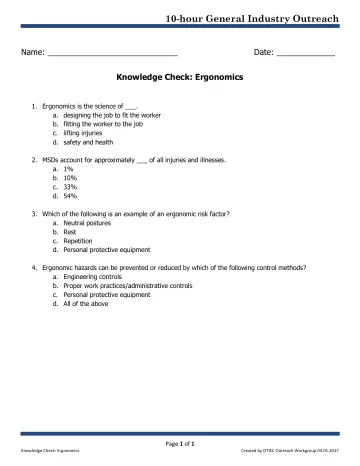
1 slidesIntroduction to Ergonomics: Knowledge Check (OSHA 10-Hour General Industry Outreach)
Student knowledge-check quiz for the OSHA General Industry introduction to ergonomics outreach deck.
U.S. Department of Labor, OSHA (with the OTIEC Outreach Workgroup)Public domain
pdfes
57 slidesIntroducción a la ergonomía (Capacitación de Extensión de 10 horas de OSHA, Industria General)
Spanish edition of OSHA's 10-hour General Industry Outreach deck on introduction to ergonomics (PDF slides; OSHA does not publish an editable Spanish PowerPoint).
U.S. Department of Labor, OSHA (with the OTIEC Outreach Workgroup)Public domain